
Blade mCP X redefines submicro performance
Mark Fadely ([email protected])
GREETINGS. You have found the RC helicopter pad.
The secret is out! Word on the street is that many curious non‑helicopter‑flying AMA members are now reading this column every month. The miniature whirly things are captivating audiences as never before.
Model aviation lovers are flocking into stores to pick up new helicopters. Technological advancements have made exciting new things possible. A 100‑size‑class electric‑powered helicopter that can perform 3‑D in your living room is coming to market. Many pilots are gravitating toward the 3‑D side of the hobby, and to be able to do your thing in such confined spaces is unprecedented.
Flying your aircraft in every possible direction and orientation defines 3‑D. Super‑cool tricks happen when new variations of the flight envelope are explored. The same stunts that large competition helicopters can do are achievable with a submicro electric variation. You can fly to the limits of your capabilities in your living room.
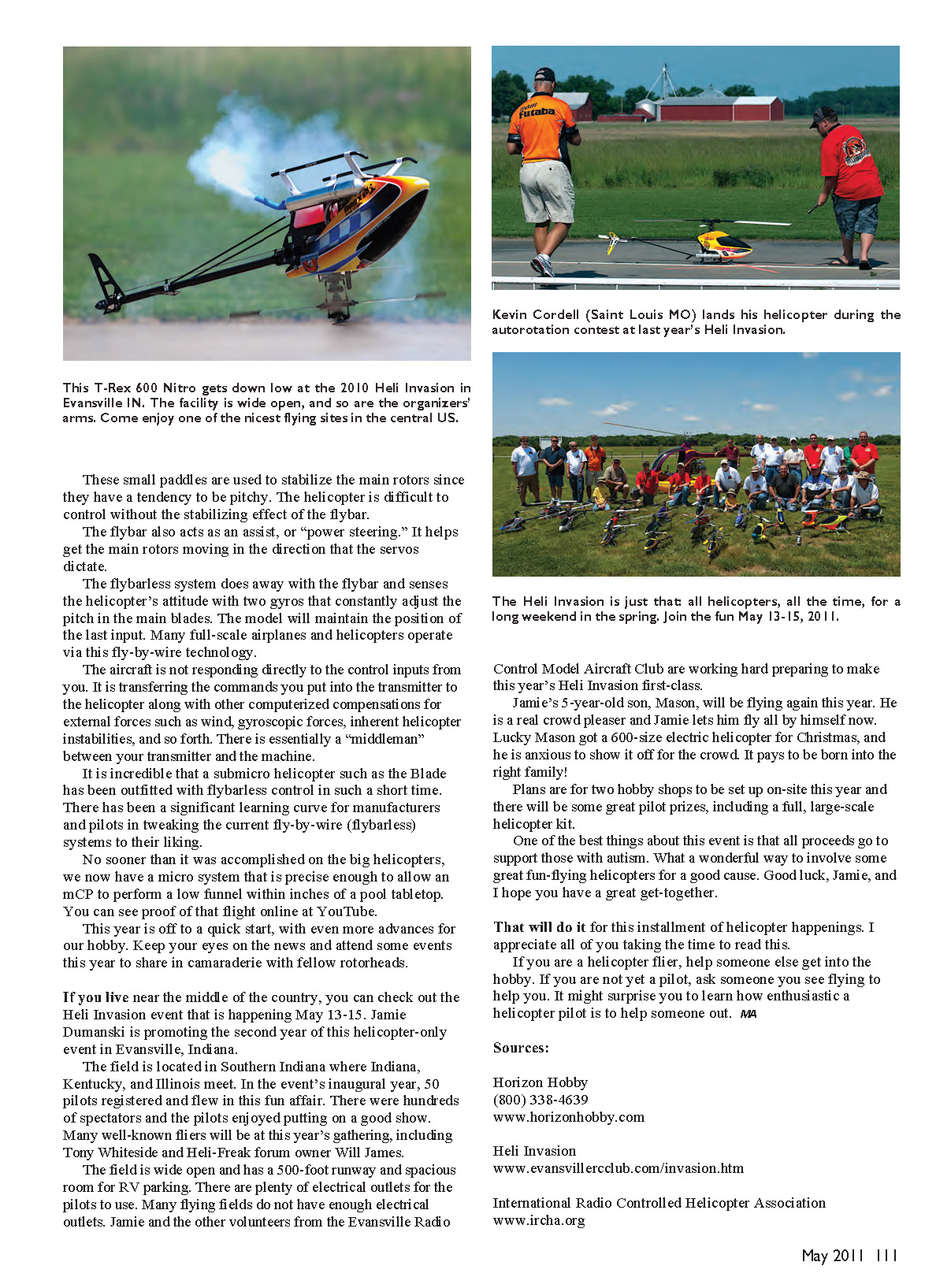
The new Blade mCP X from Horizon Hobby is redefining the standard for 3‑D indoor flying. One thing that makes it so agile is that it weighs roughly half that of similar‑size machines.
There is another very important feature that makes this little helicopter cutting edge: it’s flybarless! This miniature marvel has a flybarless control system, as do the latest large‑scale 3‑D competition machines. Sometimes people take for granted the advancements from which we benefit, but this has to make even the most unimpressed person stand up and take notice.
I remember writing about the emergence of flybarless control systems a couple years ago. At that time, many in the industry dismissed the idea of losing the flybar as a fad. Fast‑forward to now, and flybarless technology is rapidly taking over. I am currently switching one of my machines to flybarless.
In 2010 I had the opportunity to fly several flybarless helicopters. The electronics have matured, making the modern flybarless units perform with excellence. There was no learning curve or uncomfortable feeling when I took the sticks of a large 600‑size flybarless aircraft. If this is the year you are considering taking it off (I mean the flybar!), you have waited long enough.
If you are new to helicopters and do not understand what all the hype is about flybarless, most helicopters have had flybars in the past. The flybar is the shorter set of rotor blades that has small paddles at the ends instead of full‑length blades such as the main rotor.
These small paddles are used to stabilize the main rotors since they have a tendency to be pitchy. The helicopter is difficult to control without the stabilizing effect of the flybar. The flybar also acts as an assist, or "power steering." It helps get the main rotors moving in the direction that the servos dictate. The flybarless system does away with the flybar and senses the helicopter's attitude with two gyros that constantly adjust the pitch in the main blades. The model will maintain the position of the last input. Many full‑scale airplanes and helicopters operate via this fly‑by‑wire technology.
The aircraft is not responding directly to the control inputs from you. It is transferring the commands you put into the transmitter to the helicopter along with other computerized compensations for external forces such as wind, gyroscopic forces, inherent helicopter instabilities, and so forth. There is essentially a "middleman" between your transmitter and the machine.
It is incredible that a submicro helicopter such as the Blade has been outfitted with flybarless control in such a short time. There has been a significant learning curve for manufacturers and pilots in tweaking the current fly‑by‑wire (flybarless) systems to their liking.
No sooner than it was accomplished on the big helicopters, we now have a micro system that is precise enough to allow an mCP to perform a low funnel within inches of a pool tabletop. You can see proof of that flight online at YouTube.
This year is off to a quick start, with even more advances for our hobby. Keep your eyes on the news and attend some events this year to share in camaraderie with fellow rotorheads.
Heli Invasion (May 13–15)
If you live near the middle of the country, you can check out the Heli Invasion event that is happening May 13–15. Jamie Dumanski is promoting the second year of this helicopter‑only event in Evansville, Indiana.
- Location: Southern Indiana where Indiana, Kentucky, and Illinois meet
- Field features: wide open field, 500‑foot runway, spacious RV parking, plenty of electrical outlets
- Attendance last year: 50 registered pilots and hundreds of spectators
- Notable fliers expected: Tony Whiteside and Heli‑Freak forum owner Will James
- On‑site amenities: two hobby shops planned, great pilot prizes including a full large‑scale helicopter kit
- Charity: all proceeds go to support those with autism
Jamie and the other volunteers from the Evansville Radio Control Model Aircraft Club are working hard preparing to make this year's Heli Invasion first‑class. Jamie's 5‑year‑old son, Mason, will be flying again this year. He is a real crowd pleaser and Jamie lets him fly by himself now. Lucky Mason got a 600‑size electric helicopter for Christmas, and he is anxious to show it off for the crowd.
That will do it for this installment of helicopter happenings. I appreciate all of you taking the time to read this.
If you are a helicopter flier, help someone else get into the hobby. If you are not yet a pilot, ask someone you see flying to help you. It might surprise you to learn how enthusiastic a helicopter pilot is to help someone out.
MM
Sources
- Horizon Hobby — (800) 338‑4639 — www.horizonhobby.com
- Heli Invasion — www.evansvillerccclub.com/invasion.htm
- International Radio Controlled Helicopter Association — www.ircha.org
Transcribed from original scans by AI. Minor OCR errors may remain.

