
Dreaming of helicopters
By Mark Fadely [[email protected]]
Thank you for coming back to the helicopter hangout. You should get those holiday wish lists made out; it is nearing that time when the calendar clicks over once again.
It would be nice if we all received the helicopter we wanted as a gift this year. That is usually some far-fetched dreaming, though. The reality is we will have to save up our own funds and take on that responsibility ourselves.
Getting a new helicopter is a joyous time for every pilot. The new helicopter smell that pours out of the box is to die for.
Best wishes to all of you and remember not to eat too much turkey at Thanksgiving. It has been shown to slow brain function — à la the afternoon nap during the football game. We must keep our mental capacities fully functioning so that our thumbs will be quick and nimble. I cannot mention quick and nimble without starting to sing "Ice, Ice, Baby." Sorry — I digress.
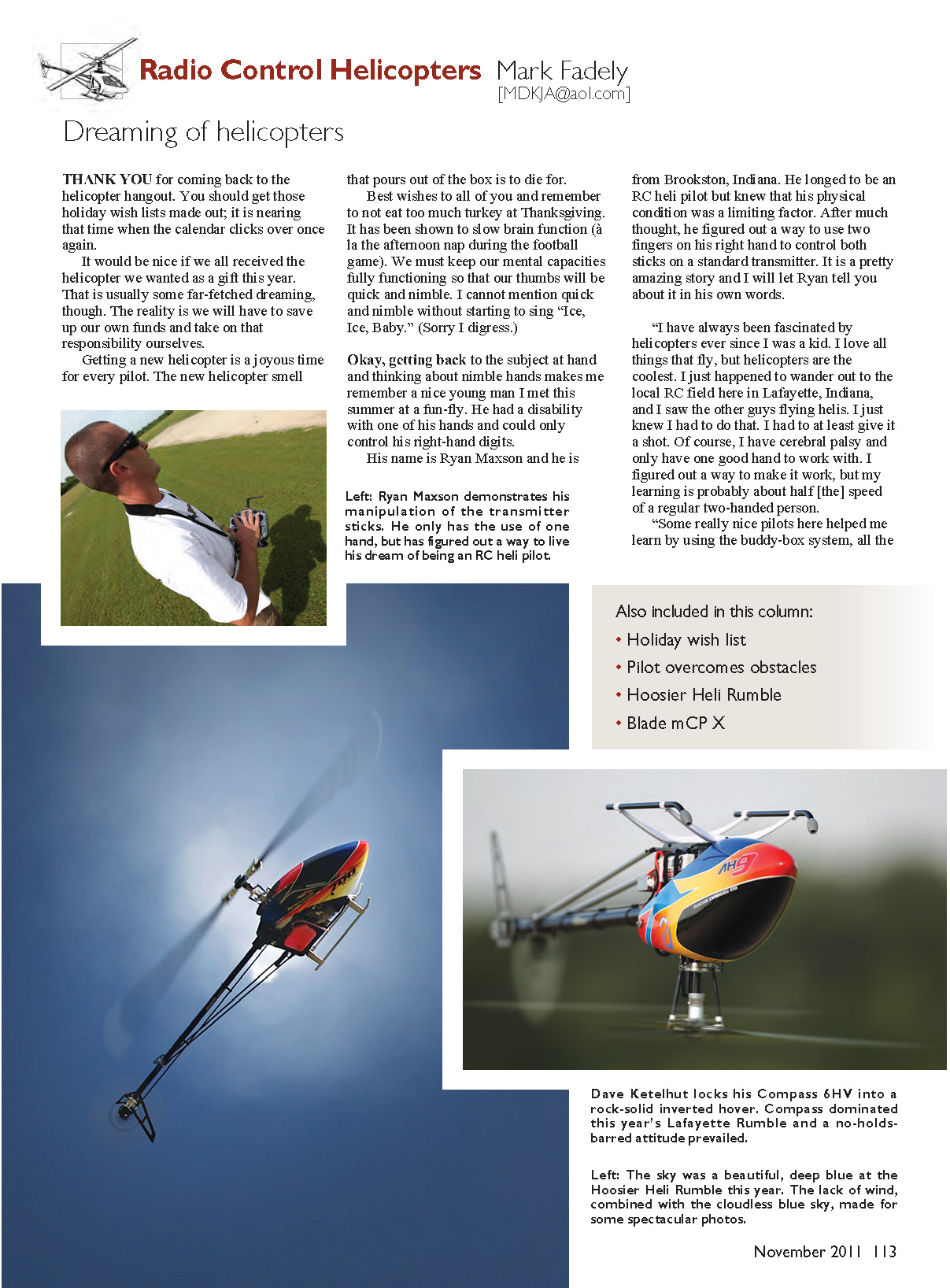
Okay, getting back to the subject at hand. Thinking about nimble hands makes me remember a nice young man I met this summer at a fun-fly. He had a disability with one of his hands and could only control his right-hand digits.
Ryan Maxson — one-handed pilot
His name is Ryan Maxson and he is from Brookston, Indiana. He longed to be an RC heli pilot but knew that his physical condition was a limiting factor. After much thought, he figured out a way to use two fingers on his right hand to control both sticks on a standard transmitter. It is a pretty amazing story and I will let Ryan tell you about it in his own words.
"I have always been fascinated by helicopters ever since I was a kid. I love all things that fly, but helicopters are the coolest. I just happened to wander out to the local RC field here in Lafayette, Indiana, and I saw the other guys flying helis. I just knew I had to do that. I had to at least give it a shot.
"Of course, I have cerebral palsy and only have one good hand to work with. I figured out a way to make it work, but my learning is probably about half the speed of a regular two-handed person. Some really nice pilots here helped me learn by using the buddy-box system, all the while giving me time to perfect the dexterity needed to fly with one hand. I flew with them for a while, and then as my confidence grew, I started flying around a little bit.
"I spend a lot of time on the simulator, which really helps, and I try to fly outside as much as I can. I fly electric helis only because they are easier to work with my disability. It would be great to give a nitro model a try — I am still thinking about that.
"The T-Rex 550 is working really well and I've been flying for two summers now. A single-stick radio may be the way to go in the future. The limits of what can be done with one hand are being pushed. I can loop, roll, and fly a bit inverted, but for really complicated moves I need to be able to fully control all the axes of the heli.
"The best thing I can say to anyone new to RC helis is just don't give up. If I can do it, then you can too. You have to practice. There is no secret on how the top pilots have gotten so good. They practice a lot."
Good words of advice, Ryan. Sometimes we do not want to work hard, but it is necessary for RC helicopters.
Hoosier Heli Rumble and new acquaintances
The Annual Hoosier Heli Rumble took place in July. This Central USA fun-fly attracts pilots from near and far for three days of heli nirvana. It was great to meet Ryan Maxson and make several new acquaintances at this year's event.
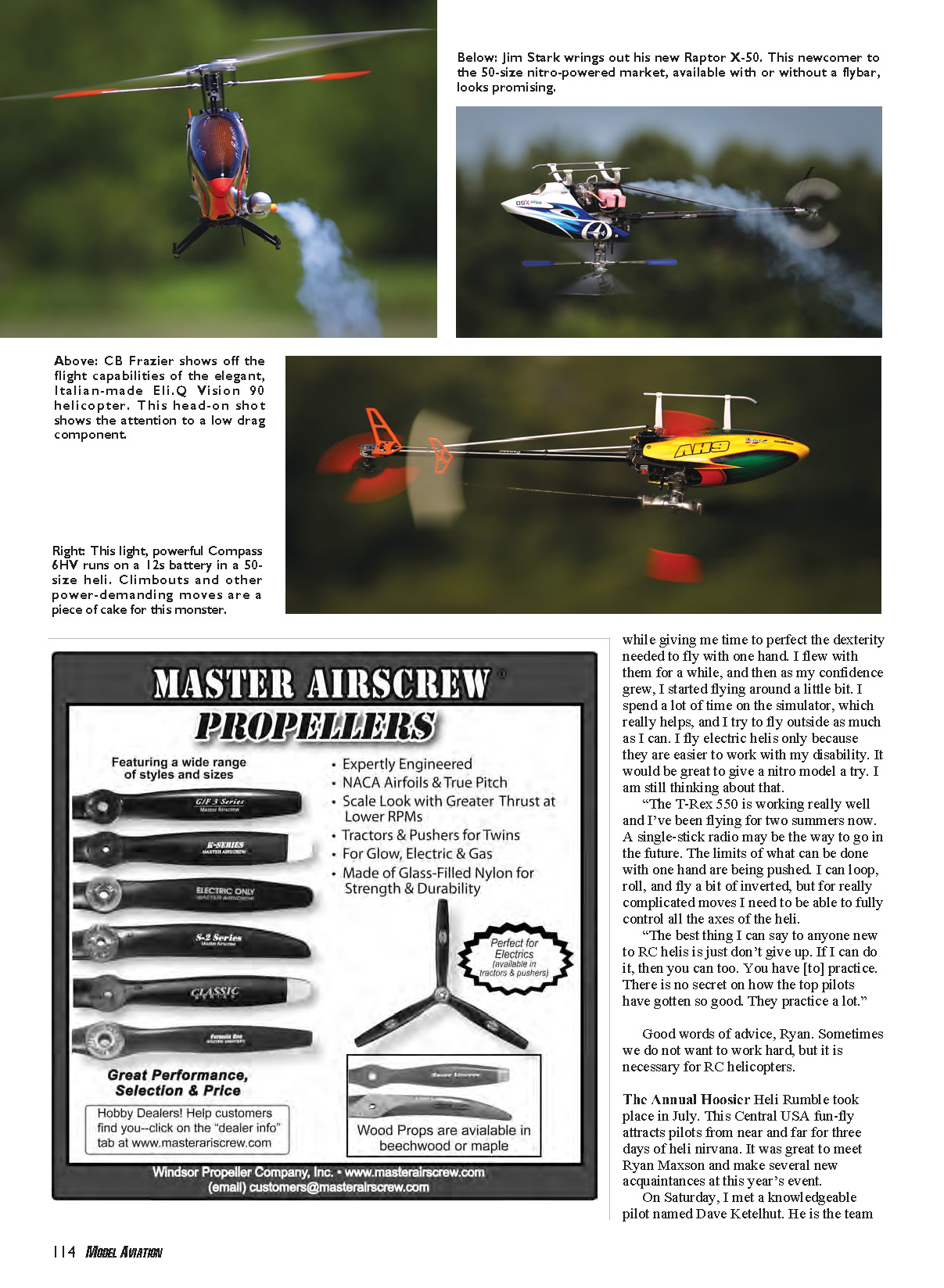
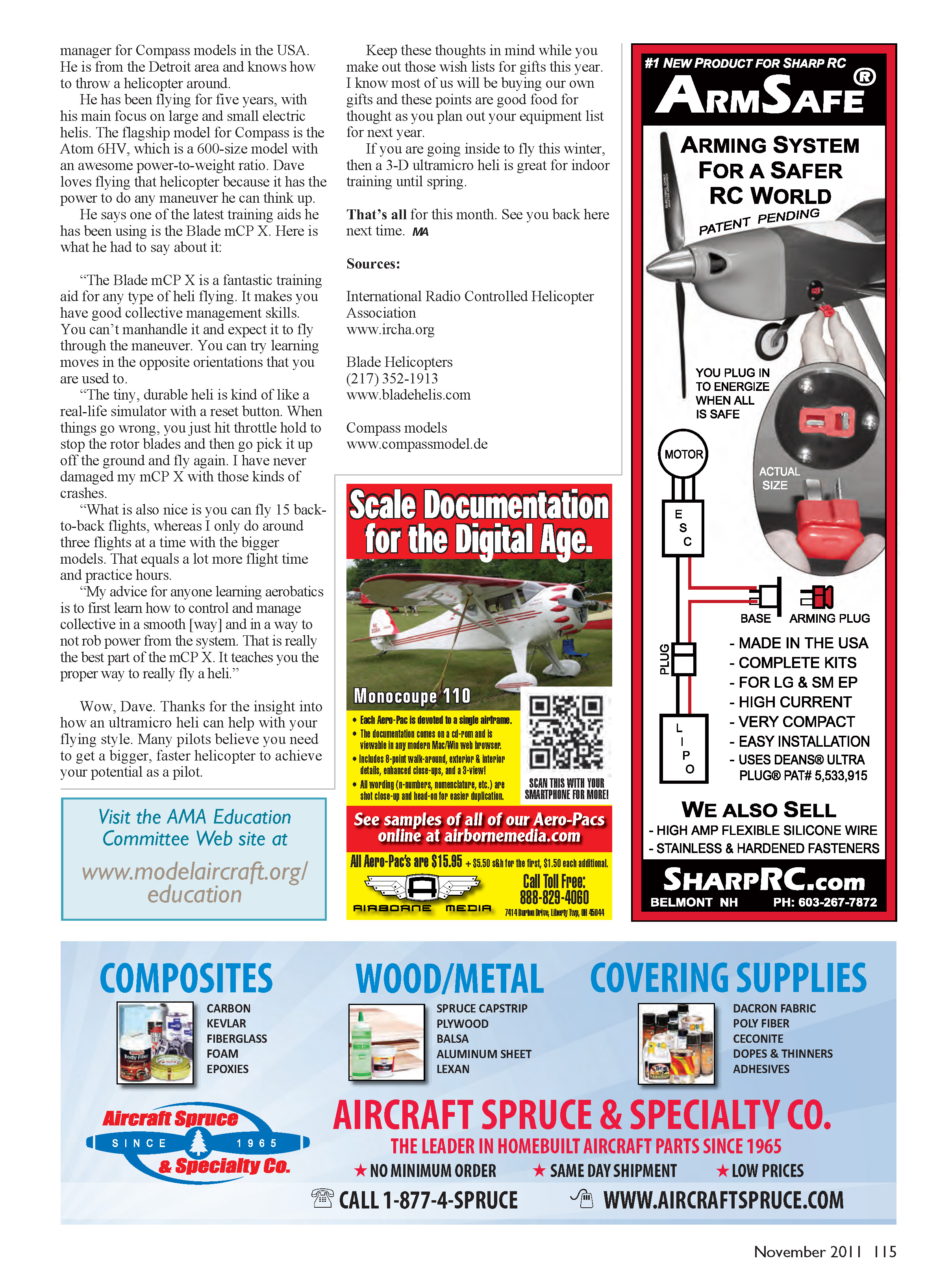
On Saturday I met a knowledgeable pilot named Dave Ketelhut. He is the team manager for Compass Models in the USA. He is from the Detroit area and knows how to throw a helicopter around.
He has been flying for five years, with his main focus on large and small electric helis. The flagship model for Compass is the Atom 6HV, which is a 600-size model with an awesome power-to-weight ratio. Dave loves flying that helicopter because it has the power to do any maneuver he can think up.
Blade mCP X — a training aid
One of the latest training aids Dave has been using is the Blade mCP X. Here is what he had to say about it:
"The Blade mCP X is a fantastic training aid for any type of heli flying. It makes you have good collective management skills. You can't manhandle it and expect it to fly through the maneuver. You can try learning moves in the opposite orientations that you are used to.
"The tiny, durable heli is kind of like a real-life simulator with a reset button. When things go wrong, you just hit throttle hold to stop the rotor blades and then go pick it up off the ground and fly again. I have never damaged my mCP X with those kinds of crashes.
"What is also nice is you can fly 15 back-to-back flights, whereas I only do around three flights at a time with the bigger models. That equals a lot more flight time and practice hours.
"My advice for anyone learning aerobatics is to first learn how to control and manage collective in a smooth way and in a way that does not rob power from the system. That is really the best part of the mCP X. It teaches you the proper way to really fly a heli."
Thanks, Dave. Many pilots believe you need to get a bigger, faster helicopter to achieve your potential as a pilot, but the ultramicro class can teach valuable skills.
Keep these thoughts in mind while you make out those wish lists for gifts this year. I know most of us will be buying our own gifts and these points are good food for thought as you plan out your equipment list for next year.
If you are going inside to fly this winter, then a 3-D ultramicro heli is great for indoor training until spring.
That's all for this month. See you back here next time.
Mark Fadely
Sources
- International Radio Controlled Helicopter Association — www.ircha.org
- Blade Helicopters — (217) 352-1913 — www.bladehelis.com
- Compass Models — www.compassmodel.de
Transcribed from original scans by AI. Minor OCR errors may remain.

