
Radio Control Jets
Jim Hiller [[email protected]]
A reminder of the ongoing need for jet-oriented safety precautions
An event in the world of modeling brings us back to the reality of the need for safety in our flying activities. Some of us have been around turbine models long enough to appreciate why we have certain rules and habits in place as part of turbine operations, but the newest in our ranks may have missed the hard-earned experiences that led to these rules.
One essential rule is to program your fail-safe operation in your PCM (pulse-code modulation) radio to shut down the turbine in case of radio loss. New turbine electronic-control units (ECUs) will shut down the turbine by shutting off its fuel supply, but that only works if the receiver is not sending a throttle position to the ECU.
If a radio switch fails and no power is sent to the receiver, there would be no position signal and the turbine would shut down. However, if your fail-safe is set to retain the last position (the normal default mode of many programmable transmitters), the receiver will maintain the last command position. If that last position was full throttle, the receiver will continue to send a full-throttle signal to the ECU even though the transmitter signal is lost, and the turbine will not shut down.
Some ECU instructions state that it is not necessary to program your radio fail-safe because the ECU will shut down if the signal is lost. Those instructions usually refer to the throttle signal from the receiver — not the transmitter-to-receiver link. You could have no control of your airplane, but if the throttle channel's fail-safe is set to a running position, the ECU will still see a throttle signal and will not shut down. This is why you must program your radio’s fail-safe to shut down the turbine.
Another important practice at jet meets is never to point the model toward the safety line. You should not see a high-speed circle, or even a rolling circle, performed toward the pilot or spectator line. Such maneuvers place the model’s energy in the direction of spectators and fellow pilots. Keep the flight path parallel to the safety line and typically fly on the far side of the runway to keep model energy and distance away from the pilot and spectator lines. This concept mirrors full-scale airshow safety methods that have protected spectators for decades.
A final item concerns starting turbines and the location of curious spectators. Turbine exhaust is hot. People often wander behind jets during start-up; don’t burn them for their lack of knowledge but do clear people from behind and from the sides. Keep them out of the jet/turbine arc just as you would clear people from the propeller arc when starting a piston model. Maintain awareness of people around you and make them aware of the danger zones.
I’ll step down from the safety soapbox and move on to some flying.
BVM KingCat — flight impressions
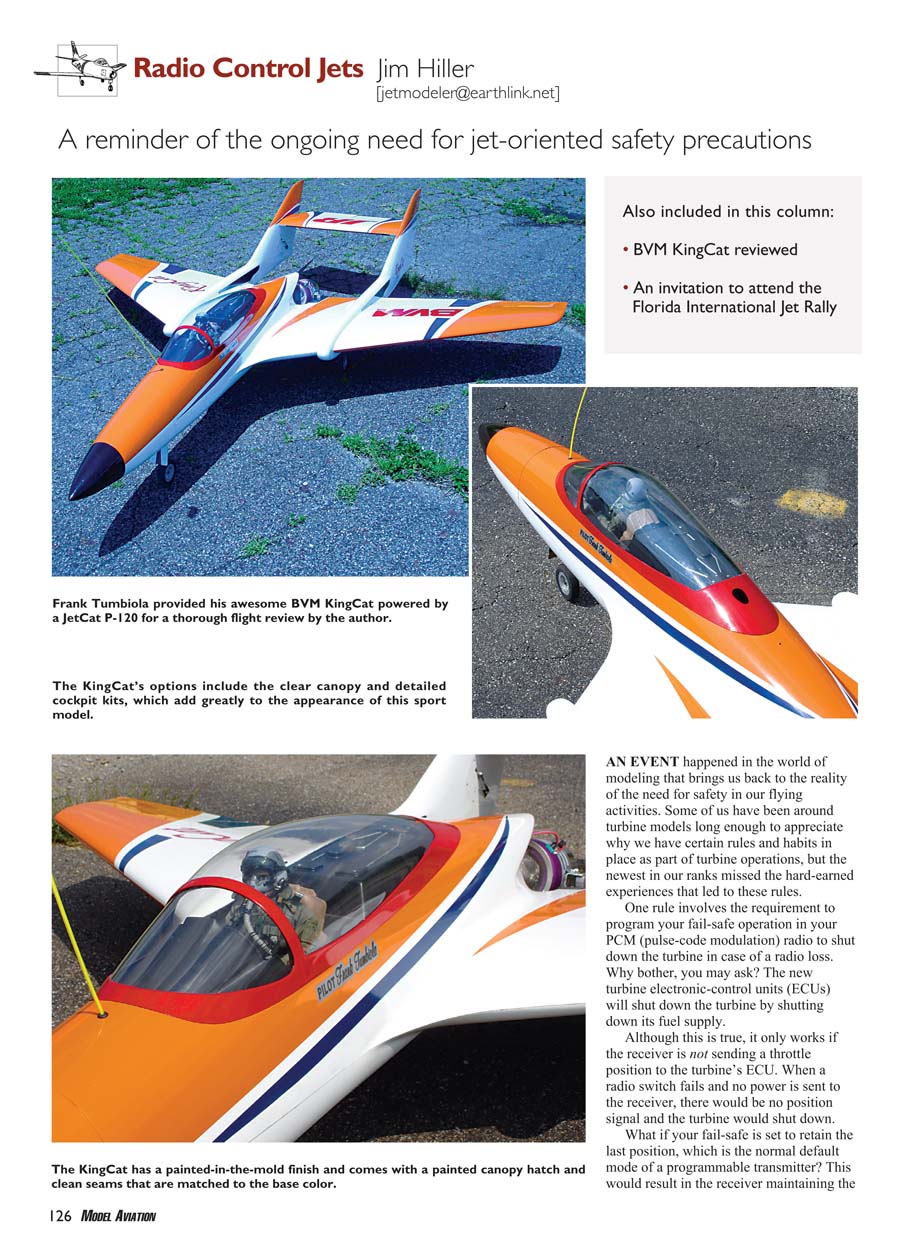
I had the opportunity to put in some quality flying time on a Bob Violett Models (BVM) KingCat, flown for me by Frank Tumbiola. The KingCat is a large ARF designed to provide low-stress jet flying while retaining good aerobatic and high-speed capability.
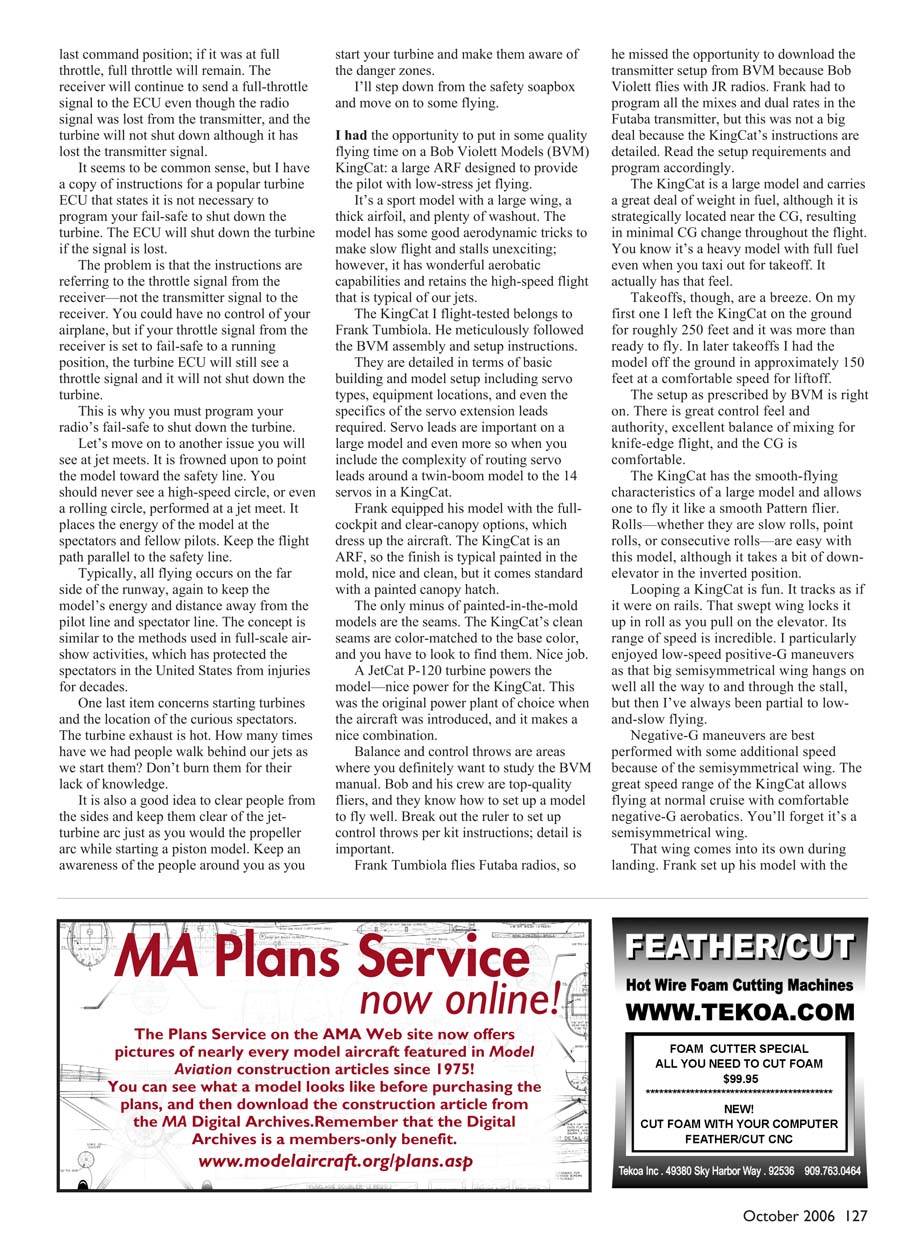
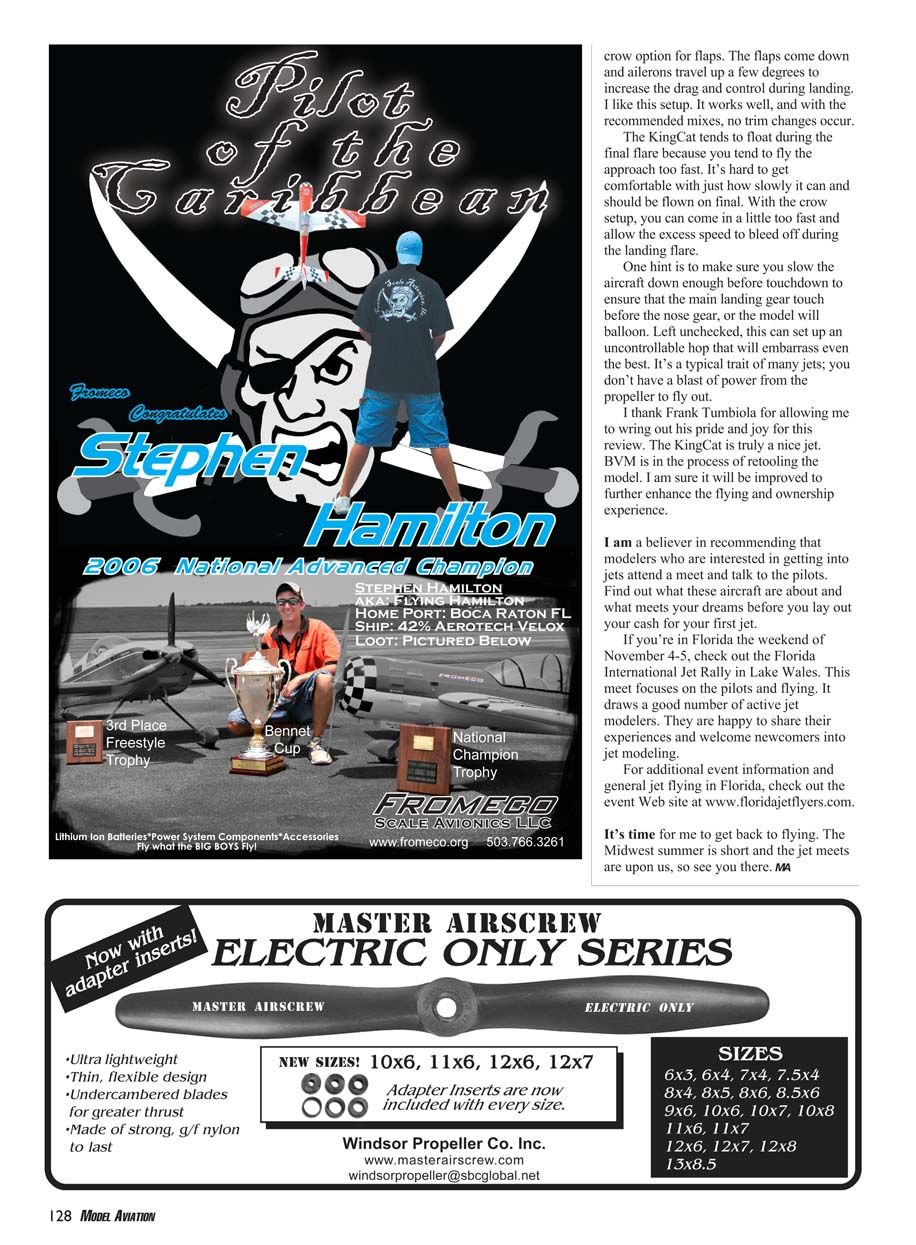
The KingCat’s options include a clear canopy and detailed cockpit kits that greatly improve appearance. The finish is painted-in-the-mold with a painted canopy hatch; seams are clean and color-matched to the base color so you have to look to find them.
The model I flight-tested belongs to Frank Tumbiola, who meticulously followed the BVM assembly and setup instructions. The manual is detailed regarding basic building and model setup, including servo types, equipment locations, and specifics of servo extension leads required. Servo leads are important on a large model and even more so when routing leads around a twin-boom model to the 14 servos in a KingCat.
Frank equipped his KingCat with the full-cockpit and clear-canopy options, which dress up the aircraft. A JetCat P-120 turbine powers the model — a nice match for this airframe. Balance and control-throw settings are areas where you definitely want to follow the BVM manual. Bob and his crew are top-quality fliers and know how to set up a model to fly well. Break out the ruler and set control throws per the kit instructions; detail matters.
Frank flies Futaba radios, so he programmed all mixes and dual rates manually rather than downloading a JR-based setup. This was not difficult because the KingCat instructions are thorough. Read the setup requirements and program accordingly.
The KingCat is a large, heavy model and carries a great deal of fuel, but the fuel is located near the CG, resulting in minimal CG change during flight. You know it’s heavy with full fuel when you taxi, but takeoffs are surprisingly easy. On my first takeoff I remained on the ground roughly 250 feet before liftoff; later takeoffs were closer to 150 feet at a comfortable speed.
The prescribed BVM setup is right on. There is great control feel and authority, excellent mixing for knife-edge flight, and a comfortable CG. The KingCat has the smooth-flying characteristics of a large model and can be flown like a smooth pattern ship. Rolls — slow rolls, point rolls, or consecutive rolls — are easy, though inverted flight requires a bit of down-elevator.
Looping the KingCat is fun; it tracks as if on rails. The swept wing locks it up in rolls as you pull on elevator. Its speed range is incredible. I particularly enjoyed low-speed positive-G maneuvers: that big semisymmetrical wing hangs on well through the stall. Negative-G maneuvers work best with additional speed because of the semisymmetrical wing, but the model’s speed range allows comfortable negative-G aerobatics.
That wing also helps during landing. Frank set his model with the crow option for flaps: the flaps come down and the ailerons travel up a few degrees to increase drag and control during landing. With the recommended mixes, no trim changes occur and the setup works well.
The KingCat tends to float during the final flare if you fly the approach too fast. It can and should be flown slowly on final; with the crow setup you can come in a bit fast and bleed off excess speed during the flare. One hint: make sure you slow the aircraft enough before touchdown so the main gear touch before the nose gear — otherwise the model can balloon and set up an uncontrollable hop. It’s a typical trait of many jets since you don’t have a propeller blast to prevent float.
Thanks to Frank Tumbiola for letting me wring out his pride and joy for this review. The KingCat is truly a nice jet. BVM is retooling the model, and I’m sure it will be improved to further enhance the flying and ownership experience.
Recommendations and events
If you’re interested in getting into jets, attend a meet and talk to the pilots. Find out what these aircraft are about and what meets your dreams before you lay out your cash for your first jet.
If you're in Florida the weekend of November 4–5, check out the Florida International Jet Rally in Lake Wales. This meet focuses on pilots and flying and draws a good number of active jet modelers who are happy to share their experiences and welcome newcomers.
For additional event information and general jet flying in Florida, check out the event website: www.floridajetflyers.com
It's time for me to get back to flying. The Midwest summer is short and the jet meets are upon us, so see you there. MA
Transcribed from original scans by AI. Minor OCR errors may remain.

