



Radio Control Jets
Jim Hiller [email protected]
RTI 2800 Special Edition Turbine
REPAIR TECHNOLOGY International (RTI) has introduced the RTI 2800 Special Edition turbine, manufactured by RTI. Carlos Villarreal, the man behind RTI, supported parts and repair services for RAM turbines after that company's demise. After years of repairing RAM and JetCat turbines, Carlos has stepped into the market with the RTI 2800.
The RTI 2800 is a 66 mm turbine of conventional layout. It features an Inconel combustion chamber for long life. The turbine wheel is Swiss-made and of proven quality.
Carlos has fine-tuned this engine to produce a reliable, guaranteed 28 pounds of thrust. Many manufacturers claim 28 pounds, but their turbines often don't achieve that figure in real-world conditions. Thrust is affected by temperature, humidity, altitude, and production variations. For RTI to guarantee its thrust rating is a bold step—testing thrust in production is difficult, and altitude-density effects make expectations vary (for example, sea level on a standard day versus a hot, humid Midwest summer day).
I like this guarantee and hope it pressures manufacturers to be realistic about claimed versus delivered thrust.
Electronics for the RTI 2800 Special Edition are supplied by RJP Models, a company experienced in producing engine control units (ECUs) for model turbines. The ECU software is open for the modeler to fine-tune parameters. Included is a throttle-curve adjustment for altitude compensation when required. Factory settings provide a 3.5–4.0 second acceleration time from idle to full throttle—a realistic figure for a quality turbine in this class.
Package contents:
- Turbine engine
- Fuel pump
- ECU
- Required solenoids
- 1800 mAh, six-cell Ni-Cd battery pack
The package price is currently set at $3,250. The RTI 2800 can be configured to run on Li-Poly or NiMH batteries if preferred. RTI is also a full product distributor for necessary support equipment and repairs. More information is available at www.rtiturbines.com.
Composite-ARF Lightning Sport Jet
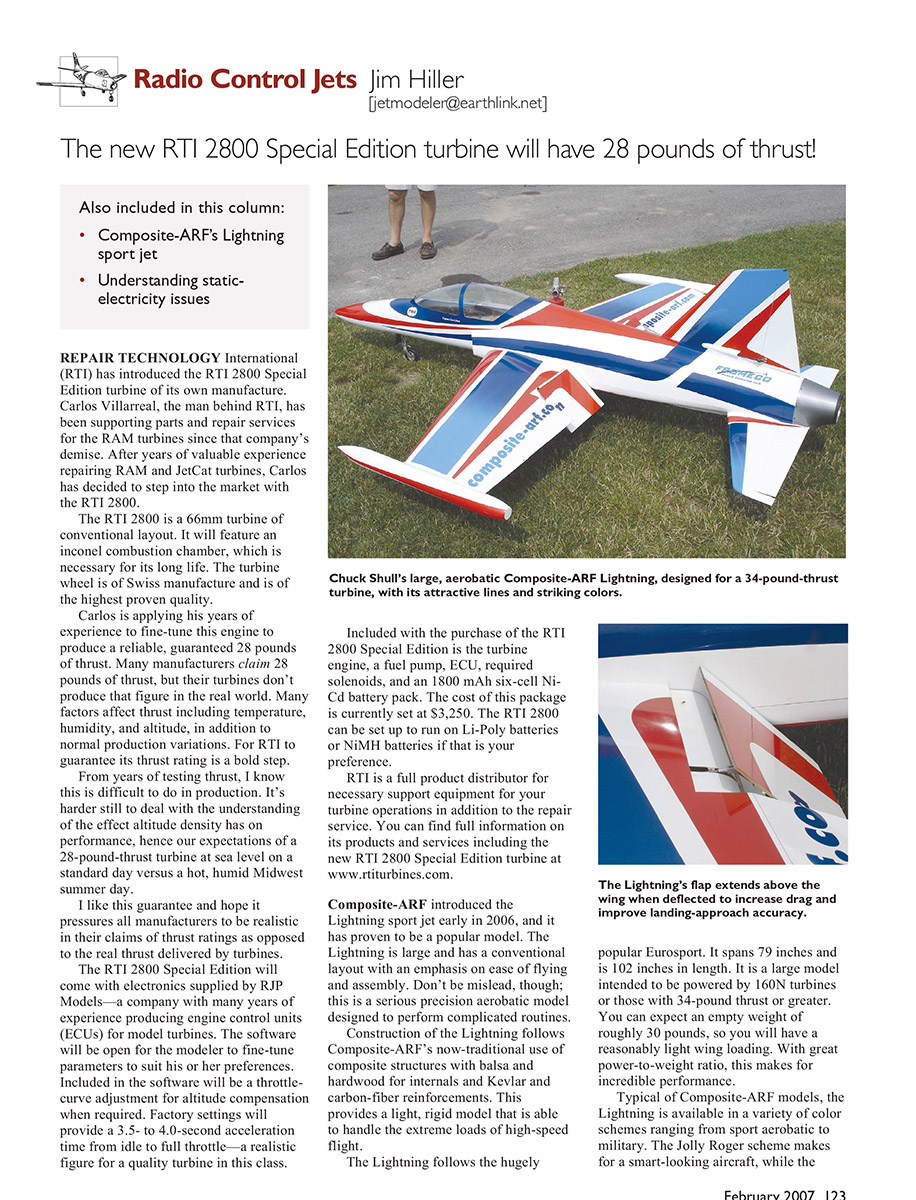
Composite-ARF introduced the Lightning sport jet in early 2006, and it has proven popular. The Lightning is large, conventional in layout, and emphasizes ease of flying and assembly. It is a serious precision aerobatic model designed for complicated routines.
Construction and materials:
- Composite structures with balsa and hardwood internals
- Kevlar and carbon-fiber reinforcements for a light, rigid airframe capable of handling extreme high-speed loads
- Factory-installed internal ductwork
- Traditional formers to stiffen the fuselage and provide hard mounting points
- All control surfaces factory-hinged
Specifications and performance:
- Wingspan: 79 inches
- Length: 102 inches
- Intended power: 160N turbines or turbines with 34 pounds of thrust or greater
- Expected empty weight: ~30 pounds (yielding reasonably light wing loading and a strong power-to-weight ratio)
Appearance:
- Several color schemes available; a Navy version adds high-visibility colors to the traditional gray camouflage. The model presents well in any scheme.
Transport and access features:
- Breakdown for transportation includes:
- Two-piece wing
- Removable stabilizer
- Removable fin
- Removable nose cone
- Interior access:
- Large canopy hatch on top
- Extremely large removable bottom hatch extending from the leading edge (LE) of the wing to the LE of the stabilizer for easy access to the turbine and systems
Flap design:
- Unique flap hinged on the bottom but extending forward on the top
- When deflected, the flap extends above the upper wing surface to act as a drag device (similar to a spoiler) while deflecting air downward from the bottom surface (similar to a traditional flap)
- Flap servo mount is well thought out and clear of the wheel well, making installation neat
Landing gear and structure:
- Wing carry-through: traditional aluminum tube extending through main landing-gear retract units to transfer landing loads
- Main landing gear: extremely wide track for improved ground handling
- Trailing-link nose gear available as part of the retract accessory kit for straight, positive ground tracking
- One-piece stabilizer bolts to the fuselage; fin is bolted on with a carbon-fiber tube support
- Complete set of gear doors included to neatly hide landing gear and tires when retracted
Fuel system:
- Provided tanks: custom-molded Kevlar fitted around inlet ductwork, nearly centered over the wing carry-through
- Tank design incorporates baffling to reduce fuel sloshing
- Tanks are Y-connected to a header tank for final feed to the fuel pump
- Optional extended-range fuel tank available; can hold 1.5–2.1 liters of additional fuel or be used for smoke oil in airshow performance
For more information and the instruction manual, see www.composite-arf.com.
Pricing:
- Cost varies by color scheme, ranging from $2,800 to $3,200
- Retract gear set with wheels and brakes adds $949
The Lightning is a substantial aircraft and comes complete with many systems.
Static Electricity and Turbine Shutdowns
A new topic in the jet-modeling community is static electricity causing turbine shutdowns, usually immediately after takeoff. The issue appears more prevalent with larger turbines.
Initial theory: static buildup from fast-rolling tires during takeoff. This has largely been debunked.
Current accepted theory: fuel flow through the airplane is the source of unwanted static buildup. Larger engines consume large volumes of kerosene, and fuel flowing at high velocity through long lengths of small-diameter tubing can develop significant static charges. Those charges can find a path through the ECU or ignition harness, causing temporary electronic failures or the ECU interpreting a stray signal as a shutdown command.
Practical observations and recommendations:
- Common practice has been to use the same-size fuel lines regardless of turbine fuel-flow requirements. I have used giant-scale-size lines from the tanks to the fuel pump, whether on an 8-pound-thrust turbine or a 40-pound-thrust turbine.
- As fuel velocity increases in small-diameter lines, static electricity can build and discharge into electronics, often causing shutdowns early in flight when the model is full of fuel.
- Large Kevlar tanks without baffling can allow fuel slosh, contributing to static-charge buildup.
- Current solutions under discussion include:
- Using conductive fuel lines or tanks with conductive material to dissipate static charges
- Fuel additives to reduce static buildup
- Improved baffling and tank design to minimize slosh
JetCat USA is actively investigating this issue and has useful information at www.jetcatusa.com. Expect more developments as knowledge and solutions progress.
It’s time for me to pack and get on to flying. Have a good day and see you at the jet meets. MA
Transcribed from original scans by AI. Minor OCR errors may remain.

