
PST Reaction 54 sport jet flight-test report
By
- Jim Hiller
- [email protected]
Overview
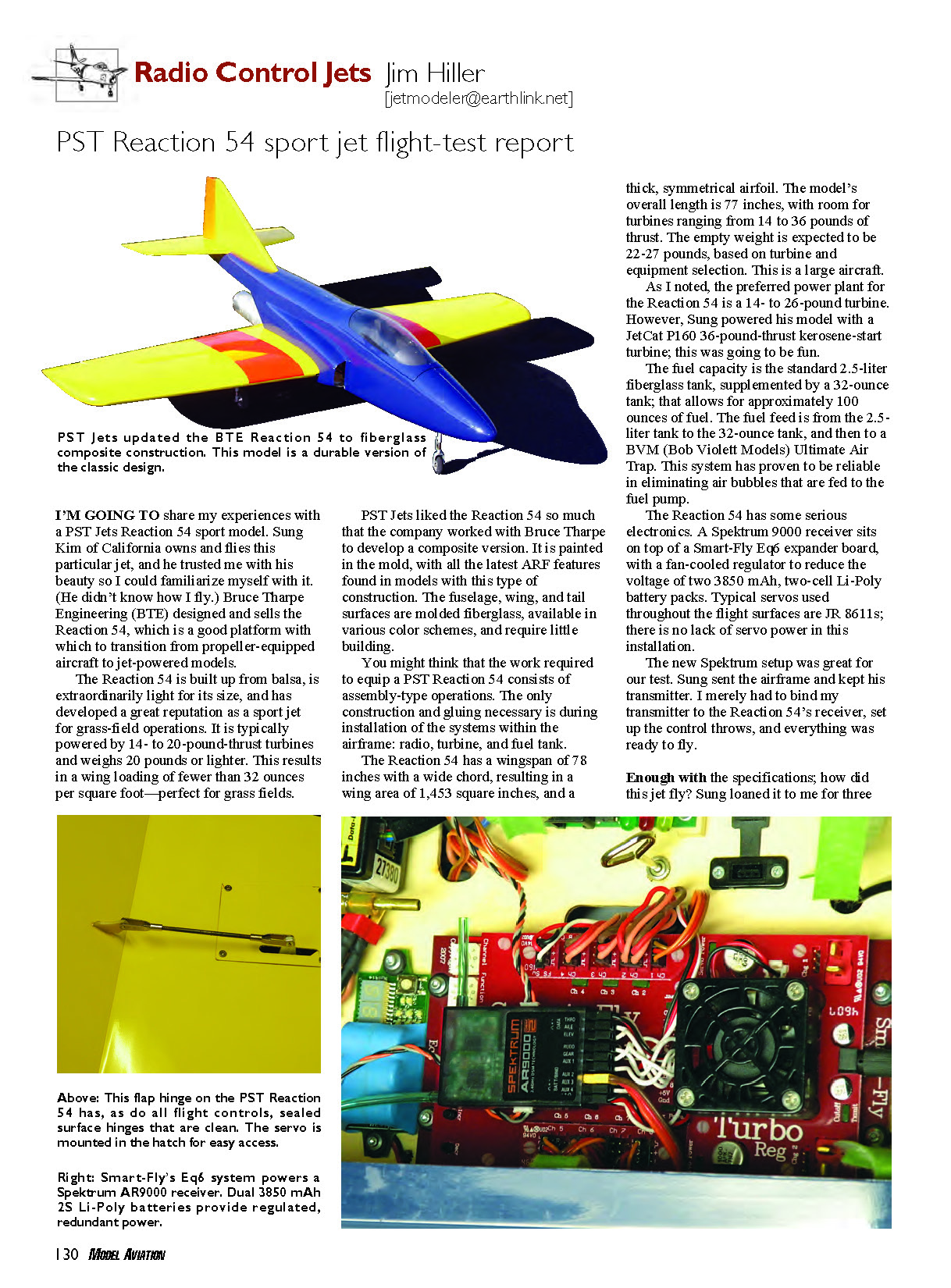
I'm going to share my experiences with a PST Jets Reaction 54 sport model. Sung Kim of California owns and flies this particular jet, and he trusted me with his airframe so I could familiarize myself with it. Bruce Tharpe Engineering (BTE) designed and sells the Reaction 54, which is a good platform for transitioning from propeller-equipped aircraft to jet-powered models.
The Reaction 54 is built up from balsa (in its original form), is extraordinarily light for its size, and has developed a great reputation as a sport jet for grass-field operations. It is typically powered by 14- to 20-pound-thrust turbines and often weighs 20 pounds or lighter, resulting in a wing loading of fewer than 32 ounces per square foot—perfect for grass fields.
PST Jets liked the Reaction 54 so much that the company worked with Bruce Tharpe to develop a composite version. It is painted in the mold, with all the latest ARF features found in models with this type of construction. The fuselage, wing, and tail surfaces are molded fiberglass, available in various color schemes, and require little building. The only construction and gluing necessary is during installation of the systems within the airframe: radio, turbine, and fuel tank.
Specifications
- Wingspan: 78 inches (wide chord)
- Wing area: 1,453 square inches (more than 10 sq ft)
- Overall length: 77 inches
- Recommended turbine: 14–26 lb thrust (can accept 14–36 lb)
- Typical empty weight: 20–27 pounds, depending on turbine/equipment
- Flight role: Sport/transition jet for grass-field operations
Sung powered his model with a JetCat P160 (36 lb thrust) kerosene-start turbine for these flights.
Fuel and Fuel System
- Standard 2.5-liter fiberglass tank, supplemented by a 32-ounce tank
- System feed: 2.5 L tank → 32 oz tank → BVM Ultimate Air Trap
- Approximate fuel capacity as used: ~100 ounces
The BVM Ultimate Air Trap proved reliable at eliminating air bubbles fed to the fuel pump.
Electronics and Servos
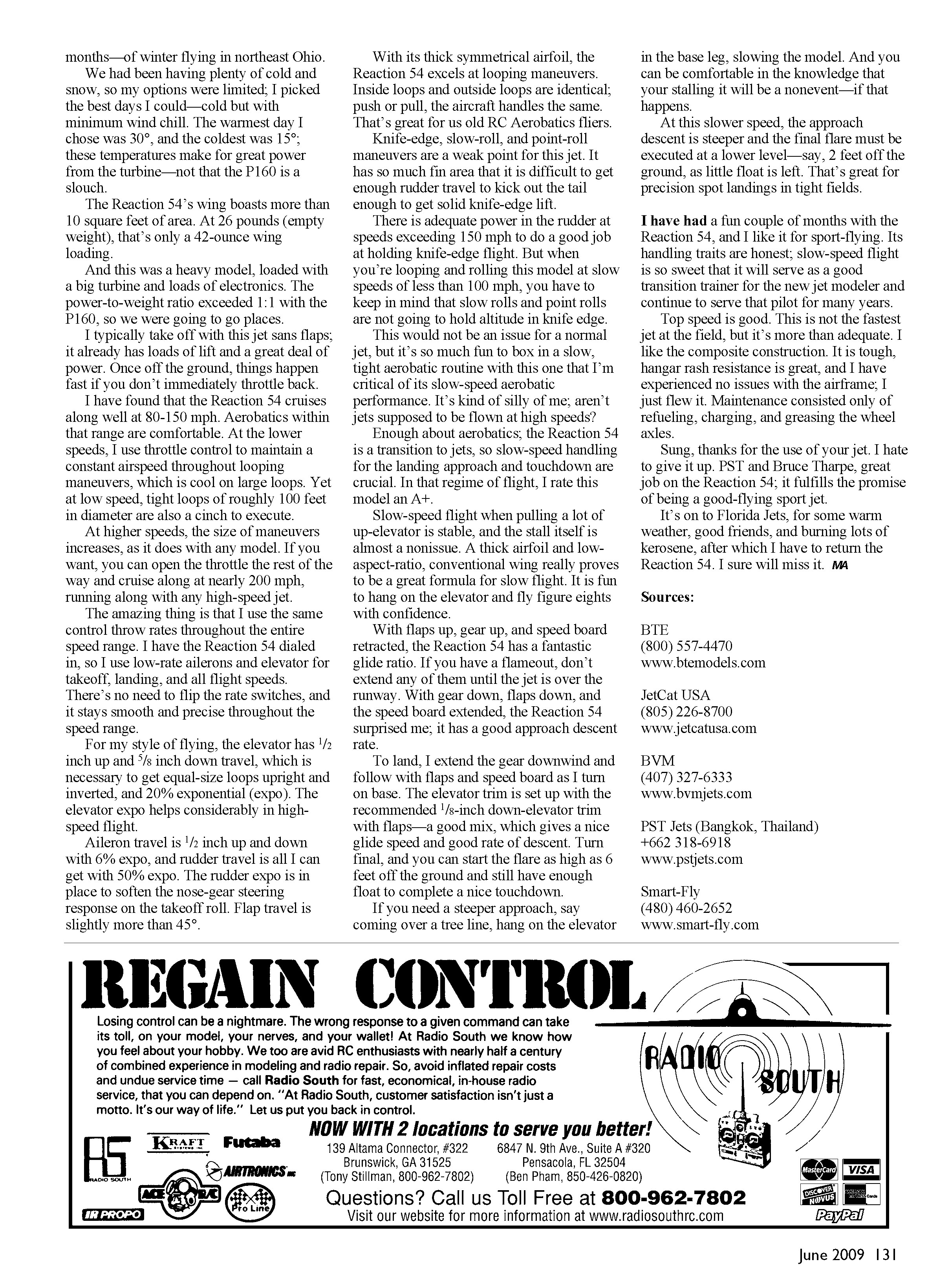
- Receiver: Spektrum 9000
- Expander board: Smart-Fly Eq6 (receiver sits on top of it)
- Power regulation: Fan-cooled regulator reducing voltage from two 3850 mAh, 2S LiPo packs
- Servos: JR 8611s on all flight surfaces (ample torque)
Sung sent the airframe and kept his transmitter; I bound my transmitter to the Reaction 54 receiver, set control throws, and was ready to fly.
Test Conditions
Sung loaned the jet to me for three months of winter flying in northeast Ohio. Conditions were cold with some snow; I chose the best days with minimum wind chill. Temperatures ranged from 30°F to 15°F, which tends to make turbine power output strong.
Performance and Handling
With the P160 installed, the power-to-weight ratio exceeded 1:1, so acceleration and vertical performance were outstanding.
Cruise and aerobatics:
- Comfortable cruise and aerobatic range: 80–150 mph
- Top cruise speed (open throttle): nearly 200 mph
- Same control-rate setup worked across the entire speed range — no need to swap rate switches
- The jet handles large and small loops well; low-speed tight loops (~100 ft diameter) are easy when using throttle control to maintain airspeed
- Inside and outside loops are identical due to the thick symmetrical airfoil
Slow-speed aerobatics limitations:
- Knife-edge, slow-roll, and point-roll maneuvers are弱 compared to its other strengths. The large fin area makes it difficult to get enough rudder authority at low speeds to produce solid knife-edge lift.
- Above ~150 mph the rudder is adequate for holding knife-edge flight. Below ~100 mph, slow rolls and point rolls will not hold altitude in knife-edge.
Control Throws and Setup
- Elevator: 1/2" up, 5/8" down; 20% exponential (helps at high speed). This gives equal-size upright and inverted loops.
- Ailerons: 1/2" up and down; 6% exponential.
- Rudder: maximum available travel; 50% exponential to soften nose-gear steering response during the takeoff roll.
- Flaps: slightly more than 45° travel.
- Recommended trim with flaps: 1/8" down-elevator trim (good mix for glide speed and descent rate).
I use low-rate ailerons and elevator for takeoff, landing, and all flight speeds; the jet stays smooth and precise throughout the speed range.
Takeoff, Landing, and Slow-Speed Handling
I typically take off without flaps; the model has plenty of lift and power. Once airborne, it's easy to accelerate too quickly if you don't immediately throttle back.
Slow-speed behavior and stalls:
- Slow-speed flight is very stable; the stall is almost a nonissue thanks to the thick airfoil and low-aspect-ratio wing.
- It’s forgiving when hanging on the elevator — nice for figure eights and precision slow flight.
Approach and landing technique:
- With gear up, flaps up, and speed board retracted, the Reaction 54 has a fantastic glide ratio. If you experience a flameout, avoid extending gear/flaps/speed board until over the runway.
- With gear down, flaps down, and the speed board extended, the jet has a respectable approach descent rate.
- Typical sequence: extend gear downwind, add flaps and speed board on base. With the recommended trim you can start the flare as high as 6 feet and still have float for a nice touchdown.
- For steeper approaches (for example, over trees), carry more up elevator in the base leg to slow the model; stalling at these speeds is not a significant concern.
- For precision spot landings in tight fields, use the steeper approach and execute the final flare lower (around 2 feet) due to reduced float.
Maintenance and Overall Impressions
I had a fun couple of months with the Reaction 54 and found it well suited to sport flying and as a transition trainer for new jet modelers. The composite construction is tough and resistant to hangar rash; I experienced no airframe issues. Maintenance during my time with the jet consisted only of refueling, charging batteries, and greasing wheel axles.
Top speed is good—it's not the field's absolute fastest jet but is more than adequate for sport flying. Overall, PST and Bruce Tharpe did a great job: the Reaction 54 fulfills the promise of being a good-flying sport jet.
Sung, thanks for the use of your jet — I hated to give it up. It’s on to Florida Jets for some warm weather, good friends, and burning lots of kerosene before I return the Reaction 54. I’ll miss it.
MA
Sources
- BTE — (800) 557-4470 — www.btmodels.com
- JetCat USA — (805) 226-8700 — www.jetcatusa.com
- BVM — (407) 327-6333 — www.bvmjets.com
- PST Jets (Bangkok, Thailand) — +662 318-6918 — www.pstjets.com
- Smart-Fly — (480) 460-2652 — www.smart-fly.com
Transcribed from original scans by AI. Minor OCR errors may remain.

