
Radio Control Jets - 2009/10
By Jim Hiller
How to choose the appropriate jet engine fuel
Also included in this column:
- Airworthiness notification preferences
- Father-and-son issues
One issue that is regularly brought up is what type of fuel to use. I have burned Jet-A purchased at airports, low-odor kerosene from hardware stores, and kerosene from the pump at a gas station. All have run fine in our turbine engines.
My fuel of choice is pump kerosene, with a red dye added for a tint. A gas station three miles from my house, on the way to the field, carries kerosene. It's inexpensive compared to other sources, and convenience rules my selection.
The red tint greatly helps me check fuel levels inside the airplane, even through composite tanks. I have been awarded a pink Jet Central hat to match my red kerosene.
My next choice (also a good one) is low-odor kerosene from hardware stores. This is usually clear and the odor is reduced, not eliminated, but it is still a plus if you store your models indoors after a flying session.
The cost of this kerosene tends to be the highest, and its availability is seasonal at best in my area. This availability issue was my prime reason for switching from this product; it's not available in the summer.
My last choice, which is especially convenient when flying from a local airport, is Jet-A fuel. Its cost is moderate—usually about a dollar more per gallon than pump kerosene. A large-mouth container is necessary, because aircraft fueling nozzles are larger in diameter than those used for automobiles. A funnel can work in a pinch.
Jet-A has a strong odor. I would store my models in the barn for a week after a flying session to air them out before taking them to my basement workshop.
I did experience a couple instances of algae growth following long-term storage (more than three months) of Jet-A—even what was left in the model.
All three sources of kerosene were reliable. My turbines ran the same regardless of the fuel used, so make a choice based on your situation. My preference for pump kerosene over other sources of fuel is pure convenience, both for purchase and for storing the model following the flying session.
Oil selection and mixing
A related issue is the oil required to be mixed with your fuel. The decision seems complex, but it shouldn't be. Follow your turbine manufacturer's recommendations. If they specify turbine oil, do so at the percentages instructed. The makers are experienced with their turbines and know what they need.
I ran turbine oil for years and used most brands (Mobil, BP, and AeroShell), with no bearing or carbon buildup issues related to a particular selection. Good and bad have been said about each type through the years, but I don't believe any brand of oil has a significant advantage over another. I always based my brand selection on availability.
I have recently switched to Mobil DTE Light: an alternative to turbine bearing oil. Both manufacturers of the turbines I am running—Jet Central and Wren—recommend Mobil DTE Light as an alternative to turbine bearing oil, which was the most important consideration before switching. I would not run Mobil DTE Light in a turbine if a turbine manufacturer did not endorse its use. Again, my switch was based on personal reasons.
Since I now have access to a paved runway at a local model field, I no longer frequent airports with turbine oil on the field. The nearest airport is 15 miles away in the opposite direction from my flying site—not so convenient. I purchased my Mobil DTE Light in a 5-gallon container from an industrial supplier located just four miles from our flying site; you can't beat that for convenience.
I mix Mobil DTE Light to the same percentages normally called for. In the case of my Wren and Jet Central turbines, it's 2.5% (1 quart per 10 gallons).
Operating issues and structural lessons
On the topic of operating issues, I was recently reminded just how damaging the high airspeeds we operate our jets at can be to an airframe. I have owned my Bob Violett Models (BVM) BobCat XL for roughly a year-and-a-half and put approximately 150 flights on it before an incident occurred.
While flying an aggressively fast flight, the model took a large bug strike to the leading edge (LE) between the tailbooms that damaged the paint and the epoxy finish on the balsa LE. It was a small nick, close to 1/8 inch in diameter.
What happened as the day progressed surprised me. Two flights later, that small nick had opened up to more than 1/2 inch in diameter and down into the balsa LE approximately 1/8 inch. It was time to quit for the day and repair; I didn't want to lose this fun machine.
Close inspection of the LE revealed that no fiberglass cloth was used on the center-section area of the wing; only an epoxy finish resin was used. Both outer wing panels have fiberglass cloth, but I don't know why the builder missed this on the center-section; it makes a difference at our speeds.
I repaired the LE with a mix of epoxy and Cabosil, then sanded it smooth and flush. I changed my mind about repainting the damaged LE; it needed additional strength. I used a layer of aluminum tape to reinforce the area and finish it similar to the polished LE cuffs on some full-scale jets. Besides, the metal finish allowed me to add rivet detail.
So far, the repair has held up to numerous bug strikes with no problems. This example proves that our jets fly at speeds that put considerable aerodynamic stress on the airframes.
I have witnessed two airframes disintegrate during the first few flights from the same structural failure: the fuselage failing at the inlets, allowing the aircraft's nose to break off. Both were ARFs of fiberglass-composite construction and appeared well built, but they had large canopy hatches. This left little structure above the inlet area forward to support the large fuselage nose section ahead of the inlets.
Both models failed at high speeds, resulting in catastrophic breakup of the airframes. As the nose separated, the turbines shut down, probably because the batteries disconnected since they were located forward in the fuselage section that separated, and the airframes tumbled to the ground.
What did they really have in common? The designers, manufacturers, and pilots lacked appreciation of the huge air loads imposed at the speeds we fly.
In one case, the manufacturer laid up a special light fuselage with less fiberglass cloth, and the new owner had his input to this impending failure. He was proud of his new, larger-than-recommended turbine installation. These two factors combined resulted in the loss of a beautiful airplane.
We regularly fly modern jets that are capable of achieving 200 mph level flight speeds, but these are not always the proven, tried-and-true airframes to which we have become accustomed. The wonderful world of prepainted ARFs and the rapid growth of manufacturers—and the rate at which they "develop" new airframes—should be a warning.
Airworthiness notifications and manufacturer guidance
I recommend that companies issue airframe directives when problems develop in the field; they assist the modeler in finding solutions. BVM has done this for years. Check the company's website for information about all of Bob's models; the experiences shared provide the pilot with knowledge for successful long-term operations of BVM aircraft.
Another company that now provides this service is Bruce Tharpe Engineering (BTE), which markets the PST Reaction 54. Great job! It is appreciated.
We modelers need to stay informed about the problems that can occur, and the manufacturers need to provide this service of disseminating information. It greatly enhances the ownership experience.
A father-and-son team
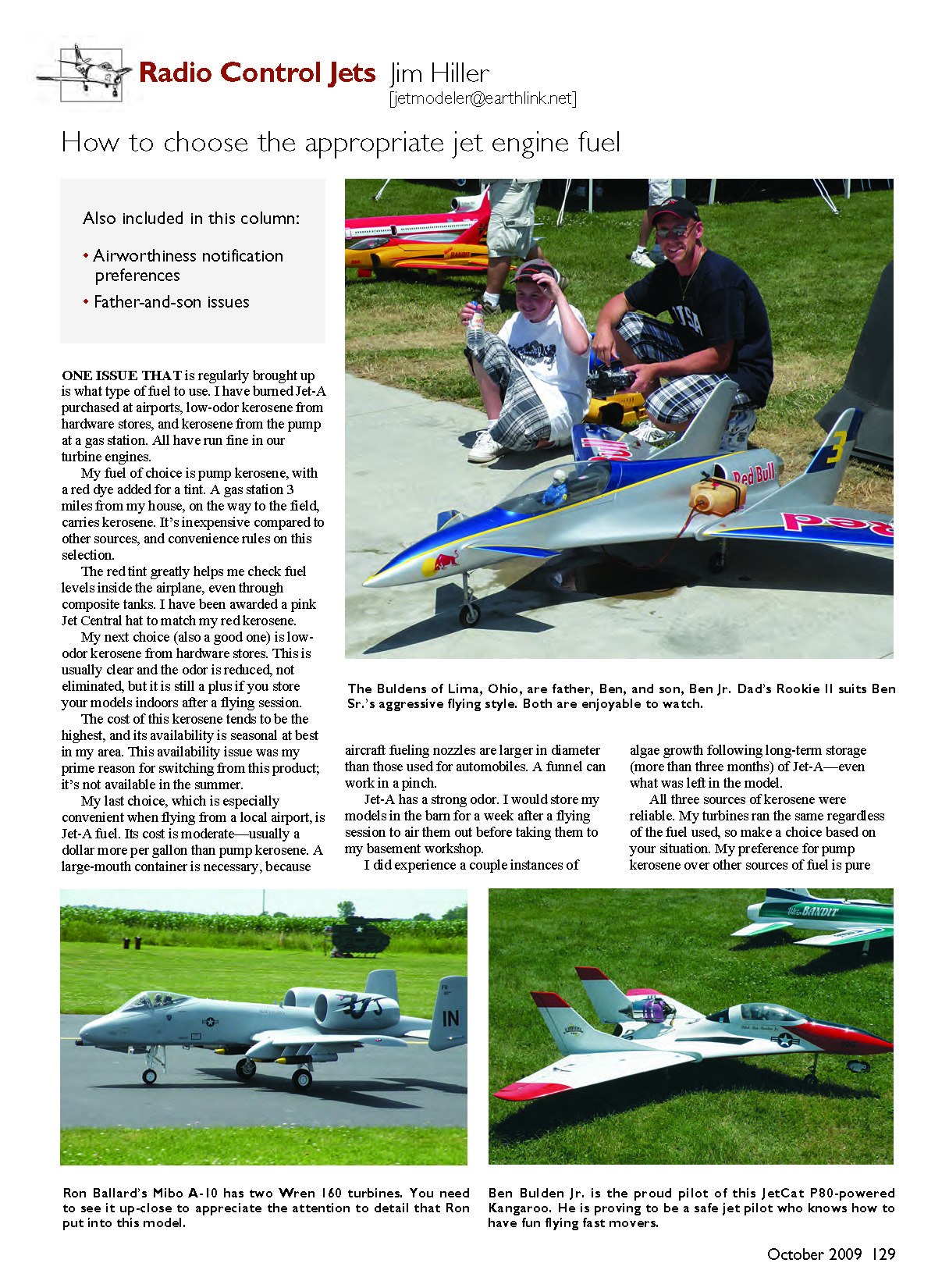
A great sight at Midwest jet events is Ben Bulden and his son, Ben Jr., flying together. The Bulden team is from Lima, Ohio, and each has his own jet. This is a great father-and-son team.
Dad's airplane is the impressive Red Bull Rookie II, powered with a JetCat P120 turbine—lots of power. And he knows how to fly it low and fast.
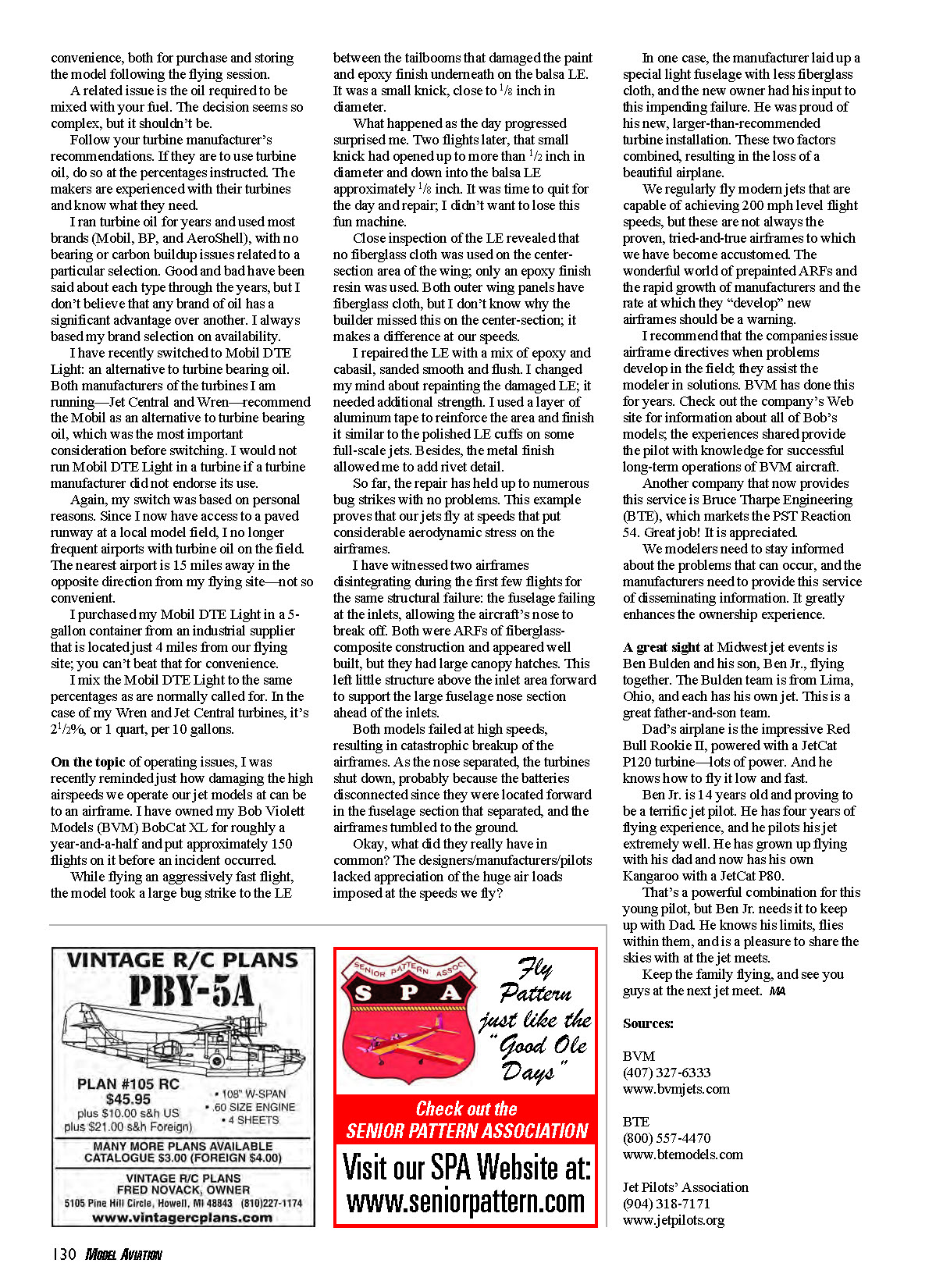
Ben Jr. is 14 years old and proving to be a terrific jet pilot. He has four years of flying experience and pilots his jet extremely well. He has grown up flying with his dad and now has his own Kangaroo with a JetCat P80.
That's a powerful combination for this young pilot, but Ben Jr. needs to keep up with Dad. He knows his limits, flies within them, and is a pleasure to share the skies with at the jet meets.
Keep the family flying, and see you guys at the next jet meet. JH
Sources
BVM (407) 327-6333 www.bvmjets.com
BTE (800) 557-4470 www.btemodels.com
Jet Pilots' Association (904) 318-7171 www.jetpilots.org
Transcribed from original scans by AI. Minor OCR errors may remain.

