
Build-a-Turbine-Engine Open House
I recently returned from the first Wren USA Open Day in Indiana. Ron Ballard became part of the company a few years ago and set up shop to service its turbines in the U.S. He has built a great reputation for service and wanted to show off his shop to friends and customers, so he invited them in November. What a great way to end a great flying season.
The schedule for the open house was a barbecue on Friday night and building, running, repairing, and discussing turbines on Saturday. I arrived Friday at roughly noon and was greeted not only by Ron Ballard, but also by Mike Murphy of Wren Turbines. Mike had flown in from England to attend the event. He is one of the company's original developers and owners, and he knows his turbines.
Ron and Mike were in the middle of running and refining turbines when I arrived—something they had been doing most of the week, because Mike had arrived early. Wren USA now has a balancer set up in the shop, with which Ron has increased the service operations he can perform and no longer has to ship turbines to Wren in England for repairs.
Balancing and Bearings
One of the reasons Mike had arrived early was to balance turbine rotating assemblies with Ron and to exchange experiences in building and repairing Wren turbines. The balancers for our small turbines are accurate and sophisticated machines capable of balancing shafts, compressors, and turbines, both as individual items and as assemblies. The Wren process for balancing is impressive, and Ron and Mike explained it all—there were no secrets.
Ron and Mike demonstrated bearing cleanliness and detection of dirty or damaged bearings. For the rear bearing, Ron held the shaft and turbine assembly (without the compressor wheel) vertical by the bearing and spun the shaft. We performed the test with the assembly straight from the kit, then washed the bearing under hot water and repeated the spin test. The difference was obvious—much smoother. It was a great tip. Another suggestion was to apply oil to the bearing before assembly.
The Build
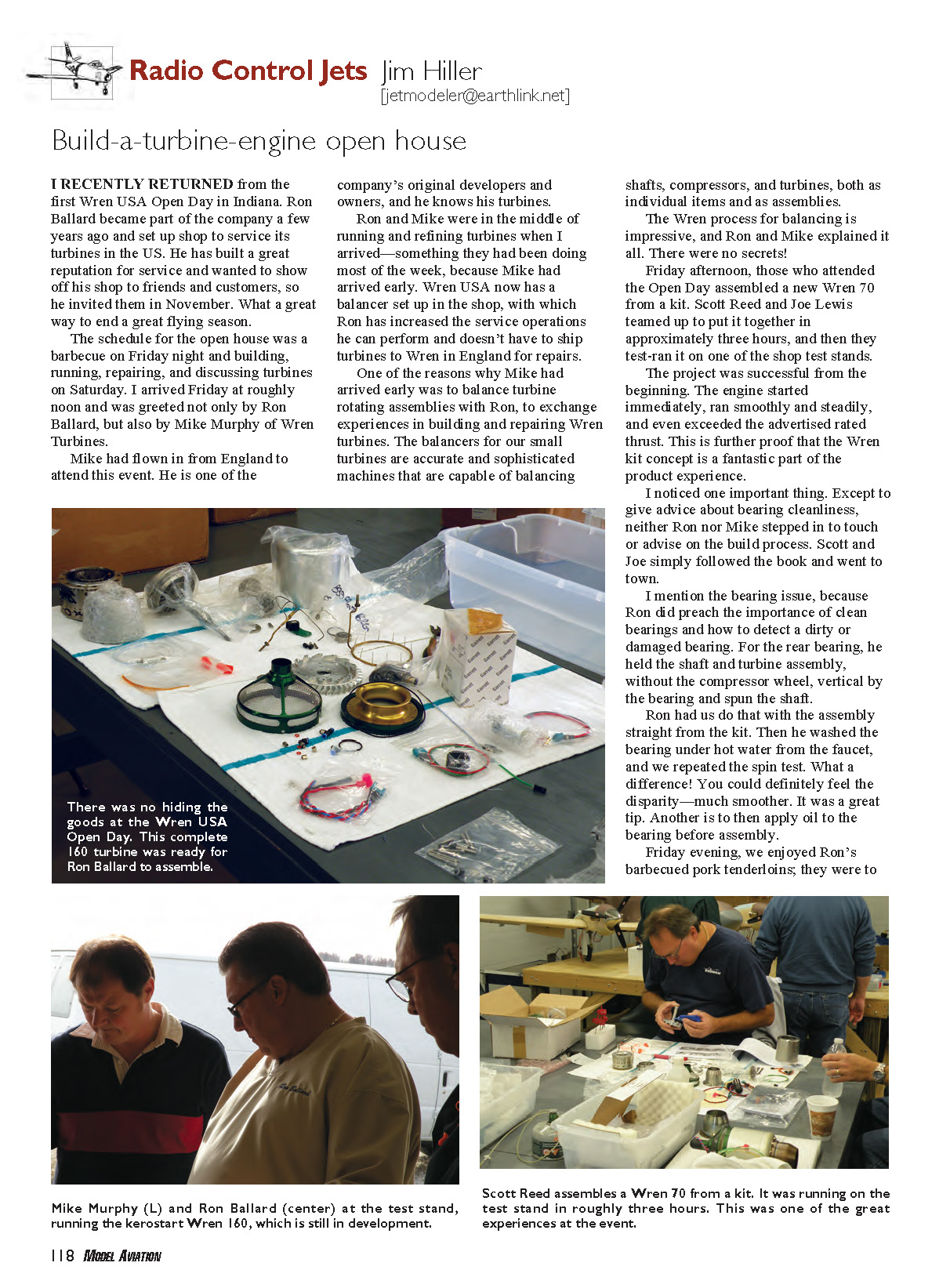
Friday afternoon, attendees assembled a new Wren 70 from a kit. Scott Reed and Joe Lewis teamed up and put it together in approximately three hours, then test-ran it on one of the shop test stands. The engine started immediately, ran smoothly and steadily, and even exceeded the advertised rated thrust. This further proves that the Wren kit concept is a fantastic part of the product experience.
I noticed one important thing: except to give advice about bearing cleanliness, neither Ron nor Mike stepped in to touch or advise on the build process. Scott and Joe simply followed the manual and went to town.
A Wren 70 assembled from a kit on Saturday likewise started right away, ran smoothly, and exceeded its rated thrust.
Food and Fellowship
Friday evening we enjoyed Ron's barbecued pork tenderloins; they were exceptional. Ron is a perfectionist not only with his turbines, but also with his barbecue. Guests ate until they could eat no more. Dave Brawley, alias "Goose," also brought barbecued ribs. Those who arrived on Friday were spoiled with plenty of great food. The plan was to save some meat for Saturday's lunch, and we ate well both days.
Kerostart Development and Demonstrations
Demonstration runs of the company's kerosene start ("kerostart") on a development Wren 160 were performed using the 34-pound-thrust turbine. This was clearly a development setup; it looked like a porcupine with multiple glow plug locations, all to find the best spot.
The Wren kerostart setup is a glow plug-and-injector arrangement, with the plug separate from the injector for easy, economical replacement. Many combinations of batteries, injector/plug locations, and start procedures were tested Friday and Saturday. Ron and Mike did not hide the development process—they wanted customer input about how to set up equipment and were willing to try different combinations all day.
While Ron built a Wren 160, Mike held a class about turbines. Ron has been an active part of the Wren 160's development, and his knowledge of this power system is impressive. He openly shared many nuances of the build process and design of that engine, even though it is not available as a kit.
Mike discussed the design and development of Wren turbines. Everyone at the open house was impressed and surprised by his knowledge and openness about his experiences developing these engines and by some technical facts he shared about turbine engineering. We learned a great deal about our engines during this time. Mike repeatedly stressed that he views open houses as an avenue to learn what customers like, want, and need in turbines—he listens to us to guide Wren's next moves.
Turboprop and Gearbox
There was discussion about the Wren 44 Turboprop, which is based on the company's 44 turbine. The Turboprop is an incredible little package. In stock form it runs a three-blade 22 x 10 propeller with a 9:1 gearbox. The company is experimenting with a 12:1 gearbox. Initial runs suggest that a two-blade 32 x 10 propeller can produce as much as 50 pounds of thrust.
Ron and Mike also showed a replaceable gearbox assembly. The importance of this is that the gearbox can be replaced easily if it is damaged by a propeller strike. Repairing a bent propeller shaft is a time-consuming issue with turboprops; Wren's replaceable assembly is quick and straightforward, so you can be flying again in minimal time and have the gearbox properly repaired back at the shop.
ECU Options: ProJet
Wren Turbines is looking into not being limited to a single electronic control unit (ECU), moving beyond the FADEC it has used almost from the beginning. One of the first runs with a ProJet ECU was made during Open Day. The initial parameters were downloaded into the ECU, and the development Wren 160 kerostart was run off the ProJet. After some initial parameter reviews, the turbine started immediately and the ProJet was used for the rest of the weekend.
ProJet electronics is going in a new direction and offers interesting options. Some programming features available in this ECU will allow much faster acceleration and deceleration times from partial throttle to full throttle. It's an extremely well-thought-out unit. The ProJet includes options for additional data recording and a 2.4 GHz onboard transmitter for downloading in-flight turbine information to the pilot. A display board can be mounted to the transmitter for data, or a speech module can be added to announce information such as fuel consumption. Having real-time fuel-remaining data could let pilots stretch flight times with greater confidence.
Repairs, Test Stands, and Openness
A table full of boxed turbines that attendees had shipped to the company for repairs awaited us. Many were fixed by their owners under the tutelage of the Wren team. Upon completion of repairs or upgrades to the most current revisions, the engines were run on a test stand equipped with thrust measurement so that underperforming units could be detected; all turbines must meet thrust ratings. It was nice to see this openness.
The event ended late Saturday afternoon with farewells and Ron's promise to do it again. Those who attended learned a great deal—more than can be detailed in this column. There were also promises of exciting new things coming from Wren Turbines.
Sources
- Wren USA — (260) 724-8936 — http://wrenturbines.co.uk/usa
- Jet Pilots Association — (904) 318-7171 — www.jetpilots.org
Transcribed from original scans by AI. Minor OCR errors may remain.

