
Radio Control Pylon Racing
Kurt Bozarth [email protected]
The state of Pylon Racing
MUCH HAS BEEN posted on the Web lately about the status of Pylon Racing. These discussions have attempted to identify solutions to the big question: How do we attract new Pylon racers?
Those of us who are currently knee-deep in Pylon Racing are concerned that potential racers may be overwhelmed by the numerous challenges (actual and perceived) associated with the event and might eventually make the unfortunate decision not to join us. Most experienced racers feel that the "perceived" challenges have been exaggerated and the "actual" challenges are far less difficult to overcome than one might initially believe.
Many excellent ideas have surfaced. Most are aimed at providing accurate information to clubs, hobby shops, and ultimately to the potential racer. Many other areas of the model-aviation community have faced similar challenges at one time or another: it's too expensive, it's too fast, it's too competitive, it's too far to drive, etc.
Also included in this column:
- Whittier Shoot Out race report
- Jedburg, South Carolina, race report
- Houston NMPRA Championship race report
Unfortunately the only ones involved in the recent discussions have been those who are already immersed in the hobby. Although many active Pylon racers can reflect on what issues delayed their own participation in the event, they can only guess what is preventing a new racer from joining us. We need to hear from those who are currently "on the fence." With that in mind, I ask potential Pylon racers to send me your comments. I would like to know specifically what challenges have prevented you from "taking the plunge." Is it the lack of racing in your area? Perhaps it's your unfamiliarity with the course and the equipment. Is cost a factor? Please e-mail me your comments or log on to one of the popular Web site forums (www.nmpra.org or www.rcuniverse.com) and post your comments. The RC Pylon Racing community would greatly appreciate your perspective.
If and when you make the jump into this event, I can guarantee that you will not be disappointed. The racing is always intense, regardless of level, and is every bit as fun. A bad day at a Pylon race is better than a good day at work. You will not find a friendlier or more helpful group of pilots. World-class racers such as Randy Bridge and Travis Flynn never hesitate to answer the most basic questions, and engine-man Mike Del Ponte will let you in on a few secrets (but not all of them).
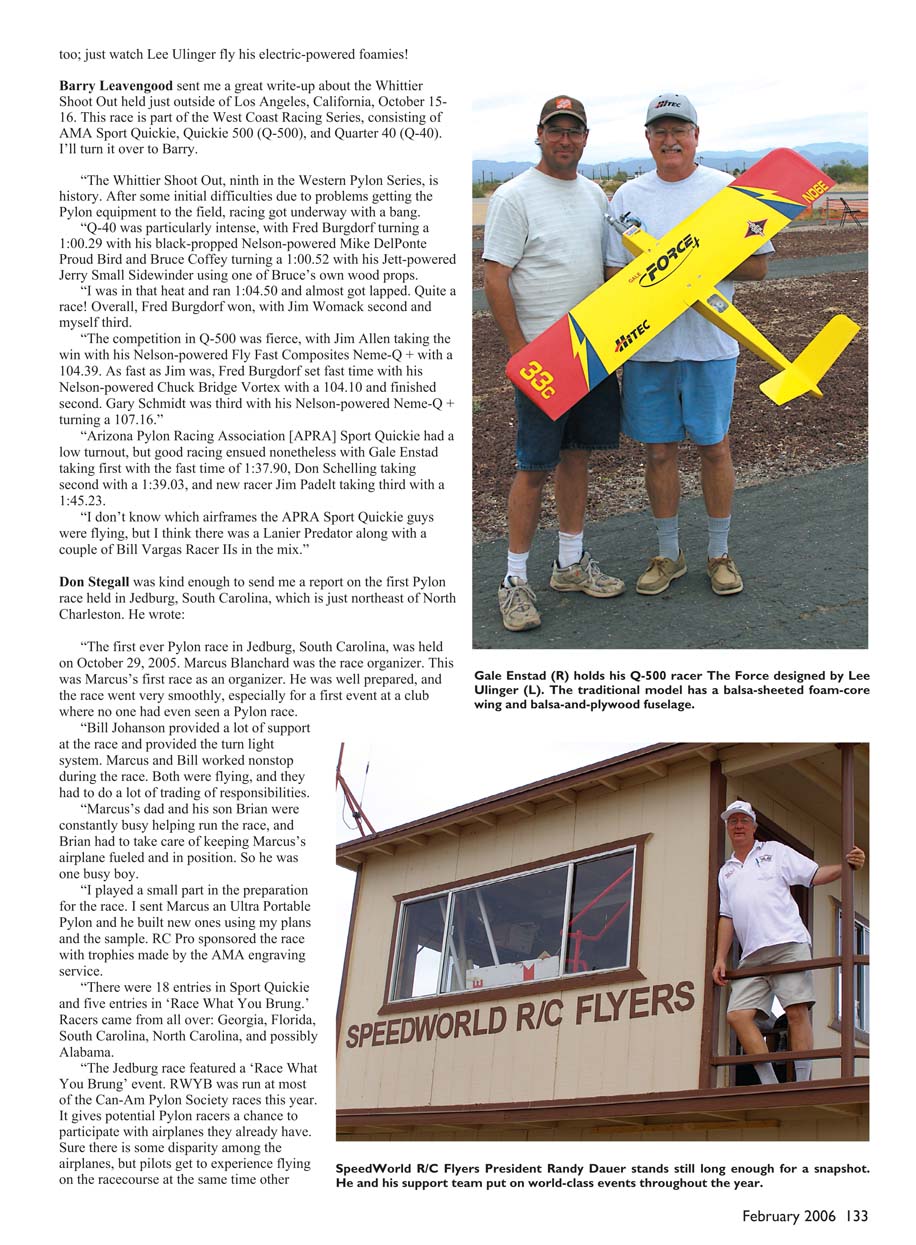
You will also enjoy the sport flying after the races. Yes, Pylon racers can turn right too; just watch Lee Ulinger fly his electric-powered foamies!
Whittier Shoot Out (Barry Leavengood)
Barry Leavengood sent a great write-up about the Whittier Shoot Out held just outside of Los Angeles, California, October 15–16. This race is part of the West Coast Racing Series, consisting of AMA Sport Quickie, Quickie 500 (Q-500), and Quarter 40 (Q-40). Barry writes:
"The Whittier Shoot Out, ninth in the Western Pylon Series, is history. After some initial difficulties due to problems getting the pylon equipment to the field, racing got underway with a bang.
"Q-40 was particularly intense, with Fred Burgdorf turning a 1:00.29 with his black-propped Nelson-powered Mike DelPonte Proud Bird and Bruce Coffey turning a 1:00.52 with his Jett-powered Jerry Small Sidewinder using one of Bruce's own wood props.
"I was in that heat and ran 1:04.50 and almost got lapped. Quite a race! Overall, Fred Burgdorf won, with Jim Womack second and myself third.
"The competition in Q-500 was fierce, with Jim Allen taking the win with his Nelson-powered Fly Fast Composites Neme-Q+ with a 104.39. As fast as Jim was, Fred Burgdorf set fast time with his Nelson-powered Chuck Bridge Vortex with a 104.10 and finished second. Gary Schmidt was third with his Nelson-powered Neme-Q+ turning a 107.16.
"Arizona Pylon Racing Association (APRA) Sport Quickie had a low turnout, but good racing ensued nonetheless with Gale Enstad taking first with the fast time of 1:37.90, Don Schelling taking second with a 1:39.03, and new racer Jim Padelt taking third with a 1:45.23.
"I don't know which airframes the APRA Sport Quickie guys were flying, but I think there was a Lanier Predator along with a couple of Bill Vargas Racer IIs in the mix."
Jedburg, South Carolina (Don Stegall)
Don Stegall sent a report on the first Pylon race held in Jedburg, South Carolina, just northeast of North Charleston. He wrote:
"The first ever Pylon race in Jedburg, South Carolina, was held on October 29, 2005. Marcus Blanchard was the race organizer. This was Marcus's first race as an organizer. He was well prepared, and the race went very smoothly, especially for a first event at a club where no one had even seen a Pylon race.
"Bill Johanson provided a lot of support at the race and provided the turn light system. Marcus and Bill worked nonstop during the race. Both were flying, and they had to do a lot of trading of responsibilities.
"Marcus's dad and his son Brian were constantly busy helping run the race, and Brian had to take care of keeping Marcus's airplane fueled and in position. So he was one busy boy.
"I played a small part in the preparation for the race. I sent Marcus an Ultra Portable Pylon and I built new ones using my plans and the sample. RC Pro sponsored the race with trophies made by the AMA engraving service.
"There were 18 entries in Sport Quickie and five entries in 'Race What You Brung.' Racers came from all over: Georgia, Florida, South Carolina, North Carolina, and possibly Alabama.
"The Jedburg race featured a 'Race What You Brung' event. RWYB was run at most of the Can-Am Pylon Society races this year. It gives potential Pylon racers a chance to participate with airplanes they already have. There is some disparity among the airplanes, but pilots get to experience flying on the racecourse at the same time other airplanes are being flown on the course.
"There were five pilots who entered RWYB. The airplanes included a Harrier 3D, a Hangar 9 Aresi, a low-wing Quickie, a World Models P-51, and a 46-size Ultra Stick converted to electric power using a Hacker C-50 motor. None of the pilots had ever flown on a three-pole course or in a race of any kind.
"RWYB was flown after a couple of rounds of Sport Quickie. Some of the pilots worked the course for Sport Quickie, so they got a double initiation.
"I spoke to most of the RWYB pilots after their first round. All were exhilarated with the experience. They couldn't wait to get back on the course.
"The wide range of airplanes created some entertaining moments for the crowd. Since the airplanes were not set up for minimal control throws, the pilots really had to fly the airplanes. A 3-D aerobatic airplane on a three-pole course is a sight to see.
"Bob Bennett, the pilot of the Harrier, decided he needed a little more speed and changed to a new prop. Even though his airplane was not the fastest, he won the event. And he had a ball doing it.
"All of the members from the Jedburg club that I met were very enthusiastic about the race. There did not seem to be any question about whether or not another race would be held. The good turnout and Marcus's excellent preparation really impressed the club members.
"In Sport Quickie the Great Planes Viper was the predominant airplane. The Viper still has incidence issues. Almost every Viper I saw had shims at the rear of the stabilizer saddle. On my latest Viper I made a firewall shim and shimmed the tail up. I still needed some up-trim. So check your Viper if you have the tools to measure the incidences.
"If you are putting a Viper together, it is a good idea to search the Pylon forums on www.rcuniverse.com or the forums at www.nmpra.org. You can also find information by clicking on 'Articles' at www.rcpro.org (aka www.rcpyln.com).
"Bill Johanson was the big winner in Sport Quickie, taking first place, Fast Time, and winning the Dash for Cash."
Thanks for the report, Don. I love hearing about first-time races. According to Marcus Blanchard, the Jedburg Flyers will be hosting two races in 2006: a one-day event March 25 and a two-day contest October 28–29.
AMA's SIG / NMPRA Championship (Houston, Texas)
The National Miniature Pylon Racing Association (NMPRA) held its championship race in Houston, Texas, October 29–30. Q-40 was the only event flown. Lee LaValley provided the following report.
"It was by far the most fun I've had racing, and if anyone's ever been up for a race at the NCPL you know that they're saying something. This was the first 'national' event I've attended, and it was a great experience for me and I learned a lot.
"I finished 18th out of 36 racers, which was way above my expectations for the trip. Besides that, I took home my airplane in one piece for the most part despite a midair in the last heat.
"In all it was a great time, and I can't wait for Phoenix in February. Thanks again to Dennis C. for putting on a great show and to everyone else who took the time to help me out in my first Q-40 race."
Randy Bridge was the big winner and pocketed $1,000. Dan Kane was second and received $500, and Travis Flynn won $250 for his third-place finish.
Dave Norman provided some interesting details about the speeds he observed during practice. He wrote:
"At Friday during practice, they had a radar gun set up about 300 feet back of Pylon Two with a large digital display that would catch the speed of an airplane coming into Pylon Two. The display was large enough for everyone on the line to see.
"I watched and flew a lot of airplanes on Friday, and the fastest airplanes I saw were Rich Beers' in the 192–194 mph range, Dubb Jett's in the 190–192 range, and Norm Johnson's with speeds in the upper 180s to the lower 190s (all were Jetts). Most of the Nelsons I saw were in the low to mid-180s with a few in the upper 180s.
"The radar worked pretty well, except when there were multiple airplanes in the sky. It takes about two seconds to reset after a pass. It's a great tool to measure racecourse speeds."
The West Coast Racing Series
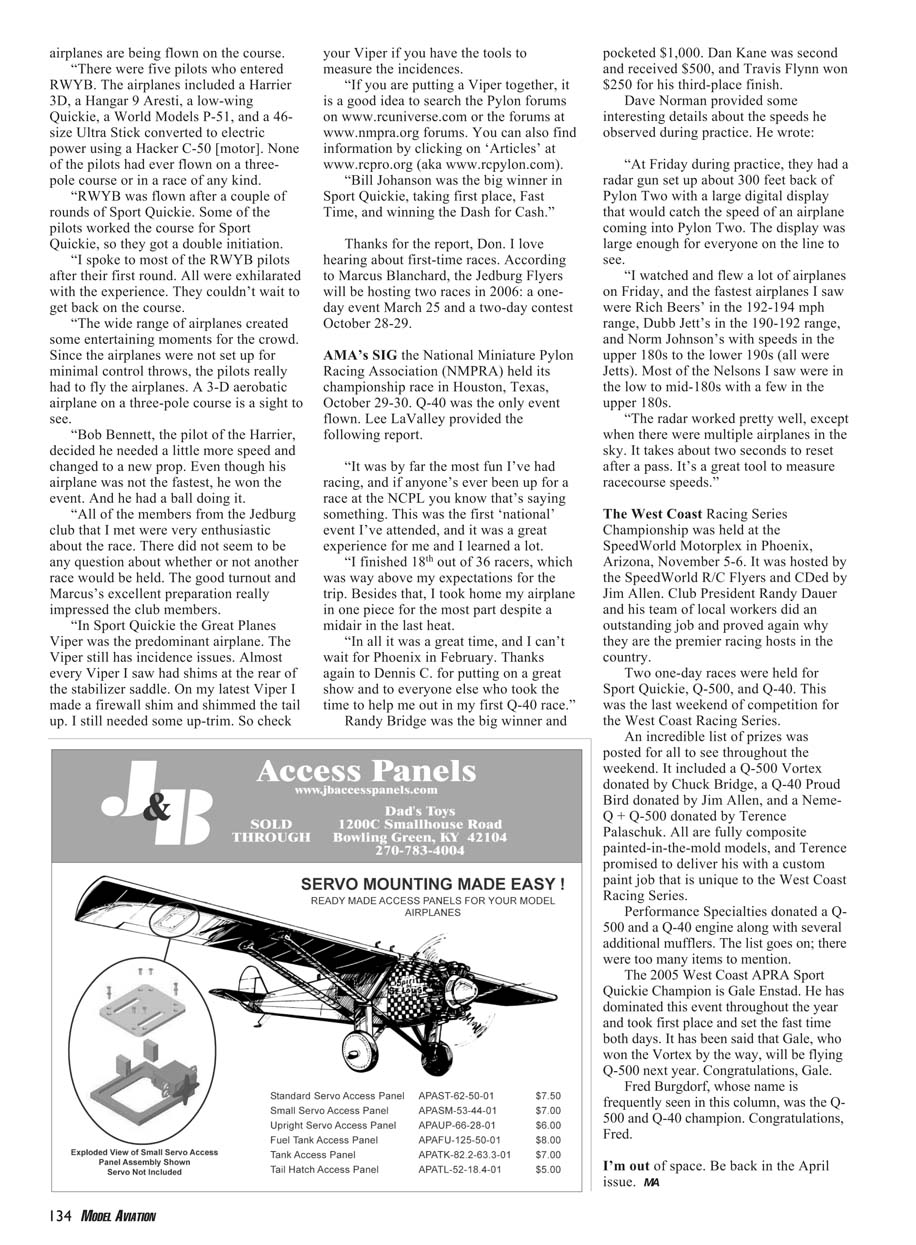
The championship was held at the SpeedWorld Motoplex in Phoenix, Arizona, November 5–6. It was hosted by the SpeedWorld R/C Flyers and CD'd by Jim Allen. Club President Randy Dauer and his team of local workers did an outstanding job and proved again why they are the premier pylon hosts in the country.
Two one-day races were held for Sport Quickie, Q-500, and Q-40. This was the last weekend of competition for the West Coast Racing Series.
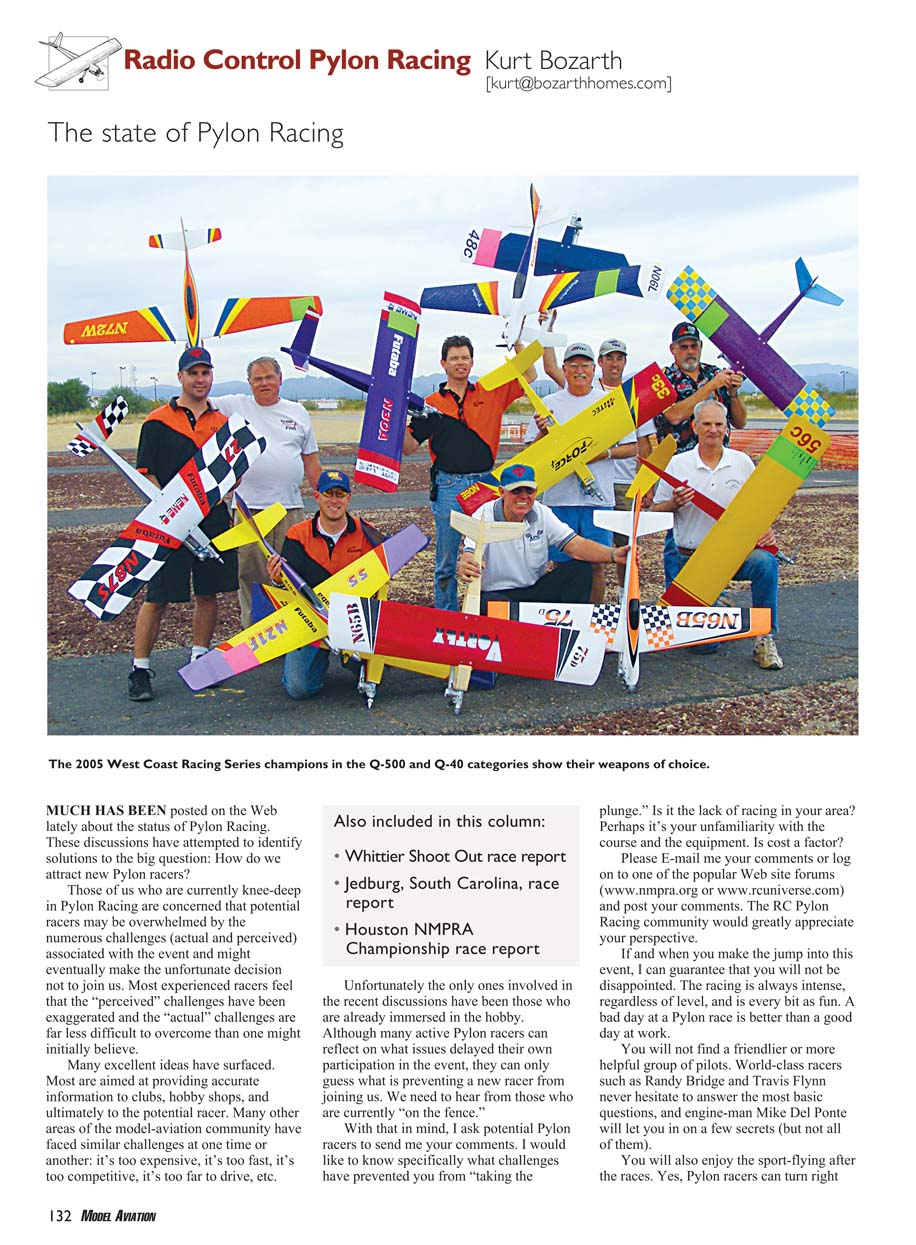
An incredible list of prizes was posted for all to see throughout the weekend. It included a Q-500 Vortex donated by Chuck Bridge, a Q-40 Proud Bird donated by Jim Allen, and a Neme-Q+ Q-500 donated by Terrence Palaschuk. All are fully composite, painted-in-the-mold models, and Terrence promised to deliver his with a custom paint job that is unique to the West Coast Racing Series.
Performance Specialties donated a Q-500 and a Q-40 engine along with several additional mufflers. The list goes on; there were too many items to mention.
The 2005 West Coast APRA Sport Quickie Champion is Gale Enstad. He has dominated this event throughout the year and took first place and set the fast time both days. It has been said that Gale, who won the Vortex by the way, will be flying Q-500 next year. Congratulations, Gale.
Fred Burgdorf was the Q-500 and Q-40 champion. Congratulations, Fred.
I'm out of space. Be back in the April issue. MA
Transcribed from original scans by AI. Minor OCR errors may remain.

