
Radio Control Pylon Racing
Kurt Bozarth <[email protected]>
Kurt receives a new Vortex
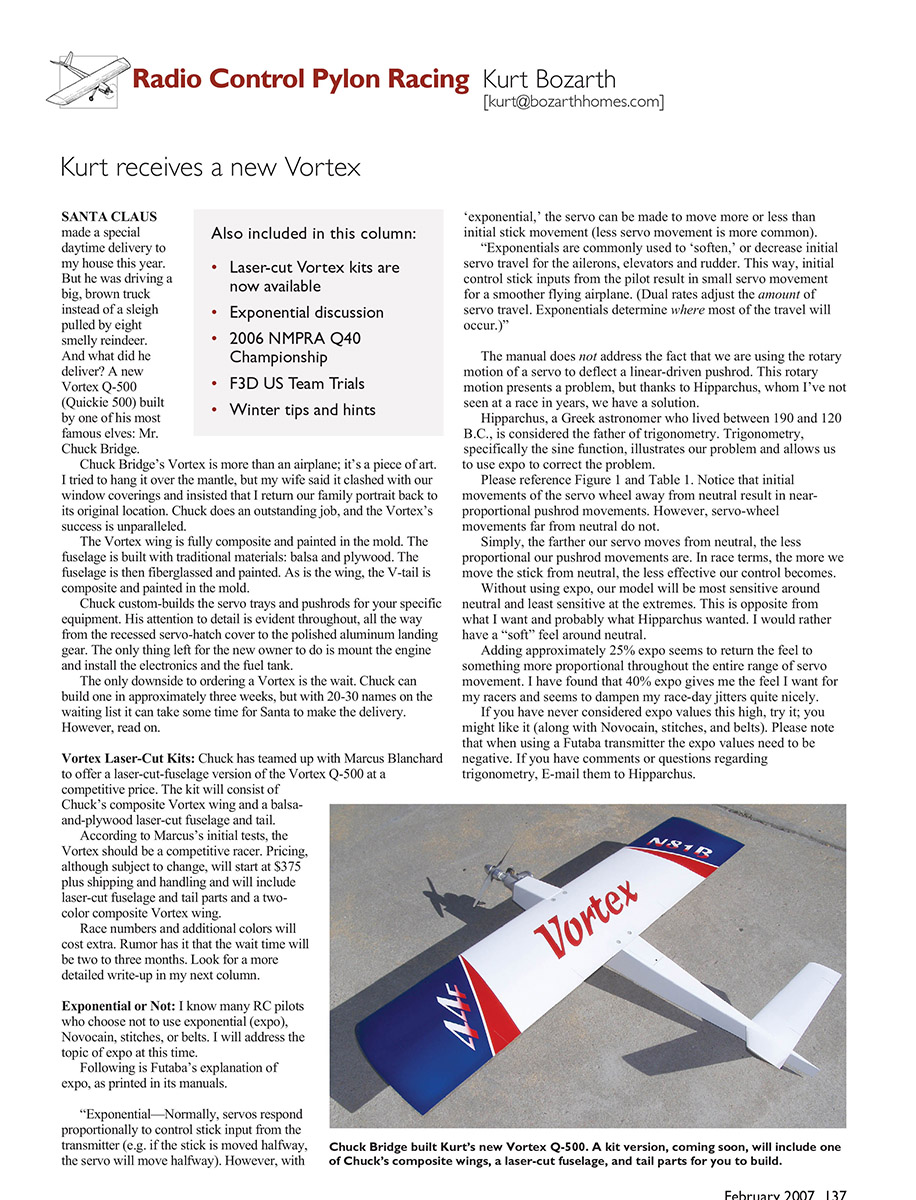
Santa Claus made a special daytime delivery to my house this year. But he was driving a big, brown truck instead of a sleigh pulled by eight smelly reindeer. And what did he deliver? A new Vortex Q-500 (Quickie 500) built by one of his most famous elves: Mr. Chuck Bridge.
Chuck Bridge’s Vortex is more than an airplane; it’s a piece of art. I tried to hang it over the mantle, but my wife said it clashed with our window coverings and insisted that I return our family portrait to its original location. Chuck does an outstanding job, and the Vortex’s success is unparalleled.
The Vortex wing is fully composite and painted in the mold. The fuselage is built with traditional materials: balsa and plywood, then fiberglassed and painted. The V-tail is composite and painted in the mold as well. Chuck custom-builds the servo trays and pushrods for your specific equipment. His attention to detail is evident throughout, from the recessed servo-hatch cover to the polished aluminum landing gear. The only thing left for the new owner to do is mount the engine, install the electronics, and fit the fuel tank.
The only downside to ordering a Vortex is the wait. Chuck can build one in approximately three weeks, but with 20-30 names on the waiting list it can take some time for Santa to make the delivery. However, read on.
Also included in this column:
- Laser-cut Vortex kits are now available
- Exponential discussion
- 2006 NMPRA Q40 Championship
- F3D US Team Trials
- Winter tips and hints
Vortex Laser-Cut Kits
Chuck has teamed up with Marcus Blanchard to offer a laser-cut-fuselage version of the Vortex Q-500 at a competitive price. The kit will consist of Chuck’s composite Vortex wing and a balsa-and-plywood laser-cut fuselage and tail. According to Marcus’s initial tests, the Vortex should be a competitive racer.
Pricing, although subject to change, will start at $375 plus shipping and handling and will include laser-cut fuselage and tail parts and a two-color composite Vortex wing. Race numbers and additional colors will cost extra. Rumor has it that the wait time will be two to three months. Look for a more detailed write-up in my next column.
Exponential or Not
I know many RC pilots who choose not to use exponential (expo), Novocain, stitches, or belts. I will address the topic of expo at this time.
Following is Futaba’s explanation of expo, as printed in its manuals:
“Exponential—Normally, servos respond proportionally to control stick input from the transmitter (e.g., if the stick is moved halfway, the servo will move halfway). However, with ‘exponential,’ the servo can be made to move more or less than initial stick movement (less servo movement is more common).
“Exponentials are commonly used to ‘soften,’ or decrease initial servo travel for the ailerons, elevators and rudder. This way, initial control stick inputs from the pilot result in small servo movement for a smoother flying airplane. (Dual rates adjust the amount of servo travel. Exponentials determine where most of the travel will occur.)”
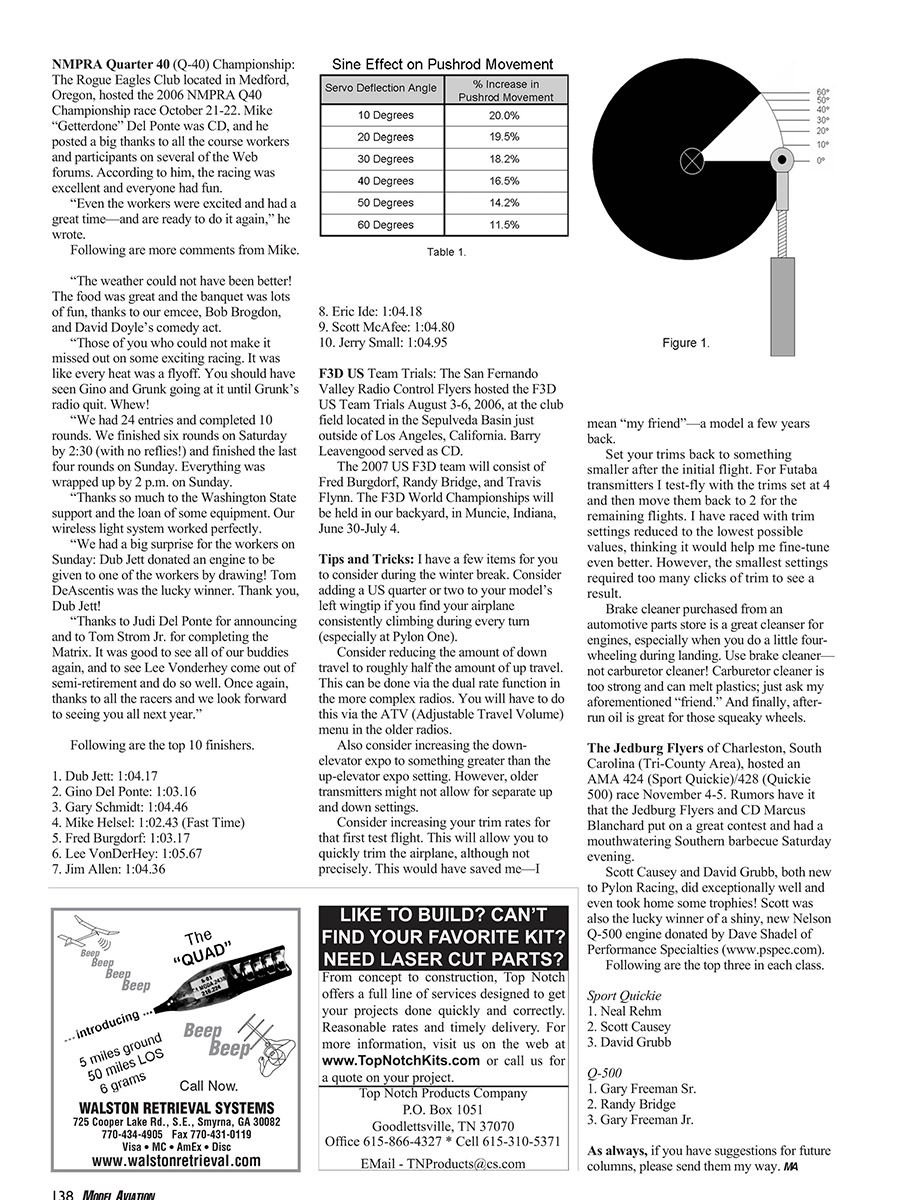
The manual does not address the fact that we are using the rotary motion of a servo to deflect a linear-driven pushrod. This rotary motion presents a problem, but thanks to Hipparchus, whom I’ve not seen at a race in years, we have a solution.
Hipparchus, a Greek astronomer who lived between 190 and 120 B.C., is considered the father of trigonometry. Trigonometry, specifically the sine function, illustrates our problem and allows us to use expo to correct the problem. Please reference Figure 1 and Table 1. Notice that initial movements of the servo wheel away from neutral result in near-proportional pushrod movements. However, servo-wheel movements far from neutral do not. Simply put, the farther our servo moves from neutral, the less proportional our pushrod movements are. In race terms, the more we move the stick from neutral, the less effective our control becomes. Without using expo, our model will be most sensitive around neutral and least sensitive at the extremes. This is opposite from what I want and probably what Hipparchus wanted. I would rather have a “soft” feel around neutral.
Adding approximately 25% expo seems to return the feel to something more proportional throughout the entire range of servo movement. I have found that 40% expo gives me the feel I want for my racers and seems to dampen my race-day jitters quite nicely.
If you have never considered expo values this high, try it; you might like it (along with Novocain, stitches, and belts). Please note that when using a Futaba transmitter the expo values need to be negative. If you have comments or questions regarding trigonometry, e-mail them to Hipparchus.
NMPRA Quarter 40 (Q-40) Championship
The Rogue Eagles Club, located in Medford, Oregon, hosted the 2006 NMPRA Q40 Championship race October 21-22. Mike "Gettlerone" Del Ponte was CD, and he posted a big thanks to all the course workers and participants on several of the web forums. According to him, the racing was excellent and everyone had fun.
"Even the workers were excited and had a great time—and are ready to do it again," he wrote.
Following are more comments from Mike:
"The weather could not have been better! The food was great and the banquet was lots of fun, thanks to our emcee, Bob Brogdon, and David Doyle's comedy act.
"Those of you who could not make it missed out on some exciting racing. It was like every heat was a flyoff. You should have seen Gino and Grunk going at it until Grunk's radio quit. Whew!
"We had 24 entries and completed 10 rounds. We finished six rounds on Saturday by 2:30 (with no refiles!) and finished the last four rounds on Sunday. Everything was wrapped up by 2 p.m. on Sunday.
"Thanks so much to the Washington State support and the loan of some equipment. Our wireless light system worked perfectly.
"We had a big surprise for the workers on Sunday: Dub Jett donated an engine to be given to one of the workers by drawing! Tom DeSantis was the lucky winner. Thank you, Dub Jett!
"Thanks to Judi Del Ponte for announcing and to Tom Strom Jr. for completing the Matrix. It was good to see all of our buddies again, and to see Lee VonDerHey come out of semi-retirement and do so well. Once again, thanks to all the racers and we look forward to seeing you all next year."
Following are the top 10 finishers:
- Dub Jett: 1:04.17
- Gino Del Ponte: 1:03.16
- Gary Schmidt: 1:04.46
- Mike Hessel: 1:02.43 (Fast Time)
- Fred Burgdorf: 1:03.17
- Lee VonDerHey: 1:05.67
- Jim Allen: 1:04.36
- Eric Ide: 1:04.18
- Scott McAfee: 1:04.80
- Jerry Small: 1:04.95
F3D US Team Trials
The San Fernando Valley Radio Control Flyers hosted the F3D US Team Trials August 3-6, 2006, at the club field located in the Sepulveda Basin just outside Los Angeles, California. Barry Leavengood served as CD.
The 2007 US F3D team will consist of Fred Burgdorf, Randy Bridge, and Travis Flynn. The F3D World Championships will be held in our backyard, in Muncie, Indiana, June 30–July 4.
Tips and Tricks
Consider the following items during the winter break:
- Add a US quarter or two to your model's left wingtip if you find your airplane consistently climbing during every turn (especially at Pylon One).
- Reduce the amount of down travel to roughly half the amount of up travel. This can be done via the dual rate function in the more complex radios. On older radios you will have to use the ATV (Adjustable Travel Volume) menu.
- Increase the down-elevator expo to something greater than the up-elevator expo setting. Note that older transmitters might not allow for separate up and down settings.
- Increase your trim rates for that first test flight to allow quick trimming (though not precise). After the initial flight, set trims back to smaller values. For Futaba transmitters I test-fly with trims set at 4, then move them back to 2 for remaining flights. Very small trim settings can require too many clicks to see a result.
- Use brake cleaner (from an automotive parts store) as a great cleanser for engines, especially after doing a little four-wheeling during landing. Use brake cleaner—not carburetor cleaner. Carburetor cleaner is too strong and can melt plastics.
- After-run oil is great for those squeaky wheels.
The Jedburg Flyers of Charleston, South Carolina
The Jedburg Flyers of Charleston, South Carolina (Tri-County Area), hosted an AMA 424 (Sport Quickie)/428 (Quickie 500) race November 4-5. Rumor has it that the Jedburg Flyers and CD Marcus Blanchard put on a great contest and had a mouthwatering Southern barbecue Saturday evening.
Scott Causey and David Grubb, both new to pylon racing, did exceptionally well and even took home some trophies! Scott was also the lucky winner of a shiny new Nelson Q-500 engine donated by Dave Shade of Performance Specialties (www.pspec.com).
Sport Quickie
- Neal Reich
- Scott Causey
- David Grubb
Q-500
- Gary Freeman Sr.
- Randy Bridge
- Gary Freeman Jr.
As always, if you have suggestions for future columns, please send them my way.
Transcribed from original scans by AI. Minor OCR errors may remain.

