
Radio Control Pylon Racing
Kurt Bozarth [[email protected]]
Jason Shulman reports on the Cliff Telford Memorial Race
The Remote Control Association of Central Florida (RCACF) hosted a Pylon Race December 1–3, 2006, at its Tangerine Field located just outside Apopka. Jason Shulman was kind enough to send me the following race write-up.
In case you’ve been stuck in a biosphere for the past decade and missed some of Jason’s accomplishments, the short list follows. He is a four-time US F3A (RC Aerobatics) team member, a 2004 AMA Nats F3A Champion, and a 2006 AMA Nats F3A third-place finisher. Jason has raced Formula 1, Quickie 500 (Q-500), and Quarter 40 (Q-40) almost 10 years ago.
I hope we hooked a big fish and Jason will continue to race with us! He wrote:
“Every once in a while I’ll get the itch to post online about a contest that is close to home. Now that I am back in Florida, I figured I would go out to the Tangerine contest for Pylon to help and take some pictures and write a little report.
“This is now known as the Cliff Telford Memorial Tangerine contest. After watching for the first two practice runs I got the itch to try racing again.
“I want to thank Gary Freeman Sr., Gary Freeman Jr., and Marcus Blanchard here. Without the help of these three, I wouldn’t have raced this weekend. Thanks to Gary Sr. for loaning me the ‘beater’ airplane, Marcus for loaning me his dirt-covered engine (he promised it wasn’t crashed), and Gary Jr. for all his help and calling. It felt like old times again—which was a decade ago.
“I was just going to race for the fun of it, staying out of everyone’s way as I was using borrowed equipment. This plan of mine was reinforced when, during my second practice run, Ray Brown and Bryan Blanchard had a midair behind me. I didn’t want to have to replace the equipment I was borrowing.
“Friday was one of those December days here in Florida when it’s about 85° and sunny, but the wind was about 15–20 mph. After the first day of racing, it was just as I remembered.
“There were a few crashes, midairs, and near misses. I saw one airplane fly through the trees, another fly into the ground, and I almost ended up in the ground myself after getting caught in some dirty air.
“There was some great racing going on. J.D. Glass started just where he ended the first day, tied for first with fast time. Stephen Vaclav was tied with him and Gary Jr. was just one point down in second. I was in seventh after the first four rounds. It’s just as much fun as I remembered, and I even got myself into the mix a few times.
“I was calling for a newcomer to racing, Blake Hilson, in 424 (Q-40) and we were having so much fun. Although I made a few mistakes, he held his own and I think he will be back soon.
“This was the first weekend that I had ever seen 424 races. I originally thought about entering this class, but after watching these and the 428s (Q-500), I couldn’t justify flying 424.
“Gary Jr. did a random tach check to make sure everyone was on an even playing field. Everyone passed.
“It’s great to see the ‘kids’ who are getting into or already involved in racing: Bryan Blanchard, Blake Hilson, Matthew Fehling, J.D. Glass, Jon Purdue, and Charlie Cline. They are consistent fliers and the next wave of racers to keep it all going fast and turning left.
“Saturday was much calmer and just as warm. In 428 J.D. Glass and Stephen Vaclav were perfect through five rounds. Stephen made it through his last heat with the win. JD ended up in second in his sixth round and tied Gary Jr. for second.
“In the flyoff Gary and J.D. were back and forth. J.D. had a cut early and we all thought it was over, until Gary cut. Then it was a race again. That is until J.D. cut out. It was a good race nonetheless.
“My highlight of the event was my last heat. Vern Smith and I were the only ones racing in our heat. I asked him to go easy on me and he said I had nothing to worry about ’cause if it was close he would end up with a cut.
“Well, after nine intense laps of back-and-forth racing I overpulled my line going around Pylon Three to One and botched it.
“Gary also reminded me that I still had an airplane and engine to return in the same condition as I got them. All in all, I finished in fourth place. I didn't break any speed records, but I had a blast. I ordered a couple of Hurricanes from Dan Kane, so I guess I'll try it again.
“It was a great weekend and I am glad that I gave it another go. I think I can speak for all the contestants and say thank you to Gary Freeman Sr., Nancy Telford, and the whole RCACF crew for putting on a great race weekend.”
Final Q-500 results:
- Stephen Vaclav
- Gary Freeman Jr.
- J.D. Glass (fast time: 1:07.41)
- Jason Shulman
- Tom Scott
- Jeryl Smith
- Matt Fehling
- Mario Travieso
- Brian Wilber
- Bill Johanson
Final Q-40 results:
- Adam Grim
- Barry West (fast time: 1:45.12)
- Doug Bebensee
- James Creech
- Lin Bradley
- Blake Hilson
- Jack Fehling
Western Pylon Racing Series
Scott McAfee is a national Pylon Racing competitor and has been instrumental in the success of the Western Pylon Racing Series. Between driving to races, flying to races, practicing for races, building, racing, and working (not necessarily in that order), he somehow found the time to produce an excellent piece on the event. Thank you very much, Scott!
He wrote:
“As more people discover that RC Pylon Racing is the best value in all of motorsports in terms of mph per dollar, Pylon Racing is experiencing a resurgence in popularity.
“As racing grows, so does the caliber of racing and the excitement it produces. Few things have contributed as much to the renewed popularity of racing as the highly successful Western Pylon Racing Series.
“The 2006 Western Pylon Racing Series consisted of seven race weekends with 11 races in each of APRA Sport Quickie, AMA 428 (Quickie 500), and AMA 422 (Quarter 40) classes. The races were held at SpeedWorld in Phoenix, AZ; Sepulveda Basin in CA; and Medford, OR.
“Originally conceived and promoted by Jim Allen and Barry Leavengood as a means to coordinate racing schedules in the western US, the Western Series has, in its second year, proven to be more successful than ever projected.
“Several factors have contributed to the success of the series. Foremost has been the tremendous sponsorship received from some very generous companies.
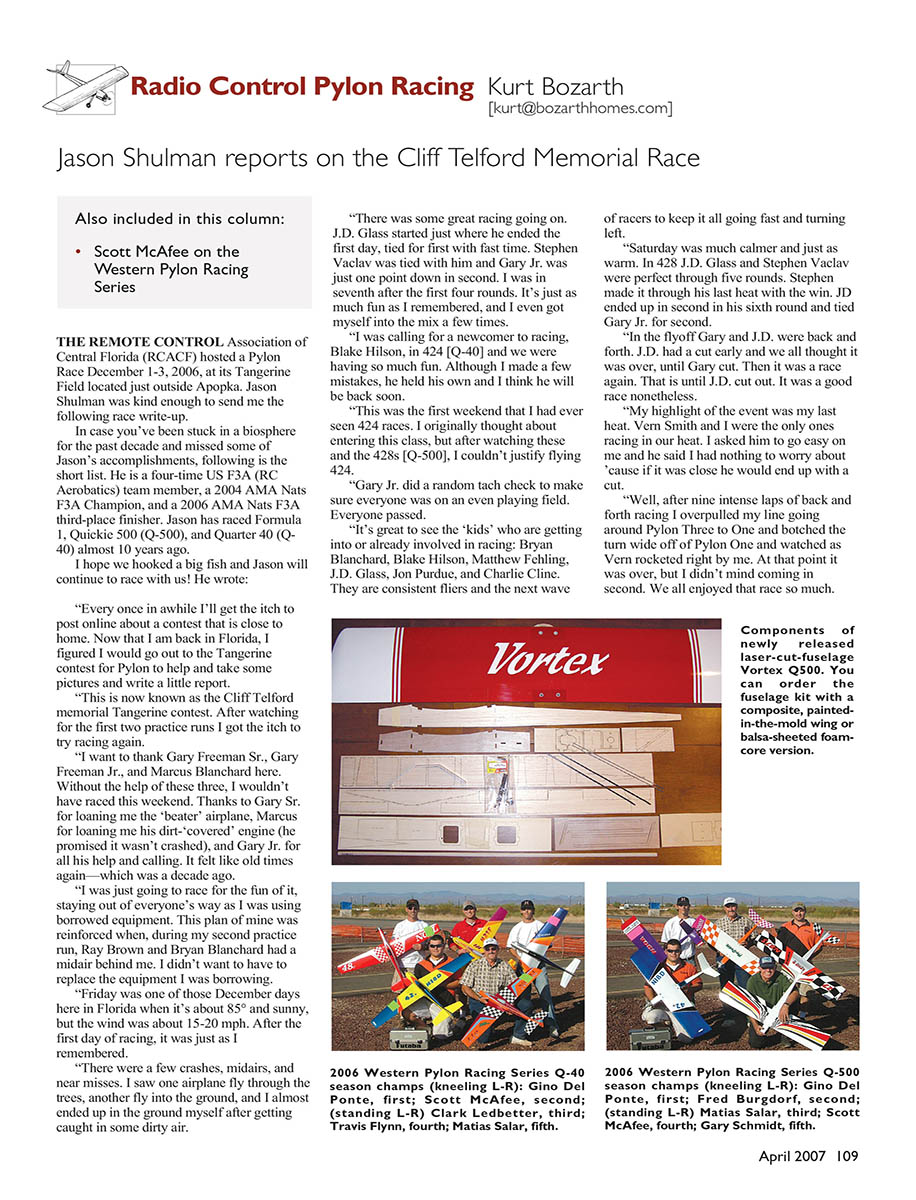
“Landing Products/APC Props contributed the seed and primary funding for the series. Airplanes were contributed by Fly Fast Composites (Meneq-Q+), Fast Lane Graphics (fully built Jim Allen Proud Bird), Vortex Racing (built by Chuck Bridge Vortex), H&M Racing Products (Miss Candace kit), and Lee Ullinger Models (RTF Edge 540).
“Dave Shadel of Performance Specialties contributed a Nelson racing engine, and additional funds and merchandise were contributed by Tony and Donna Pacini of Valley Hobby Shop, Super-T RC, Barry Leavengood at Job Cost Systems, and DarrolCady.com. Because of the generosity of these folks, there were thousands of dollars of the most desirable prizes that any Pylon racer would compete for a chance to win.
“The second factor was the coordination of the racing schedule in this part of the country. This meant that there was essentially a race a month and that there were no races on the same date or on back-to-back weekends. This raised the attendance and made it easier to plan to attend as many races as possible.
“The races were two one-day contests for all three classes, as the racers preferred this over one two-day race. This allowed them to miss a day if their schedules only allowed one day on that weekend, or if they crashed on one day they would still be able to do well the next.
“Third, the series had an innovative scoring system, which counted the best eight race results out of the 11 races. This encourages racers to attend as many races as possible but allows for a racer to still be competitive in the season’s points if he or she misses races or has some bad luck at a race or two. This really kept people engaged in the race for season points and produced an exciting race at season’s end for the prizes.
“Fourth, the series encouraged the host clubs to put forth their best efforts as the races were well attended. Over 150 people raced in series races and it was common to see 50 or more entries at each race. Having so many entrants meant that the clubs were ensured a profitable contest.
“Assured of the high turnouts that the series produced, clubs were encouraged to develop better race equipment and better-trained workers. Further, the clubs could share information and ideas on the race operation. The results were dramatic.
“The series races were incredibly well run. Even with the high turnouts and three classes being run, it was a regular occurrence to get in five rounds of racing each day.
“Fifth, the quality of the racing was top-notch. With the fabulous prizes available, there was none of the sandbagging often found at ‘local’ races where racers use old beat-up equipment and save their ‘good’ stuff for the important races. All the races were important.
“Most of the racers competing in the series set personal best times at the series races. In fact, a new record in Q-500 and the lowest times recorded in the country in all classes were recorded at Western Series races.
“The quality of racing was also enhanced as the result of the progression of many racers in the series. We have seen many racers step up from APRA to be competitive in the AMA classes as well as some dramatic improvement from many AMA-class racers due to the incentive the series provided. It got to the point where every race was a tough one for even the best pilots.
“The weekend of November 4–5 was the final race of the Western Pylon Racing Series for 2006. The race was held at the fabulous SpeedWorld complex in north Phoenix, AZ. The competition was intense because this race would decide the race for season championship points, the thousands of dollars of prizes, and the all-important bragging rights that went to the winners.
“The stakes were high and the excitement level was even higher, as after accumulating points over the previous nine series races, there were many people who were in contention for the top spots.
“The standings coming into this weekend were not only close, but many people who had no-score races could make big jumps in points as compared to people who already had scores for eight races. Thus there were no ‘sure bets’ on who would be the season’s champions, although Jim Padelt had built up a comfortable lead in APRA with his outstanding performance and 100% attendance throughout the year.
“There was no doubt that the season’s points were on everyone’s minds, as well as the individual races. Thus the racing was extremely fast and hard.
“The best example of how hard the racing was was when Travis Flynn, who was presented a one-of-a-kind Neme-Q+ for his win in last year’s series, spent most of Saturday night readying this awesome new airplane to fly on Sunday after he lost his airplane earlier when he clipped Pylon Three.
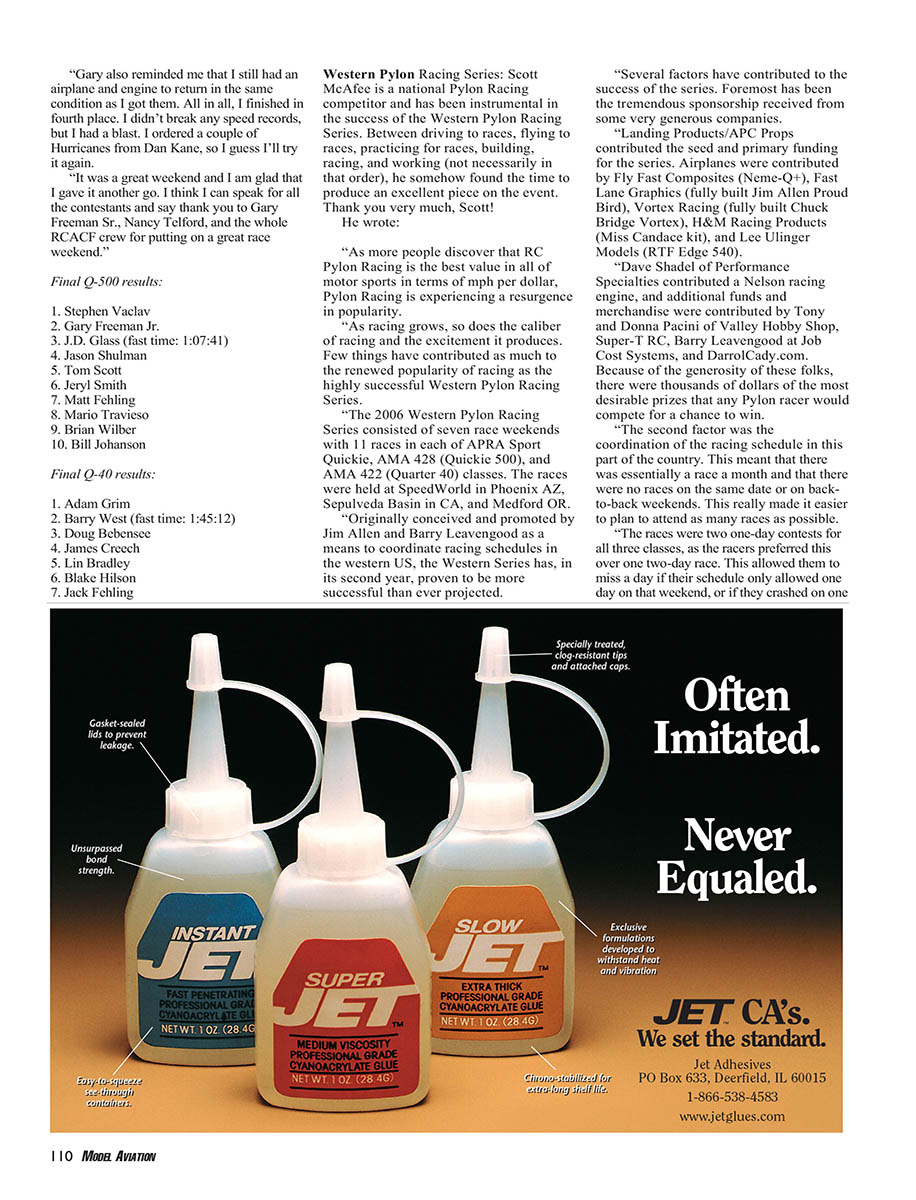
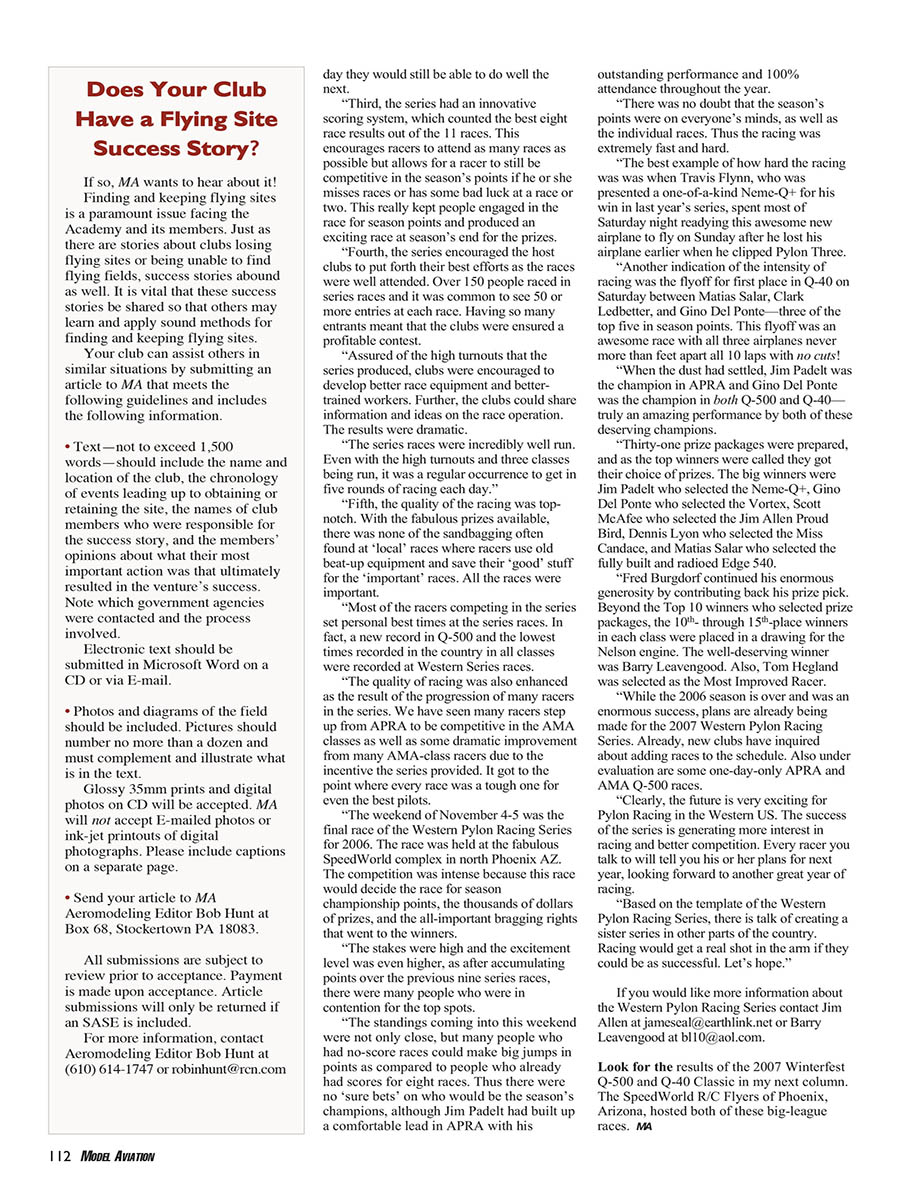
“Another indication of the intensity of racing was the flyoff for first place in Q-40 on Saturday between Matias Salar, Clark Ledbetter, and Gino Del Ponte—three of the top five in season points. This flyoff was an awesome race with all three airplanes never more than feet apart all 10 laps with no cuts!
“When the dust had settled, Jim Padelt was the champion in APRA and Gino Del Ponte was the champion in both Q-500 and Q-40—truly an amazing performance by both of these deserving champions.
“Thirty-one prize packages were prepared, and as the top winners were called they got their choice of prizes. The big winners were Jim Padelt who selected the Neme-Q+, Gino Del Ponte who selected the Vortex, Scott McAfee who selected the Jim Allen Proud Bird, Dennis Lyon who selected the Miss Candace, and Matias Salar who selected the fully built and radioed Edge 540.
“Fred Burgdorf continued his enormous generosity by contributing back his prize pick. Beyond the top 10 winners who selected prize packages, the 10th- through 15th-place winners in each class were placed in a drawing for the Nelson engine. The well-deserving winner was Barry Leavengood. Also, Tom Hegland was selected as the Most Improved Racer.
“While the 2006 season is over and was an enormous success, plans are already being made for the 2007 Western Pylon Racing Series. Already, new clubs have inquired about adding races to the schedule. Also under evaluation are some one-day-only APRA and AMA Q-500 races.
“Clearly, the future is very exciting for flying Pylon Racing in the Western US. The success of the series is generating more interest in racing and better competition. Every racer you talk to will tell you his or her plans for next year, looking forward to another great year of racing.
“Based on the template of the Western Pylon Racing Series, there is talk of creating a sister series in other parts of the country. Racing would get a real shot in the arm if they could be as successful. Let’s hope.”
If you would like more information about the Western Pylon Racing Series contact Jim Allen at [email protected] or Barry Leavengood at [email protected].
Look for the results of the 2007 Winterfest Q-500 and Q-40 Classic in my next column. The SpeedWorld RC Flyers of Phoenix, Arizona, hosted both of these big-league races. MA
Transcribed from original scans by AI. Minor OCR errors may remain.

