
Radio Control Pylon Racing - 2007/06
Kurt Bozarth [[email protected]]
Winterfest 2007 Q-500 race report
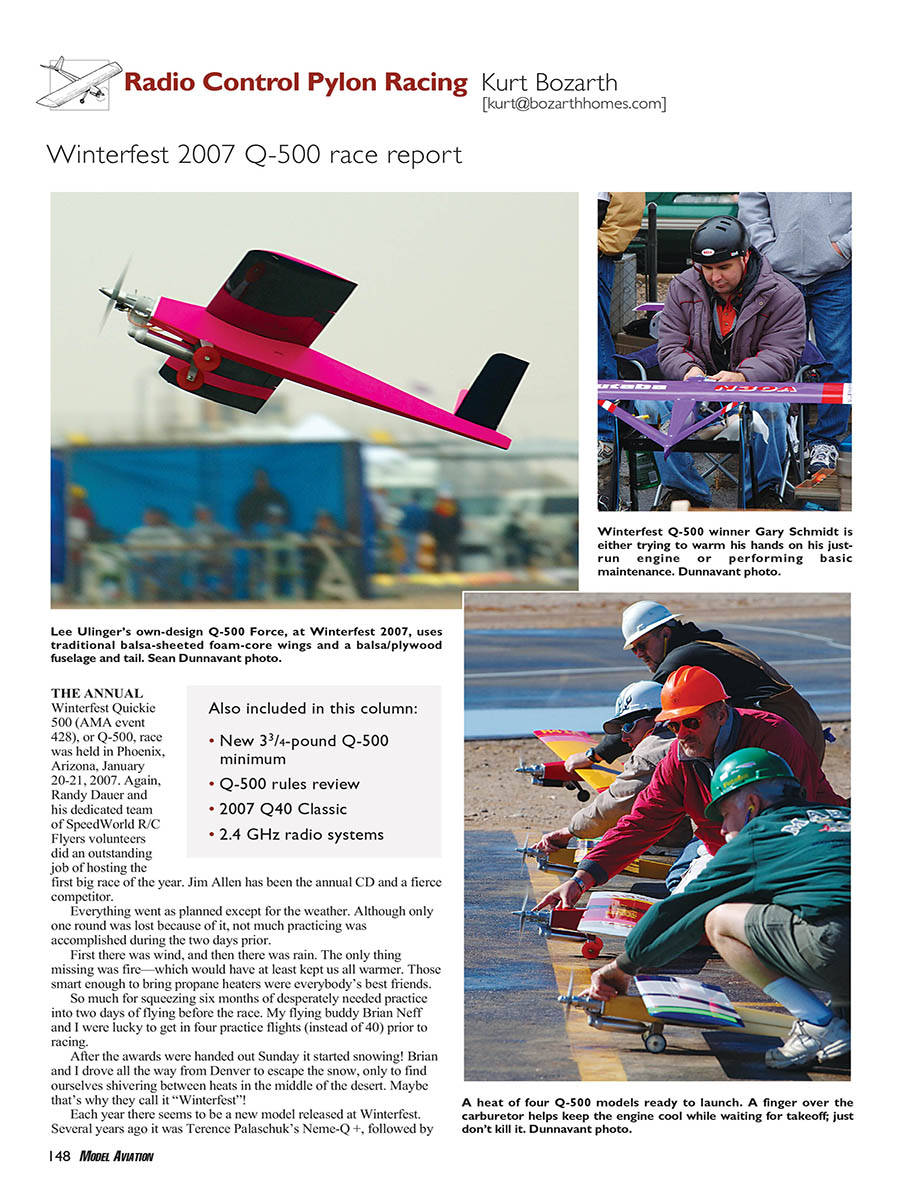
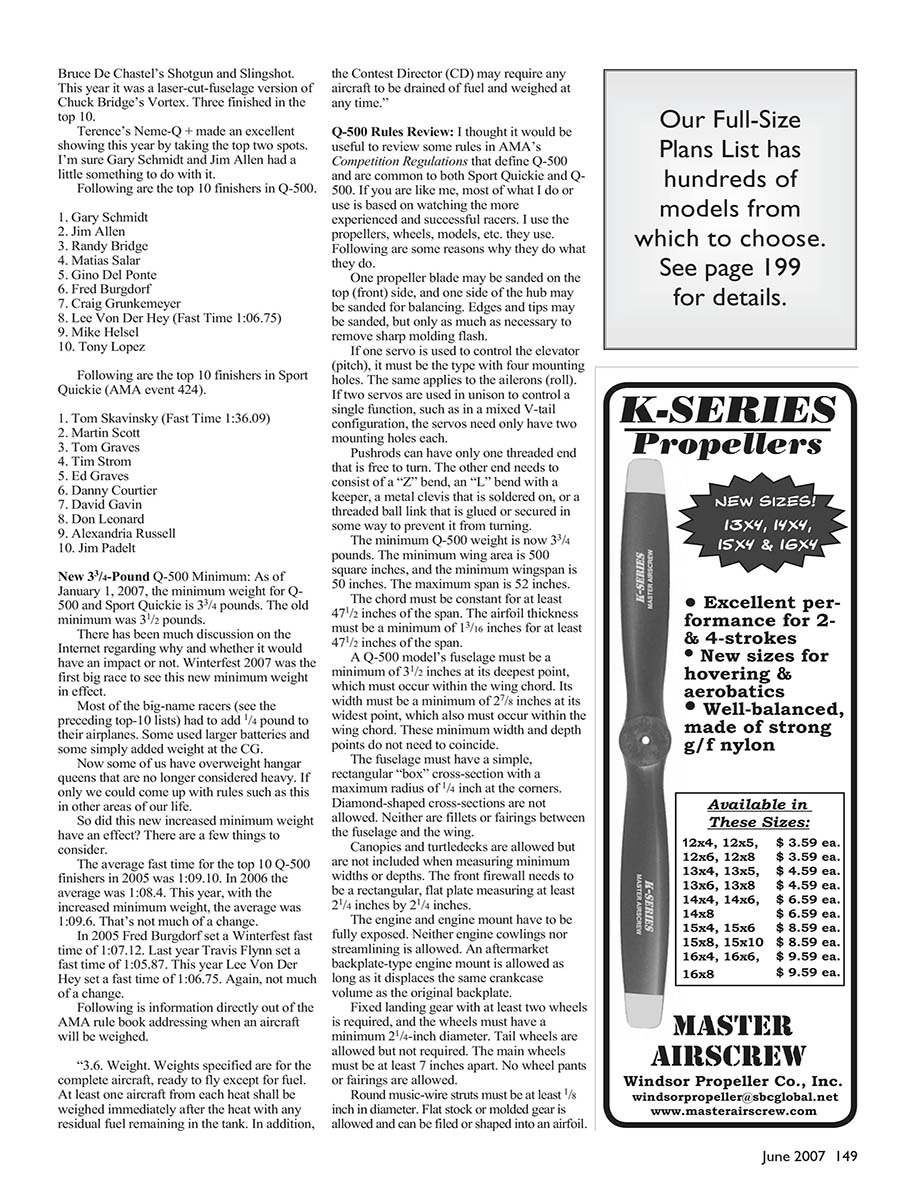
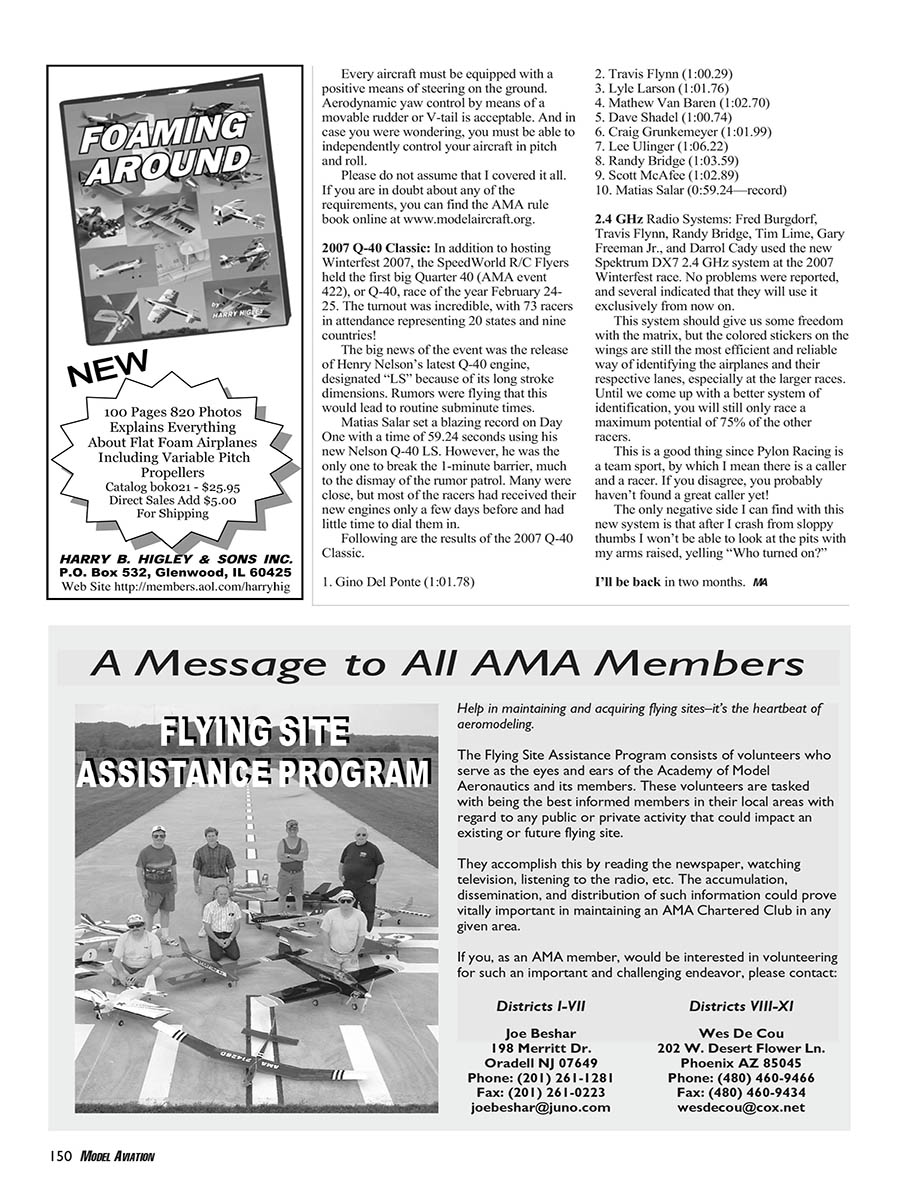
The annual Winterfest Quickie 500 (AMA event 428), or Q-500, race was held in Phoenix, Arizona, January 20–21, 2007. Again, Randy Dauer and his dedicated team of SpeedWorld R/C Flyers volunteers did an outstanding job hosting the first big race of the year. Jim Allen has been the annual CD and a fierce competitor.
Also included in this column:
- New 3 3/4-pound Q-500 minimum
- Q-500 rules review
- 2007 Q-40 Classic
- 2.4 GHz radio systems
Everything went as planned except for the weather. Although only one round was lost because of it, not much practicing was accomplished during the two days prior. First there was wind, and then there was rain. The only thing missing was fire—which would have at least kept us all warmer. Those smart enough to bring propane heaters were everybody’s best friends. So much for squeezing six months of desperately needed practice into two days of flying before the race. My flying buddy Brian Neff and I were lucky to get in four practice flights (instead of 40) prior to racing. After the awards were handed out Sunday it started snowing! Brian and I drove all the way from Denver to escape the snow, only to find ourselves shivering between heats in the middle of the desert. Maybe that’s why they call it “Winterfest”!
Each year there seems to be a new model released at Winterfest. Several years ago it was Terence Palaschuk’s Neme-Q+, followed by Bruce De Chastel’s Shotgun and Slingshot. This year it was a laser-cut-fuselage version of Chuck Bridge’s Vortex. Three finished in the top 10. Terence’s Neme-Q+ made an excellent showing this year by taking the top two spots. I’m sure Gary Schmidt and Jim Allen had a little something to do with it. Following are the top 10 finishers in Q-500.
- Gary Schmidt
- Jim Allen
- Randy Bridge
- Matias Salar
- Gino Del Ponte
- Fred Burgdorf
- Craig Grunkemeyer
- Lee Von Der Hey (Fast Time 1:06.75)
- Mike Helsel
- Tony Lopez
Following are the top 10 finishers in Sport Quickie (AMA event 424).
- Tom Skavinsky (Fast Time 1:36.09)
- Martin Scott
- Tom Graves
- Tim Strom
- Ed Graves
- Danny Courtier
- David Gavin
- Don Leonard
- Alexandria Russell
- Jim Padelt
New 3 3/4-Pound Q-500 Minimum
As of January 1, 2007, the minimum weight for Q-500 and Sport Quickie is 3 3/4 pounds. The old minimum was 3 1/2 pounds. There has been much discussion on the Internet regarding why and whether it would have an impact or not. Winterfest 2007 was the first big race to see this new minimum weight in effect. Most of the big-name racers (see the preceding top-10 lists) had to add 1/4 pound to their airplanes. Some used larger batteries and some simply added weight at the CG. Now some of us have overweight hangar queens that are no longer considered heavy. If only we could come up with rules such as this in other areas of our life.
So did this new increased minimum weight have an effect? There are a few things to consider. The average fast time for the top 10 Q-500 finishers in 2005 was 1:09.10. In 2006 the average was 1:08.4. This year, with the increased minimum weight, the average was 1:09.6. That’s not much of a change. In 2005 Fred Burgdorf set a Winterfest fast time of 1:07.12. Last year Travis Flynn set a fast time of 1:05.87. This year Lee Von Der Hey set a fast time of 1:06.75. Again, not much of a change.
Following is information directly out of the AMA rule book addressing when an aircraft will be weighed:
3.6. Weight. Weights specified are for the complete aircraft, ready to fly except for fuel. At least one aircraft from each heat shall be weighed immediately after the heat with any residual fuel remaining in the tank. In addition, the Contest Director (CD) may require any aircraft to be drained of fuel and weighed at any time.
Q-500 Rules Review
I thought it would be useful to review some rules in AMA’s Competition Regulations that define Q-500 and are common to both Sport Quickie and Q-500. If you are like me, most of what I do or use is based on watching the more experienced and successful racers. I use the propellers, wheels, models, etc. they use. Following are some reasons why they do what they do.
One propeller blade may be sanded on the top (front) side, and one side of the hub may be sanded for balancing. Edges and tips may be sanded, but only as much as necessary to remove sharp molding flash.
If one servo is used to control the elevator (pitch), it must be the type with four mounting holes. The same applies to the ailerons (roll). If two servos are used in unison to control a single function, such as in a mixed V-tail configuration, the servos need only have two mounting holes each.
Pushrods can have only one threaded end that is free to turn. The other end needs to consist of a "Z" bend, an "L" bend with a keeper, a metal clevis that is soldered on, or a threaded ball link that is glued or secured in some way to prevent it from turning.
The minimum Q-500 weight is now 3 3/4 pounds. The minimum wing area is 500 square inches, and the minimum wingspan is 50 inches. The maximum span is 52 inches.
The chord must be constant for at least 47 1/2 inches of the span. The airfoil thickness must be a minimum of 1 3/16 inches for at least 47 1/2 inches of the span.
A Q-500 model’s fuselage must be a minimum of 3 1/2 inches at its deepest point, which must occur within the wing chord. Its depth must be a minimum of 2 7/8 inches at its widest point, which also must occur within the wing chord. These minimum width and depth points do not need to coincide.
The fuselage must have a simple, rectangular "box" cross-section with a maximum radius of 1/4 inch at the corners. Diamond-shaped cross-sections are not allowed. Neither are fillets or fairings between the fuselage and the wing.
Canopies and turtledecks are allowed but are not included when measuring minimum widths or depths. The front firewall needs to be a rectangular, flat plate measuring at least 2 1/4 inches by 2 1/4 inches.
The engine and engine mount must be fully exposed. Neither engine cowlings nor streamlining is allowed. An aftermarket backplate-type engine mount is allowed as long as it displaces the same crankcase volume as the original backplate.
Fixed landing gear with at least two wheels is required, and the wheels must have a minimum 2 1/4-inch diameter. Tail wheels are allowed but not required. The main wheels must be at least 7 inches apart. No wheel pants or fairings are allowed.
Round music-wire struts must be at least 1/8 inch in diameter. Flat stock or molded gear is allowed and can be filed or shaped into an airfoil.
Every aircraft must be equipped with a positive means of steering on the ground. Aerodynamic yaw control by means of a movable rudder or V-tail is acceptable. And in case you were wondering, you must be able to independently control your aircraft in pitch and roll.
Please do not assume that I covered it all. If you are in doubt about any of the requirements, you can find the AMA rule book online at www.modelaircraft.org.
2007 Q-40 Classic
In addition to hosting Winterfest 2007, the SpeedWorld R/C Flyers held the first big Quarter 40 (AMA event 422), or Q-40, race of the year February 24–25. The turnout was incredible, with 73 racers in attendance representing 20 states and nine countries!
The big news of the event was the release of Henry Nelson’s latest Q-40 engine, designated “LS” because of its long-stroke dimensions. Rumors were flying that this would lead to routine sub-minute times.
Matias Salar set a blazing record on Day One with a time of 59.24 seconds using his new Nelson C-40 LS. However, he was the only one to break the 1-minute barrier, much to the dismay of the rumor patrol. Many were close, but most of the racers had received their new engines only a few days before and had little time to dial them in.
Following are the results of the 2007 Q-40 Classic.
- Gino Del Ponte (1:01.78)
- Travis Flynn (1:00.29)
- Lyle Larson (1:01.76)
- Mathew Van Baren (1:02.70)
- Dave Shadel (1:00.74)
- Craig Grunkemeyer (1:01.99)
- Lee Ulinger (1:06.22)
- Randy Bridge (1:03.59)
- Scott McAfee (1:02.89)
- Matias Salar (0:59.24 — record)
2.4 GHz Radio Systems
Fred Burgdorf, Travis Flynn, Randy Bridge, Tim Lime, Gary Freeman Jr., and Darrol Gady used the new Spektrum DX7 2.4 GHz system at the 2007 Winterfest race. No problems were reported, and several indicated that they will use it exclusively from now on.
This system should give us some freedom with the matrix, but the colored stickers on the wings are still the most efficient and reliable way of identifying airplanes and their respective lanes, especially at the larger races. Until we come up with a better system of identification, you will still only race a maximum potential of 75% of the other racers.
This is a good thing since pylon racing is a team sport, by which I mean there is a caller and a racer. If you disagree, you probably haven’t found a great caller yet!
The only negative side I can find with this new system is that after I crash from sloppy thumbs I won’t be able to look at the pits with my arms raised, yelling, “Who turned on?”
I’ll be back in two months. KB
Transcribed from original scans by AI. Minor OCR errors may remain.

