
Radio Control Pylon Racing
Scott Causey <[email protected]>
The Call to Racing
I heard a great quote during an NHRA (National Hot Rod Association) interview: "There are a million ways to lose, and only one way to win." Competitors are subject to numerous ways to make mistakes and hurt their chances of winning; making no mistakes is what it takes to win.
There are several keys to success in pylon racing and a number of ways to get there. In this column I explain techniques I have learned from the pylon pros to minimize frustration and maximize potential.
Preparation
Start in the workshop, assembling that new ARF or building a fresh racer from a kit. Regardless of which you do, the one thing all pylon competitors should have in common is the setup.
Checklist and setup tips:
- Center all servos and set radio subtrims to zero.
- Ensure connecting rods are in place for the control surfaces so there is minimal slop at the servo arm.
- Use a short servo arm in racers — less throw produces smoother flight and faster times.
- For the ailerons, verify there is no reflex (neither aileron should be up or down relative to the rest of the trailing edge). Use the clevis to adjust aileron position by screwing it in or out.
- After installing radio gear, check the CG and use the battery for ballast. Move the battery until the CG is spot-on.
- Follow the manufacturer's recommended CG; if uncertain, start in the middle of the recommended range.
Notes on specific classes:
- Most Quickie 500 (Q-500) racers perform best at 2 3/4–3 inches from the leading edge. The proof of the right CG location shows up on the racecourse.
- Q-40 models have a wide range of wing planforms that dictate where the aerodynamic center is and therefore how far back you can push the CG. Check with the manufacturer for the optimum CG location.
- The farther aft the CG, the faster you can safely go; an aft CG requires less elevator to complete turns, which means less drag and less time on the course.
The Caller
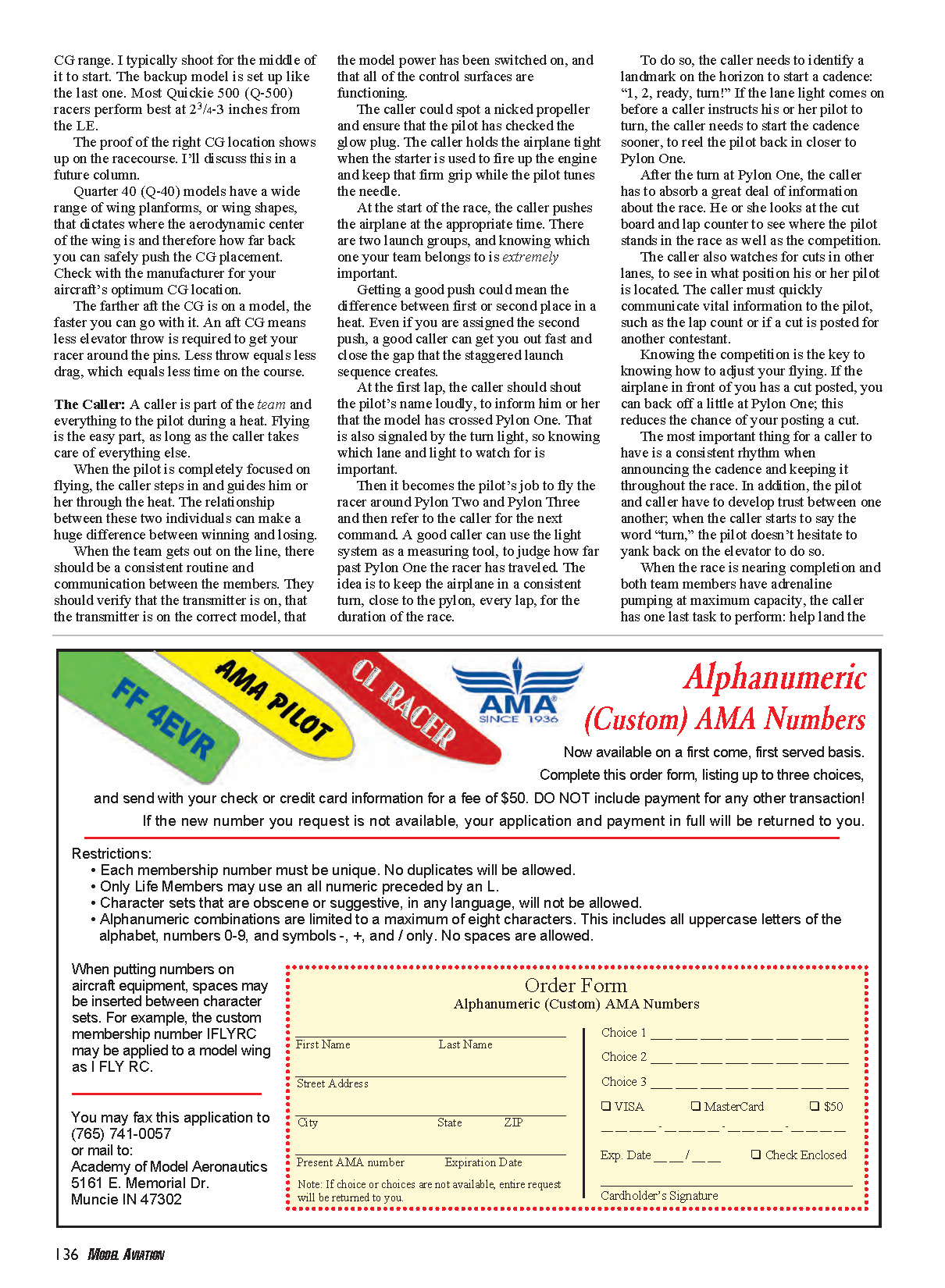
A caller is part of the team and everything to the pilot during a heat. Flying is the easy part as long as the caller handles everything else. When the pilot is completely focused on flying, the caller guides him or her through the heat. The relationship between pilot and caller can make a huge difference between winning and losing.
Pre-flight routine and duties:
- Verify the transmitter is on and set to the correct model.
- Ensure the model power is switched on and all control surfaces are functioning.
- Spot nicked propellers and check glow plugs.
- Hold the airplane steady when the starter is used and while the pilot tunes the needle.
- Push the airplane at the appropriate time at the start of the race. Know which launch group your team belongs to (there are two launch groups).
A good launch and timing can mean the difference between first and second place. Even if assigned the second push, a good caller can get you out fast and close the staggered-launch gap.
During the race:
- At the first lap, the caller should shout the pilot's name loudly to indicate the model has crossed Pylon One (this is also signaled by the turn light; know which lane and light to watch).
- After Pylon One, the pilot flies Pylon Two and Pylon Three and then refers to the caller for the next command.
- Use a landmark on the horizon to start a cadence: "1, 2, ready, turn!" If the lane light comes on before the caller instructs the pilot to turn, start the cadence sooner to reel the pilot back in closer to Pylon One.
- Watch the cut board and lap counter to see where the pilot stands and monitor the competition for cuts in other lanes.
- Quickly communicate vital information to the pilot: lap count, posted cuts for other contestants, and relative positions.
Knowing the competition lets you adjust your flying. If the airplane in front has a cut posted, you can back off a little at Pylon One to reduce your own risk of cutting.
The most important qualities for a caller:
- A consistent rhythm when announcing the cadence and keeping it throughout the race.
- Trust between pilot and caller — when the caller says "turn," the pilot must not hesitate to respond.
End of race:
- As the race winds down and adrenaline is high, the caller helps with landing. While landing is the pilot's job, the caller acts as a traffic controller when multiple powerless airplanes are coming in on the same runway.
- Inform the pilot of the racer's position, how many airplanes have landed, and where they are on the runway.
- Continue guiding until the model is on the runway and all aircraft have stopped rolling.
The caller has the hardest job out there.
Routine in the Pits
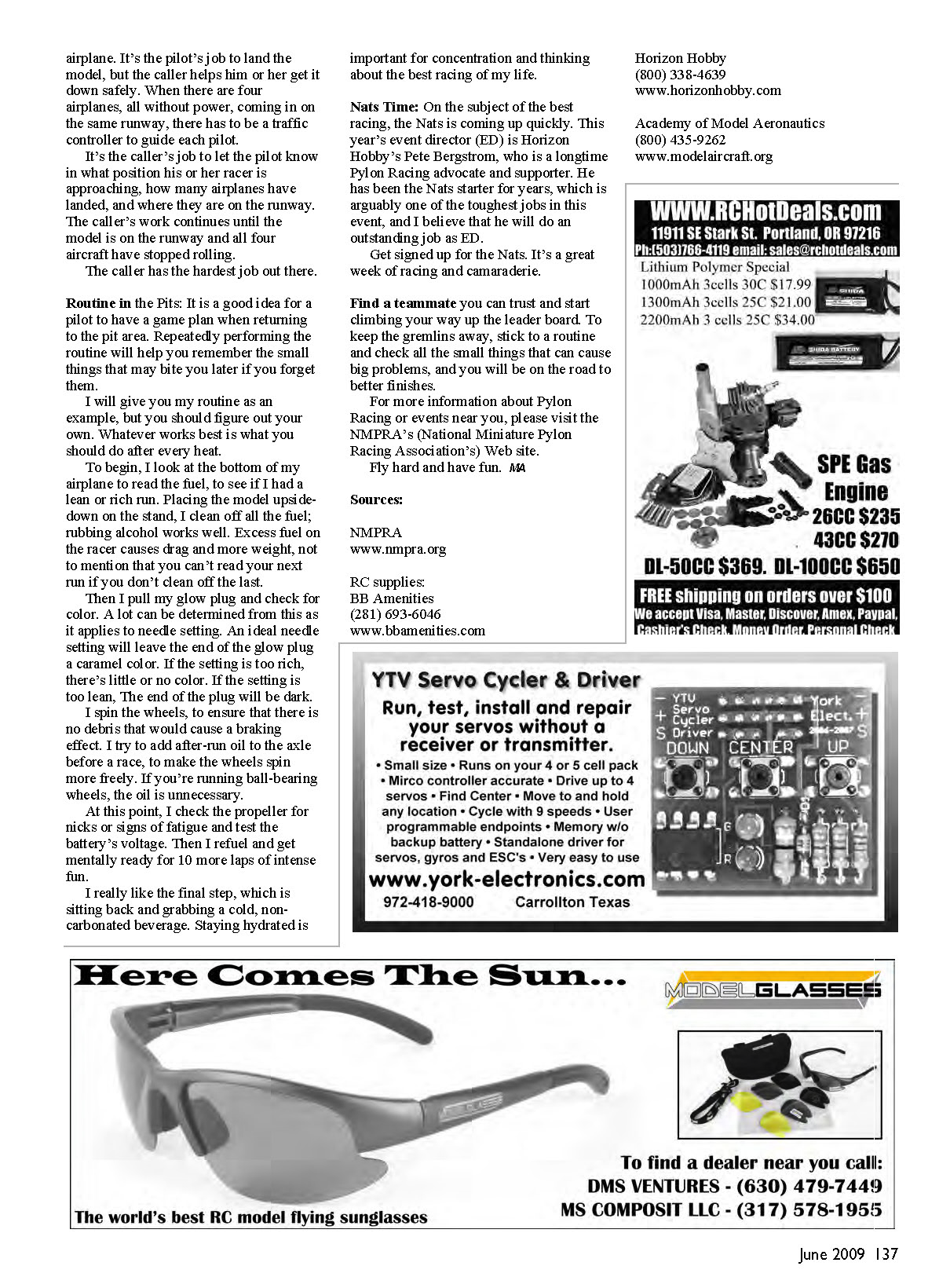
Have a consistent game plan when returning to the pit area. Repeating a routine helps ensure you don't forget small things that can cause big problems.
My routine (use it as an example; develop what works best for you):
- Inspect the bottom of the airplane to read the fuel residue and determine if the run was lean or rich. Place the model upside-down on the stand and clean off all fuel; rubbing alcohol works well. Excess fuel causes drag and weight and obscures reading your next run.
- Pull the glow plug and check its color. An ideal needle setting leaves the end of the glow plug a caramel color. Too rich: little or no color. Too lean: dark plug end.
- Spin the wheels to ensure no debris causes braking. Add after-run oil to the axle (unless running ball-bearing wheels).
- Check the propeller for nicks or signs of fatigue and test the battery voltage.
- Refuel and get mentally ready for the next heat.
Finally, sit back and grab a cold, non-carbonated beverage. Staying hydrated is important for concentration.
Nats Time
The Nats is coming up quickly. This year's event director (ED) is Horizon Hobby's Pete Bergstrom, a longtime pylon-racing advocate and supporter. He has been the Nats starter for years — one of the toughest jobs at the event — and I believe he will do an outstanding job as ED.
Get signed up for the Nats. It's a great week of racing and camaraderie. Find a teammate you can trust and start climbing the leaderboard. To keep the gremlins away, stick to a routine and check the small things that can cause big problems, and you'll be on the road to better finishes.
For more information about pylon racing or events near you, visit the NMPRA (National Miniature Pylon Racing Association) website.
Fly hard and have fun.
Sources
- NMPRA — www.nmpra.org
- RC supplies: BB Amenities — (281) 693-6046 — www.bbamenities.com
- Horizon Hobby — (800) 338-4639 — www.horizonhobby.com
- Academy of Model Aeronautics — (800) 435-9262 — www.modelaircraft.org
Transcribed from original scans by AI. Minor OCR errors may remain.

