
Radio Control Pylon Racing
Scott Causey [[email protected]]
There are some things you just shouldn't talk about
In the previous column (in the June MA), I outlined techniques to use to avoid Gremlins and the importance of teamwork in pylon racing. Apparently I should have knocked on wood or something; the Gremlins found me this season. At the Gold Cup race in Fort Lauderdale, Florida, in April, I had a fuel-tank issue that wouldn't allow me to get a full tank. My teammate and I struggled with calling around Pylon One and getting around Pylon Two. The 2009 AMA Nats was more of the same; bad air and midairs were "par for the course."
My teammate tells me that there are some things you just don't talk about. You never tell a pitcher he's throwing a no-hitter, you never talk about "wind" during a fly-fishing trip, you don't talk about crashing pylon racers, and I guess I should add Gremlins to that list. Then again, I had positive responses from that column, so maybe other racers benefited. I sure didn't.
"Big Picture" Strategy
In the last column, I wrote about the relationship between pilot and caller. I failed to mention the importance of being aware of your position on the leaderboard. Your team should have a game plan in case you get into a position to win the contest.
Last year, my teammate and I were going out to the line in Fort Lauderdale for his final heat of the contest. We failed to clearly communicate what was needed to maintain our first-place position and finish on top. All we knew was that he was tied for first and needed to win the heat to win the contest without a flyoff. Pushing hard to win the heat, a cut was posted. He dropped 2 points and finished fourth in the contest. We decided that from then on we would talk about our strategy to win the contest—not just the final heat—if we were faced with that situation again.
We did get another shot, and it paid off this past spring in Fort Lauderdale. Headed to the line, we were tied for the lead and faced the other first-place pilot. He had posted a cut by the second lap, so we backed off around the pylons to ensure that we didn't also post a cut.
What we failed to recognize this go-around was that another competitor in the contest was lurking only 1 point down the leaderboard. The third-place model in our heat passed us and dropped us a point and into another tie for first place. Again, we hadn't thought about the big picture. In the end, it all worked out for us. The other pilot dropped 2 points in his final heat, which broke the tie and provided my teammate, A.J. Seaholm, with his first national race win at the Fort Lauderdale Gold Cup contest. It was a great team win; way to go, A.J.! So keep an eye on those leaderboard points, aka the "big picture." Work as a team to get the most out of your final heats and to avoid accumulating those "shoulda, coulda, wouldas."
Flight-Box Essentials
What you take out to the flightline in your equipment box is extremely important. If you don't have all of the necessary equipment, you might fail to get your airplane up in the race. I use a flightline box from SuperT Radio Control Products that works well for me. It's easy to build, with all laser-cut, five-ply, aircraft-grade plywood parts and the required hardware.
Following are the items I carry every time I go to fly:
- Transmitter
- Starter
- Glow driver (two)
- Glow-plug wrench
- Extra glow plugs
- 1/4-inch wrench (to tighten Nelson needle valve)
- Tachometer
- Steel rod (to take spinner off)
- Propeller reamer
Recently, SuperT RC co-founder Dan Kane and I were talking about preferred flightline box items. Although I've never carried what he suggested, I thought it was insightful and good information to share with the racing community.
Dan carries a small amount of fuel tubing with a 1-inch-long piece of aluminum tubing. Those items allow him to repair a fuel-line leak he discovers on the line. The aluminum tubing can be used to splice the split line out of the system and provide a quick fix before the 60-second clock strikes zero.
I plan to add the fuel line and aluminum tubing to my box. Great idea, Dan!
Giant Scale Racing Experience
I had the opportunity to attend the Unlimited Scale Racing Association (USRA) Giant Scale Pylon race in Ashtabula, Ohio, this past June. What a great new experience!
The USRA has an entry-level class in which anyone with minimal racing experience can fly. The 80-inch Sundowner by Hangar 9 is the airframe for Giant Scale Pylon Racing. It is an excellent flier.
For the Sundowner class, the airframe has to be assembled per manufacturer's instructions and the engine has to be stock. The only issue I observed with the design is the single color scheme. If you want to participate in this class, consider adding unique graphics and colors to differentiate your model from those of your competitors.
If you've ever thought about trying Giant Scale racing, I can attest that the Sundowner is a great way to get started. If this event turns out not to be for you, you still have a superb sport airplane that you can fly the heck out of back home.
Tony Husak, the CD of the Ashtabula event, put on a well-organized and -run race. Being new to Giant Scale racing, I was made to feel welcome.
I flew into Ohio Thursday for tech inspection and started racing Friday morning. The racecourse has two pylons separated by 1,600 feet. The heats start from the air with a flying start. I had never done a flying start, but with guidance from my caller, Craig "Grunk" Grunkemeyer, I picked it up quickly.
What I recall most vividly from the flying starts was the final six or seven seconds on the start clock. Grunk would yell at me to "Dive, dive, dive!" I felt like a submarine driver all weekend.
The race was more laid-back than the 4.5-minute, flag-to-flag Phoenix pace to which I've grown accustomed. This allowed me the chance to talk with the other pilots about the next step in class progression. Everyone I approached was very helpful, and I will be back racing some Giant Scale soon.
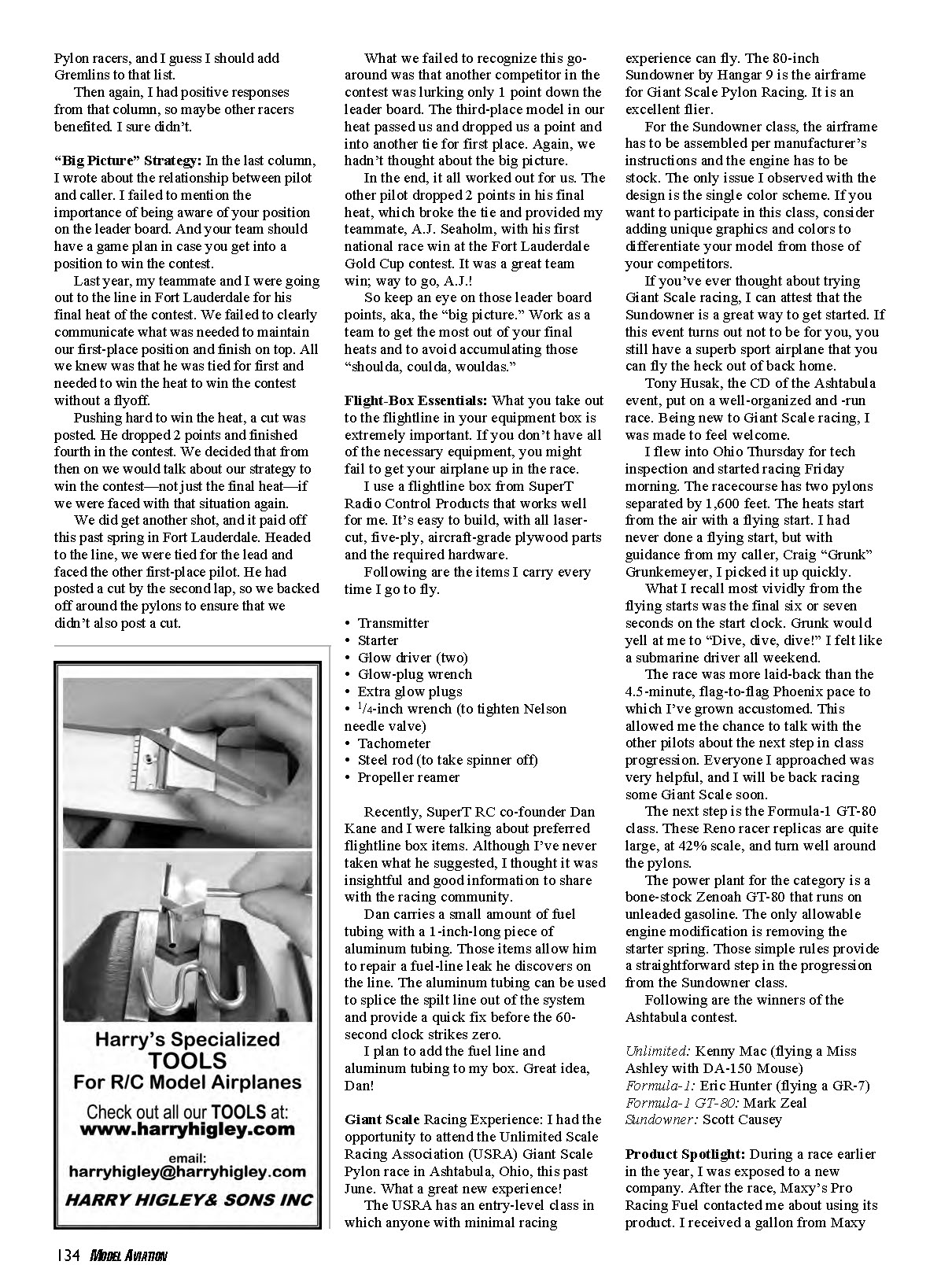
The next step is the Formula-1 GT-80 class. These Reno racer replicas are quite large, at 42% scale, and turn well around the pylons.
The power plant for the category is a bone-stock Zenoah GT-80 that runs on unleaded gasoline. The only allowable engine modification is removing the starter spring. Those simple rules provide a straightforward step in the progression from the Sundowner class.
Following are the winners of the Ashtabula contest:
- Unlimited: Kenny Mac (flying a Miss Ashley with DA-150 Mouse)
- Formula-1: Eric Hunter (flying a GR-7)
- Formula-1 GT-80: Mark Zeal
- Sundowner: Scott Causey
Product Spotlight
During a race earlier in the year, I was exposed to a new company. After the race, Maxy's Pro Racing Fuel contacted me about using its product. I received a gallon from Maxy's and performed testing with the Moki 2.10 engine I used at the Ashtabula event.
My results showed a 300–400 rpm static increase on the ground, and the head temperature decreased by more than 30°. Thank you, Maxy's, for letting me try your fuel and helping me win the Sundowner racing class.
Special Thanks
I would like to send a huge thank you to Futaba for its support when I needed it the most. Days before the Nats, I was in desperate need of a replacement transmitter. Steve Kaluf of Futaba jumped in to save the day.
I received a new radio the same day I left for Muncie, Indiana, with my model programs transferred, which saved me countless test flights on four airplanes. The service I received was exceptional.
Again, thank you, Futaba, for being there and supporting your product to the highest degree.
AMA Nats Recap
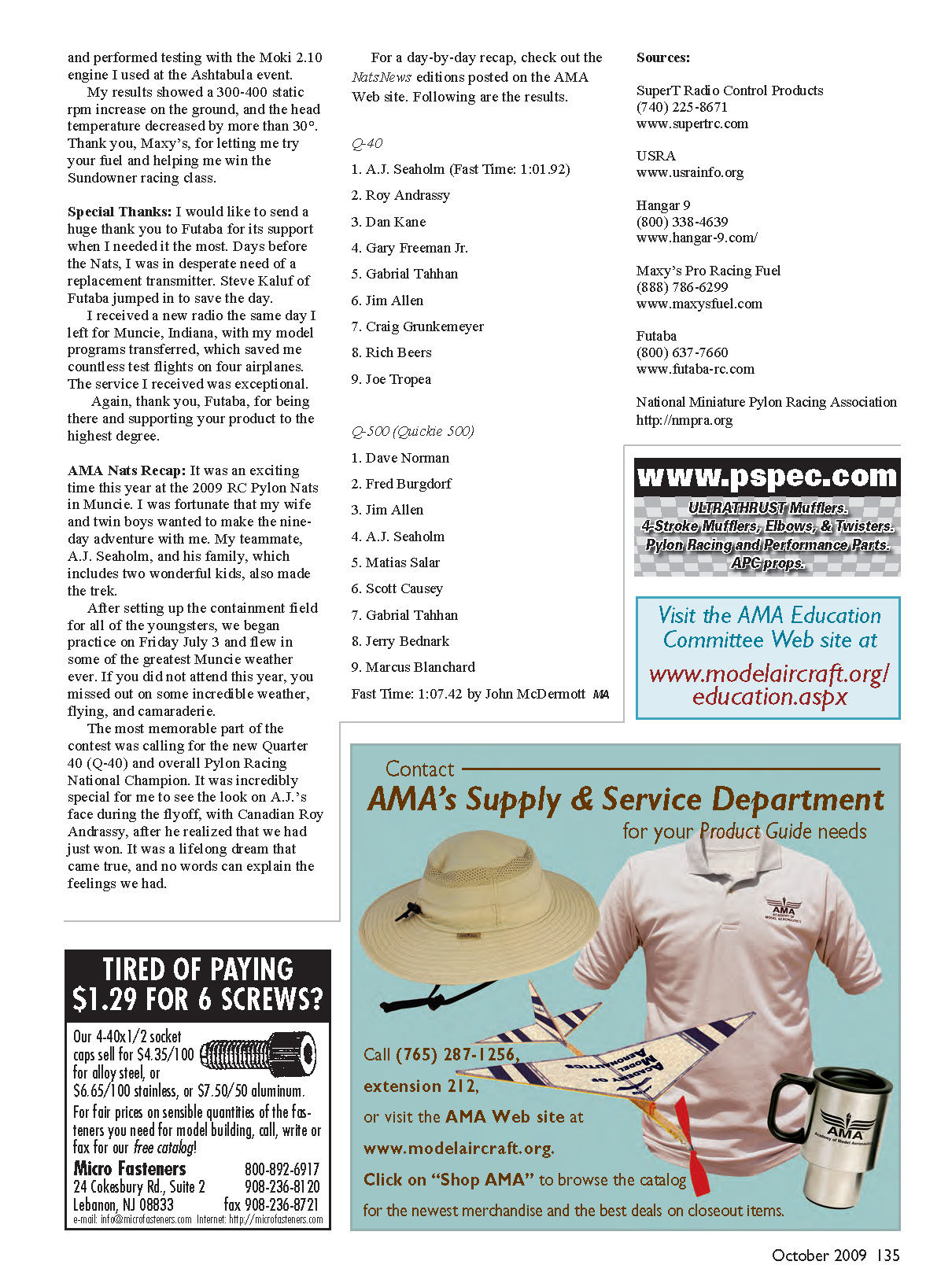
It was an exciting time this year at the 2009 RC Pylon Nats in Muncie. I was fortunate that my wife and twin boys wanted to make the nine-day adventure with me. My teammate, A.J. Seaholm, and his family, which includes two wonderful kids, also made the trek.
After setting up the containment field for all of the youngsters, we began practice on Friday, July 3, and flew in some of the greatest Muncie weather ever. If you did not attend this year, you missed out on some incredible weather, flying, and camaraderie.
The most memorable part of the contest was calling for the new Quarter 40 (Q-40) and overall Pylon Racing National Champion. It was incredibly special for me to see the look on A.J.'s face during the flyoff, with Canadian Roy Andrassy, after he realized that we had just won. It was a lifelong dream that came true, and no words can explain the feelings we had.
For a day-by-day recap, check out the NatsNews editions posted on the AMA website. Following are the results.
Q-40
- A.J. Seaholm (Fast Time: 1:01.92)
- Roy Andrassy
- Dan Kane
- Gary Freeman Jr.
- Gabrial Tahhan
- Jim Allen
- Craig Grunkemeyer
- Rich Beers
- Joe Tropea
Q-500 (Quickie 500)
- Dave Norman
- Fred Burgdorf
- Jim Allen
- A.J. Seaholm
- Matias Salar
- Scott Causey
- Gabrial Tahhan
- Jerry Bednark
- Marcus Blanchard
Fast Time: 1:07.42 by John McDermott (MA)
Sources
- SuperT Radio Control Products (740) 225-8671 www.supertrc.com
- USRA www.usrainfo.org
- Hangar 9 (800) 338-4639 www.hangar-9.com
- Maxy's Pro Racing Fuel (888) 786-6299 www.maxysfuel.com
- Futaba (800) 637-7660 www.futaba-rc.com
- National Miniature Pylon Racing Association http://nmpra.org
Transcribed from original scans by AI. Minor OCR errors may remain.

