
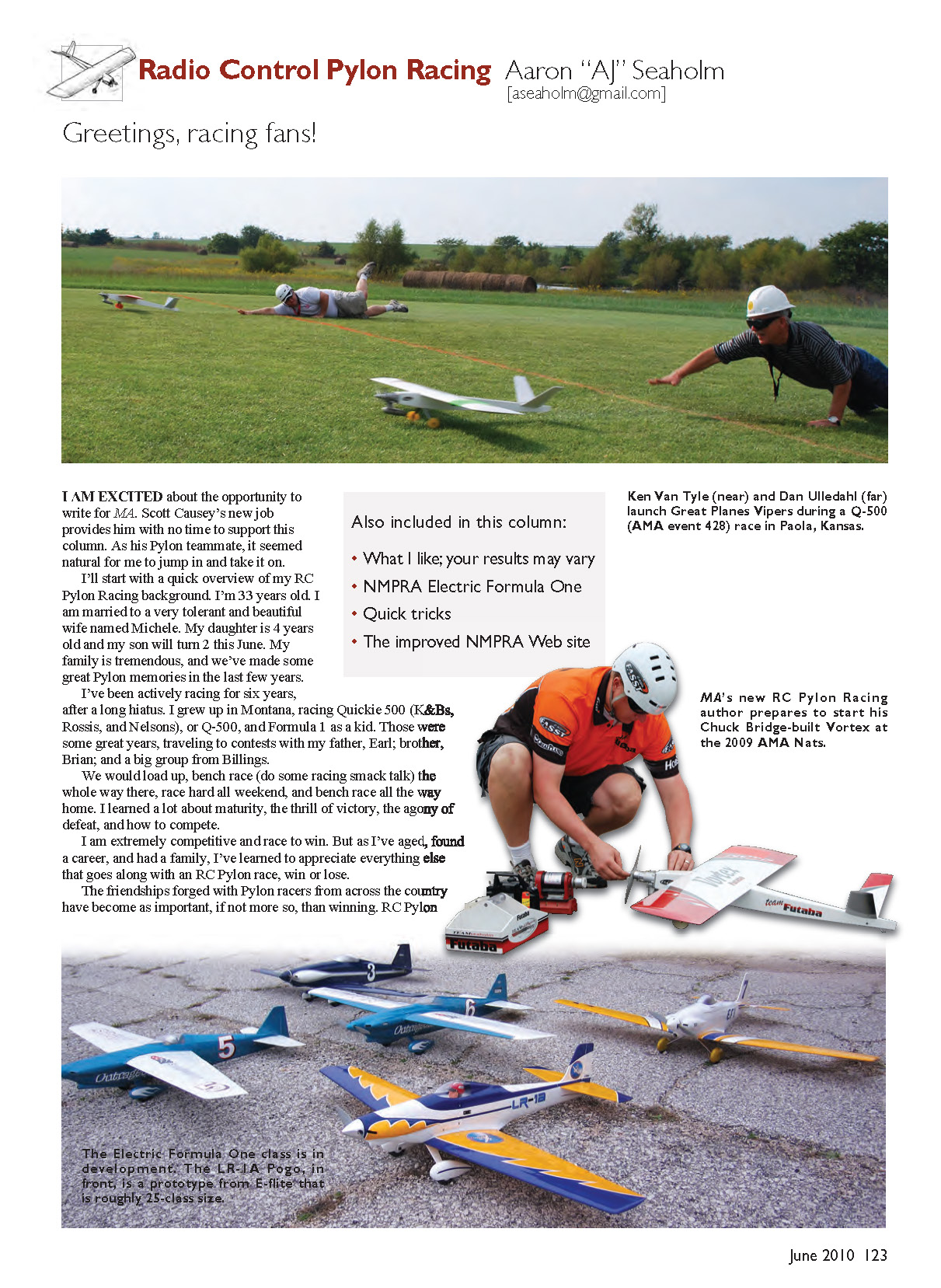
Radio Control Pylon Racing
Aaron "AJ" Seaholm <[email protected]>
Greetings, racing fans!
I am excited about the opportunity to write for MA. Scott Causey's new job provides him with no time to support this column. As his Pylon teammate, it seemed natural for me to jump in and take it on.
I'll start with a quick overview of my RC pylon racing background. I'm 33 years old. I am married to a very tolerant and beautiful wife named Michele. My daughter is 4 years old and my son will turn 2 this June. My family is tremendous, and we've made some great pylon memories in the last few years.
I've been actively racing for six years, after a long hiatus. I grew up in Montana, racing Quickie 500 (K&Bs, Rossis, and Nelsons), or Q-500, and Formula 1 as a kid. Those were some great years, traveling to contests with my father, Earl; brother, Brian; and a big group from Billings.
We would load up, bench race (do some racing smack talk) the whole way there, race hard all weekend, and bench race all the way home. I learned a lot about maturity, the thrill of victory, the agony of defeat, and how to compete.
I am extremely competitive and race to win. But as I've aged, found a career, and had a family, I've learned to appreciate everything else that goes along with an RC pylon race, win or lose. The friendships forged with pylon racers from across the country have become as important, if not more so, than winning. I try to repay them for their support throughout the years. I can gear up a Chuck Bridge Vortex in one nap time (approximately three hours), which helps keep things smooth on the home front.
In Q-40 (AMA event 422) I fly the Proud Bird II from Lyle Larson of California Speed Pros. Fuselage and vertical-fin changes corrected some flight characteristics of the initial design. It felt like it sank going around the poles and climbed with full rudder input during takeoff.
The recent increase in horsepower of the long-stroke engines has put the Proud Bird wing and airfoil in its sweet spot. The model takes off well and accelerates hard on the first lap.
The wing seems well suited for the current speeds we're running, but it will not turn as hard as some other designs. If you own a Proud Bird II, try backing down the elevator throw slightly to scrub less speed through the turns.
Q-40 is hands down my favorite event. The models look cool and fly on rails. The speeds are approximately 190 mph on the course. The first time I flew a Q-40 racer, I was hooked. The ratio of adrenaline rush per dollar spent associated with this class is unequaled.
NMPRA Electric Formula One
A newly developed RC pylon racing event has created quite a buzz. The class is called "Electric Formula One," and the models are fashioned after full-scale Reno racers.
This event is centered around equipment available at hobby shops, which appeals to a broader audience. The rules are written around an airframe with a 375-square-inch wing area, built with standard ARF materials. E-flite is prototyping an LR-1A Pogo ARF, which became available this spring.
National Miniature Pylon Racing Association (NMPRA) President Scott McAfee pledged to have electric-powered pylon models to demonstrate at the 2009 AMA Nats. With the help of Jerry Small of Texas, a longtime pylon innovator, Scott delivered. Pete Bergstrom of Horizon Hobby has also been a great advocate of Electric Formula One and has spearheaded the LR-1A development.
Numerous modelers are designing and building kits for this new class. These racers look great and, by all accounts, fly awesome. I'm looking forward to getting my hands on one soon to provide you with first-hand information.
For more information and great photos, check out the discussion titled "NMPRA Electric Formula One Racing Is Here!" on the RCGroups website.
Quick Tricks
- Use your model's CG to trim the straightaway. If your airplane feels like it's drifting in toward the pylon as it travels from Pylon Three to Pylon One, it's nose-heavy. Slide the CG back.
- A tail-heavy model will not want to drop the nose on landing and seems jumpy on the course. Work the CG by shifting the battery location.
- Use the rudder to trim your model's yaw in the straights. If the tail is hanging low or high, trim it out with a couple clicks of rudder.
- Flying with the tail up or down exposes the side of the fuselage, which acts like a parachute.
- If your model feels like it dives or balloons up through the turns, use lead tape or coins to add weight to a wingtip. If the tail kicks up, the airplane needs tip weight on the top wing, and vice versa. If the tail wants to kick down through the turn, add low tip weight.
- Don't try to figure out why this works; simply accept that it does. At least that's what I finally had to do.
New NMPRA Web site
The National Miniature Pylon Racing Association (NMPRA) has an updated website, thanks to the vision and dedication of NMPRA President Scott McAfee. I am excited to have been chosen to lead the team that developed it.
The development team included Jim Allen, Randy Bridge, Mike Helsel, Scott McAfee, Dave Norman, and Tom Scott. What a tremendous group of experienced racers with which to work. I may be biased, but we have delivered a nice product to current and future NMPRA members.
A great deal of time was spent defining and organizing information that would appeal to new and seasoned pylon racers. Content includes rule information, radio-equipment preferences, manufacturer lists, how-to articles, event results, and tons of other pylon information.
Exciting pictures were a must, and we designed each page with a unique racing photo. The NMPRA forum is a great place to get advice from racers around the world. The photo gallery features numerous event pictures from the past five or six years. Scott Causey provided most of those pictures, and they definitely capture the excitement of RC pylon racing.
I am hopeful that this column has spurred your interest. I encourage you to check out the new NMPRA website and learn more about this exciting sport. If you have questions or comments about this column, or requests for future topics, don't hesitate to drop me a line.
Race hard! AJ
Sources
- Great Planes (800) 637-6050 www.greatplanes.com
- California Speed Pros (605) 787-6340 www.calspeedpros.com
- Can-Am Pylon Racing Society www.capracing.com
- E-flite (800) 338-4639 www.e-flite.com
- NMPRA www.nmpra.org
- RCGroups www.rcgroups.com
Transcribed from original scans by AI. Minor OCR errors may remain.

