
RADIO CONTROL SCALE
Stan Alexander, 3709 Valley Ridge Dr., Nashville TN 37211; E-mail: [email protected]
One Eighth Air Force RC Scale Fly-In (March 22–23)
The One Eighth Air Force club out in Arizona really knows how to hold any event involving scale models, from competition to a great fly-in. This is a place to get together, see old friends, make new friends, eat too much steak, tell tall stories, fly models, and go home happy, wondering where the weekend went and when you'll get to do it again.
The weekend of March 22–23, the Sun Valley Fliers (SVF) hosted the One Eighth Air Force RC Scale Fly-In at the Cave Buttes recreation-area flying field. The weather was perfect, with warm temperatures and light winds, to the delight of more than 79 registered pilots who brought in excess of 100 aircraft to fly those two days.
I keep telling my wife that we need to move to Arizona; there are no trees, no limbs, no leaves, and no grass to cut or rake. That means more time to do whatever we want to do, including modeling.
Mike Peck described his weekend:
"I arrived about 9:30 Friday morning and parked my little Winnebago. After getting things set up and unloading a ton of fun-auction donations, I proceeded to put three flights on my Ultimate bipe.
All three were nice flights, but the last one was one of those where you wish you could press the 'record' button and save it for future use. Even Kent Walters commented on the landing with one of his 'very nice—hmmmm!' statements."
Jim Morrow stayed the entire weekend after dislocating his shoulder while setting up his sunshade. The paramedics took care of him after a call from Jody O'Meara. Jim flew all weekend with his arm in a sling, but he was lovingly awarded something that would help him remember the accident—ask him about it!
Many of the One Eighth Air Force's core local members and officers are also members of the SVF, and the March meet felt like a homecoming event for much of the group. They were pleased to have One Eighth Air Force founding member Frank Bigelow in attendance.
Some of the beautiful models flown during the weekend included:
- Mel Santmyers' green Gee Bee Model Y
- Dick Skoglund's XB-19 multiengine transport
- Max Hopkins' big P-47
- Jimmy Mazurek's B-25
- Ron Marshall's Alexander Bullet
- Kent Walters' Scale Masters Championship-winning SBD Dauntless
Scale modeling is a social activity as much as any part of competition. A Scale fly-in such as this 27-year-old tradition plays out almost every weekend somewhere across the country. Scale modelers help each other in competition, even if they are competitors. A gathering such as this is a good time to just enjoy each other's company and fly.
The success of any event depends on the hard work the host group puts into it. Thanks to Al and Kathi Casey, Sam Wright, and all of the others in the One Eighth Air Force, as well as the SVF, for the information and photos.
Awards
- Best Military
- First place: Max Hopkins' P-47
- Second place: Kent Walters' SBD Dauntless
- Third place: Gary Hunter's S.E.5
- Best General Aviation Flight
- First place: Ron Marshall's Alexander Bullet
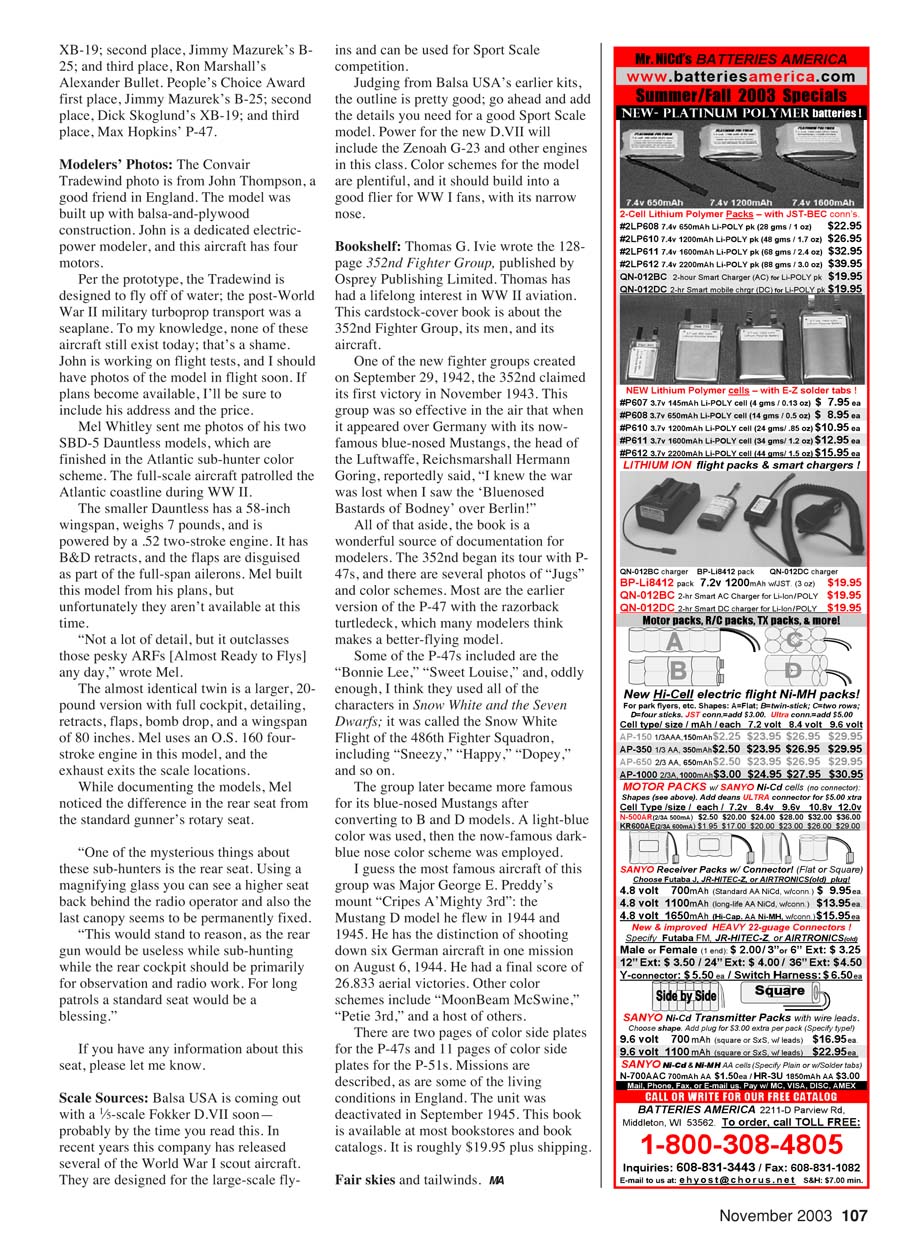
- Second place: Curtis Kitteringham's / Ron Peterka's Stinson SR-9
- Third place: Mel Santmyers' / Chuck Maitre's Gee Bee Model Y Sportster
- Commander's Choice
- First place: Mel Santmyers' Gee Bee Model Y Sportster
- Pilot's Choice
- First place: Dick Skoglund's XB-19 military transport
Modelers' Photos
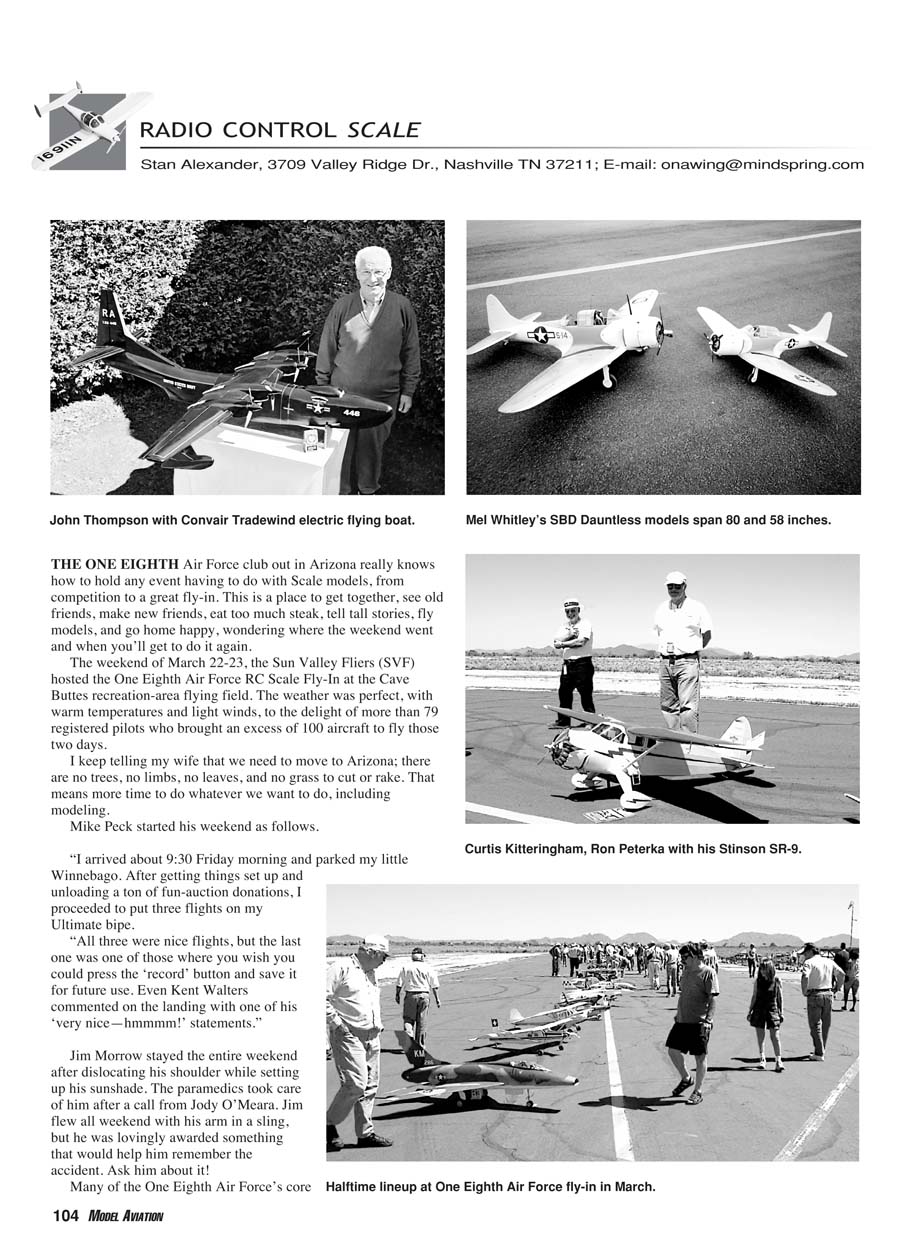
Convair Tradewind (John Thompson)
The Convair Tradewind photo is from John Thompson, a good friend in England. The model was built with balsa-and-plywood construction. John is a dedicated electric-power modeler, and this aircraft has four motors.
Per the prototype, the Tradewind is designed to operate from water; the post-World War II military turboprop transport was a seaplane. To my knowledge, none of these aircraft still exist today, which is a shame. John is working on flight tests, and photos of the model in flight should be available soon. If plans become available, I'll include his address and the price.
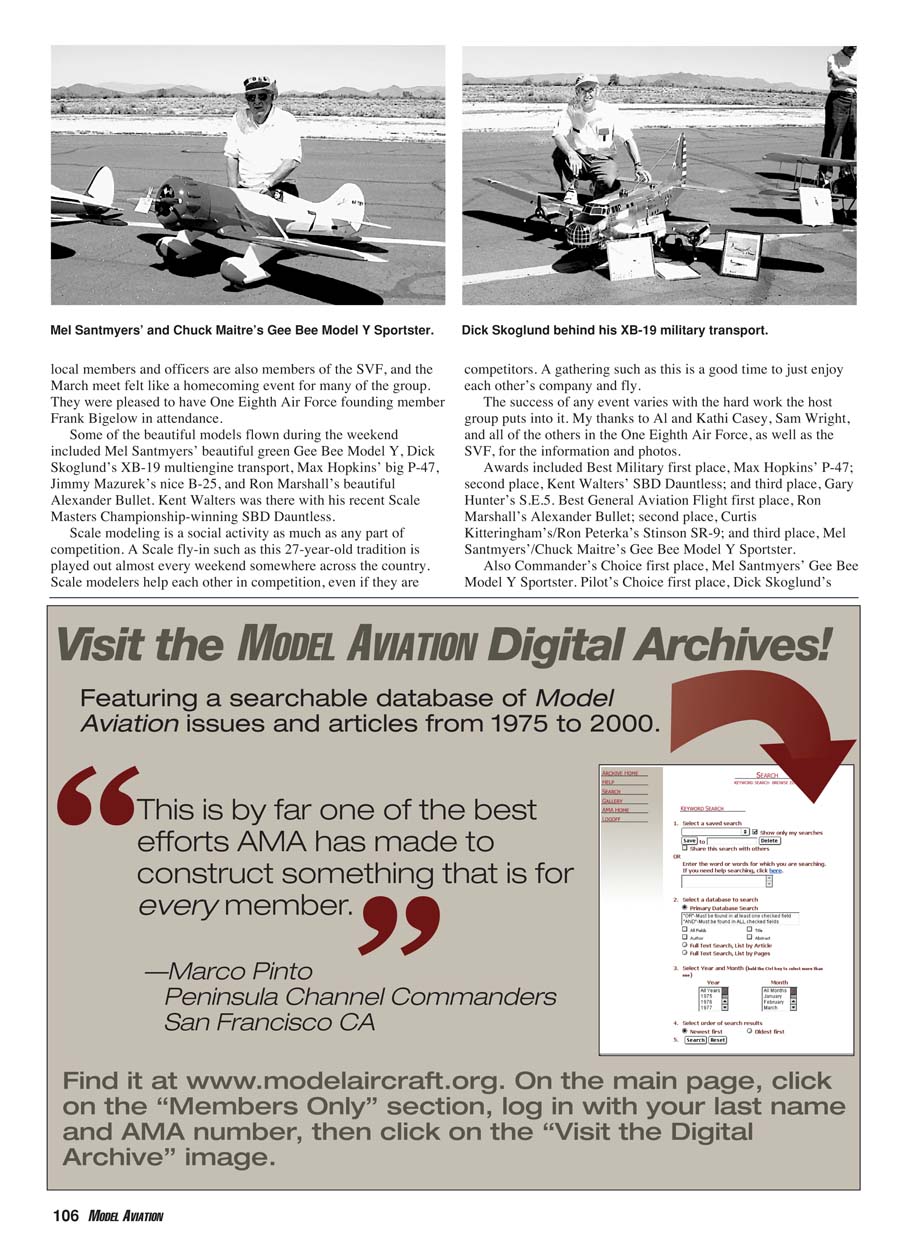
SBD-5 Dauntless (Mel Whitley)
Mel Whitley sent photos of his two SBD-5 Dauntless models, finished in the Atlantic sub-hunter color scheme. The full-scale aircraft patrolled the Atlantic coastline during WWII.
- Smaller model:
- 58-inch wingspan
- 7 pounds
- Powered by a .52 two-stroke engine
- B&D retracts
- Flaps disguised as part of full-span ailerons
- Built from Mel's plans (plans not available at this time)
- "Not a lot of detail, but it outclasses those pesky ARFs [Almost Ready to Flys] any day," wrote Mel.
- Larger model:
- 80-inch wingspan
- 20 pounds
- Full cockpit and detailing
- Retracts, flaps, and bomb drop
- Powered by an O.S. .160 four-stroke engine, with exhaust exiting scale locations
While documenting the models, Mel noticed a difference in the rear seat from the standard gunner's rotary seat:
"One of the mysterious things about these sub-hunters is the rear seat. Using a magnifying glass you can see a higher seat back behind the radio operator and also the last canopy seems to be permanently fixed.
This would stand to reason, as the rear gun would be useless while sub-hunting while the rear cockpit should be primarily for observation and radio work. For long patrols a standard seat would be a blessing."
If you have any information about this seat, please let me know.
Scale Sources
Balsa USA is coming out with a 1/3-scale Fokker D.VII—probably by the time you read this. In recent years this company has released several World War I scout aircraft. They are designed for the large-scale fly-ins and can be used for Sport Scale competition.
Judging from Balsa USA's earlier kits, the outline is pretty good; add the details you need for a good Sport Scale model. Power for the new D.VII will include the Zenoah G-23 and other engines in that class. Color schemes for the model are plentiful, and it should build into a good flier for WWI fans, with its narrow nose.
Bookshelf
Thomas G. Ivie wrote the 128-page 352nd Fighter Group, published by Osprey Publishing Limited. Thomas has had a lifelong interest in WWII aviation. This hard-cover book covers the 352nd Fighter Group, its men, and its aircraft.
One of the new fighter groups created on September 29, 1942, the 352nd claimed its first victory in November 1943. This group was so effective in the air that when it appeared over Germany with its now-blue-nosed Mustangs, the head of the Luftwaffe, Reichsmarschall Hermann Göring, reportedly said, "I knew the war was lost when I saw the 'Bluenosed Bastards of Bodney' over Berlin!"
The book is a wonderful source of documentation for modelers. The 352nd began its tour with P-47s, and there are several photos of "Jugs" and other schemes, many with the earlier razorback turtledeck that many modelers prefer.
Notable aircraft and schemes mentioned include "Bonnie Lee," "Sweet Louise," and the Snow White Flight of the 486th Fighter Squadron ("Sneezy," "Happy," "Dopey," etc.). The group later became more famous for its blue-nosed Mustangs after converting to B and D models, first using a light-blue nose and later the now-famous dark-blue nose color.
Major George E. Preddy's "Cripes A' Mighty 3rd" (a Mustang D flown in 1944–45) is featured; he shot down six German aircraft in one mission on August 6, 1944, and finished with a final score of 26.833 aerial victories. Other color schemes covered include "MoonBeam McSwine," "Pete 3rd," and many more.
The book includes two pages of color side plates for the P-47s and 11 pages of color side plates for the P-51s. Missions and some living conditions in England are discussed. The unit was deactivated in September 1945. The book is available at most bookstores and catalogs for roughly $19.95 plus shipping.
Fair skies and tailwinds. MA
Transcribed from original scans by AI. Minor OCR errors may remain.

