
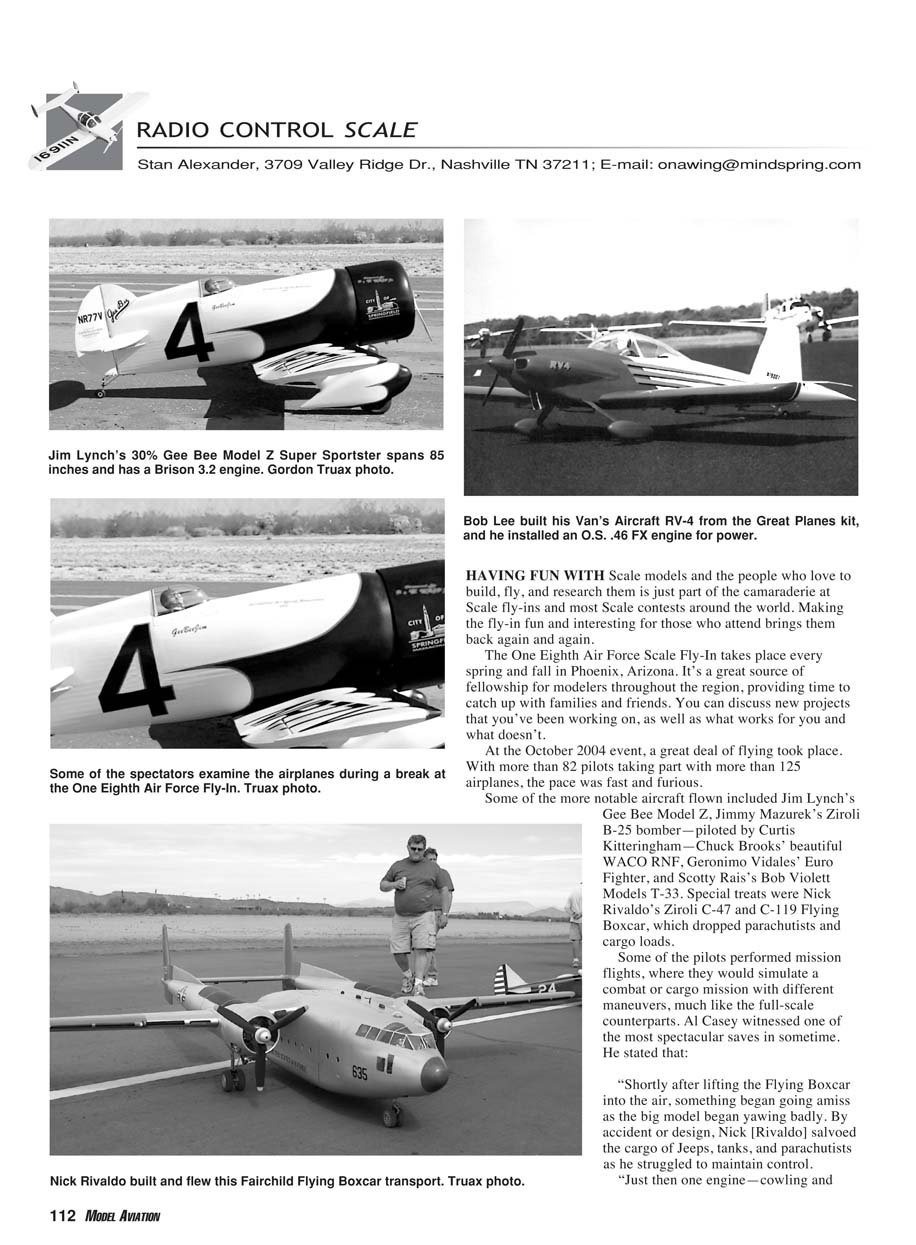
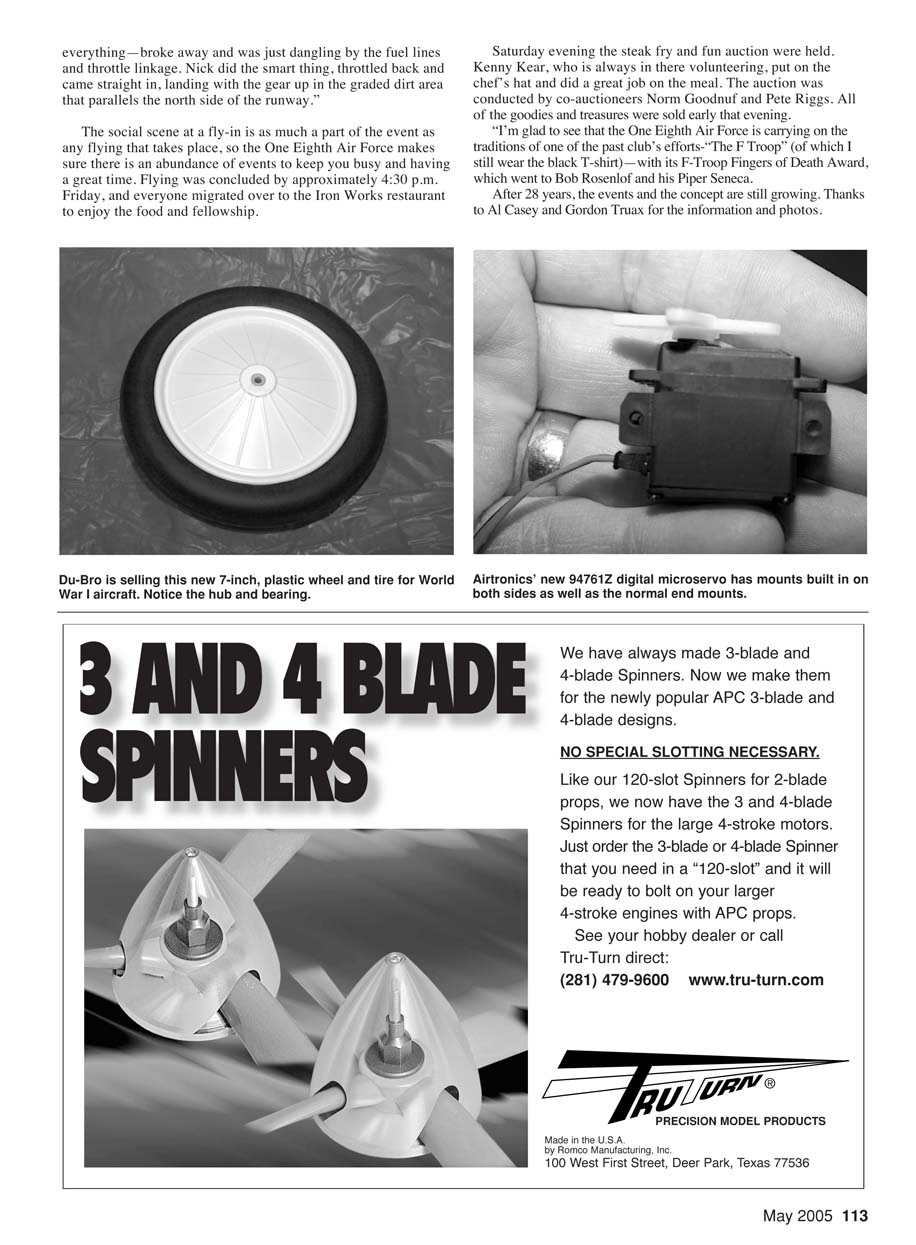
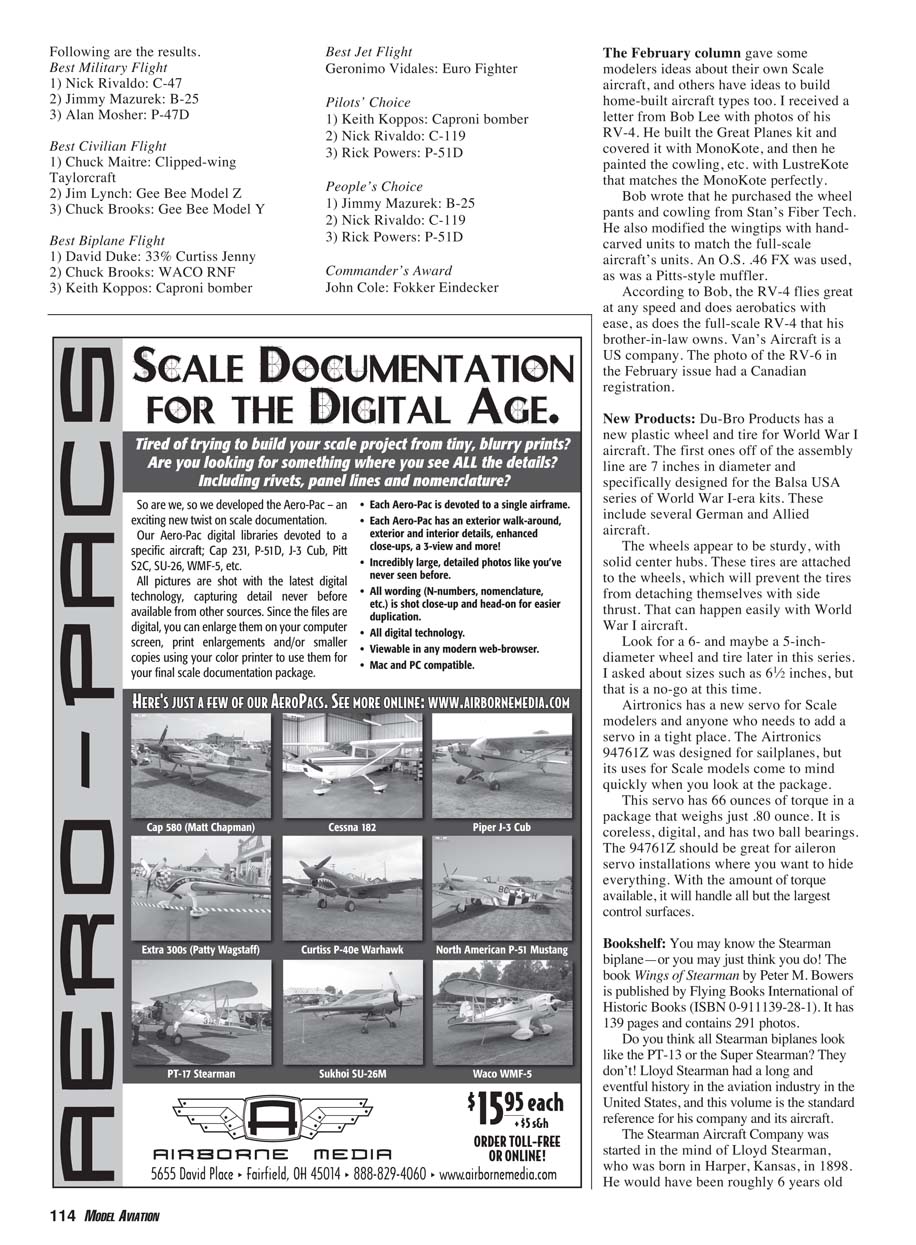
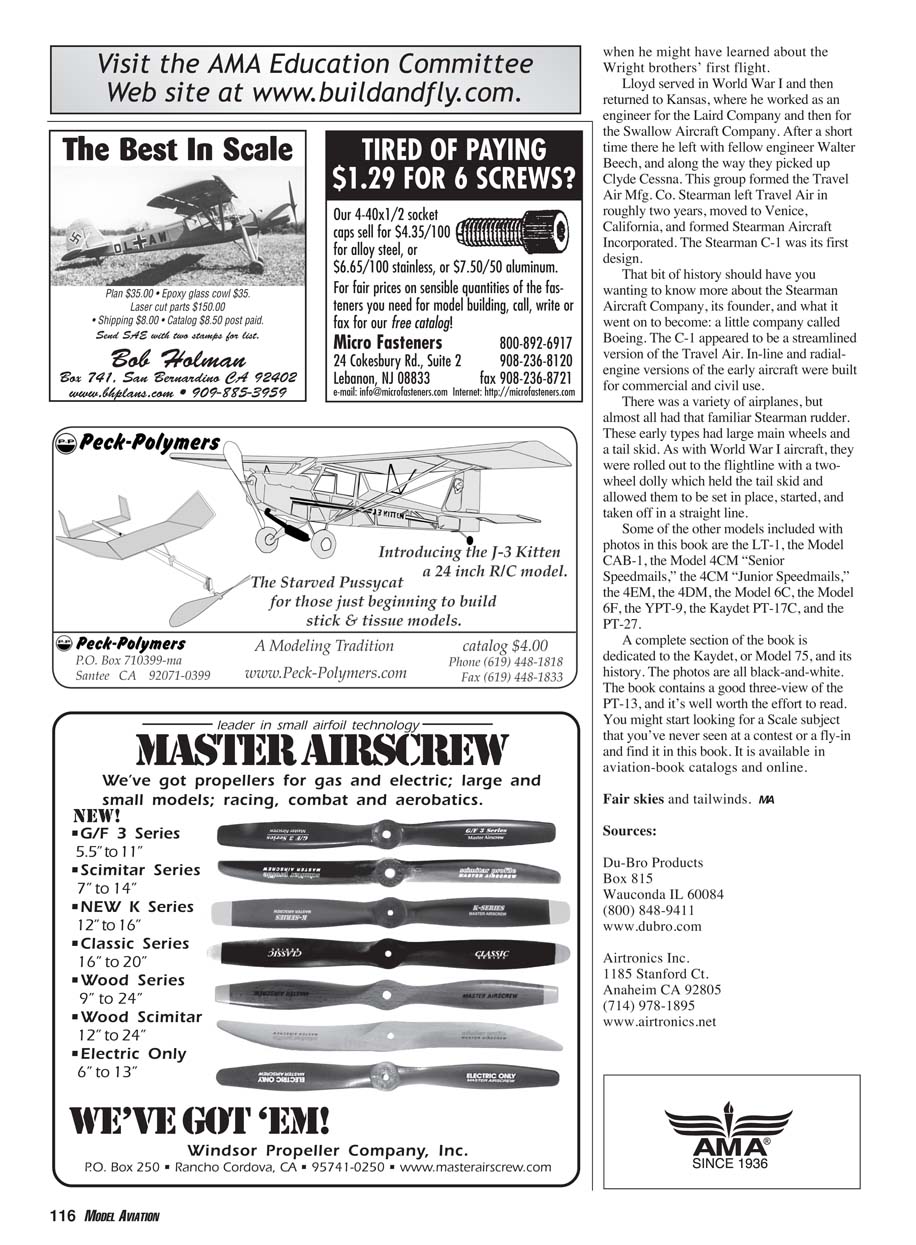
RADIO CONTROL SCALE
Stan Alexander 3709 Valley Ridge Dr., Nashville TN 37211 E-mail: [email protected]
Having fun with Scale
Scale models and the people who love to build, fly, and research them are part of the camaraderie at Scale fly-ins and most Scale contests around the world. Making the fly-in fun and interesting for those who attend brings them back again and again.
The One Eighth Air Force Scale Fly-In takes place every spring and fall in Phoenix, Arizona. It's a great source of fellowship for modelers throughout the region, providing time to catch up with families and friends. You can discuss new projects you've been working on, as well as what works for you and what doesn't.
At the October 2004 event, a great deal of flying took place. With more than 82 pilots taking part with more than 125 airplanes, the pace was fast and furious.
Some of the more notable aircraft flown included Jim Lynch's Gee Bee Model Z; Jimmy Mazurek's Ziroli B-25 bomber—piloted by Curtis Kitteringham; Chuck Brooks' beautiful WACO RNF; Geronimo Vidales' Euro Fighter; and Scotty Rais's Bob Violett Models T-33. Special treats were Nick Rivaldo's Ziroli C-47 and C-119 Flying Boxcar, which dropped parachutists and cargo loads.
Some pilots performed mission flights, where they simulated a combat or cargo mission with different maneuvers, much like their full-scale counterparts. Al Casey witnessed one of the most spectacular saves in some time. He stated:
"Shortly after lifting the Flying Boxcar into the air, something began going amiss as the big model began yawing badly. By accident or design, Nick [Rivaldo] salvoed the cargo of Jeeps, tanks, and parachutists as he struggled to maintain control.
"Just then one engine—cowling and everything—broke away and was just dangling by the fuel lines and throttle linkage. Nick did the smart thing, throttled back and came straight in, landing with the gear up in the graded dirt area that parallels the north side of the runway."
The social scene at a fly-in is as much a part of the event as the flying, so the One Eighth Air Force makes sure there are plenty of events to keep you busy and having a great time. Flying concluded by approximately 4:30 p.m. Friday, and everyone migrated to the Iron Works restaurant to enjoy the food and fellowship.
Saturday evening the steak fry and fun auction were held. Kenny Kear, always volunteering, put on the chef's hat and did a great job on the meal. The auction was conducted by co-auctioneers Norm Goodnuf and Pete Riggs. All of the goodies and treasures were sold early that evening.
"I'm glad to see that the One Eighth Air Force is carrying on the traditions of one of the past club's efforts—'The F Troop' (of which I still wear the black T-shirt)—with its F-Troop Fingers of Death Award, which went to Bob Rosenlof and his Piper Seneca."
After 28 years, the events and the concept are still growing. Thanks to Al Casey and Gordon Truax for the information and photos.
Contest results
Best Military Flight
- Nick Rivaldo: C-47
- Jimmy Mazurek: B-25
- Alan Mosher: P-47D
Best Civilian Flight
- Chuck Maitre: Clipped-wing Taylorcraft
- Jim Lynch: Gee Bee Model Z
- Chuck Brooks: Gee Bee Model Y
Best Biplane Flight
- David Duke: 33% Curtiss Jenny
- Chuck Brooks: WACO RNF
- Keith Koppos: Caproni bomber
Best Jet Flight
- Geronimo Vidales: Euro Fighter
Pilots' Choice
- Keith Koppos: Caproni bomber
- Nick Rivaldo: C-119
- Rick Powers: P-51D
People's Choice
- Jimmy Mazurek: B-25
- Nick Rivaldo: C-119
- Rick Powers: P-51D
Commander's Award
- John Cole: Fokker Eindecker
Modelers' corner
The February column gave some modelers ideas about their own Scale aircraft, and others have ideas to build home-built aircraft types too. I received a letter from Bob Lee with photos of his RV-4. He built the Great Planes kit and covered it with MonoKote, then painted the cowling, etc., with LustreKote that matches the MonoKote perfectly.
Bob wrote that he purchased the wheel pants and cowling from Stan's Fiber Tech. He also modified the wingtips with hand-carved units to match the full-scale aircraft's units. An O.S. .46 FX was used, as was a Pitts-style muffler.
According to Bob, the RV-4 flies great at any speed and does aerobatics with ease, as does the full-scale RV-4 that his brother-in-law owns. Van's Aircraft is a U.S. company. The photo of the RV-6 in the February issue had a Canadian registration.
New products
- Du-Bro Products has a new plastic wheel and tire for World War I aircraft. The first ones off the assembly line are 7 inches in diameter and specifically designed for the Balsa USA series of World War I–era kits. These include several German and Allied aircraft. The wheels appear to be sturdy, with solid center hubs. These tires are attached to the wheels, which will prevent them from detaching with side thrust—a common issue with World War I aircraft. Look for 6- and maybe 5-inch-diameter wheels and tires later in this series. Sizes such as 6-1/2 inches are not planned at the moment.
- Airtronics has a new servo for Scale modelers and anyone who needs a servo in a tight place. The Airtronics 94761Z was designed for sailplanes, but its uses for Scale models are obvious. This servo has 60 ounces of torque in a package that weighs just 0.8 ounce. It is coreless, digital, and has two ball bearings. The 94761Z should be great for aileron servo installations where you want to hide everything. With the amount of torque available, it will handle all but the largest control surfaces.
Bookshelf
You may think you know the Stearman biplane—or you may just think you do. The book Wings of Stearman by Peter M. Bowers is published by Flying Books International of Historic Books (ISBN 0-911139-28-1). It has 139 pages and contains 291 photos.
Do you think all Stearman biplanes look like the PT-13 or the Super Stearman? They don't. Lloyd Stearman had a long and eventful history in U.S. aviation, and this volume is the standard reference for his company and its aircraft.
Lloyd Stearman was born in Harper, Kansas, in 1898. He served in World War I and then returned to Kansas, where he worked as an engineer for the Laird Company and then for the Swallow Aircraft Company. After a short time there he left with fellow engineer Walter Beech, and along the way they picked up Clyde Cessna. This group formed the Travel Air Mfg. Co. Stearman left Travel Air in roughly two years, moved to Venice, California, and formed Stearman Aircraft Incorporated. The Stearman C-1 was its first design.
That bit of history should have you wanting to know more about the Stearman Aircraft Company, its founder, and what it went on to become: a little company called Boeing. The C-1 appeared to be a streamlined version of the Travel Air. In-line and radial-engine versions of the early aircraft were built for commercial and civil use.
There was a variety of airplanes, but almost all had that familiar Stearman rudder. These early types had large main wheels and a tail skid. As with World War I aircraft, they were rolled out to the flightline with a two-wheel dolly which held the tail skid and allowed them to be set in place, started, and taken off in a straight line.
Some of the other models included with photos in this book are the LT-1, the Model CAB-1, the Model 4CM "Senior Speedmail," the 4CM "Junior Speedmail," the 4EM, the 4DM, the Model 6C, the Model 6F, the YPT-9, the Kaydet PT-17C, and the PT-27.
A complete section of the book is dedicated to the Kaydet, or Model 75, and its history. The photos are all black-and-white. The book contains a good three-view of the PT-13, and it's well worth the effort to read. You might start looking for a Scale subject you've never seen at a contest or a fly-in and find it in this book. It is available in aviation-book catalogs and online.
Fair skies and tailwinds. MA
Sources
- Du-Bro Products
Box 815 Wauconda, IL 60084 (800) 848-9411 www.dubro.com
- Airtronics Inc.
1185 Stanford Ct. Anaheim, CA 92805 (714) 978-1895 www.airtronics.net
Transcribed from original scans by AI. Minor OCR errors may remain.

