
RADIO CONTROL SCALE
Stan Alexander 3709 Valley Ridge Dr., Nashville, TN 37211 E-mail: [email protected]
I often receive requests from modelers who can't find information about a certain aircraft or plans and documentation. Many times they don't know where to look, other times they don't have the time, and there are various other reasons.
But fear not! In this issue I am going to take you as far as I can on an odyssey of the who, what, when, and where to find scale documentation for anything from a Fun Scale model that needs one photo to a World Championships Scale model that needs 10 pages of documentation.
Where do you start? There are almost as many avenues to go down as there are pages in this magazine. Modelers who are looking for a color scheme on a World War I or World War II model have many resources from which to choose. The same goes for the Golden Age of Aviation, which generally refers to the years between the two world wars.
One of the best sources for a completely documented aircraft is your local airport or an airport that is within an hour or two by car. Another great source is what I call "cooperative museums"; these will let you take close-up photos and cockpit shots for the purpose of building a scale model.
Some museums won't allow you to take pictures, but if you talk to the museum manager he or she will usually try to work something out. Contact the facility well in advance of your visit; don't try it the day of the visit and expect results.
Also, if you go to a museum, Thursdays and Fridays are not good for photo shoots. Those are usually field-trip days for regional schools. I've run into this problem at the U.S. Air Force Museum in Dayton, Ohio.
Some modelers prefer to build models of aircraft that actually flew and fought in the war, whatever war that might be. They will say, "The color scheme you see at most museums and the gloss isn't a real color scheme that was used." Most of the time this argument won't "fly" and is from a modeler who doesn't want to have his model's color scheme and markings truly judged. If you are building a model of an airplane you've documented, and that model is a Corsair that has a gloss color scheme, applying one to it is correct.
If you find an aircraft you want to build, you should probably take at least two rolls of film, or 48 shots, using an eight-point walk-around of the aircraft, shooting the entire airframe from both sides, both ends, and the four quarter perspectives.
Use the next several photos to document the landing gear, cowlings, engine, propeller, windshield, and other details such as all of the markings. You won't use anywhere near all of these pictures in your documentation, but these are "building photos." If you go to any contest with a model and have only one photo of the subject, you cannot expect to receive high static scores unless you're flying in Fun Scale.
Another argument is that there is only one photo of a particular aircraft. That may be true, but surely there are other color schemes of that aircraft or type of which several photos or a photo pack is available. It just takes a little work.
Several companies have made it their business to provide modelers with good photo packs and even three-views for model construction. The latest addition to this service includes digital photos for the documentation packet. Some companies include 35mm photos or have other articles available. Several businesses consist of scale modelers and understand the reasons for having more photos than you actually need for documentation. These companies include what you want and a little more. It's nice to get the complete packet on a given aircraft.
Airborne Media has taken the art of providing documentation to a new level. It sells Aero-Pacs that include a disc with aircraft specifications, a three-view drawing (possible exploded view), and a complete walk-around of the airplane.
Let's say you want to build a WACO YMF-5 or a P-51D Mustang. The photo packs are out there and they are great to work with. Airborne Media is sticking to the standards, or more common aircraft for now, but there will be new releases in the future.
The P-51D Aero-Pac includes the three-view, as they all do, pictures of the traditional eight-point walk-around, 34 exterior photos showing things such as rivet detail, and cockpit and instrument-panel photos. Also supplied are eight factory drawings showing construction details.
Aero-Pacs are available for different aircraft, including aerobatic types you see at scale fly-ins. The current selection is limited but growing and features the A6M2 Zero, Patty Wagstaff's Extra 300S, the Cessna 182, Matt Chapman's CAP 231/SE, the Piper J-3 Cub, and the WACO YMF-5. Each package is $15.95 plus $5 postage. Contact Airborne Media for more information.
The most comprehensive catalog of full-scale aviation photos and documentation is Bob's Aircraft Documentation, which sells for $10. Bob Banka has thousands of Foto Paks available, and the catalog is considered a reference for all aircraft documentation—full-scale or model.
Bob has started publishing his catalog biennially, so when you order your items, hang on to it! He sells documentation packets for photos of airplanes, helicopters, bombs, engines, etc.
I have mentioned other documentation sources in this column, but there are a few from the Internet too. Have you tried a search using the Federal Aviation Administration (FAA) "N" number of the aircraft for which you are looking? It's simple.
I selected two aircraft in the office that I have a photo of and used their N numbers to conduct a search. The first airplane I selected was Howard's Pet 1930s racer with the number NR56Y.
I went to http://162.58.35.241/acdatabase/NNumSQL.asp and searched for 56Y. In roughly two seconds that brought up the FAA Registry for N-number inquiry results. The aircraft is serial number 1, the owner's name is Kim A. Kovach, the model replica is the Howard Ike, and the aircraft is a fixed-wing, single-engine type. Also listed is the owner's address with street, city, and zip code.
Next I looked up N2496A. I typed in 2496A for the search, and up popped Keith C. Sibille's name as the owner. The aircraft is a Piper PA-18, the year of manufacture was 1952, and it is powered by a Lycoming O-290 series engine. Keith's address is also listed.
Around Scale
Some of you out there have been busy!
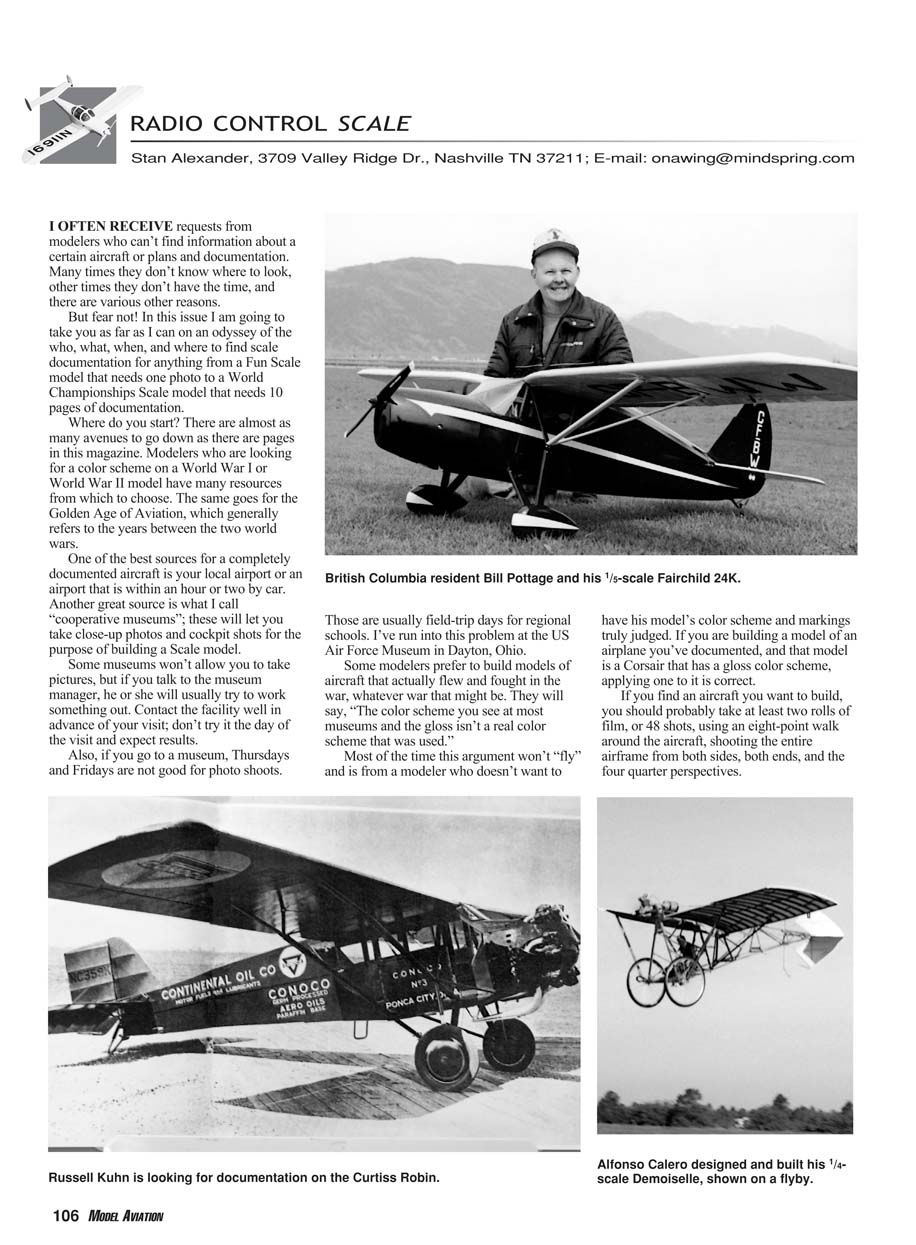
Bill Pottage of British Columbia built a beautiful Fairchild 24K from an Ikon N'West kit. The 1/5-scale model is powered by a Saito 120 four-stroke engine with a 16 x 6 propeller. It weighs 16 pounds and is covered with 21st Century fabric. The full-scale aircraft has been to Oshkosh, Wisconsin, several times.
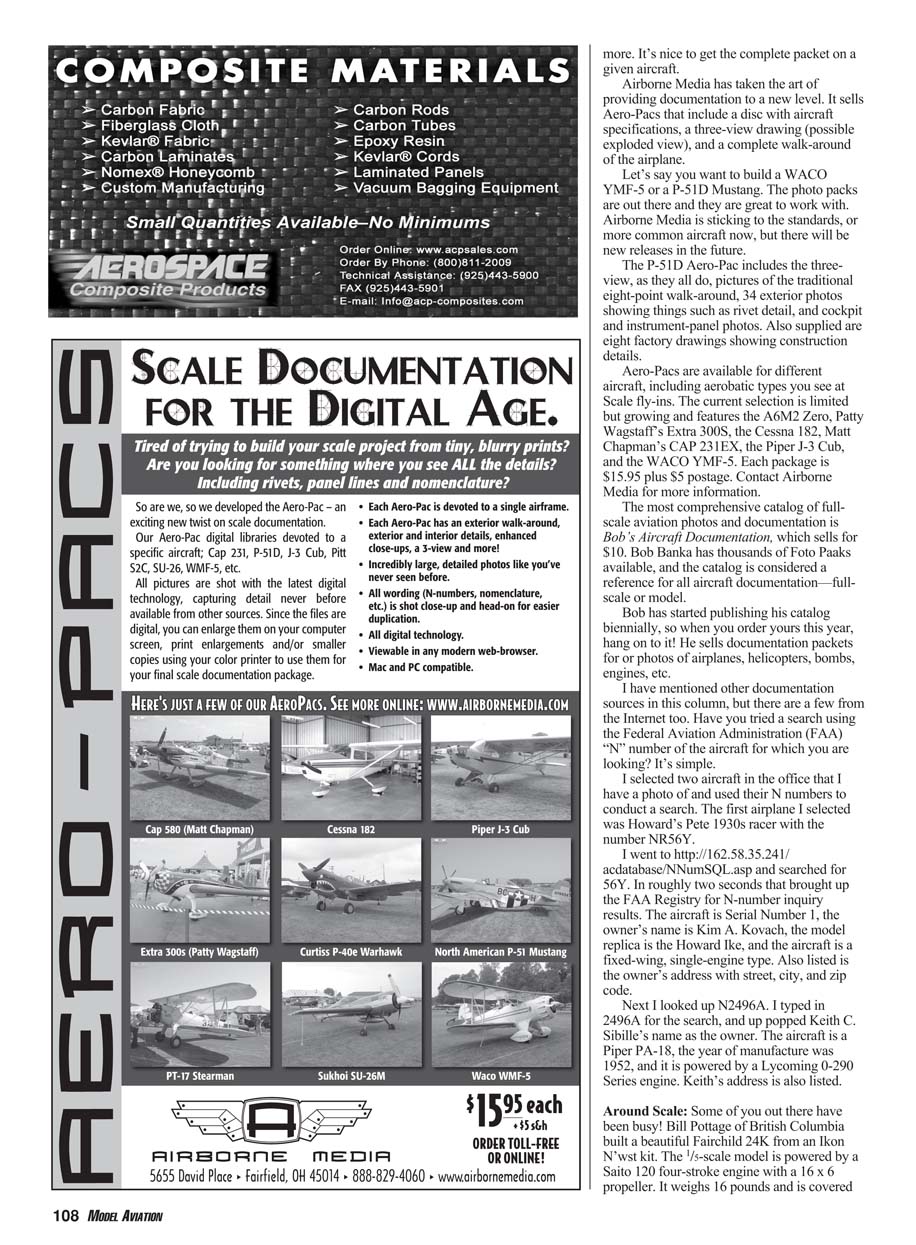
Alfonso Calero of Port Saint Lucie, Florida, has designed and built a 1/4-scale Demoiselle. The original ultralight aircraft has a wingspan of 84 inches and is powered by an Enya 91FS engine. The covering is from Coverite.
Alfonso handmade the wheels and tires. He purchased the materials at Wal-Mart, using blanks for the wheels and 90-pound steel fishing-line leaders. If you want to build the model, Alfonso says to be sure you use hard wood for the fuselage construction, including all of the sticks. Nice job!
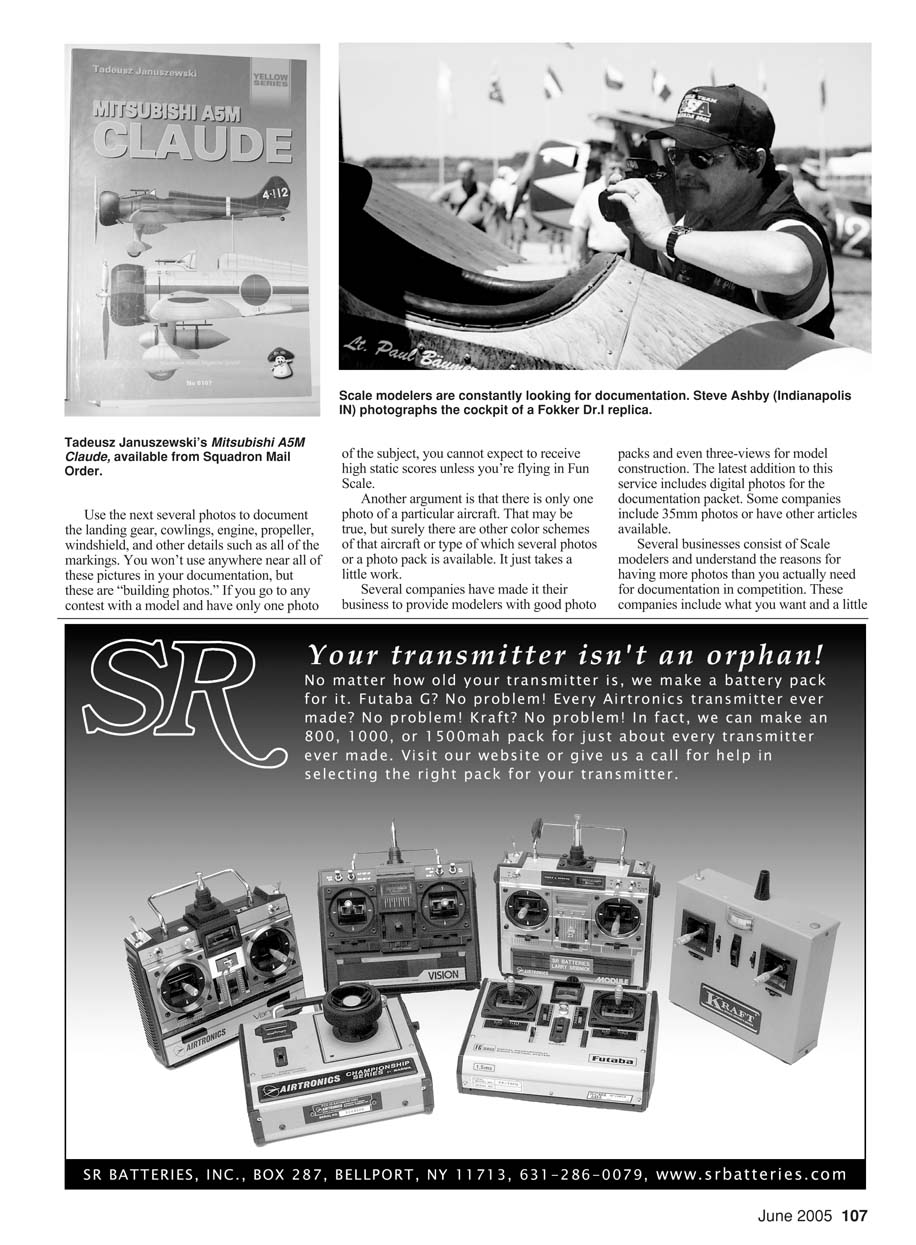
Russell Kuhn is seeking documentation for the Curtiss Robin that is shown. The company that owns the rights to the historical information about the full-scale aircraft won't release any of it. If you have any information for Russell, write to him at 8217 W. 300 S., Columbus, IN 47201.
Bookshelf
Mitsubishi A5M Claude (series No. 6107) was written by Polish author Tadeusz Januszewski and published by Mushroom Model Publications. This softcover book (ISBN 83-917178-0-1) is packed with information about an aircraft type we don't see modeled too often, even though there are plans available for it.
This volume includes scale views and color plates for the side and top, and it features several variants of the aircraft—many more than I realized. The different types include the A5M1, the A5M2, the inline A5M3, the A5M4, and the A5M4-K (two-seat trainer). It also includes 27 pages of color plates, some of which include the top view of the aircraft.
The book contains the A5M's operational history. It was the first low-wing, carrier-borne fighter in the Japanese arsenal. The type originally incorporated gull wings similar to the Corsair's, but it didn't use retracts. If you're looking for something different, model the A5M. You won't find another one at the local field!
Mitsubishi A5M Claude is $17.96 plus shipping. It is available from Squadron Mail Order, 1115 Crowley Dr., Carrollton, TX 75011. You can order by telephone at (972) 242-8663 or at www.squadron.com.
Fair skies and tailwinds. MA
Sources
- Airborne Media
7414 Burton Dr. Liberty Township, OH 45044 (888) 829-4060 www.airbornemedia.com
- Bob's Aircraft Documentation
3114 Yukon Ave. Costa Mesa, CA 92626 (714) 979-8058 Fax: (714) 979-7279 www.bobsairdoc.com
- Ikon N'West
3012 N. Altamont Spokane, WA 99207 (800) 717-4508 www.ikonnwst.com
Transcribed from original scans by AI. Minor OCR errors may remain.

