
Some Modeling Reflections Upon the New Year
Stan Alexander [[email protected]]
Another year has come and gone. Where has the time — and this past summer — gone? As I write this it’s early October and we’re already planning next year’s vacation. By the time you receive this issue Christmas will be past, but it never hurts to ask for that one item you think you will need for the next flying season. Many of us are well stocked with kits, engines, parts, and radios for that next project.
We may still have several half-completed models languishing in the back of the shop or garage for one reason or another. Some never see the shop lights again, much less the flying field. I continue to add to my list of models to build, but I have quit buying new kits and even ARFs. (Yes, I have a few ARFs too.)
This is a time of reflection for all of us who watch the hobby industry. Radio Control Modeler (RCM) is gone as far as I know, and I’m afraid some other magazines may not be far behind. I can remember RCM from the 1960s; I think I have those issues.
As do many of us pack rats who keep everything we ever had, I have quite a collection of magazines, books, and assorted “stuff” dealing with full-scale and model airplanes. In my area, unless you go to a hobby shop, modeling magazines have disappeared from the bookshelves. How about in your area?
I still buy from local hobby shops whenever an item I want or need is available there. We modelers always need some part, tool, or servo, etc., and we need it yesterday. Supporting local hobby shops continues to be valuable to the local hobby.
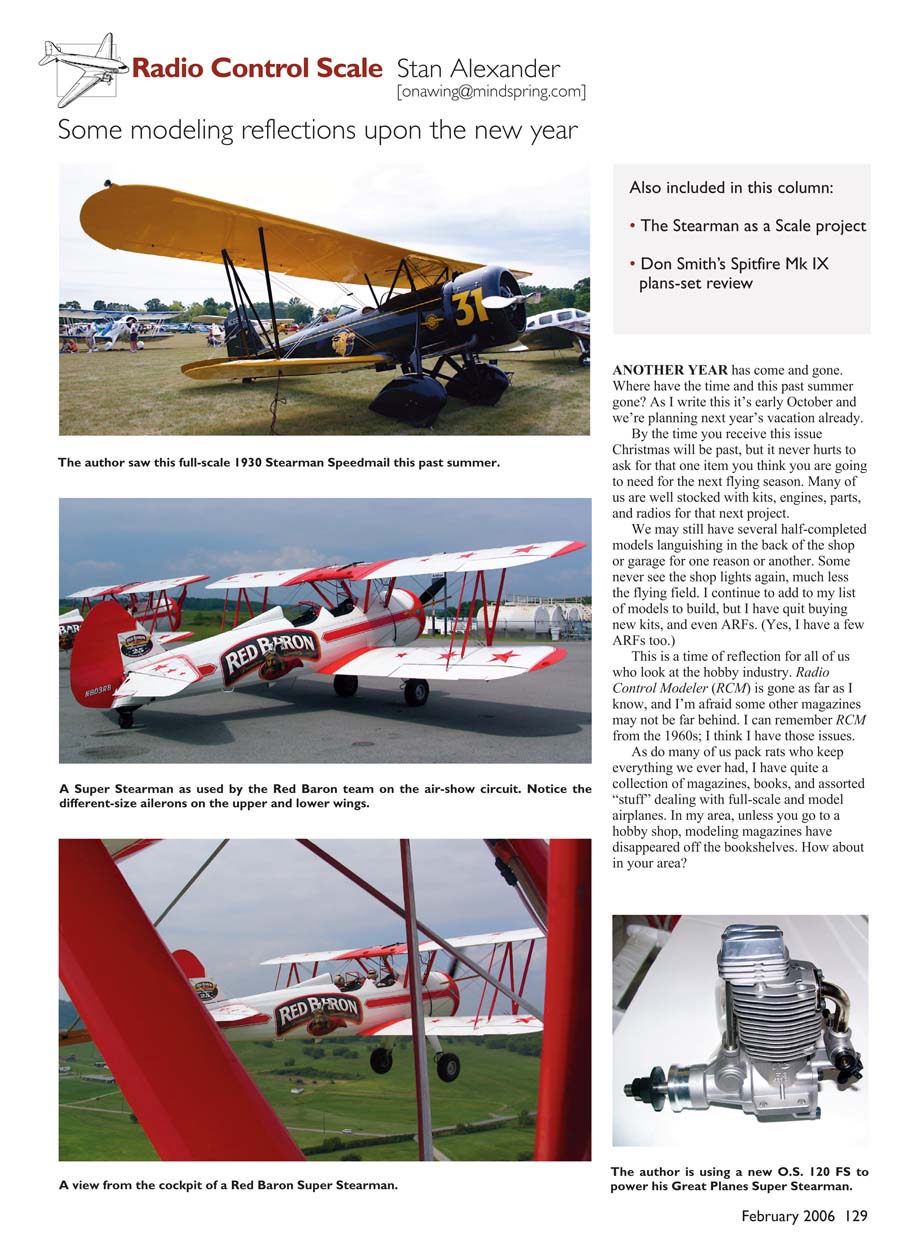
Stearman biplanes have been of great interest to me through the years. I really like the lines of the aircraft designed by Lloyd Stearman, who sold the company in 1931 to the Boeing Aircraft Company.
The biplane many of us think of as “the Stearman” began as the Model 70, then the 75, but there were many different Stearman biplanes before this classic trainer and its series of aircraft. Used by all U.S. military services and many allies, the various designs of the Stearman Model 75 were basically the same. It was built under several designations, depending on the service for which it was intended.
After World War II many surplus Stearmans were sold to crop dusters, air-show pilots, and individuals who modified the aircraft to suit their purposes. An area that usually received attention was the radial engine. Most air-show pilots changed the 225-horsepower engine to a 450-horsepower radial.
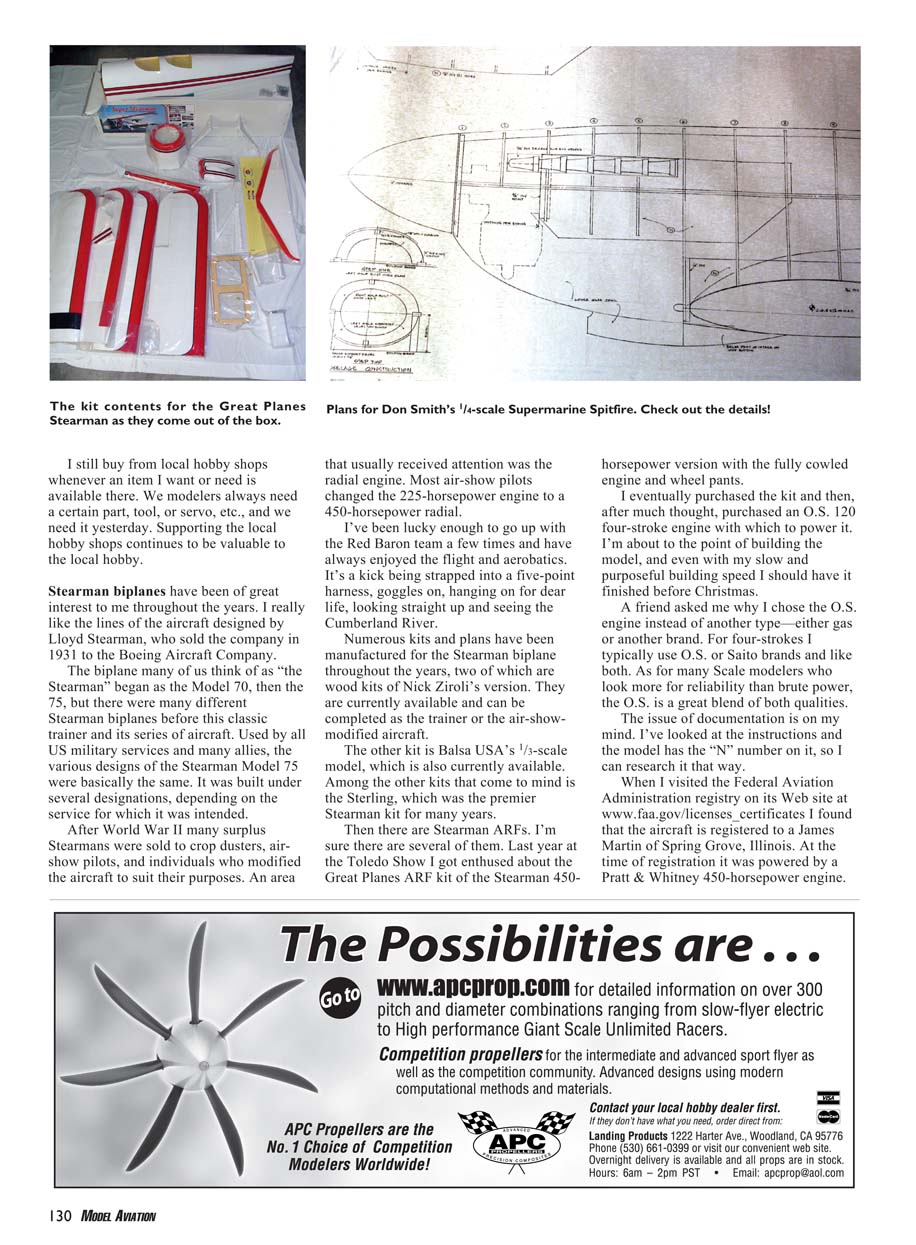
I’ve been lucky enough to go up with the Red Baron team a few times and have always enjoyed the flight and aerobatics. It’s a kick being strapped into a five-point harness, goggles on, hanging on for dear life, looking straight up and seeing the Cumberland River below.
Numerous kits and plans have been manufactured for the Stearman biplane through the years, two of which are wood kits of Nick Ziroli’s version. They are currently available and can be completed as the trainer or the air-show–modified aircraft.
The other kit is Balsa USA’s 1/3-scale model, which is also currently available. Among the other kits that come to mind is the Sterling, which was the premier Stearman kit for many years.
Then there are Stearman ARFs. I’m sure there are several of them. Last year at the Toledo show I got enthused about the Great Planes ARF kit of the Stearman 450-horsepower version with the fully cowled engine and wheel pants.
I eventually purchased the kit and then, after much thought, purchased an O.S. 120 four-stroke engine to power it. I’m about to the point of building the model, and even with my slow and purposeful building speed I should have it finished before Christmas.
A friend asked me why I chose the O.S. engine instead of another type — either glow or gas or another brand. For four-strokes I typically use O.S. or Saito brands and like both. As for many scale modelers who look more for reliability than brute power, the O.S. is a great blend of both qualities.
The issue of documentation is on my mind. I’ve looked at the instructions and the model has the N-number on it, so I can research it that way.
When I visited the Federal Aviation Administration registry on its website at www.faa.gov/licenses_certificates I found that the aircraft is registered to a James Martin of Spring Grove, Illinois. At the time of registration it was powered by a Pratt & Whitney 450-horsepower engine.
The Boeing Aircraft Company built that Stearman in 1942 with serial number 75-3268, and it is a model A75N1 (or PT-17). As have many other airplanes in this series, it went through many changes, including the cowl, wheel pants, engine, and probably several rebuilds.
When I contacted Great Planes I was informed that documentation was available for N146CM from Bob’s Aircraft Documentation, 3114 Yukon Ave., Costa Mesa, CA 92626; Tel.: (714) 979-8058; Web site: www.bobsairdoc.com. I contacted Bob, and this was one Stearman for which he didn’t have documentation.
However, he did have more than 118 Foto Paaks for the PT-17/N2S-1 Super Stearman series. I’ll have to look further and see what I can come up with.
Since the Great Planes version is an ARF you can’t use it in Sport Scale classes, but it’s a great airplane to fly at the local field or in the Fun Scale class. If I can just get those photos …
The model is intended for International Miniature Aircraft Association–type events, but Great Planes is missing a market for Fun Scale without photos. In that class you need a picture of the full-scale airplane — not a photo of the model or box-top art.
Why did I choose an ARF Stearman rather than a YBI (you build it) kit? There is so much detail on a Stearman, and I won’t use it in serious competition. I just like biplanes.
The only Stearman I’ve seen that has a convincing radial on the front is Mike Barbee’s 1/3-scale Balsa USA model. Nick Ziroli has a good one too.
However, the radial engines used on these Stearmans are no longer available, to my knowledge. If anyone has updated information about this, please let me know. I’ll write more about this next month!
Scale Products:
There are many lines of scale plans and wood kits available today, and some designers are more prolific than others. One of the best American designers is Don Smith. However, he’s not at a tender age anymore, so it continues to amaze me that he puts out as many plans as he does.
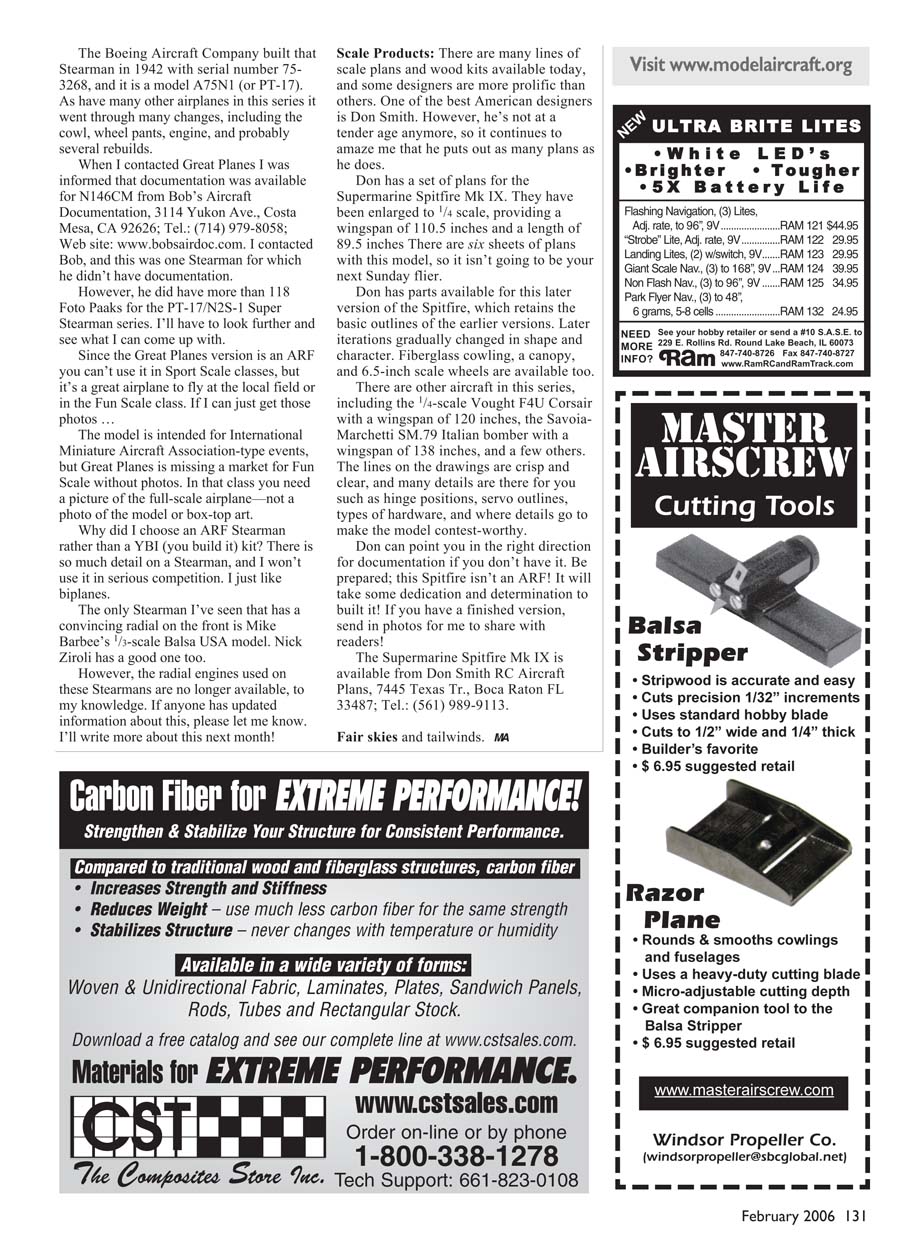
Don has a set of plans for the Supermarine Spitfire Mk IX. They have been enlarged to 1/4-scale, providing a wingspan of 110.5 inches and a length of 89.5 inches. There are six sheets of plans with this model, so it isn’t going to be your next Sunday flier.
Don has parts available for this later version of the Spitfire, which retains the basic outlines of the earlier versions. Later iterations gradually changed in shape and character. Available items include a fiberglass cowling, a canopy, and 6.5-inch scale wheels.
There are other aircraft in this series, including:
- 1/4-scale Vought F4U Corsair — wingspan 120 inches
- Savoia-Marchetti SM.79 Italian bomber — wingspan 138 inches
- a few others
The lines on the drawings are crisp and clean, and many details are there for you to use, such as hinge positions, servo outlines, types of hardware, and where details go to make the model contest-worthy.
Don can point you in the right direction for documentation if you don’t have it. Be prepared; this Spitfire isn’t an ARF! It will take some dedication and determination to build it. If you have a finished version, send in photos for me to share with readers!
The Supermarine Spitfire Mk IX is available from Don Smith RC Aircraft Plans, 7445 Texas Tr., Boca Raton, FL 33487; Tel.: (561) 989-9113.
Fair skies and tailwinds, MA
Transcribed from original scans by AI. Minor OCR errors may remain.

