

Radio Control Scale — 2006/07
Stan Alexander <[email protected]>
Thoughts about electric-powered Scale models
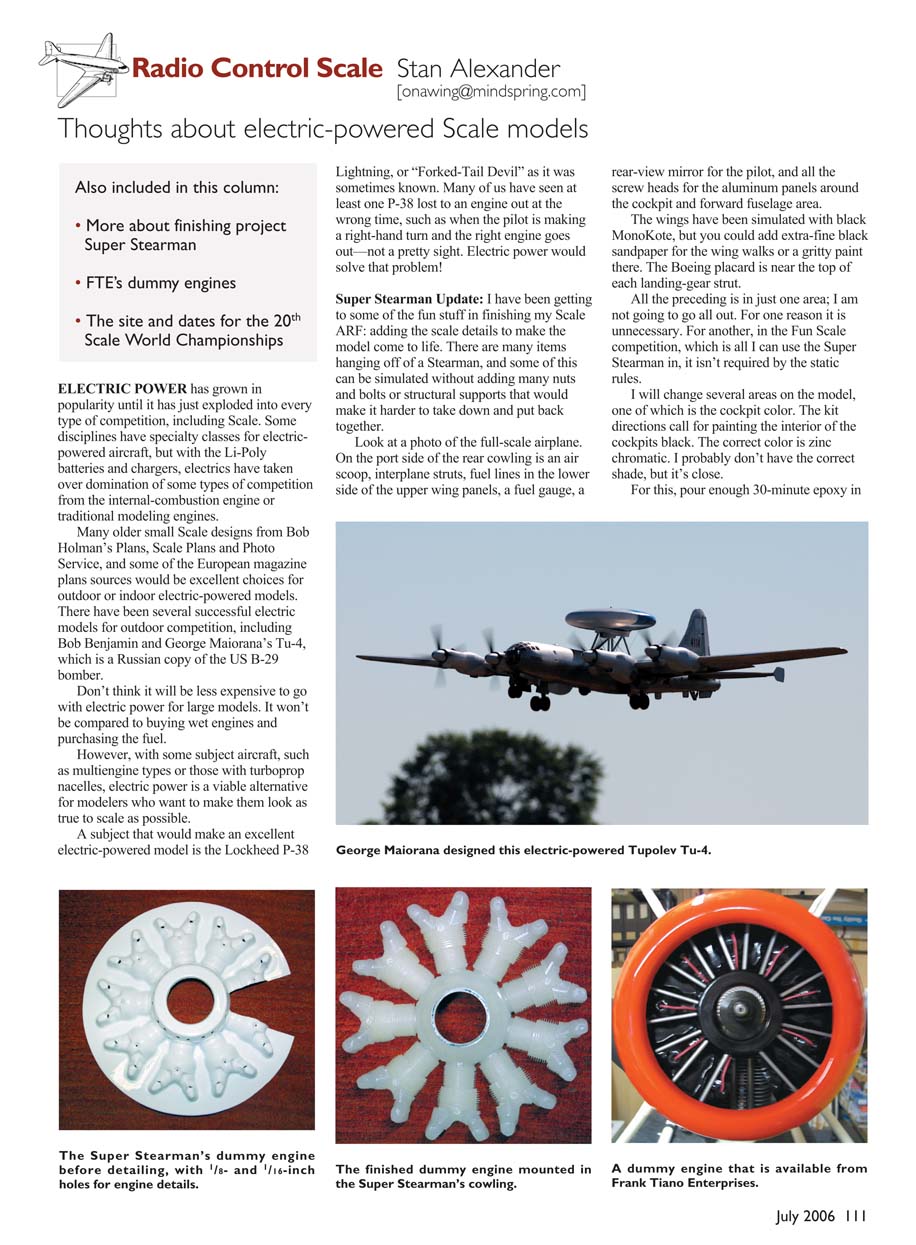
Electric power has grown in popularity until it has exploded into every type of competition, including Scale. Some disciplines have specialty classes for electric-powered aircraft, but with Li-Poly batteries and modern chargers, electrics have taken over or dominated some types of competition that were once the realm of internal-combustion or traditional modeling engines. Many older small Scale designs from Bob Holman's Plans, Scale Plans and Photo Service, and some European magazine plan sources would be excellent choices for outdoor or indoor electric-powered models. There have been several successful electric models for outdoor competition, including Bob Benjamin and George Maiorana's Tu-4, a Russian copy of the US B-29 bomber.
Don't assume it will be less expensive to go with electric power for large models. It won't be cheaper compared to buying wet engines and purchasing the fuel.
However, with some subjects — such as multi-engine types or aircraft with turboprop nacelles — electric power is a viable alternative for modelers who want to make them look as true to scale as possible. A subject that would make an excellent electric-powered model is the Lockheed P-38 Lightning, the "Forked-Tail Devil." Many of us have seen at least one P-38 lost to an engine-out at the wrong time (for example, during a right-hand turn when the right engine quits). Electric power would solve that problem.
Super Stearman Update
I've been working on finishing my Scale ARF and adding scale details to make the model come to life. There are many items hanging off a Stearman, and some of these can be simulated without adding many nuts, bolts, or structural supports that would make the model harder to take down and reassemble.
Look at a photo of the full-scale airplane. On the port side of the rear cowling is an air scoop; there are interplane struts, fuel lines on the lower side of the upper wing panels, a fuel gauge, a rear-view mirror for the pilot, and many screw heads for the aluminum panels around the cockpit and forward fuselage. The wing walks have been simulated with black MonoKote, but you could add extra-fine black sandpaper or gritty paint for more realism. The Boeing placard is near the top of each landing-gear strut.
I'm not going to go completely overboard. For one reason it is unnecessary, and for another, in Fun Scale competition (which is the only class I can use the Super Stearman in) most of these details aren't required by the static rules.
I will change several areas on the model, one of which is the cockpit color. The kit directions call for painting the interior of the cockpits black. The correct color is zinc chromate. I probably don't have the exact shade, but I'm close.
For sealing bare balsa before painting, pour enough 30-minute epoxy into a jar or mixing cup (I use baby-food jars), thin it with denatured alcohol, mix, and use it as a sealant. After approximately two coats you are ready to add finish paint. I used the same method on the cowling ring that mounts to the fuselage and is glued to the back edge of the cowling.
Use care when cutting plastic parts such as windscreens, the turtledeck, cowling, dummy engine, etc. A Dremel tool with a small grinding burr works well on many of these parts. Work slowly: if you remove too little material you can always remove more; if you remove too much, you may need to start over. It is easier to cut the plastic without cracking it. Cut these parts outside or in a well-ventilated area away from wind so fine plastic dust doesn't blow into your face — it makes a fine mess.
Adhere the turtledeck, cockpit coaming, and windscreens with an appropriate canopy glue such as RC/56. Be careful when trimming the back of the turtledeck to fit the rudder; it must also fit to the rear of the rear cockpit. I used masking tape to keep pieces tight after gluing. I usually let these parts sit for at least 24 hours, although it's probably not required.
Fit the dummy engine into the cowling and make sure it fits. If it doesn't, trim the lip on the outer edges until you obtain a good, tight fit.
Select the top-dead-center cylinder and cut the space for cooling air to enter at the bottom of that engine opening. A punch works well for marking multiple holes; after making many small holes, use a small burr on the Dremel tool to open them to a round shape. Start small and work outward — be careful not to remove too much material.
Paint the engine after fitting and final shaping. I used epoxy primer and aluminum paint for the basic finish, then added ignition wires and other small details to dress up the dummy engine.
The spots for locating the holes in the dummy engine are unmarked, so make a best guess using the photo in the directions. After drilling the two 1/8-inch holes for the pushrod tubes, try one to make sure it fits. If it does, the rest should follow. Per the directions, make 1/16-inch holes in the top part of the cylinder heads for the spark-plug wires.
After looking at several radial engines over the years, I decided to paint this one gloss black rather than flat black. Any owner worth his or her salt will keep a Stearman's radial in great shape, and the cylinders on show aircraft are often glossy. Set the dummy engine aside and let it dry after the second coat of paint.
The next day I added the pushrod tubes and then the spark-plug wires using electrical wire from my junk box. Leave approximately 3/8 inch of wire on each end to have something to epoxy to the back of the dummy engine.
Mount the dummy engine to the inside of the cowling using a mix of microballoons and epoxy. Make sure you have the cutout cylinder at the bottom to allow cooling air.
Scale Products
There are other dummy engines and cylinders you can purchase for this and other models. Frank Tiano Enterprises (FTE) supplies different sizes of resin dummy engines for Scale modelers. You can detail them to an accurate nine-cylinder radial in little time. They also add weight to the nose of a Scale model — and what radial-powered Scale model doesn't benefit from a little extra nose weight?
Engines come in a variety of sizes:
- 1/8 scale — 5.75-inch diameter
- 1/6 scale — 7.25-inch diameter
- 1/5 scale — 8.75-inch diameter
- 1/4 scale — 11.5-inch diameter
The 1/5 and 1/4 sizes weigh about 12 ounces. Add the 1/4 plywood mounting plate and you've added useful nose weight.
Prices range from $22 to $34 plus shipping. Visit www.franktiano.com for more information.
Upcoming World Championships
It has recently been announced that the 20th Scale World Championships will be held in Wloclawek, Poland, in 2008. The contest will be hosted by the Aero Club of Poland and the Aero Club of Wloclawek. Events will include F4C (RC Scale with a weight limit of 33.03 pounds, or 15 kilograms) and F4B CL Scale.
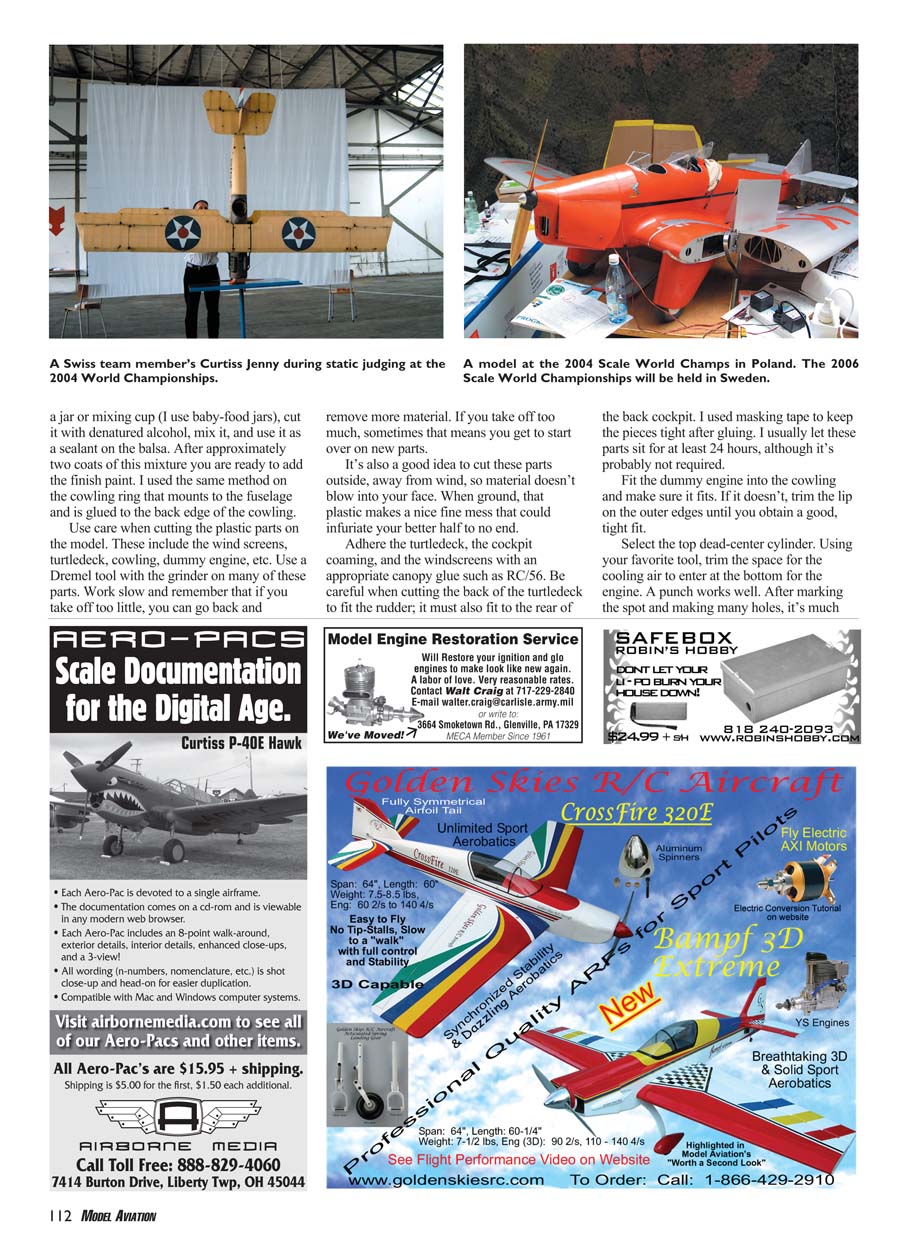
The 2004 Scale World Championships was held in Deblin, Poland, at the Air Force Academy. If any country wants to see how to run a Scale World Championships, the 2008 event is the place to go. The Poles have their act together regarding organization, officials, food, accommodations, and generous sponsorships.
Although it's not for RC Scale, in 2008 the Polish Aero Club will host, to my knowledge, the first Junior Scale event at a World Championships. It will be held for F4B, and it's great to see a country with the foresight to encourage a new generation into competition.
My wife and I were fortunate to attend the 2004 Scale World Championships and travelled through Warsaw, Krakow, and other places. The company was warm, the tours were great, and the Poles are quickly embracing Western ideas. Poland is a great place for Americans to travel; Polish currency is not on the euro yet, unlike most of Western Europe.
The US Team Selection will be sometime in 2007. If you are interested, please contact me and I'll get you the details and a list of contacts to help. For updates on Team Selection, periodically check www.nasascale.org.
Fair skies and tailwinds. MA
Sources
- Bob Holman Plans
Box 741 San Bernardino, CA 92404 (909) 885-3995 [email protected] www.bhplans.com
- Scale Plans and Photo Service
3209 Madison Ave. Greensboro, NC 27403 (336) 292-5239 (evenings)
Transcribed from original scans by AI. Minor OCR errors may remain.

