
Radio Control Scale
Stan Alexander [[email protected]]
A neat technique for modeling cable covers
One of the great things you can learn by going to contests or fly-ins is how to do things for your current or next Scale project. I have mentioned using plastic spoons for the fairings that cover the aileron cables on models such as the Piper Super Cub or other light aircraft. One builder said he used sample spoons from the local Baskin-Robbins ice cream shop to make his fairings.
A modeler who has been working on a somewhat larger scale is Larry Folk. He built a 1/3-scale Balsa USA Piper Super Cub that spans 141 inches and weighs 35 pounds. He actually built a Top Cub, which is a kit company for full-scale Cub-type aircraft. His documentation came from a trip to Oshkosh, Wisconsin, and from the company that produces the kit now.
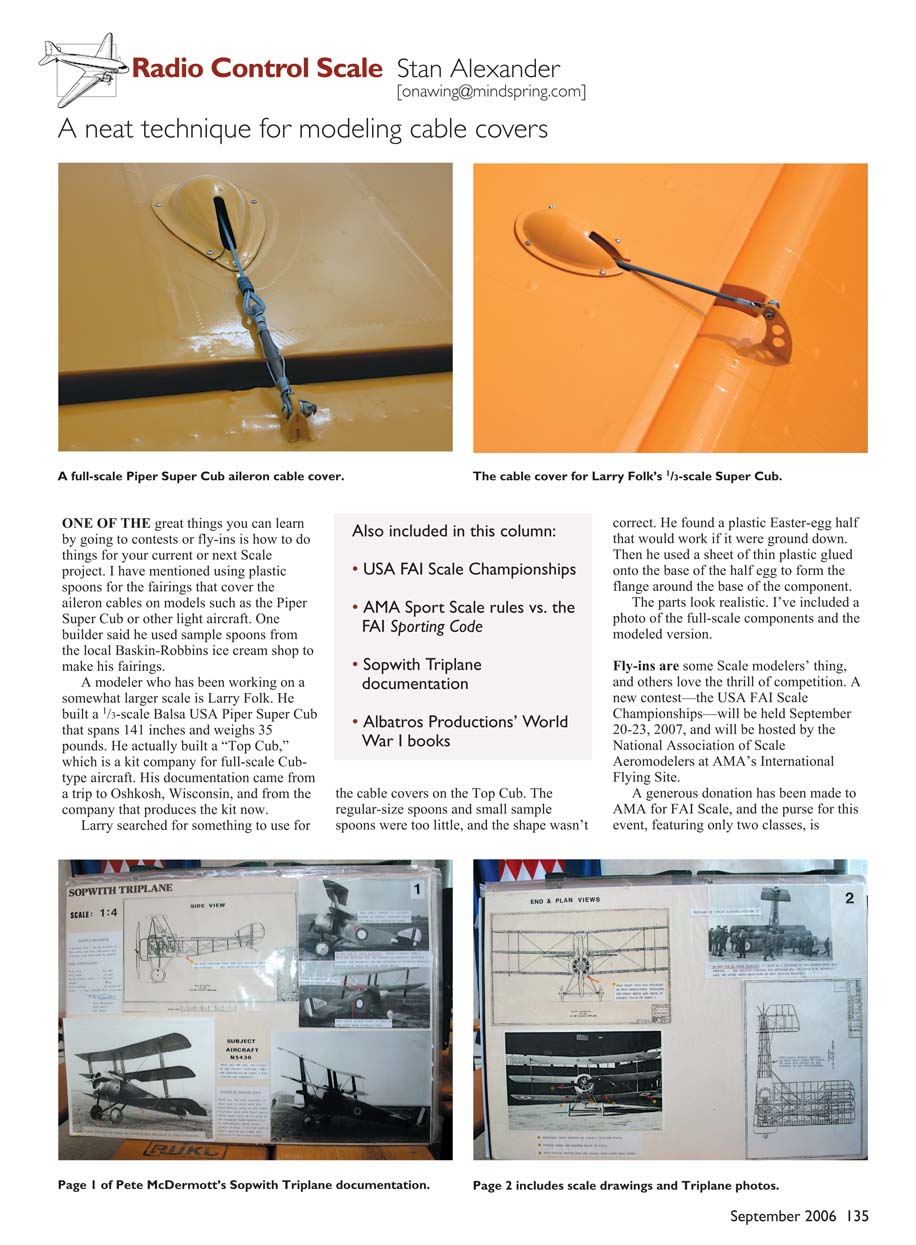
Larry searched for something to use for the cable covers on the Top Cub. The regular-size spoons and small sample spoons were too little, and the shape wasn't correct. He found a plastic Easter-egg half that would work if it were ground down. Then he used a sheet of thin plastic glued onto the base of the half egg to form the flange around the base of the component. The parts look realistic. I've included a photo of the full-scale components and the modeled version.
Also included in this column:
- USA FAI Scale Championships
- AMA Sport Scale rules vs. the FAI Sporting Code
- Sopwith Triplane documentation
- Albatros Productions' World War I books
Fly-ins are some Scale modelers' thing, and others love the thrill of competition. A new contest—the USA FAI Scale Championships—will be held September 20–23, 2007, and will be hosted by the National Association of Scale Aeromodelers at AMA's International Flying Site.
A generous donation has been made to AMA for FAI Scale, and the purse for this event, featuring only two classes, is $10,000. The F4 Scale Sporting Code rules for FAI F4C (RC Scale) and F4B (CL Scale) can be found on NASA's Web site at www.nasascale.org. Follow the links to the FAI's Web site and the downloads.
What's the difference between the AMA Sport Scale rules and the FAI Sporting Code, you might ask? There are several differences—especially in the static arena. AMA's rules and regulations for Scale competition require a smaller amount of documentation for static judging. Page 163 of AMA's rule book under "6. Proof of Scale" reads that this is the responsibility of the contestant. Section 6.2 specifies:
"Either: a. A three-view drawing (line, tone or color). Drawings with more than three (3) views are acceptable."
These drawings must be from a reliable source such as the aircraft manufacturer, model or aviation magazines, books, etc. Commercially available three-view drawings are acceptable. Plans of nonflying solid or replica models, from either a kit or magazine, are acceptable. Also acceptable are homemade or unpublished drawings, corrected three-views, or drawings approved in advance by AMA Technical Director Steve Kaluf or a Scale Contest Board member, the manufacturer or builder, or other competent authority.
Sometimes we find three-view scale drawings by the kit manufacturer here in the US. You might get away with using this; in some forms of competition it's okay. In other competition, including FAI Scale, using a three-view drawn by a model company will get you zero points in static judging for outline. Some model companies might bend the outline to more correctly match their model than the full-scale aircraft.
AMA Sport Scale rules under section 6.3 read:
"To be eligible for Finish, Color, and Markings points, some proof of the color scheme used on the model is required. This can be either: a. Photo or photos. b. Some other pictorial representation, such as a magazine or other published color painting or drawing. c. A detailed written description of the color scheme and/or markings from a reliable source. d. Notes and diagrams of markings on black-and-white three-view ..."
This is one area that differs vastly between AMA and FAI Scale requirements. To be able to compete in any FAI Scale contest, you have to meet the minimum of one photo of the complete aircraft. The picture has to show the entire aircraft you intend to model, from front to tail feathers.
There should also be at least two other photos, preferably from different aspects if available, of the aircraft you model or of the prototype aircraft with different markings.
Let’s say you intend to model the P-51B Mustang "Miss Elizabeth" and you can find only one side photo showing the entire aircraft. No others exist. To this one photo you need to add two other photos of P-51B aircraft. Not partial shots or nose shots, but of the entire airplane.
It states in the FAI Sporting Code on page 49 under section 6.1.9.4 a) that "The photographic evidence is the prime means of judging scale accuracy against the prototype."
It has been said in Scale circles that the preceding requirements limit Scale modelers’ choices. That could be one way to put it, I agree. On the flip side, it also means that the competitor will have to document the full-scale aircraft to a higher degree of accuracy to score well in static judging.
I can’t tell you the number of models I’ve seen that have a color slide view as their only documentation for a photo. Watching the competition, these models are at a distinct disadvantage and usually finish somewhere in the middle to low end of the pack.
In the scenario I have described, these are the minimums to be able to compete. This in no way means this is what you need to win the competition.
The photos
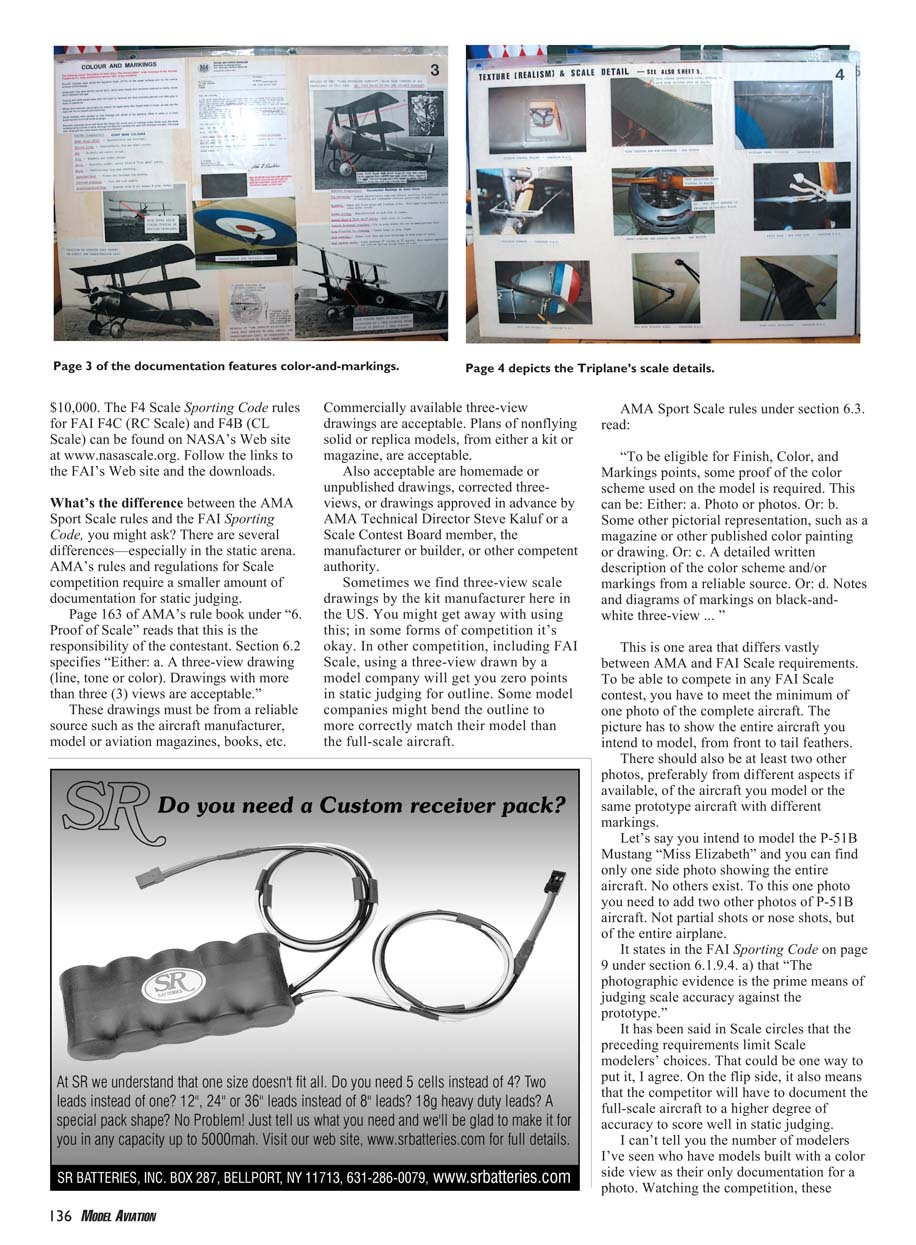
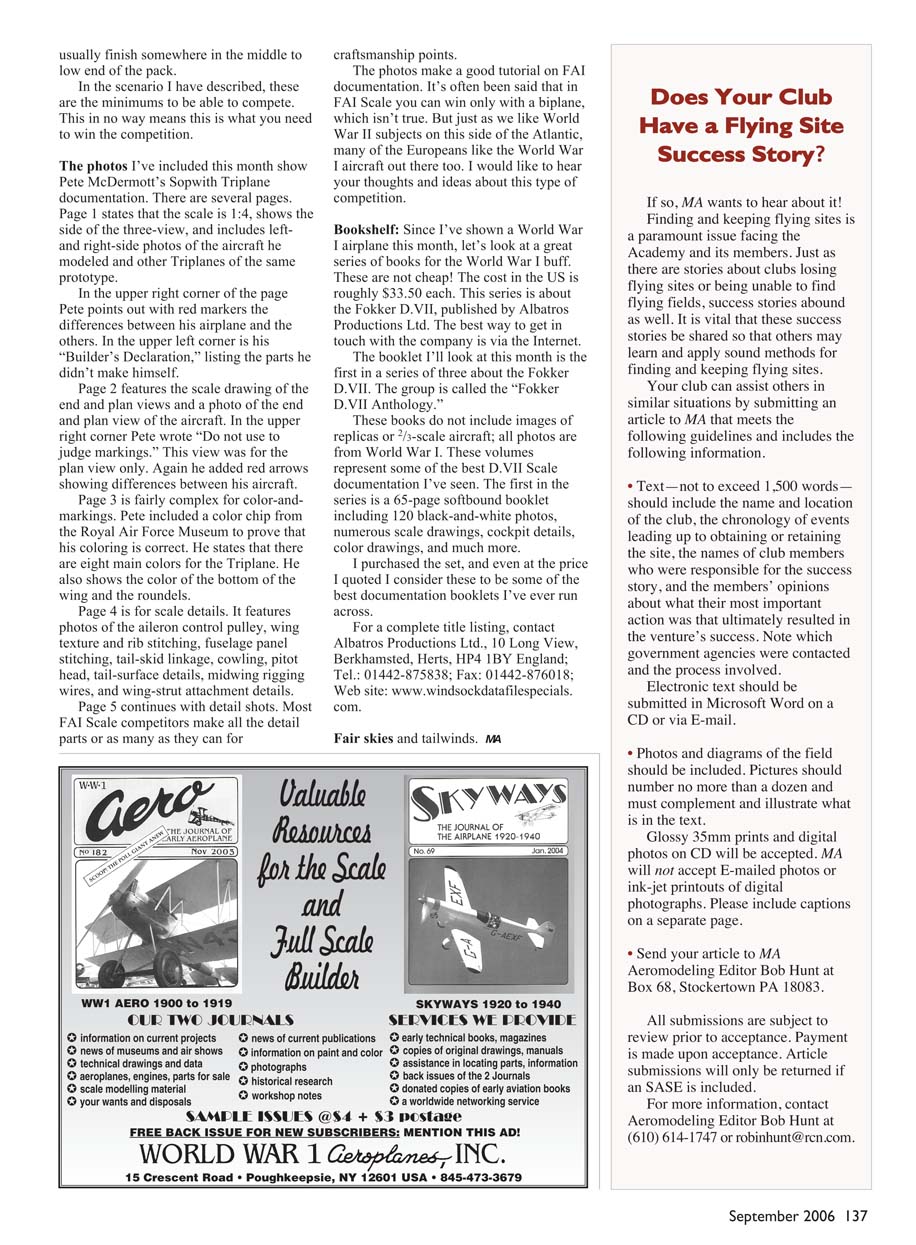
The photos I’ve included this month show Pete McDermott’s Sopwith Triplane documentation. There are several pages.
Page 1 states that the scale is 1:4, shows the side of the three-view, and includes left- and right-side photos of the aircraft he modeled and other Triplanes of the same prototype. In the upper right corner of the page Pete points out with red markers the differences between his airplane and the others. In the upper left corner is his "Builder’s Declaration," listing the parts he didn’t make himself.
Page 2 features the scale drawing of the end and plan views and a photo of the end and plan view of the aircraft. In the upper right corner Pete wrote "Do not use to judge markings." This view was for the plan view only. Again he added red arrows showing differences between his aircraft.
Page 3 is fairly complex for color and markings. Pete included a color chip from the Royal Air Force Museum to prove that his coloring is correct. He states that there are eight main colors for the Triplane. He also shows the color of the bottom of the wing and the roundels.
Page 4 is for scale details. It features photos of the aileron control pulley, wing texture and rib stitching, fuselage panel stitching, tail-skid linkage, cowling, pitot head, tail-surface details, midwing rigging wires, and wing-strut attachment details.
Page 5 continues with detail shots. Most FAI Scale competitors make all the detail parts or as many as they can for craftsmanship points.
The photos make a good tutorial on FAI documentation. It’s often been said that in FAI Scale you can win only with a biplane, which isn’t true. But just as we like World War II subjects on this side of the Atlantic, many Europeans like World War I aircraft too. I would like to hear your thoughts and ideas about this type of competition.
Bookshelf
Since I’ve shown a World War I airplane this month, let’s look at a great series of books for the World War I buff. These are not cheap—the cost in the US is roughly $33.50 each. This series is about the Fokker D.VII, published by Albatros Productions Ltd. The best way to get in touch with the company is via the Internet.
The booklet I’ll look at this month is the first in a series of three about the Fokker D.VII. The group is called the "Fokker D.VII Anthology."
These books do not include images of replicas or 2/3-scale aircraft; all photos are from World War I. These volumes represent some of the best D.VII scale documentation I’ve seen. The first in the series is a 65-page softbound booklet including 120 black-and-white photos, numerous scale drawings, cockpit details, color drawings, and much more.
I purchased the set, and even at the price I quoted I consider these to be some of the best documentation booklets I’ve ever run across.
For a complete title listing, contact:
- Albatros Productions Ltd.
- 10 Long View, Berkhamsted, Herts, HP4 1BY, England
- Tel.: 01442-875838
- Fax: 01442-876018
- Web: www.windsockdatafilespecials.com
Fair skies and tailwinds. MA
Transcribed from original scans by AI. Minor OCR errors may remain.

