
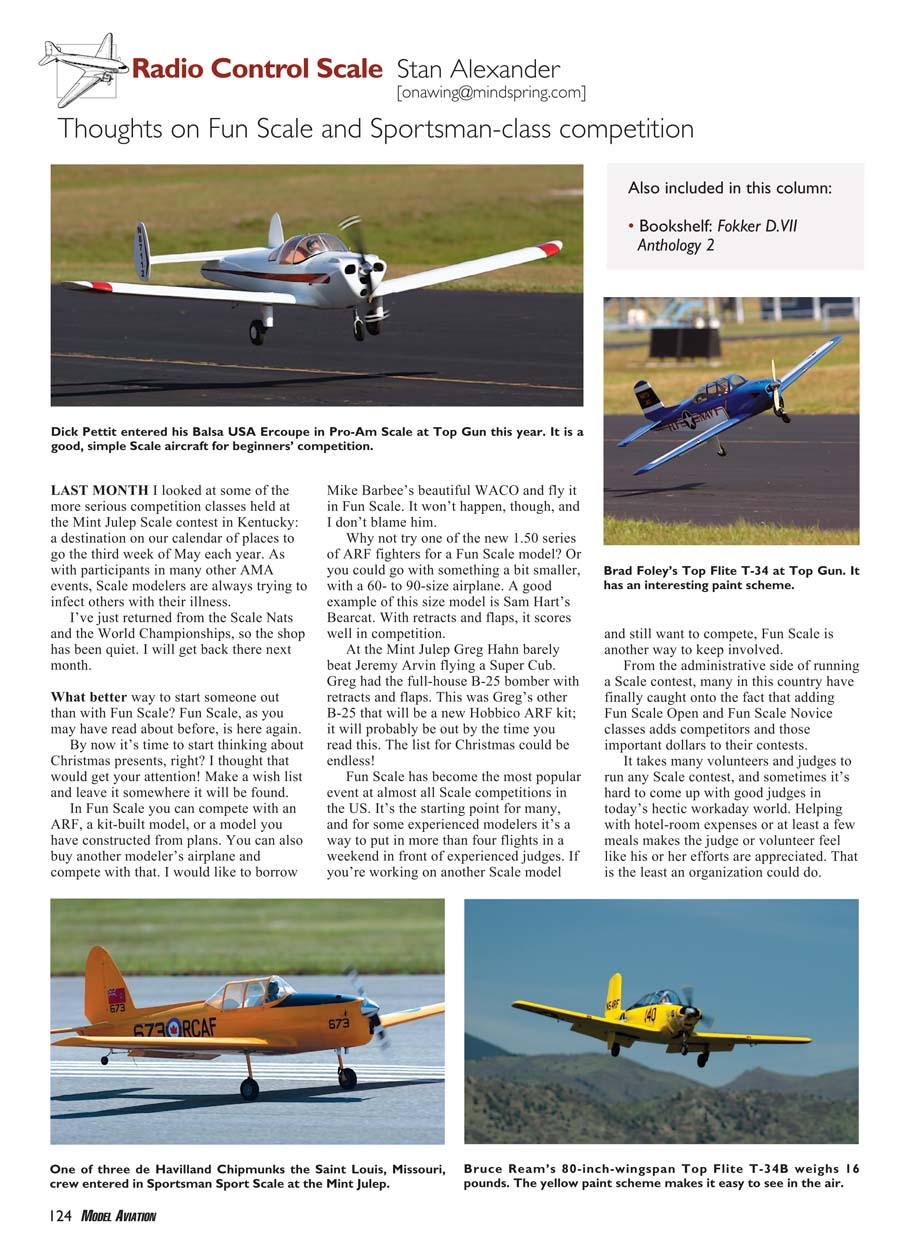
Radio Control Scale — Thoughts on Fun Scale and Sportsman-class competition
Stan Alexander [[email protected]]
Last month I looked at some of the more serious competition classes held at the Mint Julep Scale contest in Kentucky: a destination on our calendar of places to go the third week of May each year. As with participants in many other AMA events, Scale modelers are always trying to infect others with their illness. I’ve just returned from the Scale Nats and the World Championships, so the shop has been quiet. I will get back there next month.
What better way to start someone out than with Fun Scale? Fun Scale, as you may have read about before, is here again. By now it’s time to start thinking about Christmas presents, right? I thought that would get your attention! Make a wish list and leave it somewhere it will be found.
In Fun Scale you can compete with an ARF, a kit-built model, or a model you have constructed from plans. You can also buy another modeler’s airplane and compete with that. I would like to borrow Mike Barbee’s beautiful WACO and fly it in Fun Scale. It won’t happen, though, and I don’t blame him.
Why not try one of the new .1.50 series of ARF fighters for a Fun Scale model? Or you could go with something a bit smaller, with a 60- to 90-size airplane. A good example of this size model is Sam Hart’s Bearcat. With retracts and flaps, it scores well in competition.
At the Mint Julep, Greg Hahn barely beat Jeremy Arvin flying a Super Cub. Greg had the full-house B-25 bomber with retracts and flaps. This was Greg’s other B-25 that will be a new Hobbico ARF kit; it will probably be out by the time you read this. The list for Christmas could be endless!
Fun Scale has become the most popular event at almost all Scale competitions in the US. It’s the starting point for many, and for some experienced modelers it’s a way to put in more than four flights in a weekend in front of experienced judges. If you’re working on another Scale model and still want to compete, Fun Scale is another way to keep involved.
From the administrative side of running a Scale contest, many in this country have finally caught onto the fact that adding Fun Scale Open and Fun Scale Novice classes adds competitors and those important dollars to their contests.
It takes many volunteers and judges to run any Scale contest, and sometimes it’s hard to come up with good judges in today’s hectic workaday world. Helping with hotel-room expenses or at least a few meals makes the judge or volunteer feel like his or her efforts are appreciated. That is the least an organization could do.
You haven’t been to a Mint Julep unless you’ve had part of Dale’s “Bag of Fun” time at the banquet. Adding the two Fun Scale classes and two Expert-class divisions (I and II, mentioned in last month’s column) have helped with the meet’s attendance, which is easily as large as any in the country for pure Scale competition. The idea for those separate divisions is one rule proposal many would like to see for AMA Sport Scale classes. It puts similar aircraft with similar options and capabilities in the same category. You don’t have jets competing against Fokker Dr.I triplanes.
Sportsman class is the next step up for modelers, and this is where the ranks seem to be fewer. Many Scale modelers seem to make the jump straight into Expert, which is a huge mistake. Once you make that jump and find out your skills aren't what you thought they were, you become disillusioned with the competition. You have put yourself in a class you won't win for several years, if ever.
Sportsman class is a breeding ground for future Scale National Champions. At the Mint Julep this year there were several modelers from the Saint Louis, Missouri, area, and they all competed with Dynaflite de Havilland Chipmunks. All used the same three-view drawings and similar photos.
Those are good beginner kits for the Sportsman class and fly well. Al Kretz has a beautiful Chipmunk, and he did a great deal of work on it to make it more competitive. There were three of the Dynaflite Chipmunks in Sportsman class: Mike Stellern’s, Rick Karg’s, and Mark Stellern’s.
There are many great subject aircraft for the Sportsman class, and full-scale military trainers are some of the best. The T-34 kit by Top Flite is popular, as is the PT-19 kitted by Dynaflite. Both have a good choice of color schemes, and the T-34 offers a nose gear for takeoffs and landings.
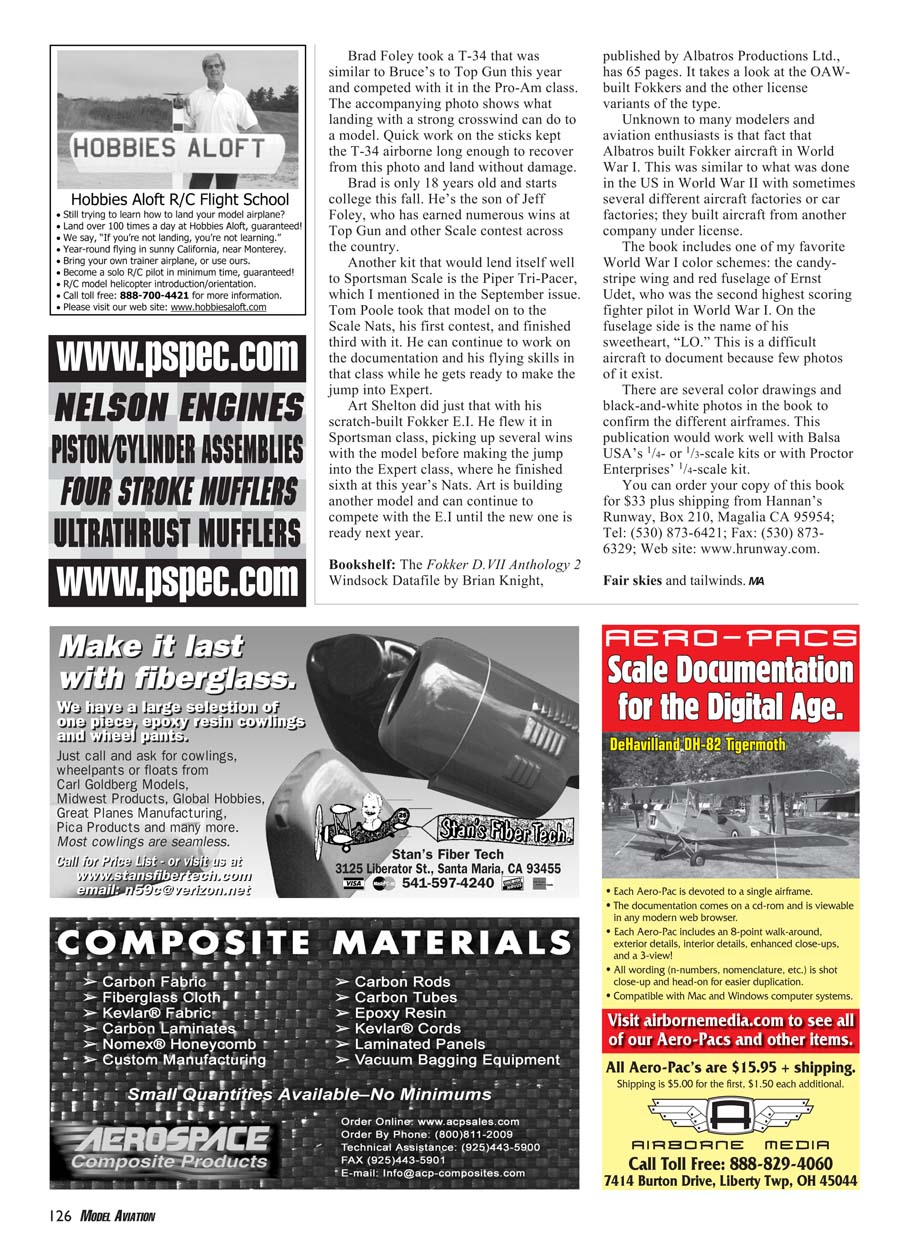
Bruce Ream’s version of the Top Flite T-34 spans 80 inches and weighs 16 pounds. He uses a Magnum 1.60 twin four-stroke engine for power, along with the standard Robart retracts that are manufactured for that particular kit. The T-34 has retracts as well as flaps.
There are two mechanical options used in the flight program in AMA Scale classes, so you only have to have three other flight options to go along with the mechanical options. You might choose:
- a military roll
- a Split-S
- the Immelmann turn
The T-34 kit can be a serious competitor at regional contests if the modeler takes his or her time and documents the aircraft well.
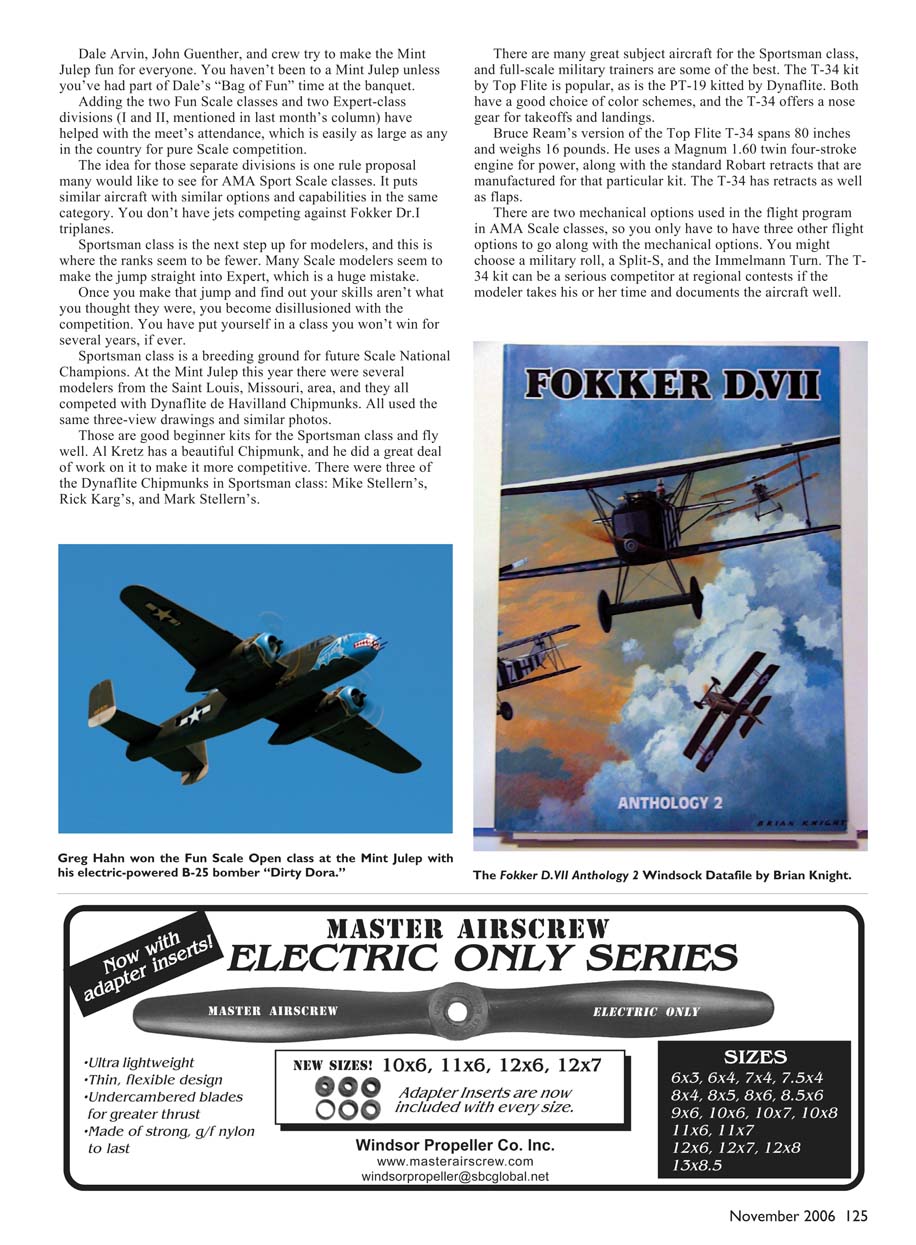
Brad Foley took a T-34 that was similar to Bruce’s to Top Gun this year and competed with it in the Pro-Am class. The accompanying photo shows what landing with a strong crosswind can do to a model. Quick work on the sticks kept the T-34 airborne long enough to recover from this photo and land without damage. Brad is only 18 years old and starts college this fall. He’s the son of Jeff Foley, who has earned numerous wins at Top Gun and other Scale contests across the country.
Another kit that would lend itself well to Sportsman Scale is the Piper Tri-Pacer, which I mentioned in the September issue. Tom Poole took that model on to the Scale Nats, his first contest, and finished third with it. He can continue to work on the documentation and his flying skills in that class while he gets ready to make the jump into Expert.
Art Shelton did just that with his scratch-built Fokker E.I. He flew it in Sportsman class, picking up several wins with the model before making the jump into the Expert class, where he finished sixth at this year’s Nats. Art is building another model and can continue to compete with the E.I. until the new one is ready next year.
Bookshelf: The Fokker D.VII Anthology 2 — Windsock Datafile
By Brian Knight, published by Albatros Productions Ltd., 65 pages. It takes a look at the OAW-built Fokkers and the other license variants of the type.
Unknown to many modelers and aviation enthusiasts is the fact that Albatros built Fokker aircraft in World War I. This was similar to what was done in the US in World War II, when sometimes several different aircraft factories built aircraft from another company under license.
The book includes one of my favorite World War I color schemes: the candy-stripe wing and red fuselage of Ernst Udet, who was the second highest scoring fighter pilot in World War I. On the fuselage side is the name of his sweetheart, “LO.” This is a difficult aircraft to document because few photos of it exist.
There are several color drawings and black-and-white photos in the book to confirm the different airframes. This publication would work well with Balsa USA’s 1/4- or 1/3-scale kits or with Proctor Enterprises’ 1/4-scale kit.
You can order your copy of this book for $33 plus shipping from:
- Hannan’s Runway
- Box 210, Magalia CA 95954
- Tel: (530) 873-6421
- Fax: (530) 873-6329
- Web: www.hrunway.com
Fair skies and tailwinds. MA
Transcribed from original scans by AI. Minor OCR errors may remain.

