
Stan visits the Fantasy of Flight Museum
In most of the country it’s time to be building seriously. The weather is generally cold or worse, and it’s a great time to hole up in the shop and build, and wait until it gets a little warmer to do the painting outside or in a well-ventilated shop.
How many of you have started your scale models without documentation? Do you have that photo for Fun Scale or a complete documentation set for Sportsman, Expert, Designer, or FAI?
I usually shoot 40–60 photos for a Sport Scale model to use for documentation. I don’t use all those pictures in the presentation, but they will help you get your pride and joy as close as you can to the full-scale version. Employ the photos you can use to prove your skill, and leave the others in the file.
Where do you find the elusive information and photos? In some cases this can be a quest like something out of the movies. In other cases it’s as simple as going to your local airport.
There are so many ARFs now that it’s amazingly simple to find these photos in each kit—or is it? I’ve been amazed by the number of ARFs that are built claiming to be “scale models” but have no documentation, no source inside the kit, and no photo of the full-scale aircraft on the box top—despite paying more than $400 for the kit.
Last year at the Toledo R/C Expo I even saw an ARF kit of a PT-19 with retracts. Now there’s an idea.
If you’re building a model yourself, visiting aviation museums and seeking out obscure documentation becomes a subhobby within the scale fraternity. Anywhere my wife and I travel I do a Google search and check to see if there is a museum close by. If there is, my wife knows we will stop there at least one afternoon for a couple of hours.
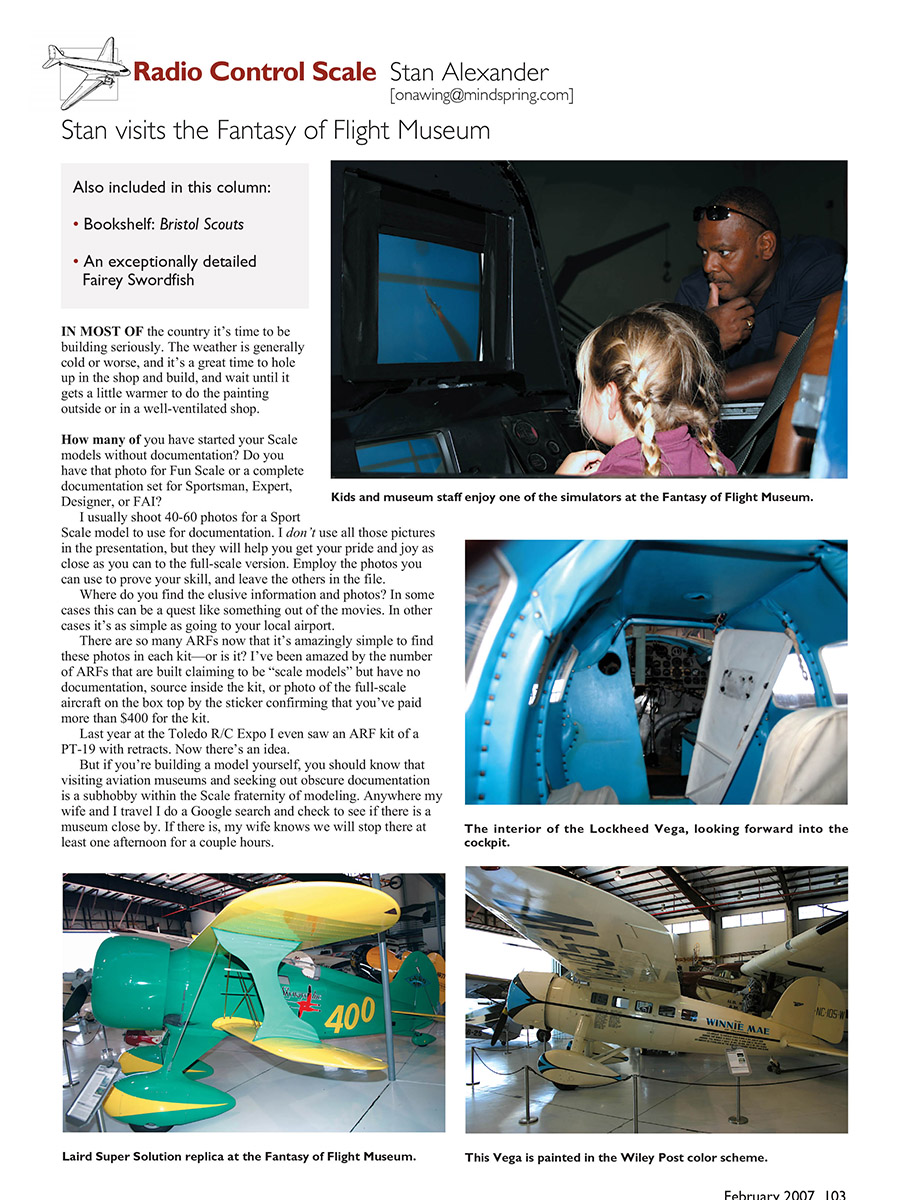
Almost all aviation museums have become kid-friendly and are now also teaching institutions. Many of these museums have simulators—some with computer screens and state-of-the-art programs similar to the ones we modelers use when we can’t go to the field. There are many reasons for this, including luring the interest of the next generation of aviation enthusiasts. Tax breaks are probably another reason. In one museum during spring break three years ago I witnessed the younger generation completely disregard the “aviation” section of the museum, while the space-exploration side was packed. The old biplanes and monoplanes of 1909–1955 didn’t hold the younger visitors’ interest. This museum didn’t cater to them with simulators and other kid-friendly activities. There might be a lesson there for us all.
Fantasy of Flight Museum (Polk City, Florida)
This year we took several trips, and I made it a point to stop at every aviation museum we could. One of those is located in the Orlando, Florida, area between Disney World and Lakeland. The Fantasy of Flight Museum is located west of Orlando in Polk City. This museum is the dream of Kermit Weeks and, unlike many of the military museums we visit, is an aviation attraction in a string of attractions in Central Florida.
Admission is pricy, but when you realize where you are and the pristine condition of this aviation collection, you understand why. General admission is $26.95 per person and $24.95 per person if you are 55 or older. When you enter the museum you’ll see the aviation-themed café to the right and the gift shop on the left, which—like any other gift shop—is cleverly designed to catch your attention before you exit the facility.
Two hangars are currently open, and the restoration facility is available for tours. You can also purchase flights in Stearman biplanes.
This is an active private museum (the largest) with a collection of historic and replica aircraft that makes most scale modelers drool with anticipation. Many of the replicas are of aircraft of which the originals no longer exist. Replicas and notable examples include:
- Gee Bee Model Z
- Gee Bee Model R-2
- Ryan NYP "Spirit of St. Louis"
- Fokker Dr.I
- Laird Super Solution
The list of historic aircraft is much larger, with more than 44 on display and several I had never seen before, such as:
- Focke-Wulf Fw 44 Stieglitz — a 1930s biplane trainer
- Cierva C.30A Autogiro
- Curtiss Junior
Many other aircraft are listed on the museum’s website at www.fantasyofflight.com.
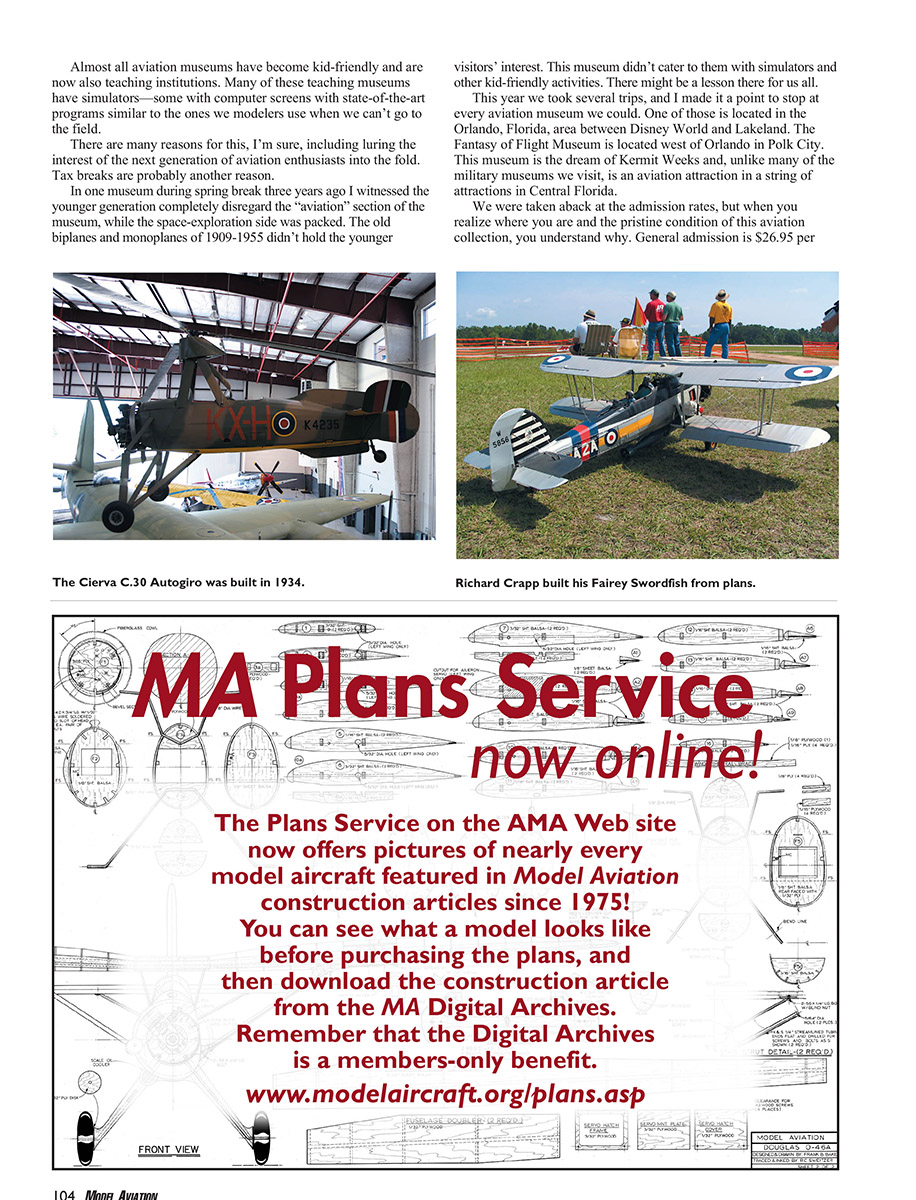
Talking to museum staff and letting them know you appreciate the historic value of these priceless airframes helps sometimes. An aircraft that interested me in particular was built by Lockheed in 1929—only two years after Charles Lindbergh's New York-to-Paris flight. It is airframe number 72.
A total of 198 of the historically significant Lockheed Vegas were built. The Vega's sister aircraft were the midwing Orion and the low-wing Sirius. I have seen only one Orion, and it’s in a transportation museum in Switzerland finished in Swiss colors.
While taking walk-around photos of the Vega and talking to the staff about its history, I asked if it would be possible to go inside and shoot the interior. Initially I was told no, to which I replied that I understood and thanked the supervisor for his time. He walked off and came back roughly ten minutes later to tell me to come on inside.
So this is how we view the photos of the interior of an airplane built from molded wood with the halves glued together—it worked! The pilot’s seat is a bench that folds down after the pilot climbs into the cramped cockpit. I didn’t try that; I’m 6 feet 3 inches tall and just didn’t think it was made for people my size.
For more information about the Vega, all the other aircraft, and the museum, contact the Fantasy of Flight Museum staff via their website. Maps and all other aspects of the museum are available there.
Bookshelf: Bristol Scouts
Bristol Scouts by J.M. Bruce is Windsock Datafile 44. Compared to the Sopwith Pup, the Nieuport 11, and the Hanriot HD.1, the series of Bristol Scouts represents an evolution of aircraft design in the making.
The booklet has a cardstock cover, and the only color drawings are on the front and back covers. There are 36 pages of black-and-white photos and scale drawings for modelers, as well as a short history of the type.
Bristol had a series of Scouts from the A to D models with various changes. I’d hoped there would be a couple of pages of color side views for these aircraft within the pages, but there aren’t. However, this book is still worth the price with all the scale drawings and photos if you’re interested in World War I biplanes.
Bristol Scouts is available from Hannan’s Runway at (530) 873-6421 or www.hrunway.com.
Fairey Swordfish (model by Richard Crapp)
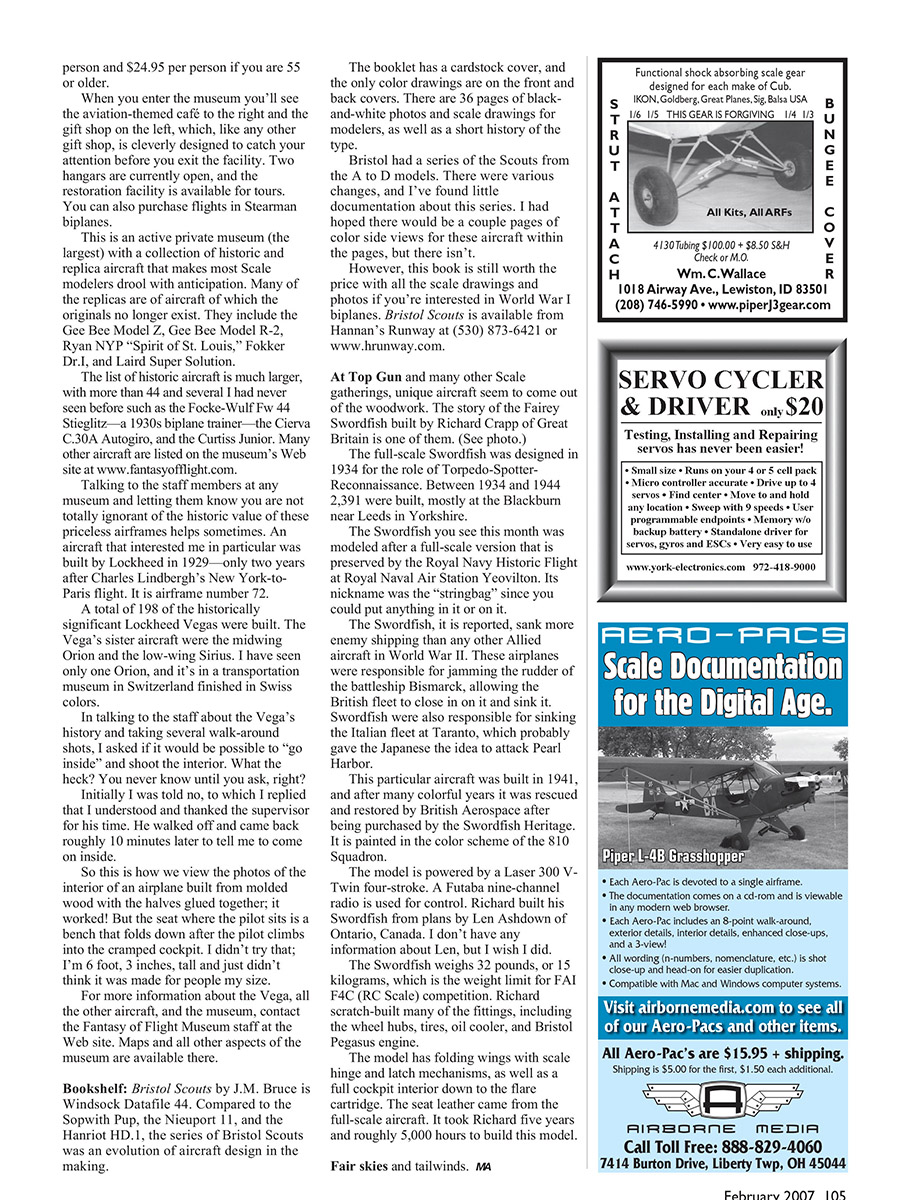
At Top Gun and many other scale gatherings, unique aircraft seem to come out of the woodwork. The story of the Fairey Swordfish built by Richard Crapp of Great Britain is one of them.
The full-scale Swordfish was designed in 1934 for the role of torpedo-spotter-reconnaissance. Between 1934 and 1944, 2,391 were built, mostly at the Blackburn plant near Leeds in Yorkshire.
The Swordfish you see this month was modeled after a full-scale example preserved by the Royal Navy Historic Flight at Royal Naval Air Station Yeovilton. Its nickname was the "Stringbag" since you could put anything in it or on it.
The Swordfish, it is reported, sank more enemy shipping than any other Allied aircraft in World War II. These airplanes were responsible for jamming the rudder of the battleship Bismarck, allowing the British fleet to close in and sink it. Swordfish were also responsible for the attack on the Italian fleet at Taranto, which probably gave the Japanese the idea to attack Pearl Harbor.
This particular full-scale aircraft was built in 1941 and, after many colorful years, was rescued and restored by British Aerospace after being purchased by the Swordfish Heritage. It is painted in the color scheme of 810 Squadron.
Richard’s model is powered by a Laser 300 V-Twin four-stroke engine and uses a Futaba nine-channel radio for control. He built his Swordfish from plans by Len Ashdown of Ontario, Canada.
The model weighs 32 pounds (about 15 kilograms), which is the weight limit for FAI F4C (RC Scale) competition. Richard scratch-built many of the fittings, including the wheel hubs, tires, oil cooler, and a scale Bristol Pegasus engine.
The model has folding wings with scale hinge and latch mechanisms, as well as a full cockpit interior down to the flare cartridge. The seat leather came from the full-scale aircraft. It took Richard five years and roughly 5,000 hours to build this model.
Fair skies and tailwinds. MA
Transcribed from original scans by AI. Minor OCR errors may remain.

