
Radio Control Scale - 2008/04
There will be inaugural flight covers for the routes. The US Postal Service has been brought onboard and will have an updated replica of the original airmail “Jenny” stamp. There will be a different cachet for each of the four days of airmail flights. For Scale modelers who are interested in this era of aviation, or stamp collecting for that matter, this is an event not to miss!
Around Scale
A host of models across the country fit the description of “airmail” types. Some of the full-scale versions were purpose-built airplanes, but many were off-the-shelf 1920s- to 1930s-era civil and military aircraft that were pressed into service.
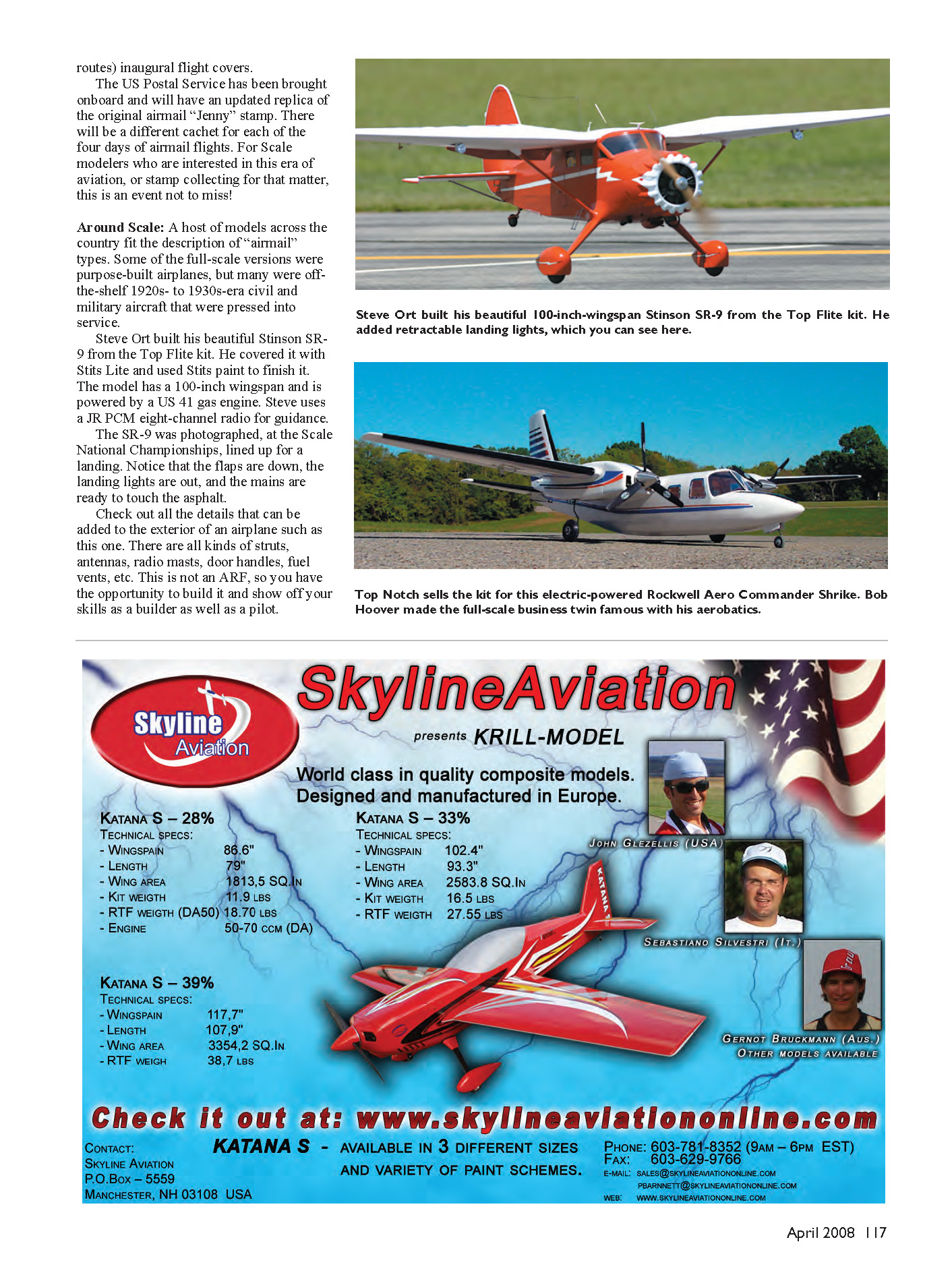
Steve Ort built his beautiful Stinson SR-9 from the Top Flite kit. He covered it with Stits Lite and used Stits paint to finish it. The model has a 100-inch wingspan and is powered by an OS 41 gas engine. Steve uses a JR PCM eight-channel radio for guidance.
The SR-9 was photographed at the Scale National Championships, lined up for a landing. Notice that the flaps are down, the landing lights are out, and the main wheels are ready to touch the asphalt.
Check out all the details that can be added to the exterior of an airplane such as this one: struts, antennas, radio masts, door handles, fuel vents, and more. This is not an ARF, so you have the opportunity to build it and show off your skills as a builder as well as a pilot.
The Vega shown was modeled after the aircraft in which Amelia Earhart completed her solo crossing of the Atlantic. This particular version was named the "Little Red Bus." Lockheed built a family of aircraft including the Vega, the Orion, and the Air Express. Lloyd Roberts scratch-built this model, and, to my knowledge, plans are unavailable.
The Travel Air 2000 is another 1920s-era aircraft that was pressed into service as an airmail carrier. This series of Travel Air aircraft did a variety of jobs for its owners including charter service, airmail, and flight training.
Lawrence Klingberg, a West Coast resident, builds all his models from scratch, including the 1/4-scale Travel Air 2000. It is covered with Solartex and finished with Rust-Oleum spray paints.
Museums
The Tennessee Museum of Aviation is located at the airport in Sevierville, in the eastern part of the state. There are plenty of signs leading you to the facility. Once inside, you go by the gift center and pay your entry fee, and then you can go into the hangar.
I enjoyed looking at the P-51D, two P-47s, the SNJ, and the Grumman TBM Avenger, as well as a few other aircraft. After reviewing the whole lineup, I had to wonder where the Stinson and Vultee aircraft were—those are aircraft with some Tennessee history.
I walked back out to see the photos and plaques from the honorees in the museum's Hall of Fame and ran into a museum volunteer. I asked him where the Stinsons and Vultees were, and he told me that most of those aircraft had been destroyed and they weren't as popular as the warbirds. This is a beautiful facility—it's clean and well lit—but something is missing.
New Products
I had never heard of Top Notch Product Company before I saw its booth at the last swap meet I attended in Nashville. I talked with John Valentine, the president of the business, and realized that he has some nice stuff.
All the Top Notch kits feature laser-cut parts and complete instructions. John's offerings include:
- Shoestring Formula I racer — 64-inch wingspan
- Lear Fan jet short kit — 78-inch wingspan
- Cessna 195 — 48-inch wingspan (there is even a float kit available)
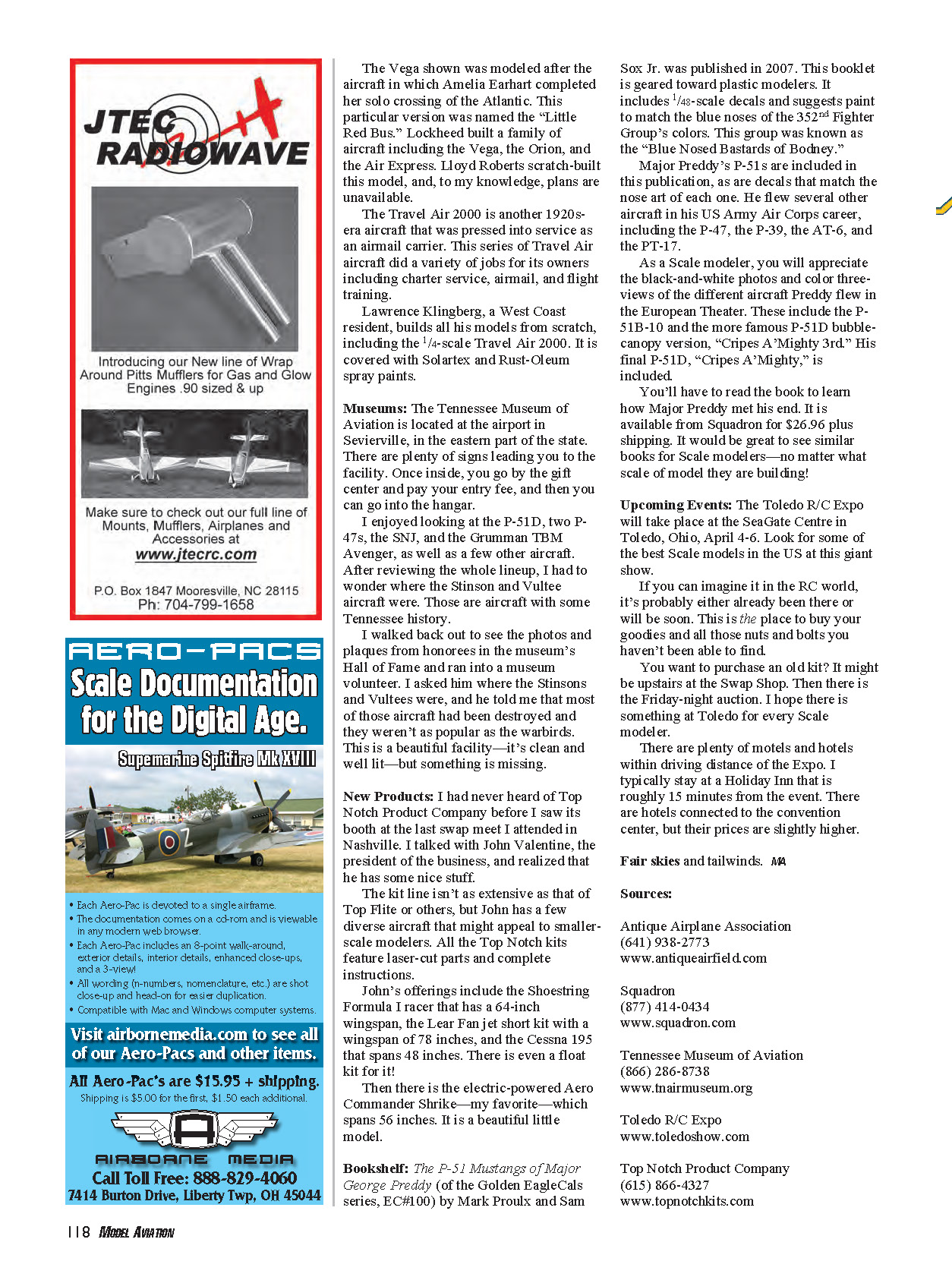
- Electric-powered Aero Commander Shrike — 56-inch wingspan (my favorite)
The kit line isn't as extensive as that of Top Flite or others, but the diverse aircraft should appeal to smaller-scale modelers.
Bookshelf
The P-51 Mustangs of Major George Preddy (Golden Eagle Cals series, EC#100) by Mark Proulx and Sam Sox Jr. was published in 2007. This booklet is geared toward plastic modelers. It includes 1/48-scale decals and suggests paint to match the blue noses of the 352nd Fighter Group's colors. This group was known as the "Blue Nosed Bastards of Bodney."
Major Preddy's P-51s are included in this publication, as are decals that match the nose art of each one. He flew several other aircraft in his US Army Air Corps career, including the P-47, the P-39, the AT-6, and the PT-17.
As a Scale modeler, you will appreciate the black-and-white photos and color three-views of the different aircraft Preddy flew in the European Theater. These include the P-51B-10 and the more famous P-51D bubble-canopy version, "Cripes A'Mighty 3rd." His final P-51D, "Cripes A'Mighty," is included.
You'll have to read the book to learn how Major Preddy met his end. It is available from Squadron for $26.96 plus shipping. It would be great to see similar books for Scale modelers—no matter what scale of model they are building!
Upcoming Events
The Toledo R/C Expo will take place at the SeaGate Centre in Toledo, Ohio, April 4–6. Look for some of the best Scale models in the US at this giant show.
If you can imagine it in the RC world, it's probably either already been there or will be soon. This is the place to buy your goodies and all those nuts and bolts you haven't been able to find.
Want to purchase an old kit? It might be upstairs at the Swap Shop. Then there is the Friday-night auction. I hope there is something at Toledo for every Scale modeler.
There are plenty of motels and hotels within driving distance of the Expo. I typically stay at a Holiday Inn that is roughly 15 minutes from the event. There are hotels connected to the convention center, but their prices are slightly higher.
Fair skies and tailwinds. MA
Sources:
- Antique Airplane Association: (641) 938-2773, www.antiqueairfield.com
- Squadron: (877) 414-0434, www.squadron.com
- Tennessee Museum of Aviation: (866) 286-8738, www.tnairmuseum.org
- Toledo R/C Expo: www.toledoshow.com
- Top Notch Product Company: (615) 866-4327, www.topnotchkits.com
LOW-voltage
A hot rod in its time, this low-wing sportster could perform amazingly with modern power and RC equipment
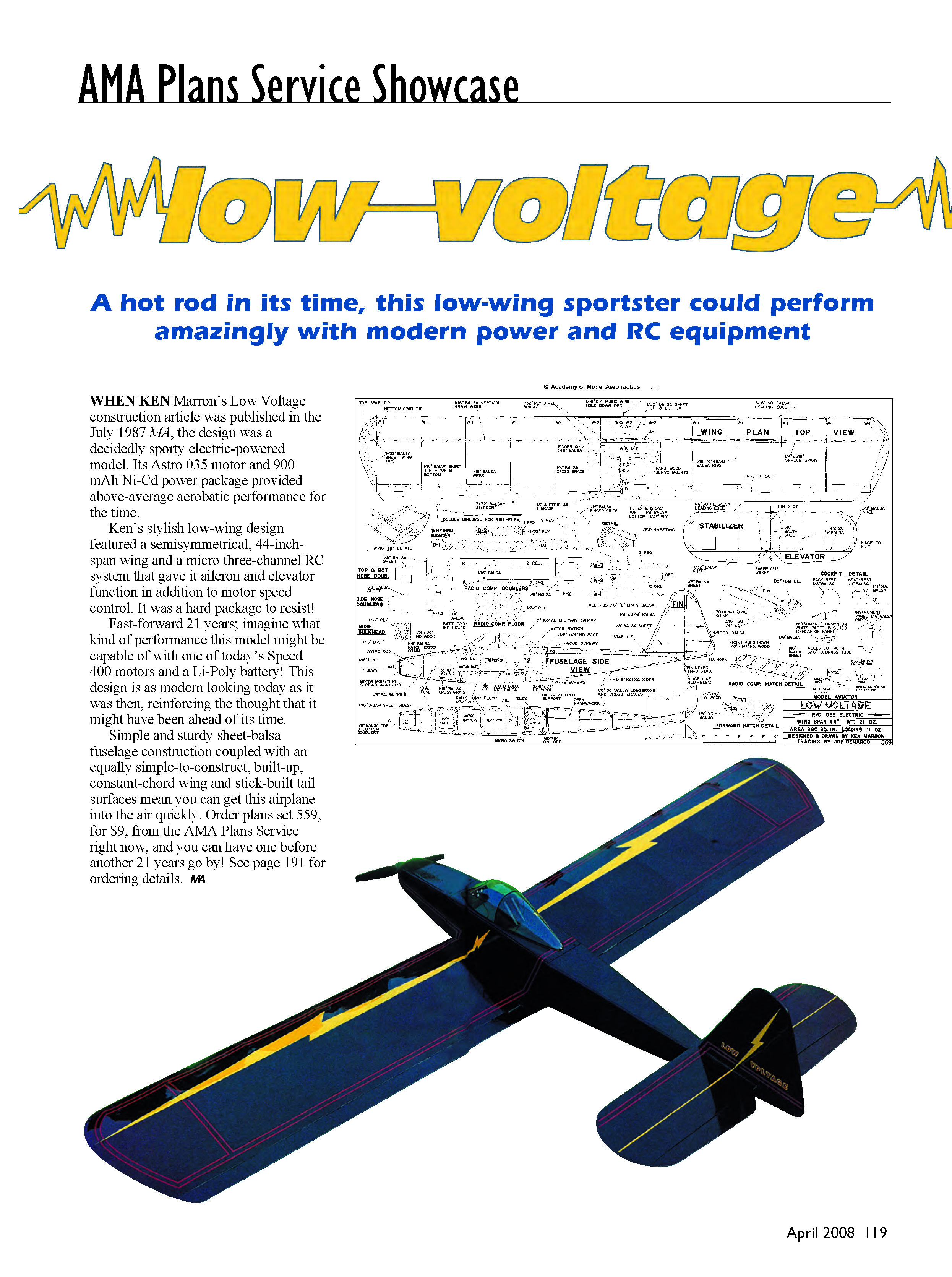
When Ken Marron's Low Voltage construction article was published in the July 1987 MA, the design was a decidedly sporty electric-powered model. Its Astro 035 motor and 900 mAh Ni-Cd power package provided above-average aerobatic performance for the time.
Ken's stylish low-wing design featured a semisymmetrical, 44-inch-span wing and a micro three-channel RC system that gave it aileron and elevator function in addition to motor speed control. It was a hard package to resist!
Fast-forward 21 years; imagine what kind of performance this model might be capable of with one of today's Speed 400 motors and a Li-Poly battery! This design is as modern looking today as it was then, reinforcing the thought that it might have been ahead of its time.
Simple and sturdy sheet-balsa fuselage construction coupled with an equally simple-to-construct, built-up, constant-chord wing and stick-built tail surfaces mean you can get this airplane into the air quickly. Order plans set 559, for $9, from the AMA Plans Service right now, and you can have one before another 21 years go by!
Transcribed from original scans by AI. Minor OCR errors may remain.

