
Problems with gasoline enhanced with ethanol
Stan Alexander [email protected]
WOW! A NEW year is about to begin. It seems like they arrive more quickly each year. Have you made some New Year's resolutions for the hobby? Maybe you're thinking about obtaining a new model or kit, attending a competition or event, or just getting some time off and flying more.
Each of those things has crossed my mind, especially since the recent lack of gas in Tennessee after the last hurricane has put a dent in the human spirit. Our Texan friends on the south coast have it much worse, with little or no services, much less flying models.
Many scale modelers use gasoline engines, especially if their airplanes are quarter scale or larger. Since the introduction of ethanol, this has caused some interesting side effects — apparently not only for automobiles, but also for smaller gas engines and their fuel systems.
When mixed with gasoline, ethanol seems to produce less fuel mileage in cars. It would appear that the same additive could be responsible for the failure of fuel tubing we use for gasoline-engine-powered models.
Several modelers, including Frank Tiano, noticed that with ethanol mixed into the gasoline, their trusty gas burners weren't working as they did before. Thinking at first that the tubing needed to be a smaller diameter, changing the lines had no positive effect; they still slid off the brass tube in the tank. Stoppers were leaking and clunks were falling off, and all of this was occurring on equipment that was designed for gasoline operation. The "gas-proof" fuel tubing seemed to be swelling in the fuel tank and on the attachment to the carburetor.
It would seem that the ethanol additive, now in almost all gasoline, is the culprit. Some modelers suggested switching to aviation gasoline, but when I went to the airport with a 5-gallon gas can, I was told that the fuel can only be dispensed into aircraft; it's a federal law.
There are other solutions to this problem, and they are cheaper than buying avgas. One solution is Decalin Runup Fuel Additive (item 05-01406) from Aircraft Spruce & Specialty. It is reportedly safe to handle and ship, as opposed to some other additives. A 16-ounce bottle will treat 320 gallons of fuel.
Another alternative is to buy gasoline from oil companies that sell fuel without ethanol, such as some Marathon Oil Corporation service stations.
A solution that may help modelers nationwide — and which I've seen done — is to use Coleman Camp Fuel, available at sporting-goods stores such as Bass Pro Shops or Wal-Mart. It's white gas, which used to be available from service stations.
Also included in this column:
- Piper PA-11 build-along
- Aces by W. Wayne Patton
- Calvin’s Classic Plans
- Upcoming events
Piper PA-11 build-along
This Carl Goldberg Products kit is available from Tower Hobbies and local hobby shops through Hobbico. At this point, the basic wing and fuselage structures are finished. A bit more sanding with 200-grit paper is the only thing required before covering.
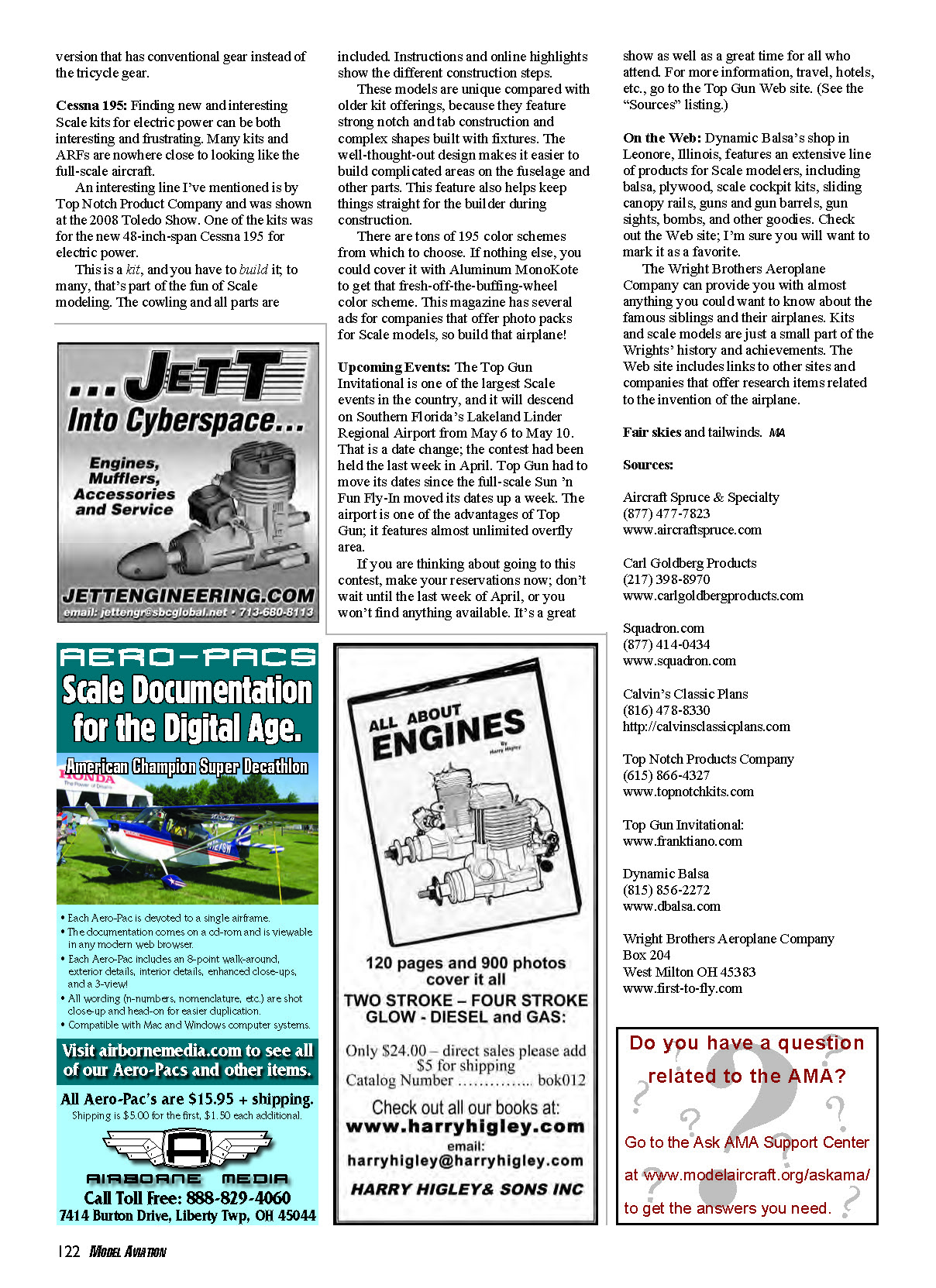
Now it's time to add the wing to the fuselage with mounts and wing bolts. This is one of the critical steps in building a good-flying model. Temporarily install the windshield, then align the wing against the fuselage, measuring to make sure both the front and rearmost points on the fuselage are equal. Mark the wing at the front and trailing edge, as well as the fuselage where the two parts meet. This alignment, along with the same diligent process on the tail surfaces, will help ensure that your airplane will fly straight when commanded by the RC pilot.
Decide how much detail to add to the PA-11. This is a personal choice on almost any model. Some finer details have to be added either before the basic structure is finished or before covering. I'm going to paint the cockpit Cub Yellow. It will make little difference under the windows, since that area is covered with radio gear. I'll put a pilot bust in the cockpit and a stock Piper Cub instrument panel for interior detail.
As mentioned in the plans, additional struts can be added behind the windshield in the forward cockpit area. These small touches add a great deal to the model. A ton of details can be added to the outside of a simple airplane such as the PA-11. That is one reason why different types of Cubs are seen at events. Super Cubs and the like that are built to one-quarter or one-third scale score well in competition.
One neat detail I've seen is aileron cables running from the underside of the wing to the inside of the fuselage, per the full-scale airplane. That takes some effort, but it looks great.
Bookshelf
The Aces books by W. Wayne Patton, published by Squadron/Signal Publications, include Aces, Aces II, and Aces III. This short series of card-stock-cover books covers aces from World War I through the Vietnam War. Besides aviation aces, there are a few tank and submarine aces too.
Color side views, pilot histories, black-and-white drawings of each ace featured, and a few multiviews are included in the three-volume package. There are a few — and I mean a few — photos in each book, but they are rare and all black-and-white.
For help with a Fun Scale project, these books are inexpensive and worth the money. For Sport Scale competition models, you would want something that goes into more detail about particular aircraft types. The history of some of the pilots is interesting in itself.
New Products
Well, the airplane isn't new, but the supplier is. I have received several requests for information about the Piper Tri-Pacer that was shown in the column a couple of months ago.
To my knowledge, the 1/4-scale version from Ikon N'Wst is unavailable at this time. The company is going through a major retooling of the kit line. I hope it will be back in business in 2009.
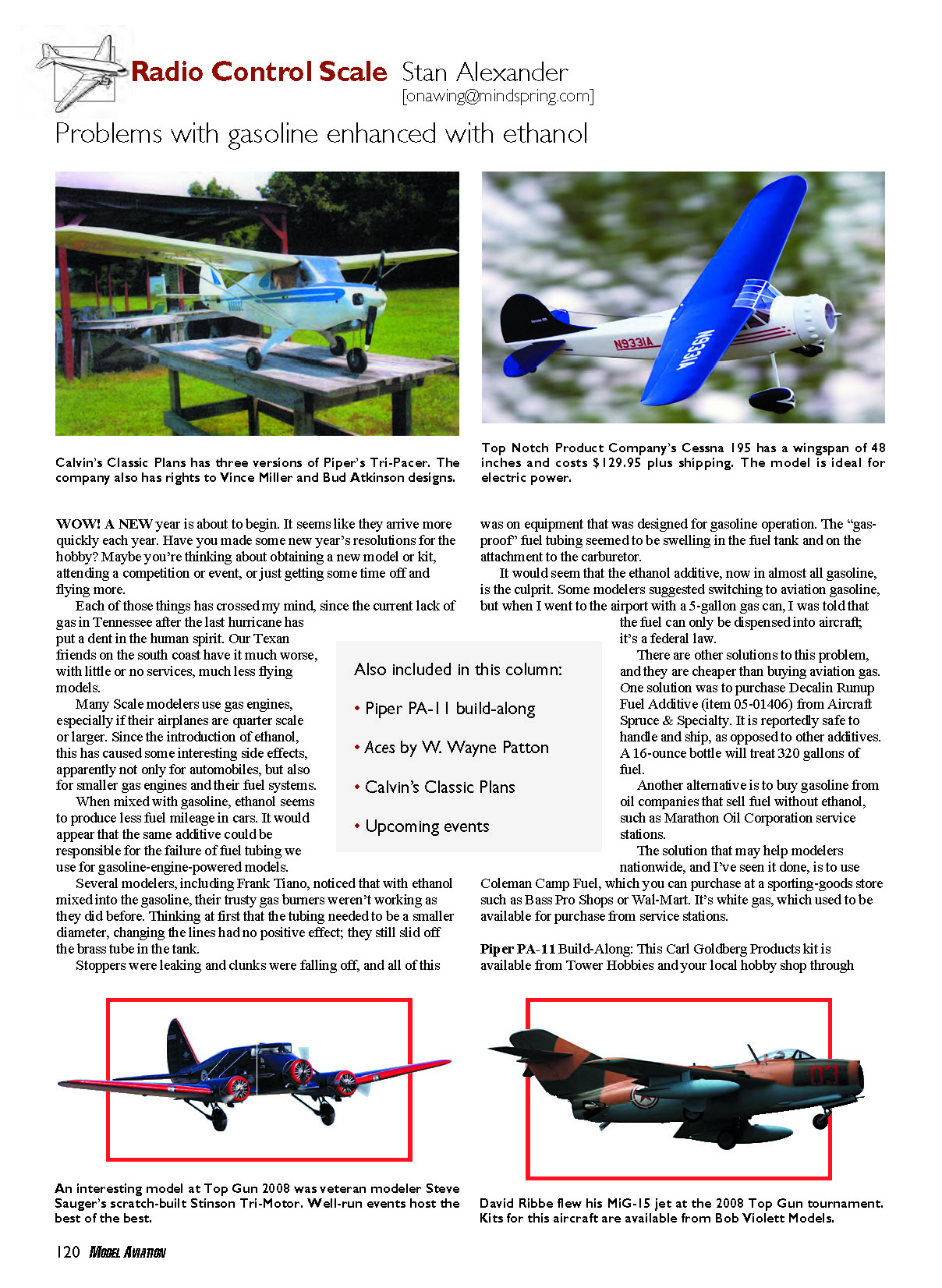
If you're interested in the Tri-Pacer, plans are available from Calvin's Classic Plans. The company now has rights to distribute the plans by Vince Miller and Bud Atkinson. This model is available in 1/6 scale (58.5 inches span), 1/5 scale (71.5 inches span), and 1/4 scale (88.5 inches span). The plans are for typical stick-and-former construction for a light civil aircraft, as are many Piper kits and plans. You can also build the version that has conventional gear instead of tricycle gear.
Cessna 195
Finding new and interesting scale kits for electric power can be both interesting and frustrating. Many kits and ARFs are nowhere close to looking like the full-scale aircraft.
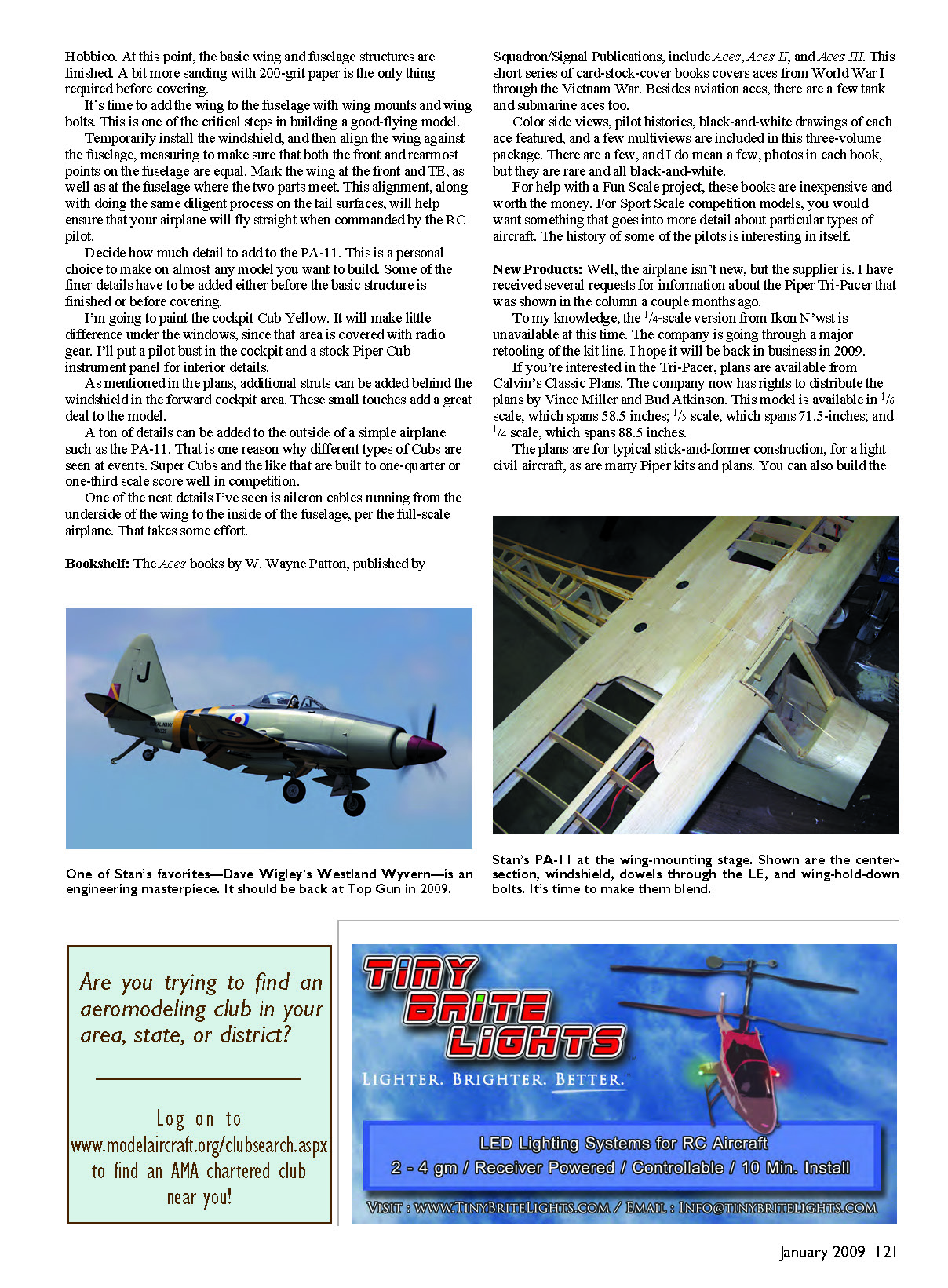
An interesting line I've mentioned is by Top Notch Products Company and was shown at the 2008 Toledo Show. One of the kits was for a new 48-inch-span Cessna 195 for electric power.
This is a kit — you have to build it — and to many, that's part of the fun of scale modeling. The cowling and all parts are included. Instructions and online highlights show the different construction steps.
These models are unique compared with older kit offerings because they feature strong notch-and-tab construction and complex shapes built with fixtures. The well-thought-out design makes it easier to build complicated areas on the fuselage and other parts. This feature also helps keep things straight for the builder during construction.
There are tons of Cessna 195 color schemes from which to choose. If nothing else, you could cover it with Aluminum MonoKote to get that fresh-off-the-buffing-wheel look. This magazine has several ads for companies that offer photo packs for scale models, so build that airplane!
Upcoming Events
The Top Gun Invitational is one of the largest scale events in the country, and it will descend on Southern Florida's Lakeland Linder Regional Airport from May 6 to May 10. That is a date change; the contest had been held the last week in April. Top Gun had to move its dates since the full-scale Sun 'n Fun Fly-In moved its dates up a week. The airport is one of the advantages of Top Gun; it features almost unlimited overfly area.
If you are thinking about going to this contest, make your reservations now; don't wait until the last week of April, or you won't find anything available. It's a great show as well as a great time for all who attend. For more information, travel, hotels, etc., go to the Top Gun web site (see the "Sources" listing).
On the Web
Dynamic Balsa's shop in Leonore, Illinois, features an extensive line of products for scale modelers, including balsa, plywood, scale cockpit kits, sliding canopy rails, guns and gun barrels, gun sights, bombs, and other goodies. Check out the web site; you'll want to mark it as a favorite.
The Wright Brothers Aeroplane Company can provide almost anything you could want to know about the famous siblings and their airplanes. Kits and scale models are just a small part of the Wrights' history and achievements. The web site includes links to other sites and companies that offer research items related to the invention of the airplane.
Fair skies and tailwinds. Stan Alexander
Sources
- Aircraft Spruce & Specialty
(877) 477-7823 www.aircraftspruce.com
- Carl Goldberg Products
(217) 398-8970 www.carlgoldbergproducts.com
- Squadron/Signal Publications (Squadron.com)
(877) 414-0434 www.squadron.com
- Calvin's Classic Plans
(816) 478-8330 http://calvinsclassicplans.com
- Top Notch Products Company
(615) 866-4327 www.topnotchkits.com
- Top Gun Invitational
- Dynamic Balsa
(815) 856-2272 www.dbalsa.com
- Wright Brothers Aeroplane Company
Box 204 West Milton, OH 45383 www.first-to-fly.com
Transcribed from original scans by AI. Minor OCR errors may remain.

