
Radio Control Scale
Stan Alexander
What kind of yellow is your model?
Have you built a new Scale model or been thinking about a subject that might interest you? Could it be a P-51 Mustang or a jet? Maybe a simpler type of homebuilt such as a Bowers Fly Baby or a Pietenpol Scout is more to your liking.
This year at the Experimental Aircraft Association’s Oshkosh AirVenture gathering in Wisconsin, the Brodhead Pietenpol Association—the “type club” for the full-scale aircraft—will celebrate its 80th anniversary. For more information about this airplane, visit the Brodhead organization’s website. Start planning now for your next winter build.
As soon as the paint dried on the Piper PA-11 interior, I realized that I had goofed. The yellow from Nelson was what I ordered, but it was a lemon shade—not the color featured on the full-scale version.
In talking to Jerry Nelson of Nelson Hobby Specialties, I realized that there are several "Piper" yellows on the market. All of the covering manufacturers make a version for Piper aircraft that appears to be a hue of lemon.
I needed a paint with a deeper orange tint, which turned out to be Nelson Lockhaven Yellow. It matches color chips from Randolph Paint Company, which produces paints for full-scale aircraft.
Once I ordered and received the tone I wanted, I painted a strip of scrap fabric and held it up after it had dried for 15 minutes. I had what I needed to finish covering the airframe.
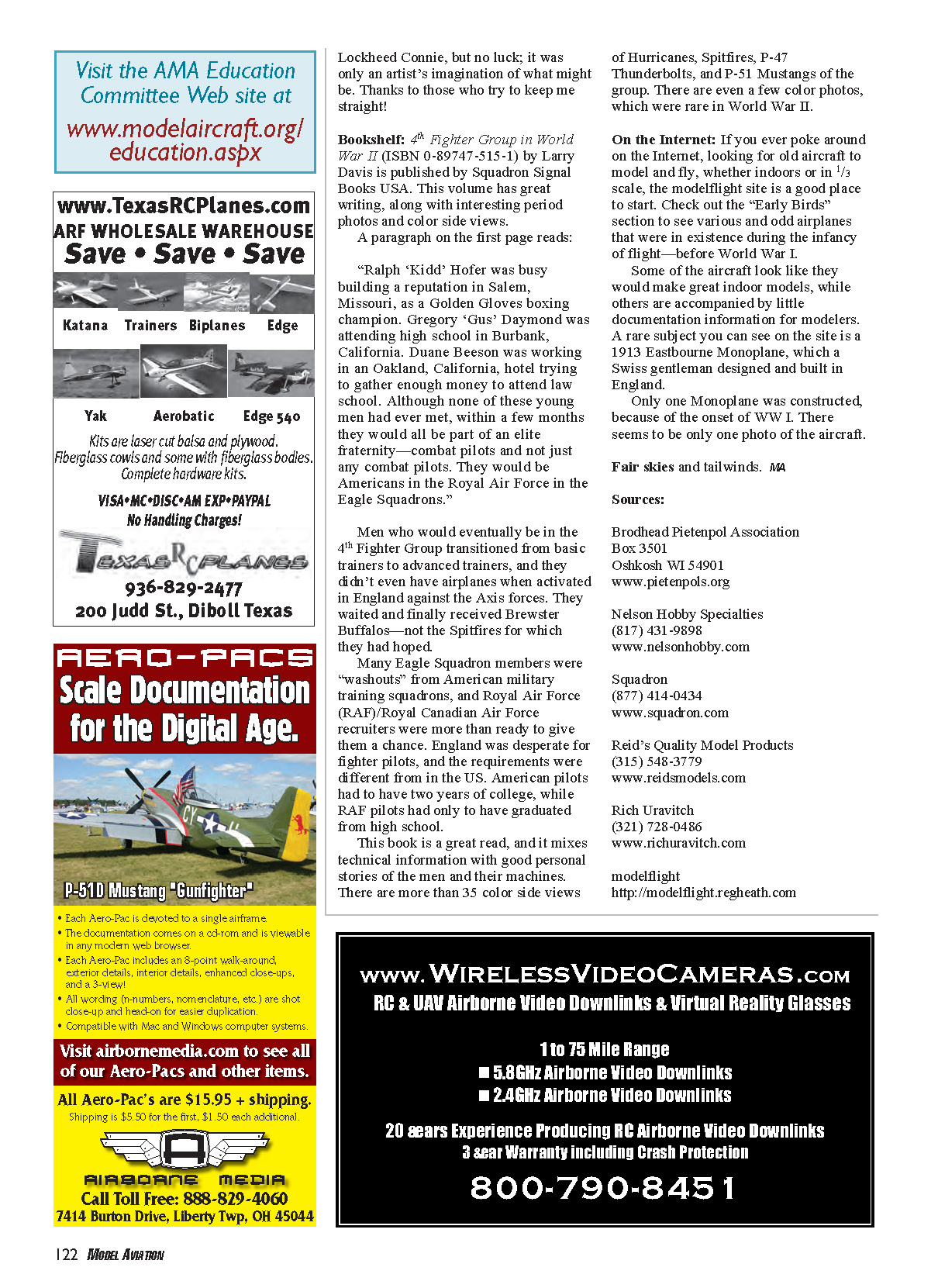
I painted the PA-11's fuselage with a sponge, which was a new adventure in modeling. I had never used this method, but I'm open to experimenting with different techniques.
A good thing about using a sponge is that you don't have to worry about shedding a bristle into your paint job. After adding the primer coat to a surface, you can wet-sand the airframe to even out any high spots that the primer creates.
When using the sponge, make long strokes from front to back; ensure that your strokes are the length of the part on which you are working. This will keep the finish smooth and ready for the next layer of paint.
You add a sealant at the rate of eight drops per ounce of paint to protect against fuel damage (including gas or anything with nitromethane). I mixed my paint in baby-food jars, which is quick and easy.
The Nelson paint cleans up with water and doesn't smell up the house. That had something to do with my wife's liking it. There is much less odor when using the Nelson product than with even latex house paint.
Best of all, the Nelson paint is nontoxic. You don't have to wear a body suit and respirator or carry an air tank to use it. Automotive paints are not intended for most modelers. Work quickly on one section at a time; the paint will dry in less than 15 minutes.
I used typing paper to make a pattern for the separation of colors on the fuselage sides. Folding the paper in half and cutting out the pattern produced mirror images for each side. Use whatever tape works for you to tack the paper to the primer coat. When using the sponge, it is much easier to get a straight line on the fuselage by carefully laying the side in your lap.
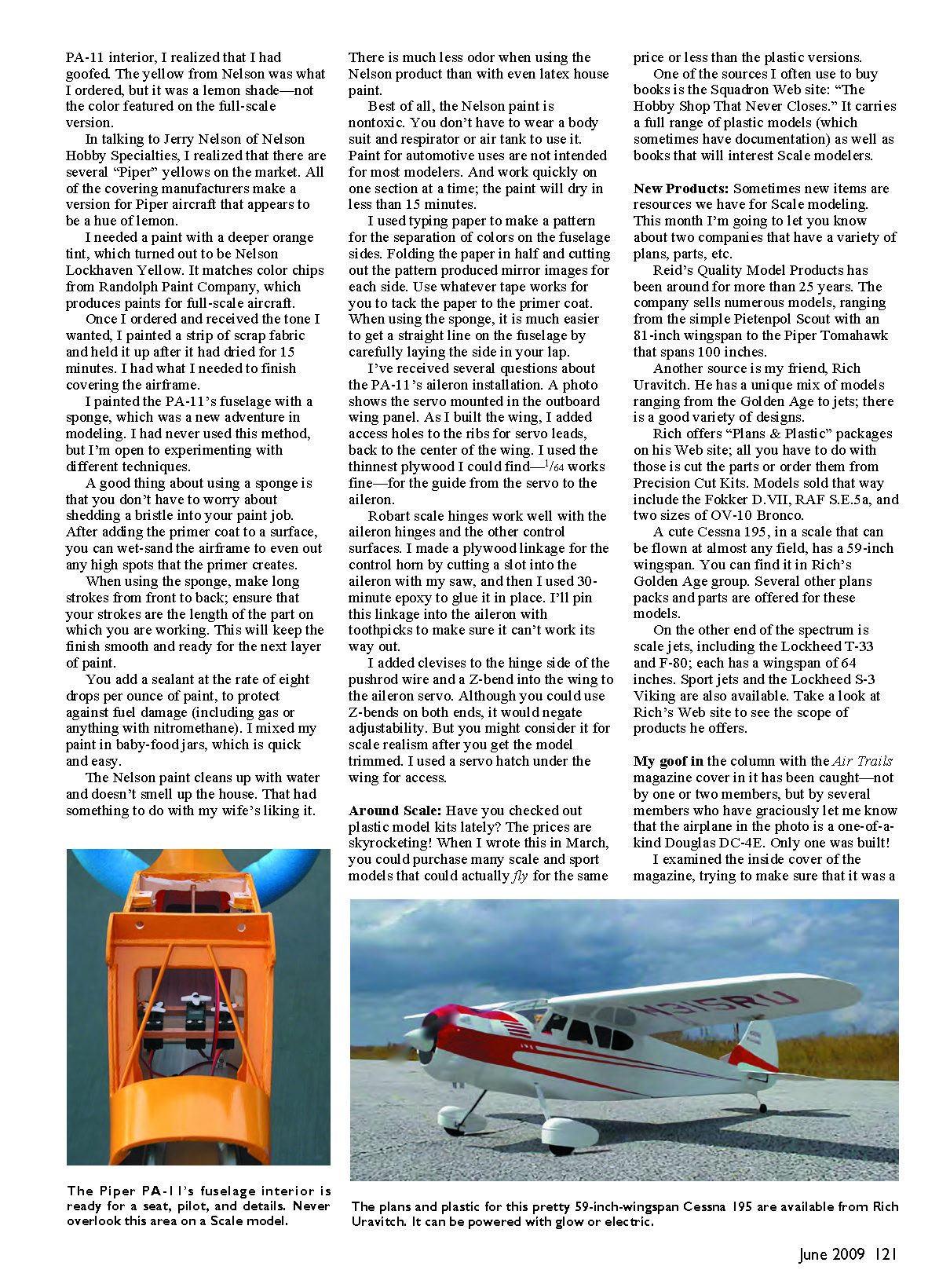
I've received several questions about the PA-11's aileron installation. A photo shows the servo mounted in the outboard wing panel. As I built the wing, I added access holes to the ribs for servo leads back to the center of the wing. I used the thinnest plywood I could find—1/64 inch works fine—for the guide from the servo to the aileron.
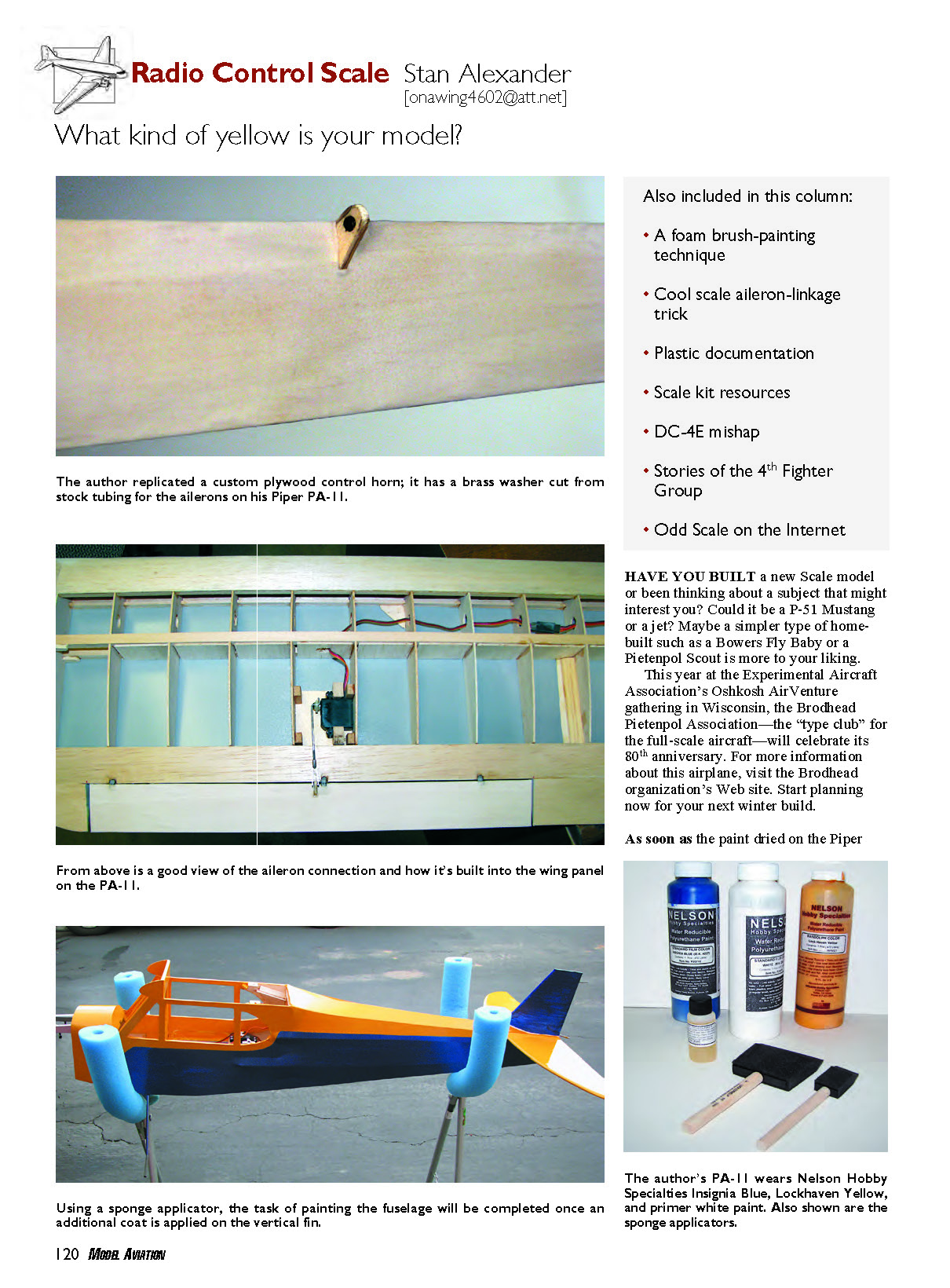
Robart scale hinges work well with the aileron hinges and the other control surfaces. I made a plywood linkage for the control horn by cutting a slot into the aileron with my saw, and then I used 30-minute epoxy to glue it in place. I'll pin this linkage into the aileron with toothpicks to make sure it can't work its way out.
I added clevises to the hinge side of the pushrod wire and a Z-bend into the wing to the aileron servo. Although you could use Z-bends on both ends, it would negate adjustability. You might consider it for scale realism after you get the model trimmed. I used a servo hatch under the wing for access.
My goof in the column with the Air Trails magazine cover in it has been caught—not by one or two members, but by several members who have graciously let me know that the airplane in the photo is a one-of-a-kind Douglas DC-4E. Only one was built!
I examined the inside cover of the magazine, trying to make sure that it was a Lockheed Connie, but no luck; it was only an artist’s imagination of what might be. Thanks to those who try to keep me straight!
Around Scale
Have you checked out plastic model kits lately? The prices are skyrocketing! When I wrote this in March, you could purchase many scale and sport models that could actually fly for the same price or less than the plastic versions.
One of the sources I often use to buy books is the Squadron website: "The Hobby Shop That Never Closes." It carries a full range of plastic models (which sometimes have documentation) as well as books that will interest Scale modelers.
New Products
Sometimes new items are resources we have for Scale modeling. This month I'm going to let you know about two companies that have a variety of plans, parts, etc.
Reid's Quality Model Products has been around for more than 25 years. The company sells numerous models, ranging from the simple Pietenpol Scout with an 81-inch wingspan to the Piper Tomahawk that spans 100 inches.
Another source is my friend Rich Uravitch. He has a unique mix of models ranging from the Golden Age to jets; there is a good variety of designs.
Rich offers "Plans & Plastic" packages on his website; all you have to do with those is cut the parts or order them from Precision Cut Kits. Models sold that way include the Fokker D.VII, RAF S.E.5a, and two sizes of OV-10 Bronco.
A cute Cessna 195, in a scale that can be flown at almost any field, has a 59-inch wingspan. You can find it in Rich's Golden Age group. Several other plans packs and parts are offered for these models.
On the other end of the spectrum are scale jets, including the Lockheed T-33 and F-80; each has a wingspan of 64 inches. Sport jets and the Lockheed S-3 Viking are also available. Take a look at Rich's website to see the scope of products he offers.
Bookshelf
4th Fighter Group in World War II (ISBN 0-89747-515-1) by Larry Davis is published by Squadron Signal Books USA. This volume has great writing, along with interesting period photos and color side views.
A paragraph on the first page reads:
“Ralph ‘Kidd’ Hofer was busy building a reputation in Salem, Missouri, as a Golden Gloves boxing champion. Gregory ‘Gus’ Daymond was attending high school in Burbank, California. Duane Beeson was working in an Oakland, California, hotel trying to gather enough money to attend law school. Although none of these young men had ever met, within a few months they would all be part of an elite fraternity—combat pilots and not just any combat pilots. They would be Americans in the Royal Air Force in the Eagle Squadrons.”
Men who would eventually be in the 4th Fighter Group transitioned from basic trainers to advanced trainers, and they didn’t even have airplanes when activated in England against the Axis forces. They waited and finally received Brewster Buffalos—not the Spitfires for which they had hoped.
Many Eagle Squadron members were “washouts” from American military training squadrons, and RAF/RCAF recruiters were more than ready to give them a chance. England was desperate for fighter pilots, and the requirements were different from in the U.S. American pilots had to have two years of college, while RAF pilots had only to have graduated from high school.
This book is a great read, and it mixes technical information with good personal stories of the men and their machines. There are more than 35 color side views of Hurricanes, Spitfires, P-47 Thunderbolts, and P-51 Mustangs of the group. There are even a few color photos, which were rare in World War II.
On the Internet
If you ever poke around on the Internet, looking for old aircraft to model and fly, whether indoors or in 1/3 scale, the modelflight site is a good place to start. Check out the “Early Birds” section to see various and odd airplanes that were in existence during the infancy of flight—before World War I.
Some of the aircraft look like they would make great indoor models, while others are accompanied by little documentation information for modelers. A rare subject you can see on the site is a 1913 Eastbourne Monoplane, which a Swiss gentleman designed and built in England.
Only one Monoplane was constructed, because of the onset of WW I. There seems to be only one photo of the aircraft.
Fair skies and tailwinds. MA
Sources
- Brodhead Pietenpol Association
Box 3501 Oshkosh, WI 54901 www.pietenpols.org
- Nelson Hobby Specialties
(817) 431-9898 www.nelsonhobby.com
- Squadron
(877) 414-0434 www.squadron.com
- Reid’s Quality Model Products
(315) 548-3779 www.reidsmodels.com
- Rich Uravitch
(321) 728-0486 www.richuravitch.com
- modelflight
http://modelflight.regheath.com
Transcribed from original scans by AI. Minor OCR errors may remain.

