
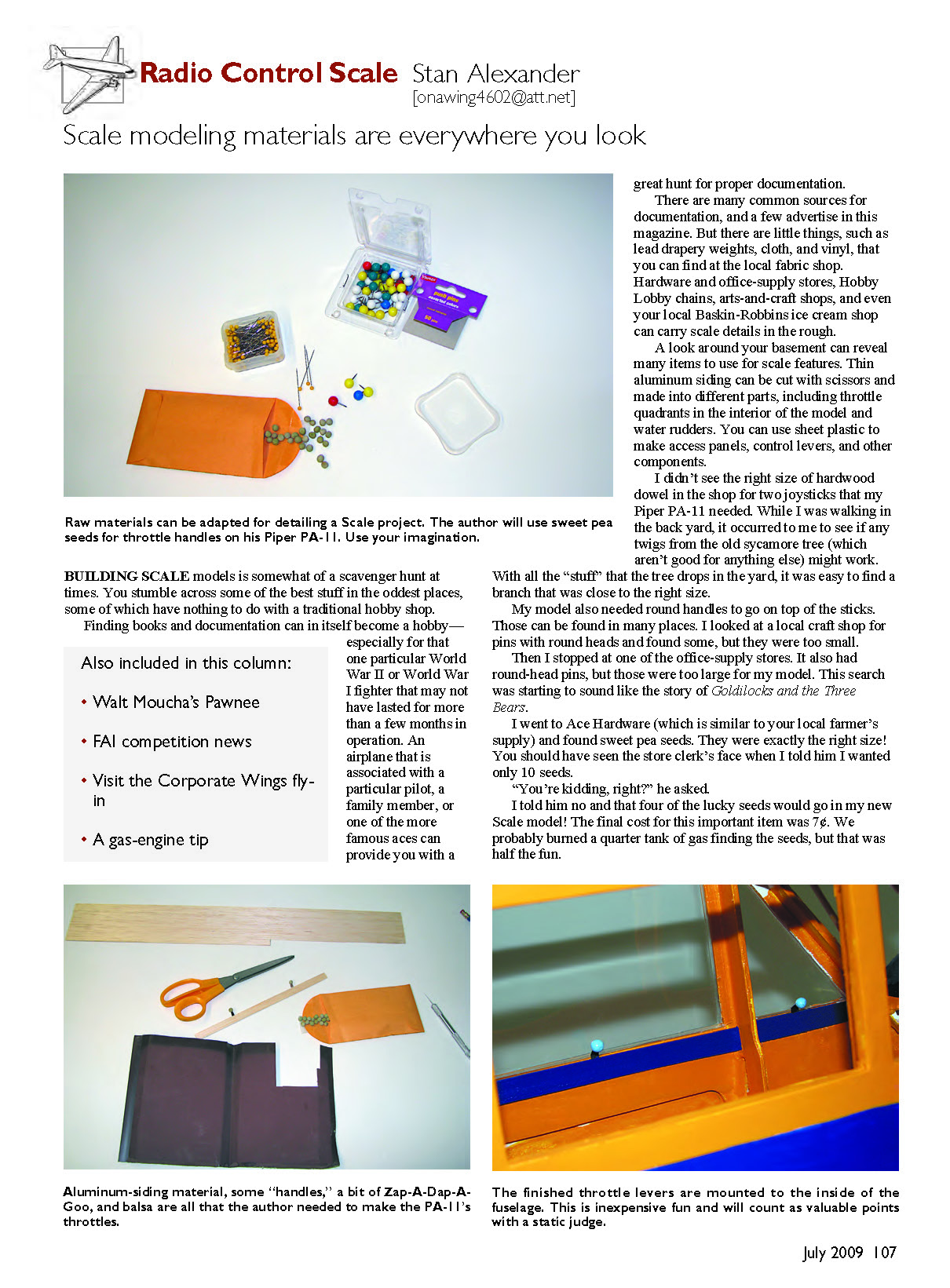
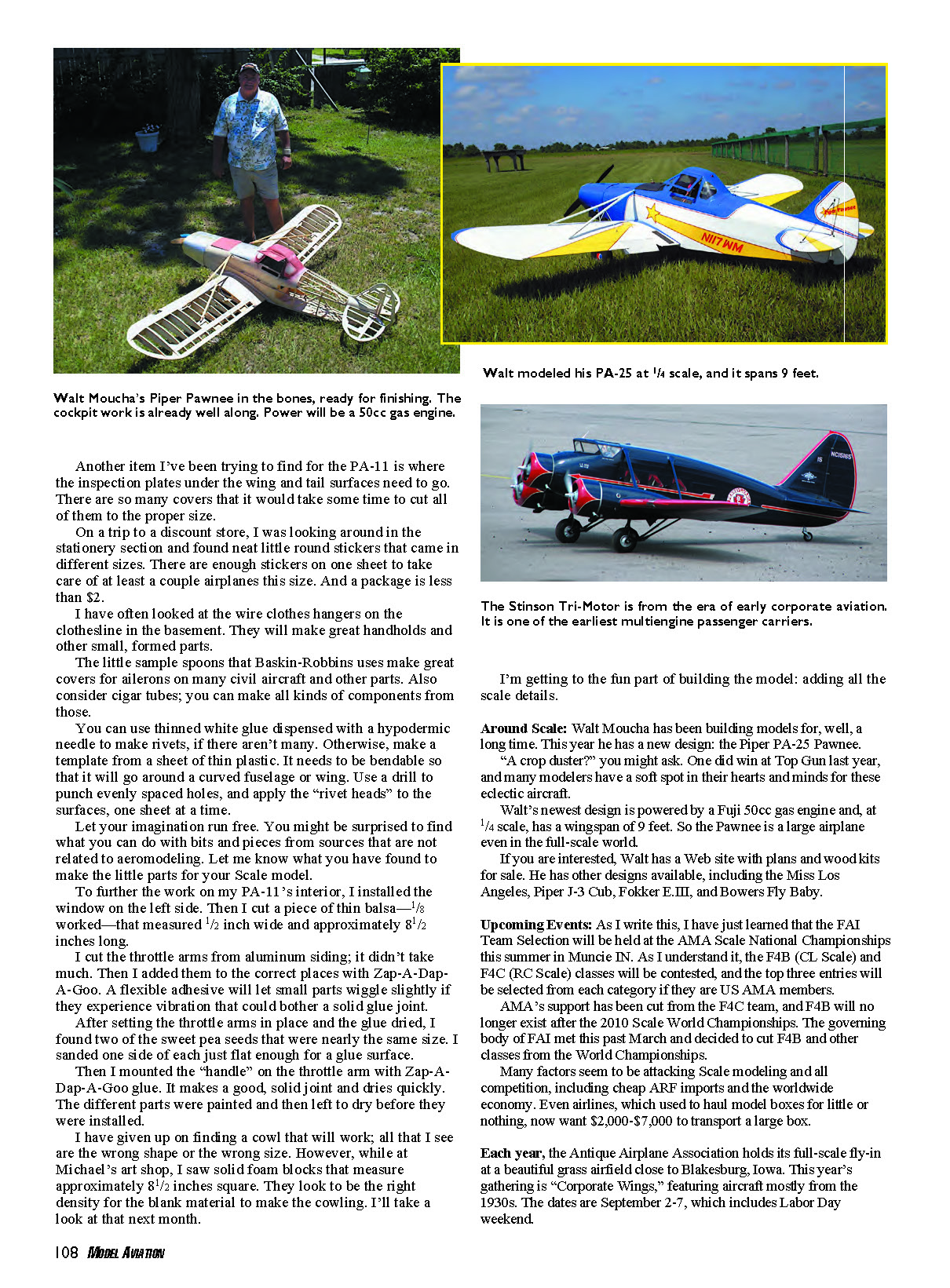
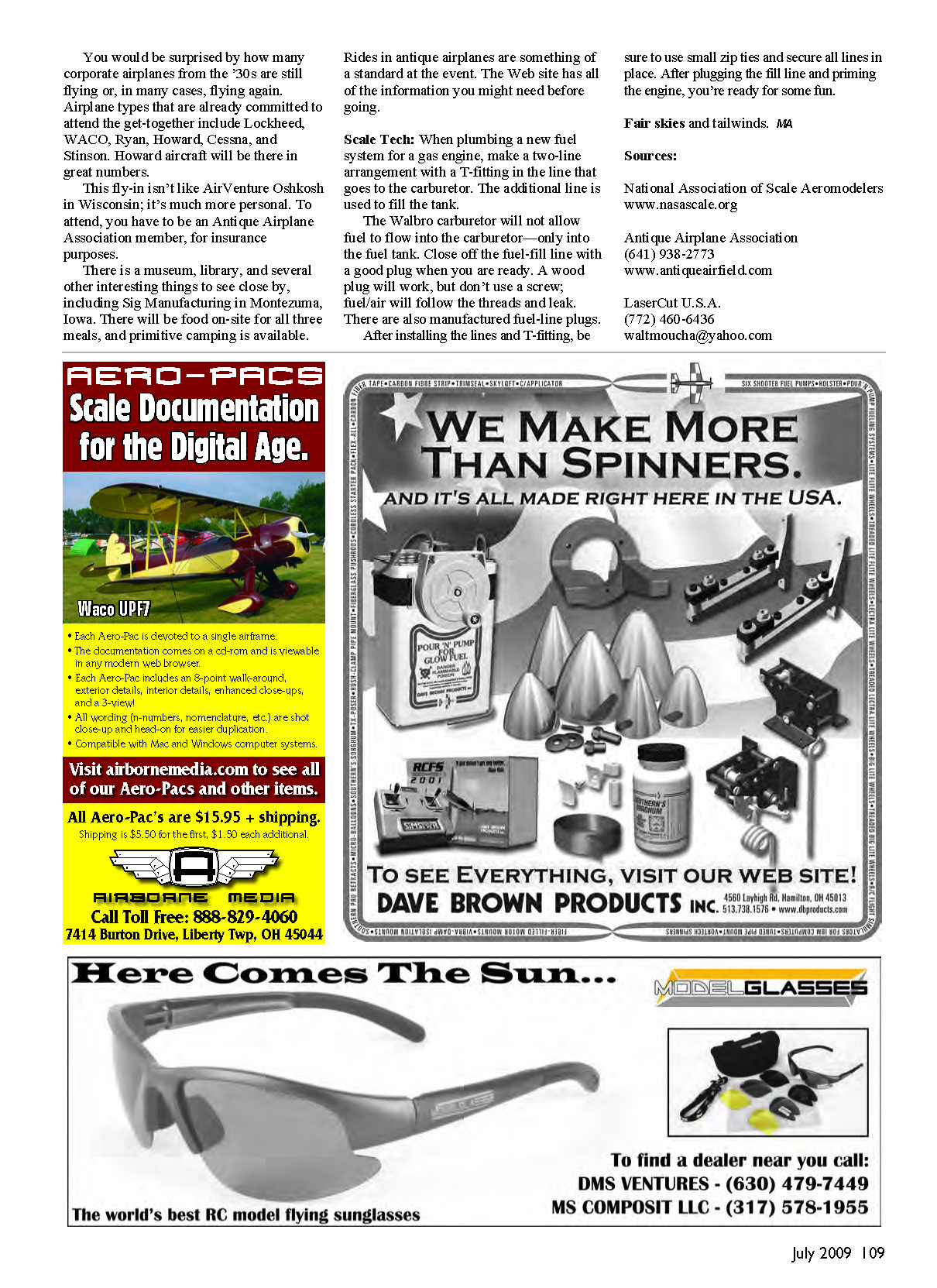
Radio Control Scale
Stan Alexander [[email protected]]
Scale modeling materials are everywhere you look
Building scale models is sometimes a scavenger hunt. You stumble across some of the best stuff in the oddest places, many of which have nothing to do with a traditional hobby shop.
Finding books and documentation can become a hobby—especially for that one particular World War I or World War II fighter that may not have lasted long in service. An airplane associated with a particular pilot, family member, or one of the more famous aces can send you on a great hunt for proper documentation.
Also included in this column:
- Walt Moucha’s Pawnee
- FAI competition news
- Visit the Corporate Wings fly-in
- A gas-engine tip
There are many common sources for documentation, and a few advertise in this magazine. But there are little things, such as lead drapery weights, cloth, and vinyl, that you can find at the local fabric shop. Hardware and office-supply stores, Hobby Lobby chains, arts-and-craft shops, and even your local Baskin-Robbins ice cream shop can carry scale details in the rough.
A look around your basement can reveal many items to use for scale features. Thin aluminum siding can be cut with scissors and made into parts including throttle quadrants in the interior of the model and water rudders. Sheet plastic works well for access panels, control levers, and other components.
I couldn’t find the right size hardwood dowel for two joysticks my Piper PA-11 needed. While walking in the backyard, I tried twigs from the old sycamore tree. With all the “stuff” the tree drops, it was easy to find a branch close to the right size.
My model also needed round handles to go on top of the sticks. I checked a local craft shop (round-head pins too small) and an office-supply store (pins too large). Then I went to Ace Hardware and found sweet pea seeds that were exactly the right size. The clerk was surprised when I asked for only 10 seeds. The final cost was 7¢. We probably burned more gas finding the seeds than they cost, but that was half the fun.
Another item I’ve been trying to find for the PA-11 is inspection plates under the wing and tail surfaces. Cutting all those covers to size would take time. On a trip to a discount store I found neat little round stickers in the stationery section that come in different sizes; one sheet will cover at least a couple of airplanes and costs less than $2.
I’ve often looked at wire clothes hangers in the basement—they make great handholds and other small, formed parts. The little sample spoons used at Baskin-Robbins make great covers for ailerons on many civil aircraft. Also consider cigar tubes; you can make many components from those.
Let your imagination run free. You might be surprised by what you can make from bits and pieces not related to aeromodeling. Let me know what you’ve found to make the little parts for your scale model.
To further work on my PA-11’s interior, I installed the left-side window, then cut a strip of thin balsa (1/8", 1/2" x ~8-1/2") for trim. I cut the throttle arms from aluminum siding and attached them in the correct places with Zap-A-Goo—flexible adhesive helps small parts survive vibration without breaking a rigid joint.
After the throttle arms dried, I found two sweet pea seeds that were nearly the same size. I sanded one side of each flat enough for gluing and mounted the “handles” on the throttle arms with Zap-A-Dap-A-Goo. The joints were solid, dried quickly, and the parts were painted before final installation.
I’ve given up on finding a cowl of the right shape and size. While at Michael’s art shop I found solid foam blocks (about 8-1/2" square) that look to have the right density for carving a cowling. I’ll try that next month.
I’m getting to the fun part of building the model: adding all the scale details.
Scale Tech
When plumbing a new fuel system for a gas engine, make a two-line arrangement with a T-fitting in the line that goes to the carburetor. The additional line is used to fill the tank. The Walbro carburetor will not allow fuel to flow into the carburetor—only into the fuel tank. Close off the fuel-fill line with a good plug when you are ready. A wood plug will work, but don’t use a screw; fuel/air will follow the threads and leak. There are also manufactured fuel-line plugs.
After installing the lines and T-fitting, use small zip ties and secure all lines in place. After plugging the fill line and priming the engine, you’re ready for some fun.
Other tech and material tips:
- Use thinned white glue dispensed with a hypodermic needle to make a few rivets. For many rivets, make a template from a bendable sheet of thin plastic. Drill evenly spaced holes and apply the “rivet heads” to the surface, one sheet at a time.
- Small round stickers (from the stationery section) make quick inspection plates and covers.
- Wire clothes hangers, sample spoons, and cigar tubes are good sources for small formed parts and covers.
- Secure fuel lines and fittings carefully to avoid leaks and vibration issues.
Fair skies and tailwinds.
Around Scale
Walt Moucha has been building models for a long time. This year he has a new design: the Piper PA-25 Pawnee. “A crop duster?” you might ask. One did win at Top Gun last year, and many modelers have a soft spot for these eclectic aircraft.
Walt’s newest design is powered by a Fuji 50cc gas engine and, at 1/4 scale, has a 9-foot wingspan. The Pawnee is a large airplane even in the full-scale world.
Walt has a website with plans and woodkits for sale. He also offers other designs including Miss Los Angeles, Piper J-3 Cub, Fokker E.III, and Bowers Fly Baby.
Contact for Walt Moucha:
- LaserCut U.S.A.
- (772) 460-6436
- [email protected]
Upcoming Events
FAI Team Selection: The FAI Team Selection will be held at the AMA Scale National Championships this summer in Muncie, IN. The F4B (CL Scale) and F4C (RC Scale) classes will be contested, and the top three entries in each category will be selected if they are US AMA members. Note that AMA’s support has been cut for the F4C team, and F4B will no longer exist after the 2010 Scale World Championships. The FAI governing body decided in March to cut F4B and other classes from the World Championships.
Challenges facing scale modeling and competition include cheap ARF imports and the worldwide economy. Even airlines, which used to haul model boxes cheaply, now charge $2,000–$7,000 to transport a large box.
Antique Airplane Association — Corporate Wings fly-in: Each year the Antique Airplane Association holds its full-scale fly-in at a beautiful grass airfield near Blakesburg, Iowa. This year’s gathering is “Corporate Wings,” featuring aircraft mostly from the 1930s. Dates: September 2–7 (Labor Day weekend).
You might be surprised how many corporate airplanes from the 1930s are still flying—or flying again. Types already committed include Lockheed, WACO, Ryan, Howard, Cessna, and Stinson; Howard aircraft will be there in great numbers.
This fly-in is much more personal than AirVenture Oshkosh. Attendance requires Antique Airplane Association membership for insurance purposes. There is a museum, library, and several interesting sites nearby, including Sig Manufacturing in Montezuma, Iowa. Food is available on-site for all three meals, and primitive camping is available. Rides in antique airplanes are common. Visit the event website for more information.
Sources
- National Association of Scale Aeromodelers
- www.nasascale.org
- Antique Airplane Association
- (641) 938-2773
- www.antiqueairfield.com
- LaserCut U.S.A.
- (772) 460-6436
- [email protected]
Transcribed from original scans by AI. Minor OCR errors may remain.

