

Radio Control Scale
Stan Alexander [[email protected]]
The AMA Plans Service has your size
Finding resources for scale modeling can be a quest at times. Then again, they can be right under your nose.
On a recent visit to AMA Headquarters I stopped at the museum, which I almost always do. It's fun to see what is different and new. Since the last time I had been there, the gift shop had gone through a major change; it's much more open and accessible now.
But the reason I wanted to go was to look at the list of plans that AMA has on file in the area behind the aviation library. It was the weekend and only one volunteer was there. The computer in the museum lobby needs a major update; it freezes when you try to look up plans. Still, we talked about the plans service and another item of interest to most scale modelers: resizing plans.
The AMA can resize plans for modelers. This can be handy with the interest in large models, and I'm sure some want plans reduced. There is a list of available plans on the Academy's website.
In the Plans Service area, adjacent to the museum, are several plans catalogs. Two are by John Pond, and one catalog is almost entirely sport models. When I refer to "sport models" that includes almost everything but scale. Many of those plans are from the 1940s through the 1970s. There are sets for Ken Willard's Headmaster, the Smog Hog, and the Belly Dance — I might order that one just to see what it looks like.
The scale catalog from the John Pond collection has more than 5,000 plans on 98 pages. A good one from that source is the Fokker D.VII: one of the most popular WW I models to build. There are 52 sets of plans for that Fokker, ranging from 12-inch to 50-inch spans. There are also 32 sets of plans for Gee Bee aircraft, including several that could be adapted for RC indoor scale. One lesser-modeled Gee Bee is the Model D Sportster; Don Srull designed a 38-inch-span version that would make a great electric-powered aircraft.
AMA's plans list also includes many of Henry Haffke's Gee Bee plans, including his Model Y Senior Sportster in 1/4 scale. I would love to see it increased to 1/3 scale, along with the Super Sportster and others. There is a great deal of material there. The catalog isn't oriented toward Giant Scale; many of the designs span fewer than 60 inches. There are plans for free-flight (FF) and control-line (CL) modelers as well as for RC.
There are more than 20 sets of plans for the Curtiss P-40 Warhawk; many are small, and the largest is a 66-inch-span RC version designed by Brian Taylor. Other aircraft are more obscure, including the Dornier Do 18 flying boat (66-inch span), which was published in 1965. Each set of plans is accompanied by the designer or manufacturer, wingspan, airplane name, type of control, and price. Many old FF scale and FF sport designs would make wonderful small electric-powered models or could be enlarged into custom designs. It's getting to be that time of year for building your winter project. If you want to make a plans purchase from the AMA, do so soon to beat the rush. I've already made my order.
Piper PA-11
Work has slowed this summer on my PA-11. I've been working on the interior as well as the cowling. I had hoped to have it ready for this year's AMA Nationals, but I believe it will premiere at next year's Mint Julep Scale Meet instead.
With a model this size, you can add much of the interior or a removable shelf with the pilot bust on it that is secured with Velcro to four hardwood attachment posts on the fuselage sides. On this shelf, which can be painted black or any other neutral color, you can add the seat backs and control-stick columns. I used the stick-on instrument panel that came with the kit and mounted it in the correct position at the forward end of the fuselage.
A photo caption in the July column read, "This is inexpensive fun and will count as valuable points with a static judge." This is incorrect. In AMA Sport Scale, the interior of the model is not judged in static competition. But it does add realism to the model. Sometimes, small touches such as throttle quadrants, control sticks, and seat backs can add to the illusion of the full-scale aircraft. These details may elicit "oohs" and "aahs" at the static table, but they are not specific judged items.
Mounting the PA-11's engine inverted has caused issues with exhaust placement; it looks like the exhaust will exit the left side of the cowling instead of the prototype's right side. I have ordered several extensions and curved pipes from O.S., with no suitable outcome so far. I will keep you informed of the progress.
Extremes in scratch building
Different models from various builders are what make the scale world go around. Take, for instance, George Majorana's Tu-95 or Greg Hahn's B-25; they represent large investments of time, energy, and money spent on a scale aircraft. Sometimes modelers consider a smaller airplane a break from 1/4- or 1/3-scale builds. This month I will show what some might call two extremes in scratch building.
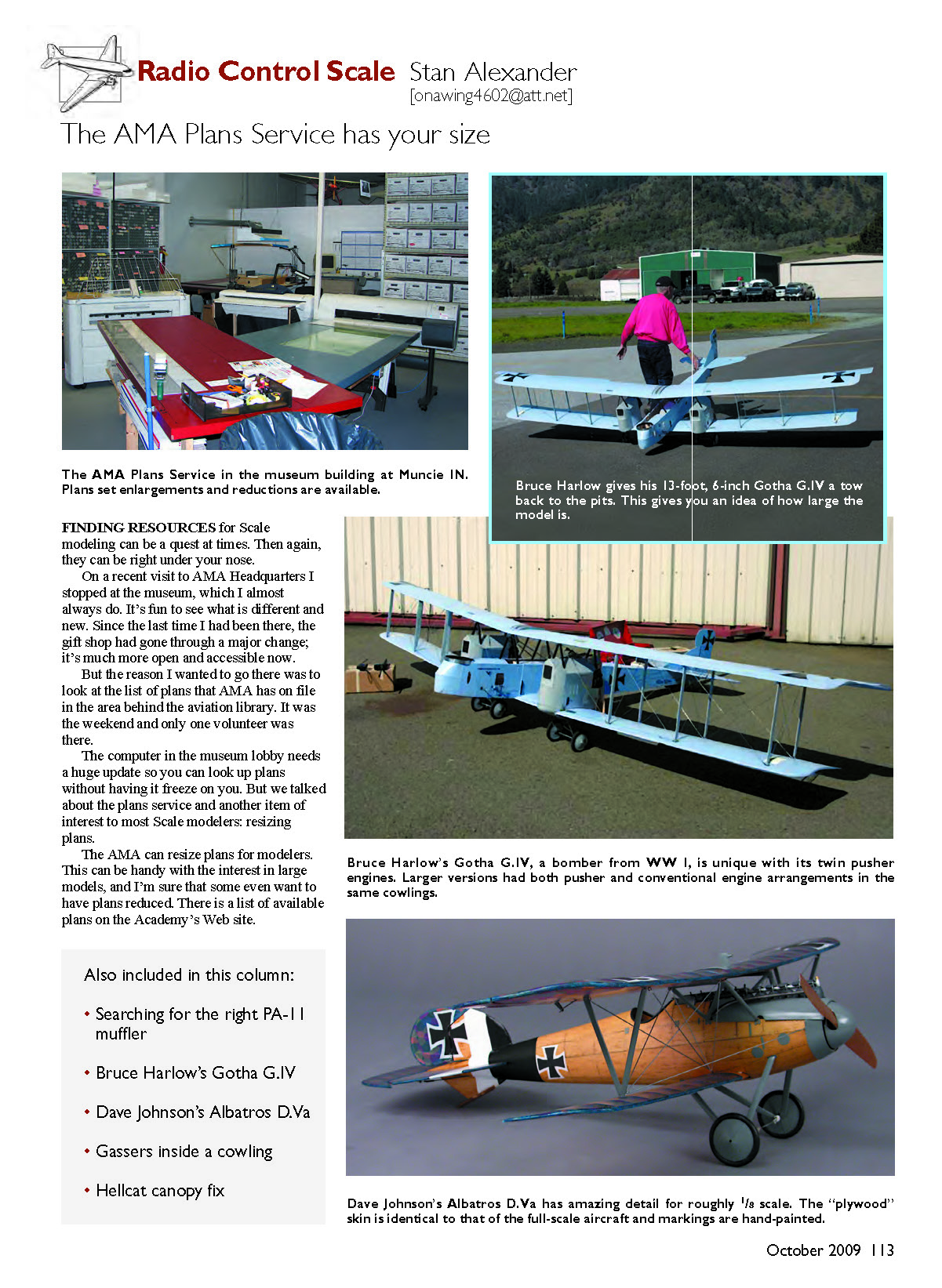
Bruce Harlow is known in the western U.S. for building some huge models. A few years ago he built a Martin TT, an early biplane trainer, finished in white linen fabric with whitewall tires — it was impressive. Recently Bruce applied his skills to another Dan Gregory design: the Gotha G.IV. It has a wingspan of 13 feet 6 inches and is powered by two G-20 ignition engines with pusher propellers. The model is covered with Nelson LiteFAB fabric and Nelson paint; Jerry Nelson matched the paint to a chip Bruce provided.
Dave Johnson, who works for Hobbico by day, also has a passion for scale models — particularly WW I aircraft. He has built several 1/3-scale Albatros models for competition, which have been featured at Top Gun, the Scale Nationals, and Scale Masters. Dave has won numerous awards and a national championship.
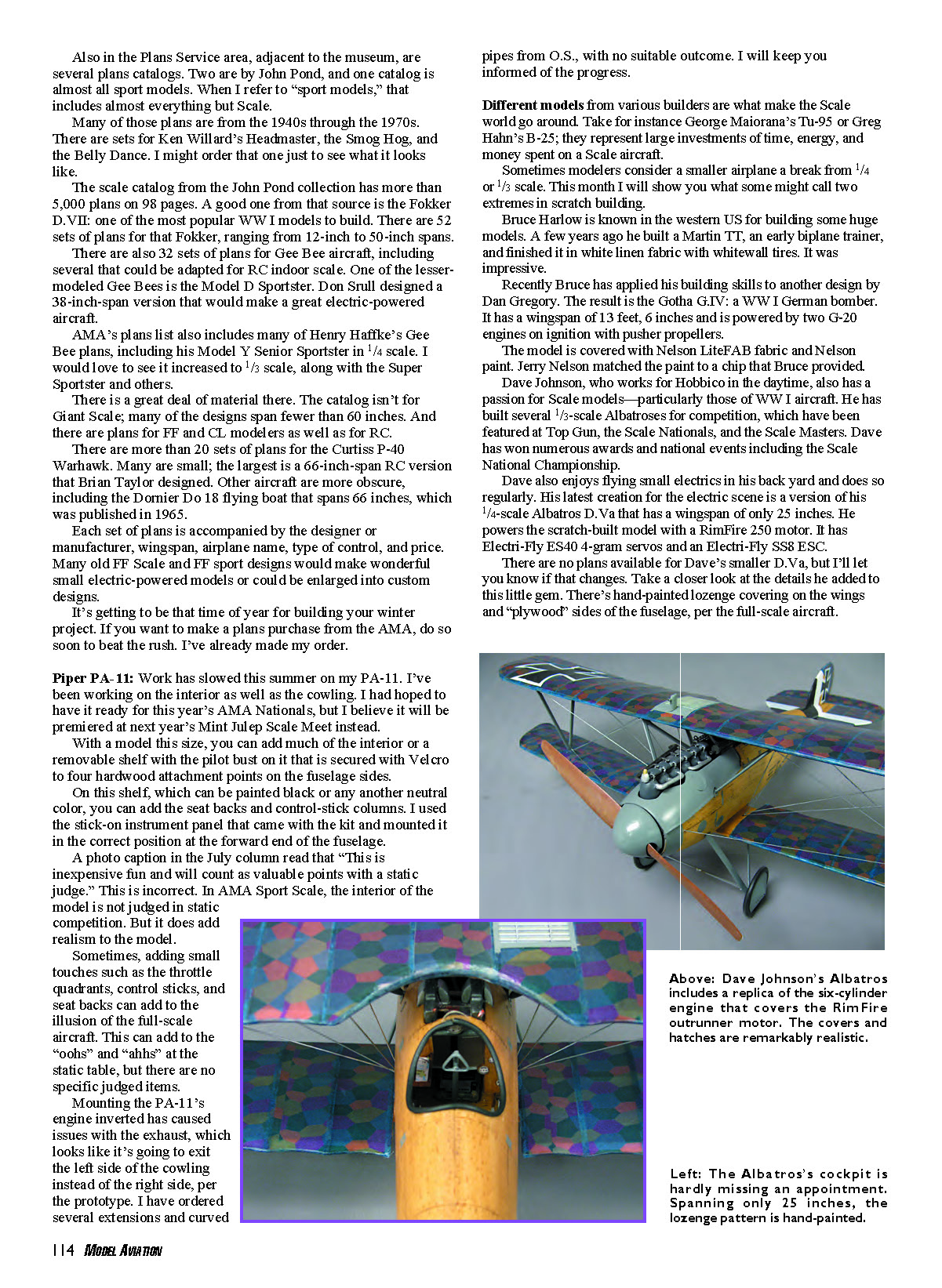
Dave also enjoys flying small electrics in his backyard. His latest creation for the electric scene is a version of his 1/4-scale Albatros D.Va that has a wingspan of only 25 inches. He powers the scratch-built model with a RimFire 250 motor and uses ElectriFly ES40 4-gram servos and an ElectriFly S8 ESC. There are no plans available for Dave's smaller D.Va, but I'll let you know if that changes. Take a closer look at the details he added: hand-painted lozenge covering on the wings and "plywood" sides of the fuselage, per the full-scale aircraft.
Scale Tech
I received an e-mail from Robert about the intake stack on the Zenoah G-20 and G-26 engines. He wanted to know if he could use the G-26ei without the velocity stack on the carburetor, to retain the scale outline without the stack sticking out of the cowling.
If there is enough room in the cowling, Robert should be able to use the carburetor without the velocity stack — provided he allows enough airflow to the carburetor. Robert also asked if there is a good way to activate the choke once the cowling is attached. Sure: use an additional servo to activate the choke, using a Nyrod with a plastic clevis.
I recommend using a 2.4 GHz radio system with any ignition-system-equipped model. The 2.4 system helped the G-20 and its glitches in a short airframe more than any other fix.
Hangar 9 Hellcat
A modeler and I e-mailed at length about the Hangar 9 Hellcat. The canopy is prone to cracking and breaking on turnovers in the field or on the runway. Zap Canopy Glue will solve most problems with cracks or breaks in the canopy, but you will need to obtain spare parts from Hangar 9. A good fix is to add carbon-fiber strips under the canopy frame before assembly; that should prevent most problems with this part.
Fair skies and tailwinds. MA
Sources
- AMA Plans Service — (765) 287-1256, ext. 507 — www.modelaircraft.org/plans.aspx
- Nelson Hobby Specialties — (817) 431-1038 — www.nelsonhobby.com
- Dan Gregory Designs — (253) 517-5435
- National Association of Scale Aeromodelers — www.nasascale.org
Transcribed from original scans by AI. Minor OCR errors may remain.

