
U.S. Scale Masters Championships
Stan Alexander [[email protected]]
There are many scale competitions across the country to consider attending this year. Many start the flying season with Top Gun in Florida in April, while the Gunsmoke Scale Masters qualifier is held in Arizona in March.
The Scale National Championships in Muncie, Indiana, in July is also a great contest to attend. To see a complete listing of scale competitions, check the contest calendar on the AMA web site.
An event that is on my calendar each year is the Mint Julep Scale Meet, held at Rough River Dam State Resort Park in Kentucky. The facility features a full-scale runway, which is closed for the event in May.
This contest, as are most others, is a qualifier for the U.S. Scale Masters Championships, which is held at a different site across the country each fall. The 2011 Scale Masters site hadn't been selected when I wrote this, but I will report the location as soon as I learn it.
The neat thing about the Scale Masters is that wherever you are in the U.S. there is usually a qualifier nearby. Some Europeans consider a close contest to be a half-hour away, but we Americans often have to think in terms of an eight- to ten-hour drive. The 2010 championships were held in southern Indiana, so this year's edition might be on the West Coast.
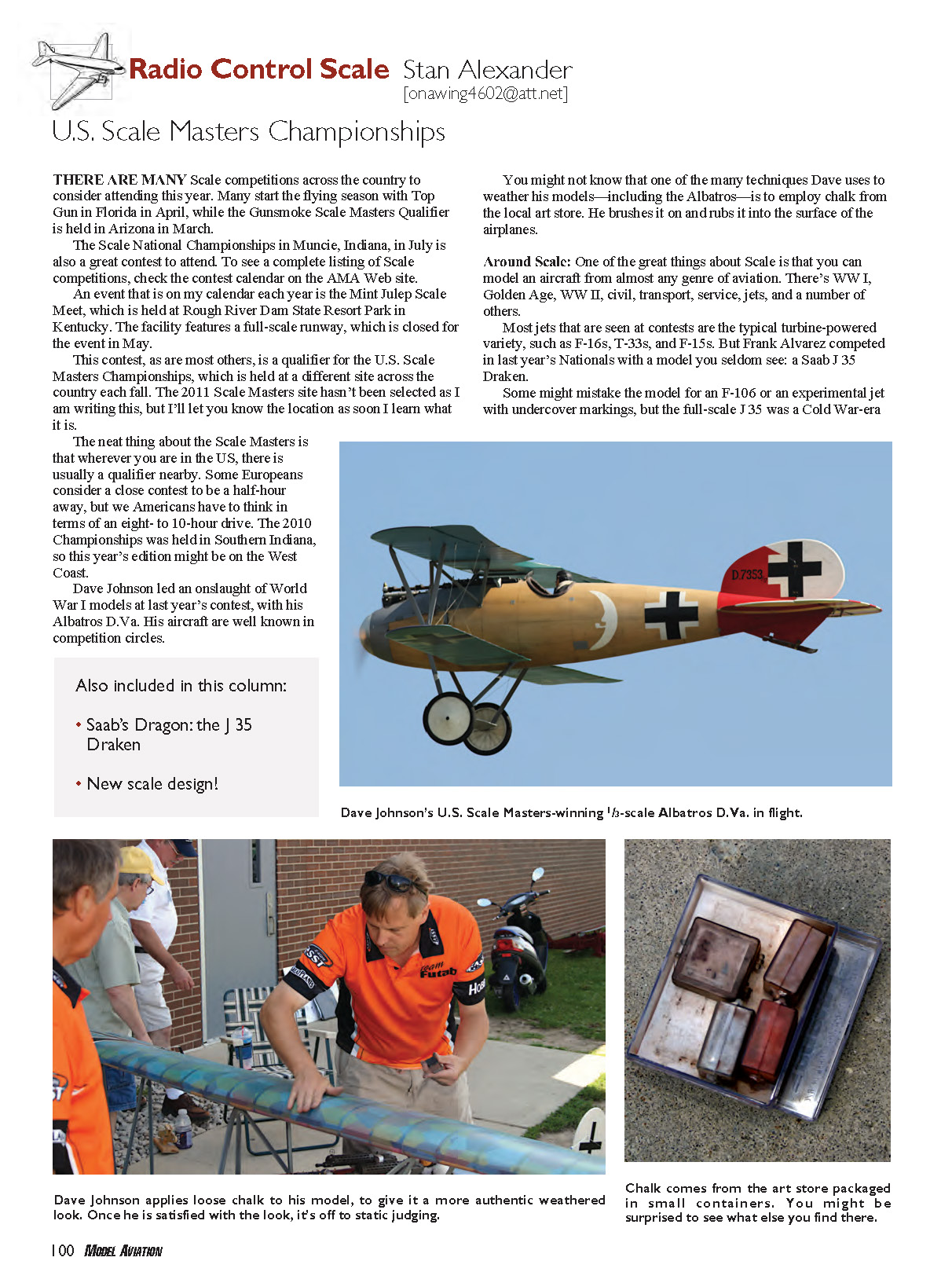
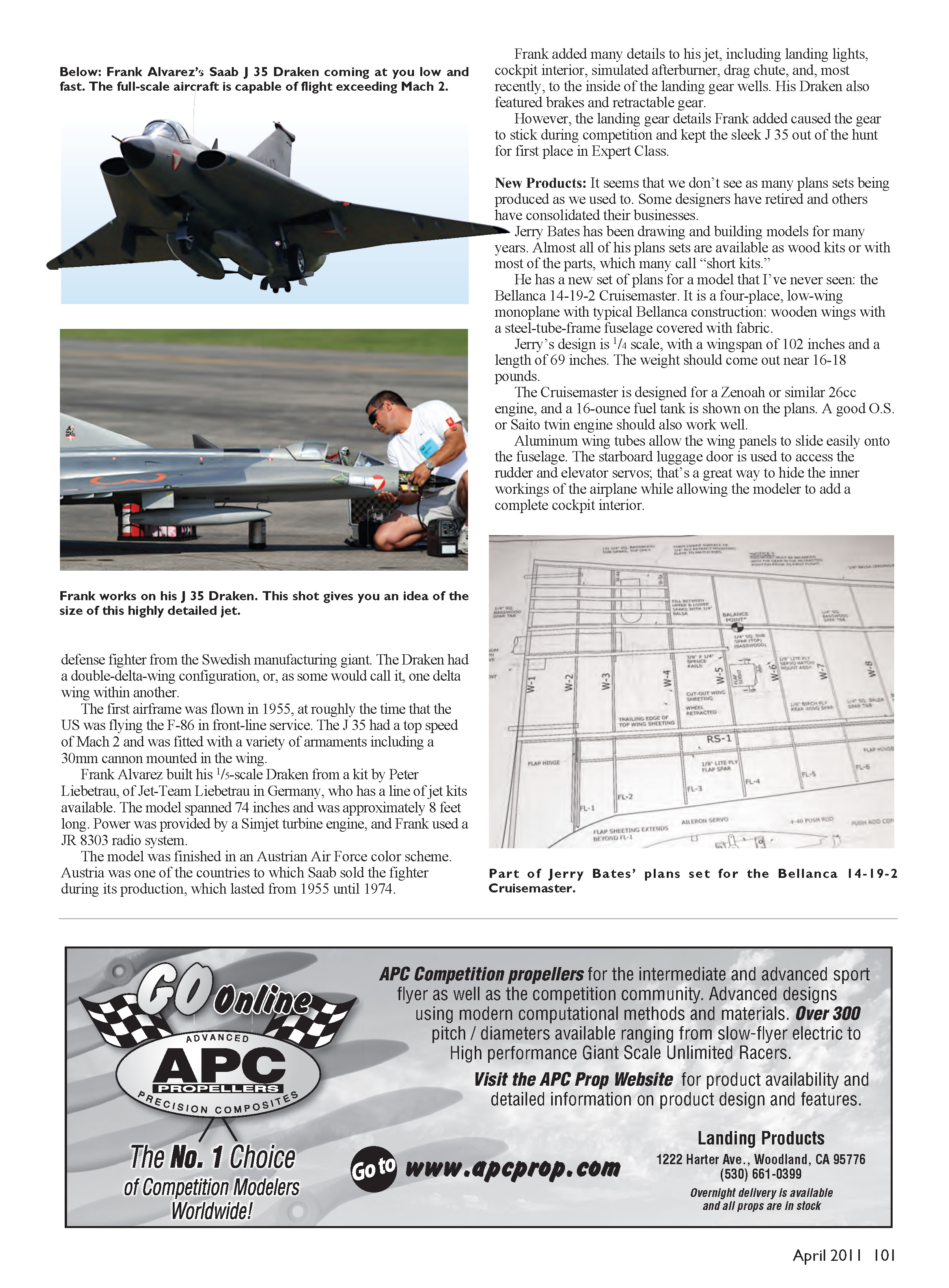
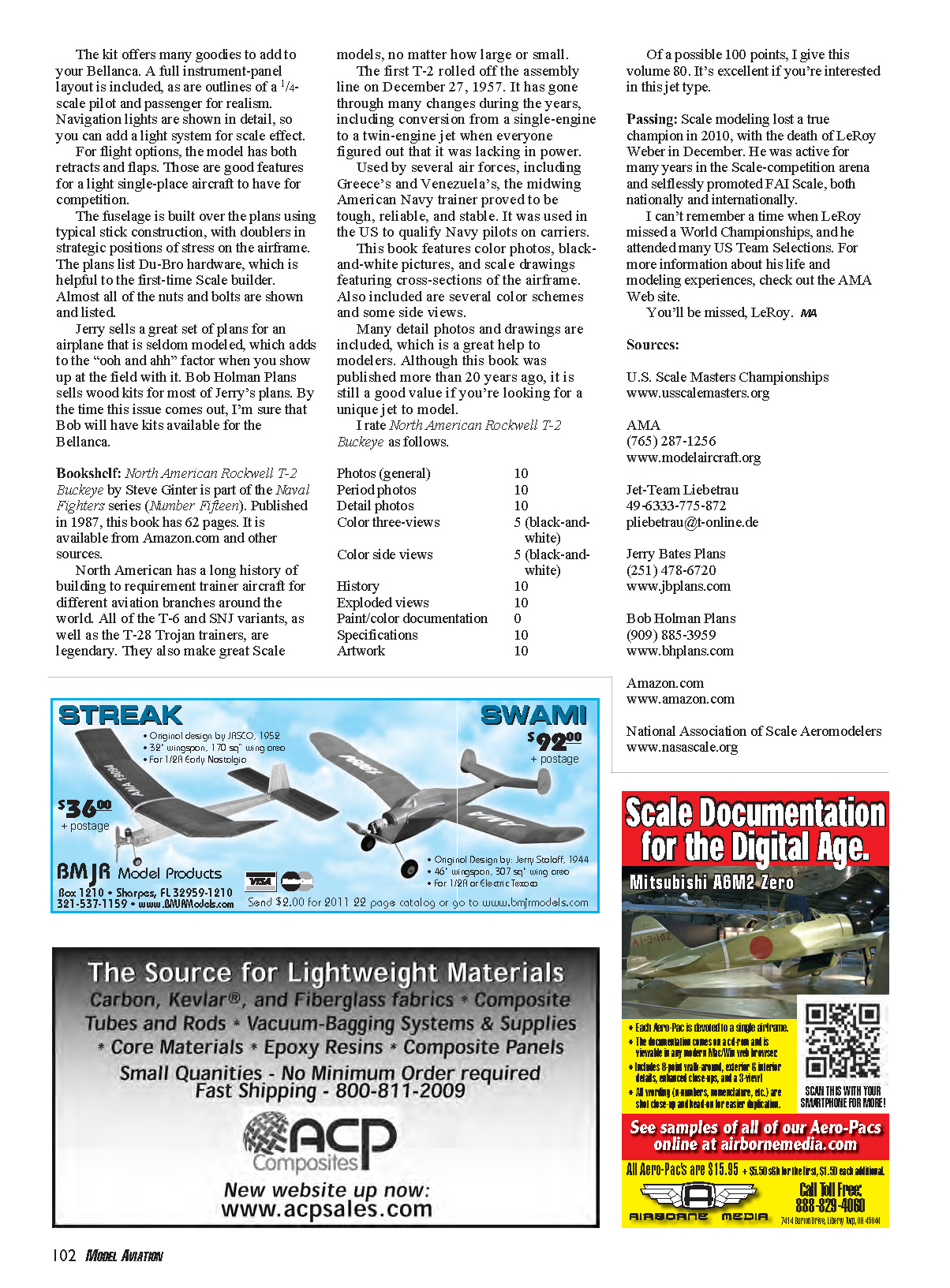
Dave Johnson led an onslaught of World War I models at last year's contest with his Albatros D.Va. His aircraft are well known in competition circles. You might not know that one of the many techniques Dave uses to weather his models — including the Albatros — is to employ chalk from the local art store. He brushes it on and rubs it into the surface of the airplanes.
Around Scale
One of the great things about scale is that you can model an aircraft from almost any genre of aviation: WWI, Golden Age, WWII, civil, transport, service, jets, and others.
Most jets seen at contests are the typical turbine-powered variety, such as the F-16, T-33, and F-15. But Frank Alvarez competed in last year's Nationals with a model you seldom see: a Saab J 35 Draken.
Some might mistake Frank's model for an F-106 or an experimental jet with undercover markings, but the full-scale J 35 was a Cold War–era defense fighter from the Swedish manufacturer Saab. The Draken had a double-delta-wing configuration — one delta wing within another. The first airframe was flown in 1955. The J 35 had a top speed of Mach 2 and was fitted with a variety of armaments, including a 30 mm cannon mounted in the wing.
Frank Alvarez built his 1/5-scale Draken from a kit by Peter Liebetrau of Jet-Team Liebetrau in Germany. The model spanned 74 inches and was approximately 8 feet long. Power was provided by a Simjet turbine engine, and Frank used a JR 8303 radio system. The model was finished in an Austrian Air Force color scheme; Austria was one of the countries to which Saab sold the fighter during its production from 1955 until 1974.
Frank added many details to his jet, including landing lights, cockpit interior, simulated afterburner, drag chute, and, more recently, detailing to the inside of the landing gear wells. His Draken also featured brakes and retractable gear. However, the landing gear details Frank added caused the gear to stick during competition and kept the sleek J 35 out of the hunt for first place in Expert Class.
New Products
It seems we don't see as many plan sets being produced as we used to. Some designers have retired and others have consolidated their businesses.
Jerry Bates has been drawing and building models for many years. Almost all of his plan sets are available as wood kits or with most of the parts included, which many call "short kits."
He has a new set of plans for a model that I’ve rarely seen: the Bellanca 14-19-2 Cruisemaster. It is a four-place, low-wing monoplane with typical Bellanca construction: wooden wings with a steel-tube-frame fuselage covered with fabric.
Jerry's design is 1/4 scale, with a wingspan of 102 inches and a length of 69 inches. The flying weight should come out near 16–18 pounds. The Cruisemaster is designed for a Zenoah or similar 26 cc engine, and a 16-ounce fuel tank is shown on the plans. A good O.S. or Saito twin engine should also work well.
Aluminum wing tubes allow the wing panels to slide easily onto the fuselage. The starboard luggage door is used to access the rudder and elevator servos; that's a great way to hide the inner workings of the airplane while allowing the modeler to add a complete cockpit interior.
The kit offers many goodies to add to your Bellanca. A full instrument-panel layout is included, as are outlines of a 1/4-scale pilot and passenger for realism. Navigation lights are shown in detail, so you can add a light system for scale effect.
For flight options, the model has both retracts and flaps — good features for a light single-engine aircraft in competition. The fuselage is built over the plans using typical stick construction, with doublers in strategic high-stress areas. The plans list Du-Bro hardware, which is helpful to the first-time scale builder. Almost all of the nuts and bolts are shown and listed.
Jerry sells a great set of plans for an airplane that is seldom modeled, which adds to the "ooh and ahh" factor when you show up at the field with it. Bob Holman Plans sells wood kits for most of Jerry's designs, and kits should be available for the Bellanca.
Bookshelf
North American Rockwell T-2 Buckeye by Steve Ginter is part of the Naval Fighters series (Number Fifteen). Published in 1987, this book has 62 pages and is available from Amazon.com and other sources.
North American has a long history of building trainer aircraft for military branches around the world. The T-6/SNJ variants and the T-28 Trojan are legendary and make great scale subjects. The first T-2 rolled off the assembly line on December 27, 1957. It went through many changes over the years, including conversion from a single-engine to a twin-engine jet when it was found lacking in power.
Used by several air forces (including Greece and Venezuela), the midwing U.S. Navy trainer proved to be tough, reliable, and stable. It was used in the U.S. to qualify Navy pilots on carriers.
This book features color photos, black-and-white pictures, and scale drawings with cross-sections of the airframe. Also included are several color schemes and some side views. Many detail photos and drawings are included, which is a great help to modelers. Although the book was published more than 20 years ago, it is still a good value if you're looking for a unique jet to model.
I rate North American Rockwell T-2 Buckeye as follows:
- Photos (general): 10
- Period photos: 10
- Detail photos: 10
- Color three-views: 5 (black-and-white)
- Color side views: 5 (black-and-white)
- History: 10
- Exploded views: 10
- Paint/color documentation: 0
- Specifications: 10
- Artwork: 10
Of a possible 100 points, I give this volume 80. It's excellent if you're interested in this jet type.
Passing
Scale modeling lost a true champion in 2010 with the death of LeRoy Weber in December. He was active for many years in the scale-competition arena and selflessly promoted FAI scale, both nationally and internationally.
I can't remember a time when LeRoy missed a World Championships, and he attended many U.S. Team Selections. For more information about his life and modeling experiences, check out the AMA web site.
You'll be missed, LeRoy. MA
Sources
- U.S. Scale Masters Championships: www.usscalemasters.org
- AMA: (765) 287-1256, www.modelaircraft.org
- Jet-Team Liebetrau: +49 6333 775-872, [email protected]
- Jerry Bates Plans: (251) 478-6720, www.jbplans.com
- Bob Holman Plans: (909) 885-3959, www.bhplans.com
- Amazon.com: www.amazon.com
- National Association of Scale Aeromodelers: www.nasscale.org
Transcribed from original scans by AI. Minor OCR errors may remain.

