
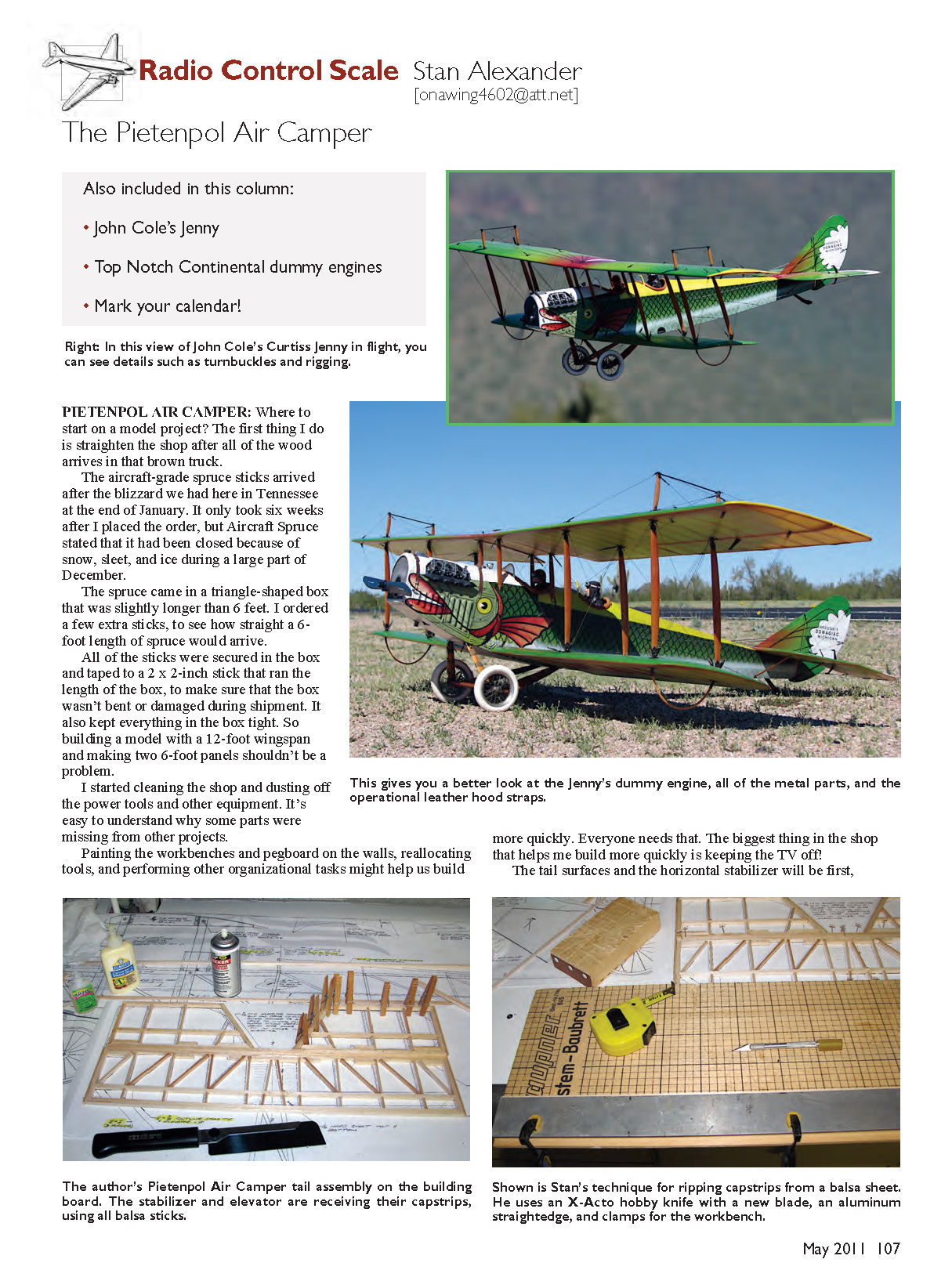

The Pietenpol Air Camper
Stan Alexander [[email protected]]
PIETENPOL AIR CAMPER: Where to start on a model project? The first thing I do is straighten the shop after all of the wood arrives in that brown truck.
The aircraft-grade spruce sticks arrived after the blizzard we had here in Tennessee at the end of January. It took six weeks after I placed the order; Aircraft Spruce said it had been closed because of snow, sleet, and ice during a large part of December.
The spruce came in a triangle-shaped box slightly longer than 6 feet. I ordered a few extra sticks to see how straight a 6-foot length of spruce would arrive. All of the sticks were secured in the box and taped to a 2x2-inch stick that ran the length of the box to make sure that the box wasn't bent or damaged during shipment. It also kept everything in the box tight. So building a model with a 12-foot wingspan by making two 6-foot panels shouldn't be a problem.
I started cleaning the shop and dusting off the power tools and other equipment. It's easy to understand why some parts were missing from other projects. Painting the workbenches and pegboard on the walls, reallocating tools, and performing other organizational tasks might help us build more quickly. Everyone needs that. The biggest thing in the shop that helps me build more quickly is keeping the TV off!
The tail surfaces and the horizontal stabilizer will be first, followed by the rudder and fuselage. With a parasol airplane, we need to build the wings last and make sure that the fuselage is straight and that the uprights for the wing center section are square and secure. After getting all of your wood types together and putting the plan sheets in order of your assembly, cover the plans with waxed paper. This keeps the glue off of them and keeps the adhesive where it should be: in the glue joints.
The 1/4-inch square medium balsa will form the outline of the stabilizer, while 1/4 x 1/8-inch sticks will be the "ribs" for the stabilizer. Leave roughly 1/8 inch to carefully sand the area where glue is applied. This gives a less porous surface for the glue to attach to, so it doesn't soak into the grain and makes a stronger joint. You could use a power saw, but there's really no need. You merely need a good hobby saw. When selecting a new hobby saw blade, the higher the tooth count, the finer and better the cut you will make.
Using a 2x4-inch piece of wood for a sanding block works well and doubles as a cutting board on the back. Cut your sandpaper to the same length as the 2x4 and secure it with thumbtacks. If you need larger or smaller sanding blocks, cut the 2x4 to the length you need. This works great.
The Pietenpol has thin capstrips on all ribs, either on the wing or tail surfaces. On a good sheet of 1/16-inch wood, mark the distances at each end. Take your trusty X-Acto hobby knife with a new blade, an aluminum straightedge, and clamps to your workbench. Clamp the sheet and the aluminum straightedge to the bench. Use the knife to carefully rip the capstrips needed for the tail surfaces. After each strip is cut, reclamp the wood and straightedge to the surface and rip the next one. Check the capstrips for accuracy. This process should take less than 20 minutes.
Around Scale
In this segment of the column I like to highlight models I've seen across the country while attending scale contests or fly-ins. This month's subject flew at the 2010 One Eighth Airforce Spring Fly-In. It was built, or started out, as a Proctor kit of the Curtiss Jenny.
Proctor Enterprises kits are some of the most accurate in all respects. They have construction that is as close as possible to the full-scale aircraft, such as operational wing warping on a Fokker Eindecker E.III. It takes time to soak in all of the details.
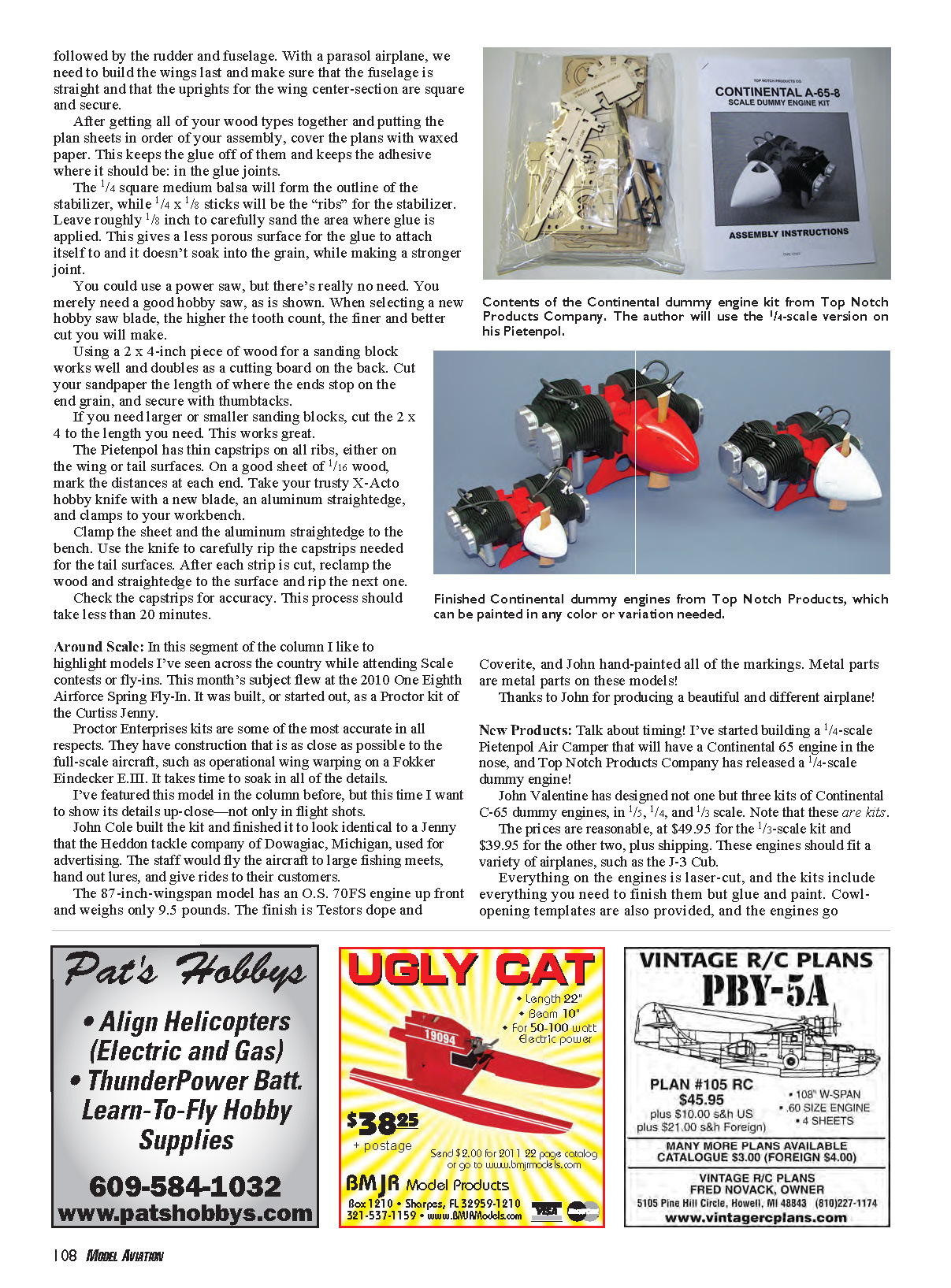
I've featured this model in the column before, but this time I want to show its details up close—not only in flight shots. John Cole built the kit and finished it to look identical to a Jenny that the Heddon Tackle Company of Dowagiac, Michigan, used for advertising. The staff would fly the aircraft to large fishing meets, hand out lures, and give rides to their customers.
The 87-inch-wingspan model has an O.S. 70FS engine up front and weighs only 9.5 pounds. The finish is Testors dope and Coverite, and John hand-painted all of the markings. Metal parts are metal parts on these models!
Thanks to John for producing a beautiful and different airplane!
New Products
Talk about timing! I've started building a 1/4-scale Pietenpol Air Camper that will have a Continental 65 engine in the nose, and Top Notch Products Company has released a 1/4-scale dummy engine!
John Valentine has designed not one but three kits of Continental C-65 dummy engines, in 1/5, 1/4, and 1/3 scale. Note that these are kits. The prices are reasonable: $49.95 for the 1/3-scale kit and $39.95 for the other two, plus shipping. These engines should fit a variety of airplanes, such as the J-3 Cub.
Everything on the engines is laser-cut, and the kits include everything you need to finish them except glue and paint. Cowl-opening templates are also provided, and the engines go together with assembly fixtures. The kit includes detailed assembly directions with good photos of the sequence. This no-nonsense approach is designed to make constructing any of the company's airplane or engine kits a success.
If you're unhappy with the molded-in engine sitting there staring back at you, check out these dummy power plants. For dimensions and assembly instructions, check out the Top Notch Products web site.
Upcoming Events
- The FAI Scale Team Selection for next year will be held in conjunction with this year's Scale National Championships in Muncie, Indiana, July 1-3. The F4C (RC Scale) class will be flown during the RC Scale portion of the Nationals. For more information, get in touch with FAI Team Coordinator Colleen Pierce at AMA Headquarters (contact information is in the Sources listing).
- The 2012 FAI Scale World Championships will be held at Santa Cilia Airfield in Spain. A three-member team will be selected at the upcoming Scale Team Selection to represent the U.S. and compete against scale modelers from around the world.
- This year's Mint Julep Scale Meet will take place May 20-22. One of the many things I enjoy about this contest is that you can take an underpowered, nonaerobatic civil airplane to the event and compete against others of the same type. You won't fly a Cub against an F-86 or a P-51 Mustang. Another plus is that this event is held at one of the few state parks—the Rough River Dam State Resort Park—with a full-scale runway available. It is a 3,200-foot asphalt strip with parking on the north end. The park is located northwest of Morgantown, Kentucky. For more information, contact Dale Arvin or visit the Southern Indiana R/C Modelers web site. Making reservations early is a must. Some attendees make reservations for several years in advance. Thanks to the Southern Indiana R/C Modelers for continuing to host this event after more than 30 years of great friends, competition, and fun.
- The 2011 U.S. Scale Masters Championships will be held in Fresno, California, October 6-9. The host club will be the Fresno Radio Modelers. Check out the Scale Masters web site for more information.
Fair skies and tailwinds, MA
Sources
- Proctor Enterprises
(503) 651-1918 www.proctor-enterprises.com
- Top Notch Products Company
(615) 866-4327 www.topnotchkits.com
- Colleen Pierce
(765) 287-1256, ext. 252 [email protected]
- Rough River Dam State Resort Park
(270) 257-2311 http://parks.ky.gov/findparks/resortparks/rr
- Dale Arvin
(812) 284-0162 [email protected]
- Southern Indiana R/C Modelers
- U.S. Scale Masters Championships
- National Association of Scale Aeromodellers
Transcribed from original scans by AI. Minor OCR errors may remain.

