
What is the difference between a scale ARF and an ARF?
Stan Alexander [[email protected]]
For many years, the model airplane industry has flooded us with ARFs, and we have greedily bought them. This has been great for many, especially when they are scale ARFs. But when is a scale ARF not a scale model?
There will be much debate on this question—both pros and cons—but why ask the question at all?
A scale model is a model of any full-size subject. In our case, a scale model is a small replica of a full-scale airplane. It has the same paint scheme, markings, number of windows, and wheels. The scale model also has the FAA N-number for registration. This can be a huge sticking point for scale models competing in scale contests across the country—either in AMA Fun Scale Novice or in Open Scale in the Masters class.
Manufacturers sometimes produce complete and accurate scale kits, but the markings or colors on the ARF are incorrect. The level of excellent construction and finish put into many of today's ARFs is amazing; however, some fail when it comes to finishing by having the incorrect color and/or FAA N-number.
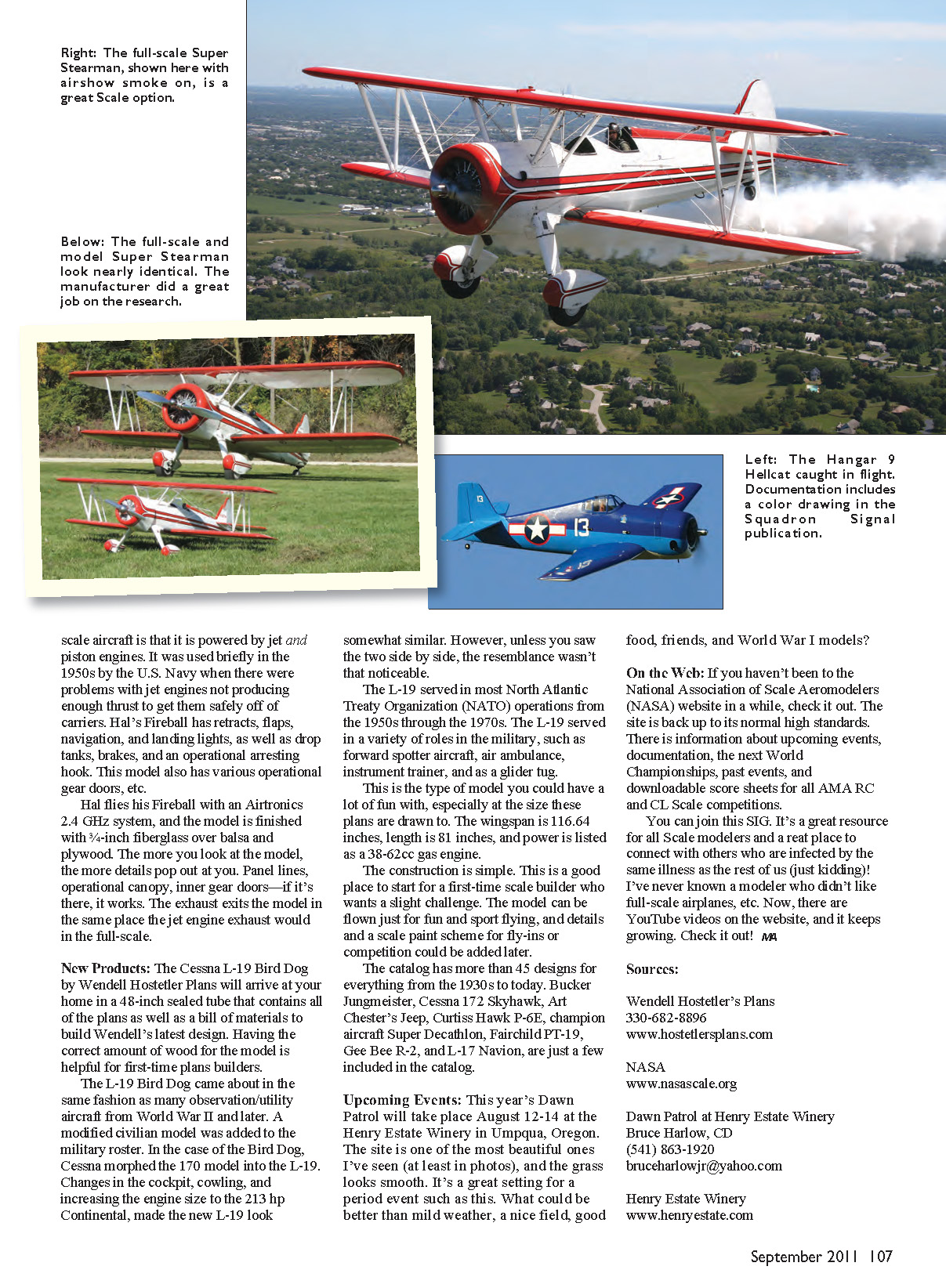
A great scale ARF is the Hangar 9 Hellcat. The model has a three-tone paint scheme in UltraCote with the number 13 on the rudder and all of the national markings. On first inspection, I thought the national markings on the fuselage side were too large. But upon checking the Squadron Signal booklet on the Hellcat, I found they were correct in placement, size, and color. I was impressed. Take that booklet to the contest with a tab on the center page and you have all the documentation you need.
Great Planes did a nice job on its Super Stearman. I researched the N-number on the FAA website and found that the 450 hp Stearman, trimmed in red and white, is registered in Illinois. Writing to the owner can glean photos of the full-scale model too, which is what happened with my Stearman. I received flight shots, static shots, etc.—great stuff for entering Fun Scale. The model is still available, and is one of the longest-produced ARFs in that line of models. Many of us would love to see a 1/4-scale PT-19 from somebody out there.
Have you seen any models with an incorrect color scheme or wrong N-numbers? It's a shame to invest all the research, time, and development into an ARF, and then blow it by goofing up the N-number and/or the paint scheme.
Around Scale
Unique subjects are part of what scale modeling is all about. While at the Mint Julep Scale Meet in Kentucky this past spring, I saw two longtime competitors in scale: Hal Parenti and his son, Gary. For many years, Hal worked for Top Flite models and designed the company's 60-size Zero kit and several others. Hal has been a member of the US FAI F4C Scale Team for several years, and has been named Nats Scale Champion.
One of Hal's unique skills is choosing a difficult subject and building it from scratch—not from someone else's plans. When you build from scratch, you take scale drawings, draw the plans, cut the wood, and put all of the pieces together. You engineer the mechanical and technical aspects of the model before you start.
This month's model is the Ryan Fireball. This 72-inch-span model is powered by a YS 1.2 FS engine. A unique feature of the full-scale aircraft is that it is powered by jet and piston engines. It was used briefly in the 1950s by the U.S. Navy when there were problems with jet engines not producing enough thrust to get them safely off of carriers. Hal's Fireball has retracts, flaps, navigation and landing lights, as well as drop tanks, brakes, and an operational arresting hook. This model also has various operational gear doors and other details.
Hal flies his Fireball with an Airtronics 2.4 GHz system, and the model is finished with 3/4-inch fiberglass over balsa and plywood. The more you look at the model, the more details pop out at you: panel lines, an operational canopy, inner gear doors—if it's there, it works. The exhaust exits the model in the same place the jet engine exhaust would on the full-scale.
New Products
The Cessna L-19 Bird Dog by Wendell Hostetler Plans will arrive at your home in a 48-inch sealed tube that contains all of the plans as well as a bill of materials to build Wendell's latest design. Having the correct amount of wood for the model is helpful for first-time plans builders.
The L-19 Bird Dog came about in the same fashion as many observation/utility aircraft from World War II and later: a modified civil model was added to the military roster. In the case of the Bird Dog, Cessna morphed the 170 model into the L-19. Changes in the cockpit, cowling, and an increase in engine size to the 213 hp Continental made the new L-19 look somewhat different. However, unless you saw the two side by side, the resemblance wasn't that noticeable.
The L-19 served in most North Atlantic Treaty Organization (NATO) operations from the 1950s through the 1970s. The L-19 served in a variety of military roles, such as forward spotter aircraft, air ambulance, instrument trainer, and glider tug.
This is the type of model you could have a lot of fun with, especially at the size these plans are drawn to. The wingspan is 116.64 inches, length is 81 inches, and recommended power is a 38–62 cc gas engine.
The construction is simple. This is a good place to start for a first-time scale builder who wants a slight challenge. The model can be flown just for fun and sport flying, and details and a scale paint scheme for fly-ins or competition could be added later.
The catalog has more than 45 designs for everything from the 1930s to today, including:
- Bucker Jungmeister
- Cessna 172 Skyhawk
- Art Chester's Jeep
- Curtiss Hawk P-6E
- Champion Aircraft Super Decathlon
- Fairchild PT-19
- Gee Bee R-2
- L-17 Navion
Upcoming Events
This year's Dawn Patrol will take place August 12–14 at the Henry Estate Winery in Umpqua, Oregon. The site is one of the most beautiful ones I've seen (at least in photos), and the grass looks smooth. It's a great setting for a period event such as this. What could be better than mild weather, a nice field, good food, friends, and World War I models?
On the Web
If you haven't been to the National Association of Scale Aeromodelers (NASA) website in a while, check it out. The site is back up to its normal high standards. There is information about upcoming events, documentation, the next World Championships, past events, and downloadable score sheets for all AMA RC and CL Scale competitions.
You can join this SIG. It's a great resource for all scale modelers and a neat place to connect with others who are infected by the same illness as the rest of us (just kidding)! I've never known a modeler who didn't like full-scale airplanes, etc. Now, there are YouTube videos on the website, and it keeps growing. Check it out!
Sources
- Wendell Hostetler's Plans
330-682-8896 www.hostetlersplans.com
- NASA
- Dawn Patrol at Henry Estate Winery
Bruce Harlow, CD (541) 863-1920 [email protected]
- Henry Estate Winery
Transcribed from original scans by AI. Minor OCR errors may remain.

