
RADIO CONTROL SCALE AEROBATICS
Mike Hurley 11542 Decatur Ct., Westminster CO 80234 E-mail: [email protected]
As the building season starts to creep up on most of the country, it’s time to start thinking about that next project. Generally, the state of the art for Scale Aerobatics (SA) aircraft hasn’t changed much in the last year or so, but some new trends are starting to emerge and new equipment is becoming available all the time.
The build — Extra 330S
I thought you might like to see my most recent build and some of the detail I used in this Unlimited-class aerobat. You may know that I’m a dyed-in-the-wool Extra fan. I’ve owned many of Carden Aircraft’s designs through the years, so it was a no-brainer that I would build the company’s newest 40%er: the Extra 330S.
Servo selection and setup
I started building with the intention of using JR DS8411 servos. My original plan was:
- four servos for the rudder
- two servos for each aileron (two per aileron)
- two servos for each elevator half
During the build, JR announced the new digital DS8611 servo. It has the same fast transit speed as the DS8411—0.18 second/60° at 4.8 volts—but is ultra high torque: 220 in-oz at 4.8 V or 260 in-oz at 6 V, all in a standard-size case (slightly larger, but it fits with minimal shoehorning).
Because of the 8611’s high torque and other upgrades, I was able to reduce servo count, saving cost, weight, and complexity. My final servo layout:
- three servos for the rudder (ganged)
- one servo for each elevator half
- two servos for the ailerons (to spread the load across the span)
To set up the 8611s, I used a program mix for the rudder servos to match them in a ganged configuration, mixing the other two servos directly to the rudder channel. A multipoint mix could get the servos matched exactly, but standard mixes were sufficient. For the ailerons I used a matchbox buried in the root of each wing to match the servos.
Hangar 9’s in-line volt/amp meter proved invaluable for matching servos. You plug the meter in-line while setting up a servo and adjust the mix down to the lowest amperage draw. It made servo setup easy and repeatable.
Receiver and power distribution
A notable trend in big models is using just one receiver. For years, most pilots building 40% or larger SA aircraft used two receivers—either for perceived redundancy or power distribution—but that practice has spread unnecessarily into smaller models. A receiver is one of the least likely components to fail; tape the crystal in and mount it to minimize vibration and you’ve taken the necessary precautions.
JR has tested receiver current loads, servo loads, and overall system demands to determine if a single receiver power bus can handle the servos in a large SA airplane. Findings:
- The receiver power bus will handle up to about 60 amps.
- A fully stalled DS8411 is roughly 1.5 A (I could only get one to draw ~800 mA in practice).
- JR reports an 8611 will draw ~2.7 A; 10 such servos would be about 27 A, well within the bus capacity.
Other factors—voltage drop across connectors, battery current capacity, etc.—also matter, but based on these tests a single receiver is more than up to the job for 10 high-current servos. Another finding: a second receiver can reduce reception range because receivers and antennas can interact and affect each other. Some JR testers reported better range with a single receiver. Top fliers like Quique Somenzini and Peter Goldsmith now use a single receiver in their giant SA airplanes, and many field pilots are doing the same.
I stick with the principle that simple is better. My giant 40% SA aerobat has:
- one receiver
- two NiMH battery packs
- two switches
- two matchboxes
- 10 servos
—and that’s it: no regulators, no extra power-distribution systems, bells, or whistles.
Tuned pipes
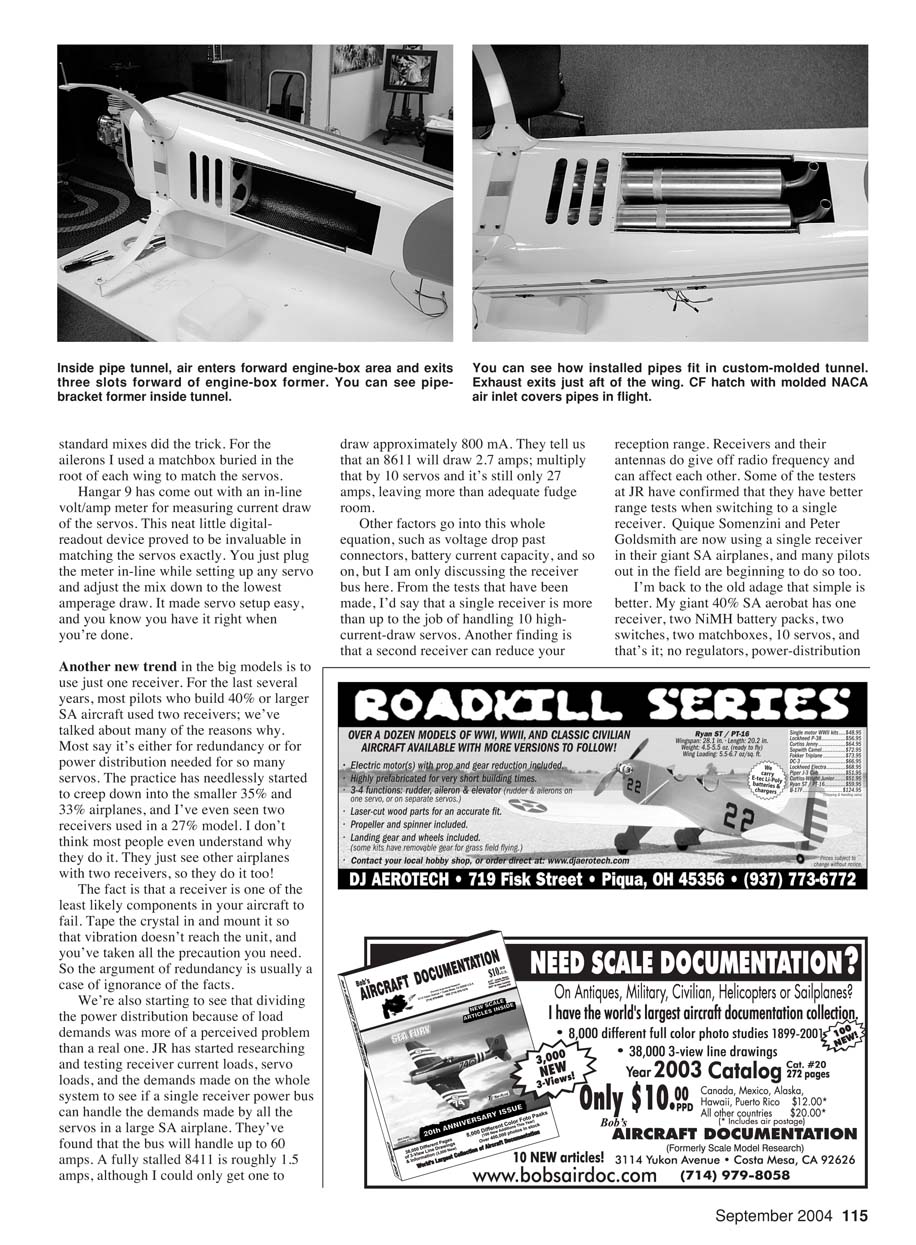
A significant change in this build was adding tuned pipes—long, baseball-bat-sized tuned pipes, not canister mufflers. Because this model is slightly bigger than most other 40% airplanes, it was a couple pounds heavier than others I have. At my altitude flying in Denver, the engine couldn’t handle the extra weight, so I decided to try tuned pipes.
The decision was tough: few installs existed nationwide and results weren’t guaranteed. The pipes would add another 2–3 pounds, so I was risking extra weight to gain power. The potential for a quieter model with more power convinced me to try them.
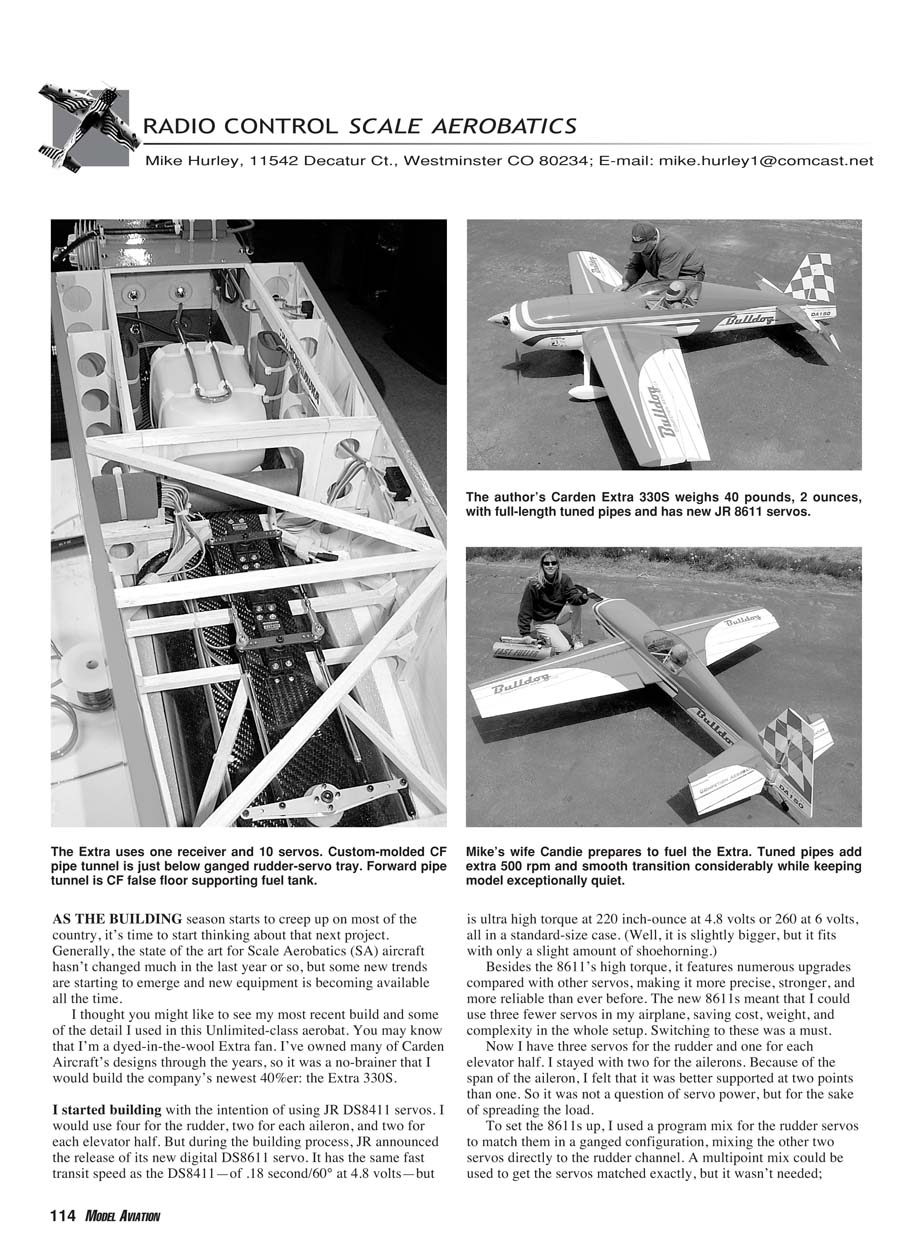
Installation required planning and some modifications. The Carden Extra’s engine box is the right size for two canisters but about 14 inches too short for these pipes, so I modified the rear engine-box former to allow the pipes to pass through. That former became a good place for a simple but effective pipe bracket (made by MTW and sold by Desert Aircraft) that holds four pieces of silicone tubing snugly around the pipe.
To isolate the pipes inside the engine box, I used a piece of carbon-fiber (CF) laminate to make a false floor. The CF also added strength and rigidity to the engine-box assembly. Aft of the engine-box former I made a pipe tunnel: Erik Richard molded a single-layer CF tunnel that was epoxied inside the fuselage. The tunnel weighed about 2 ounces and the false floor about 4 ounces—minimal structure with a clean look.
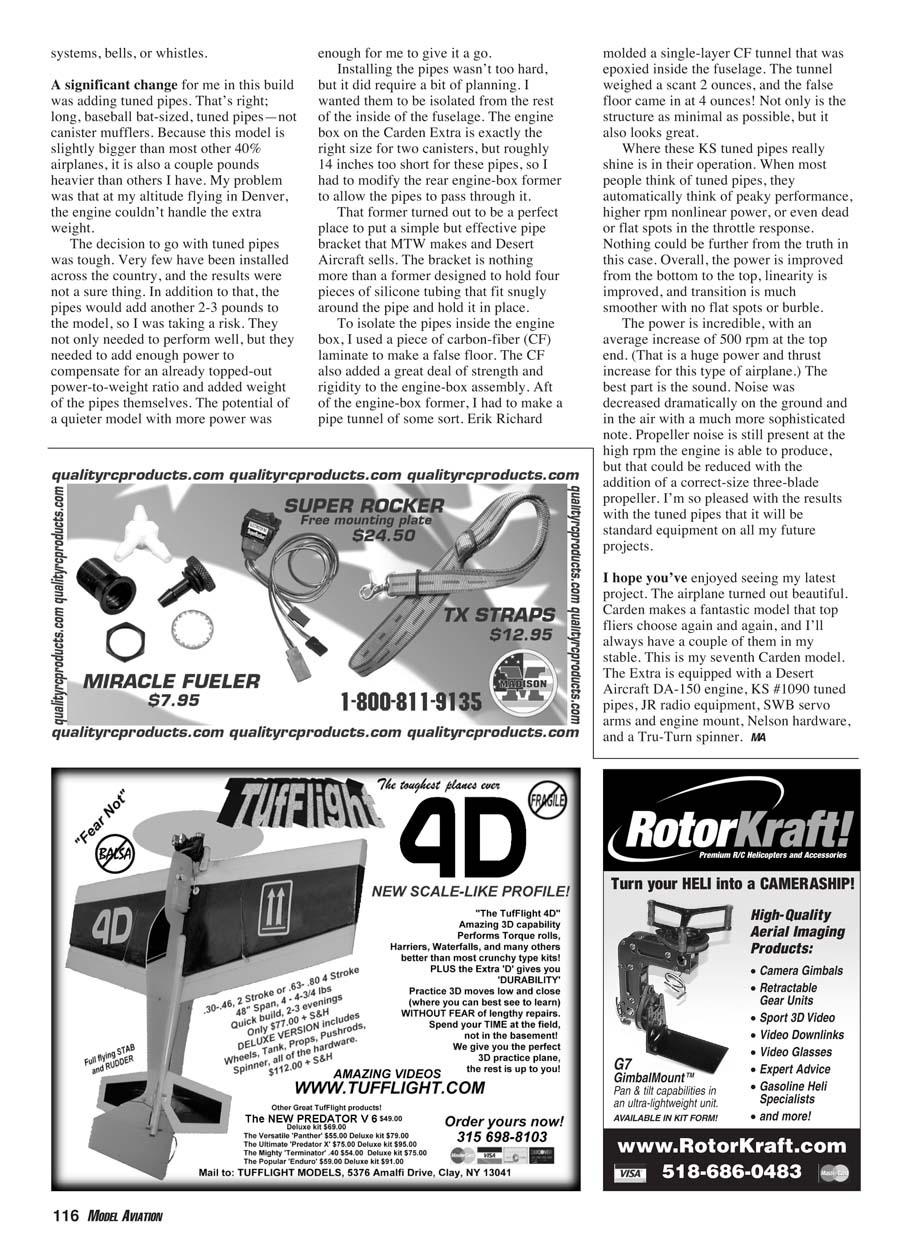
Performance and sound are where the KS tuned pipes shine. Contrary to the stereotype that tuned pipes are peaky or cause nonlinear throttle response, these pipes improve power across the range. Improvements observed:
- Improved power from bottom to top, with smoother transition and no flat spots or burble.
- Average increase of about 500 rpm at the top end (a significant power and thrust increase for this type of airplane).
- Noise decreased dramatically on the ground and in the air, with a more sophisticated tonal quality. Propeller noise remains at high rpm, which could be reduced with the correct three-blade propeller.
I’m pleased with the results; tuned pipes will be standard equipment on my future projects.
Conclusion
The airplane turned out beautiful. Carden makes a fantastic model that top fliers choose again and again; this is my seventh Carden model. The Extra is equipped with a Desert Aircraft DA-150 engine, KS #1090 tuned pipes, JR radio equipment, SWB servo arms and engine mount, Nelson hardware, and a Tru-Turn spinner.
Transcribed from original scans by AI. Minor OCR errors may remain.

