
RADIO CONTROL SCALE AEROBATICS
Mike Hurley 11542 Decatur Ct., Westminster CO 80234 E-mail: [email protected]
Introduction
In model aviation terms, 3-D as a segment of the hobby has only recently been vigorously explored. Since 3-D is not represented in this magazine as its own column and since it was originally, and still is, most often associated with Scale Aerobatics (SA), I consider it part of SA.
Today there are many 3-D models available that are not scale, and I’ll write about some of them from time to time. Flat-winged foamie electric 3-D models are most often represented as SA airplanes and have proven to be exceptional 3-D performers. I’m a big fan of flat-airfoil aircraft; they are revolutionizing 3-D and the ability to perform 3-D with a low-cost, capable platform.
I probably won’t write about the fun-fly-type models with very fat airfoils and either profile or built-up fuselages that are labeled as 3-D-specific designs. Although they fly well for fun-fly-type maneuvers, I’ve not yet found one that will fly well in 3-D. Their fat, forward high-point wings are designed to resist stall and are poor performers once into a stall. Generally speaking, 3-D is a stalled condition. Yes, I know they can hover, but there’s more to 3-D than hovering and torque-rolling.
It isn’t going to do any good to write to me telling how great your latest ProBro 3-D “whatsit” performs—I’ve flown many of them, and they’re just not stable in a high-alpha or stalled condition.
One caveat: here in Denver I fly at an altitude of 5,500–6,500 feet, so an airplane that is adequately stable at sea level may not do well at this altitude. That fact may have skewed my perception, but more likely it exaggerates an airplane’s true qualities.
Chip Hyde Products and the Vision 3D
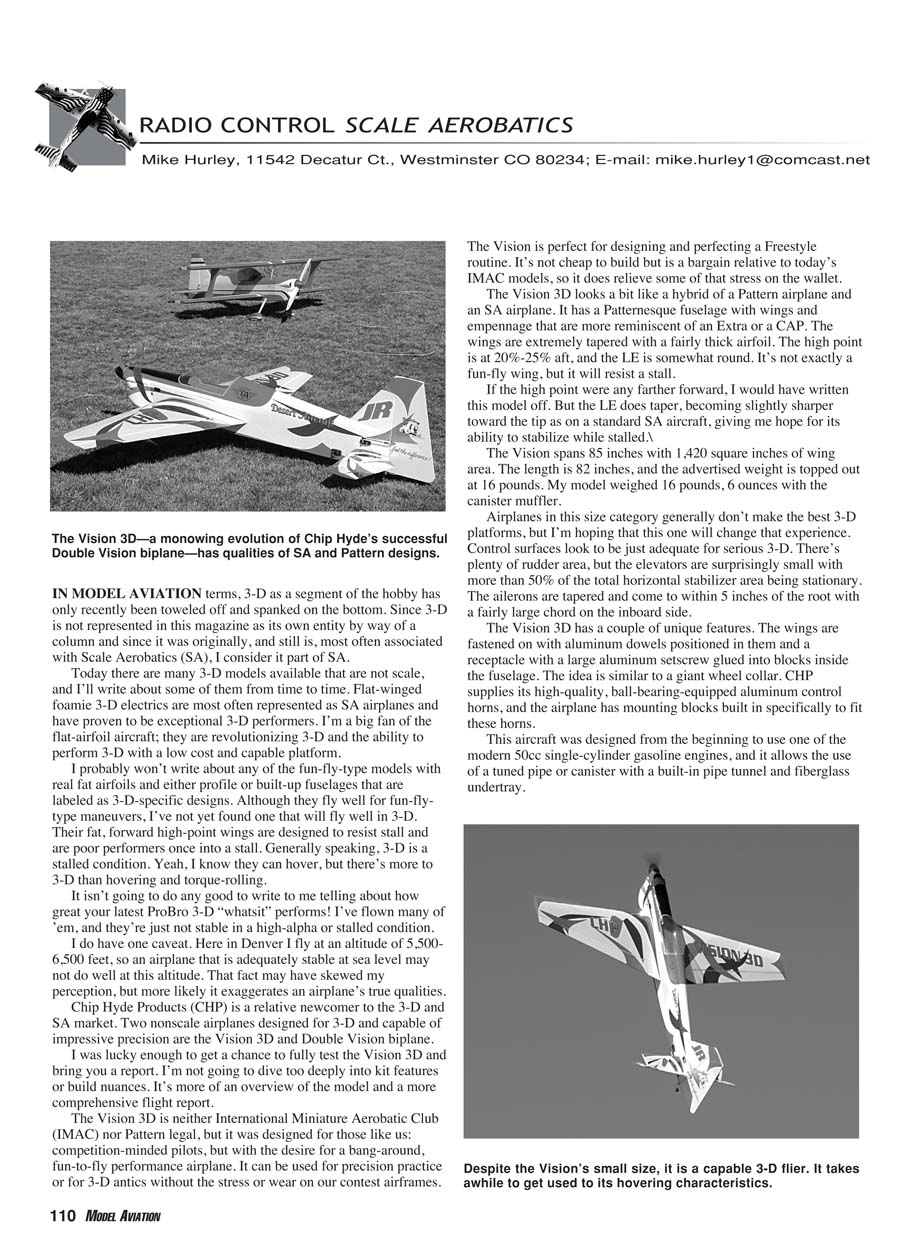
Chip Hyde Products (CHP) is a relative newcomer to the 3-D and SA market. Two non-scale airplanes designed for 3-D and capable of impressive precision are the Vision 3D and Double Vision biplane. I was lucky enough to fully test the Vision 3D and bring you a report. Rather than dive deeply into kit features or build nuances, this is an overview of the model and a comprehensive flight report.
The Vision 3D is neither International Miniature Aerobatic Club (IMAC) nor Pattern legal, but it was designed for pilots who are competition-minded yet want a bang-around, fun-to-fly performance airplane. It can be used for precision practice or 3-D antics without the stress or wear on contest airframes. The Vision is perfect for designing and perfecting a Freestyle routine. It’s not cheap to build but is a bargain relative to today’s IMAC models, so it does relieve some stress on the wallet.
Design and specifications
The Vision 3D looks like a hybrid of a Pattern airplane and an SA airplane. It has a Pattern-esque fuselage with wings and empennage reminiscent of an Extra or a CAP. The wings are extremely tapered with a fairly thick airfoil. The high point is about 20%–25% aft, and the leading edge is somewhat round. It’s not exactly a fun-fly wing, but it will resist a stall. The leading edge tapers, becoming slightly sharper toward the tip as on a standard SA aircraft, which helps stabilize it while stalled.
Key specs:
- Wingspan: 85 in
- Wing area: 1,420 sq in
- Length: 82 in
- Advertised weight: up to 16 lb
- Test model weight: 16 lb 6 oz (with canister muffler)
Control surfaces appear adequate for serious 3-D. There’s plenty of rudder area, but the elevators are surprisingly small (more than 50% of the horizontal stabilizer area is stationary). The ailerons are tapered and come within about 5 in of the root, with a fairly large inboard chord.
Notable features:
- Wings fastened with aluminum dowels and a large aluminum setscrew receptacle glued into blocks inside the fuselage (similar to a giant wheel collar).
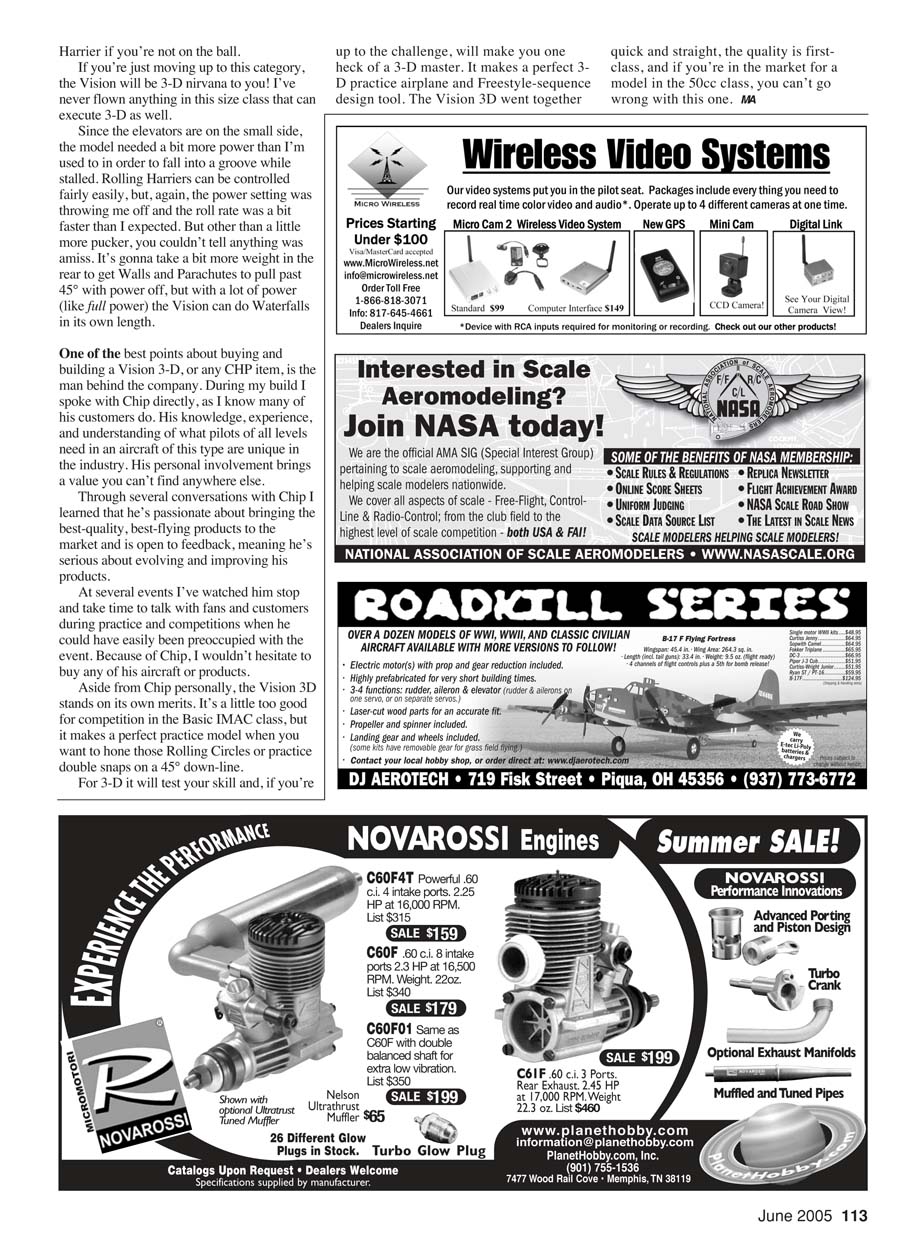
- High-quality, ball-bearing-equipped aluminum control horns supplied by CHP, with mounting blocks built in to fit the horns.
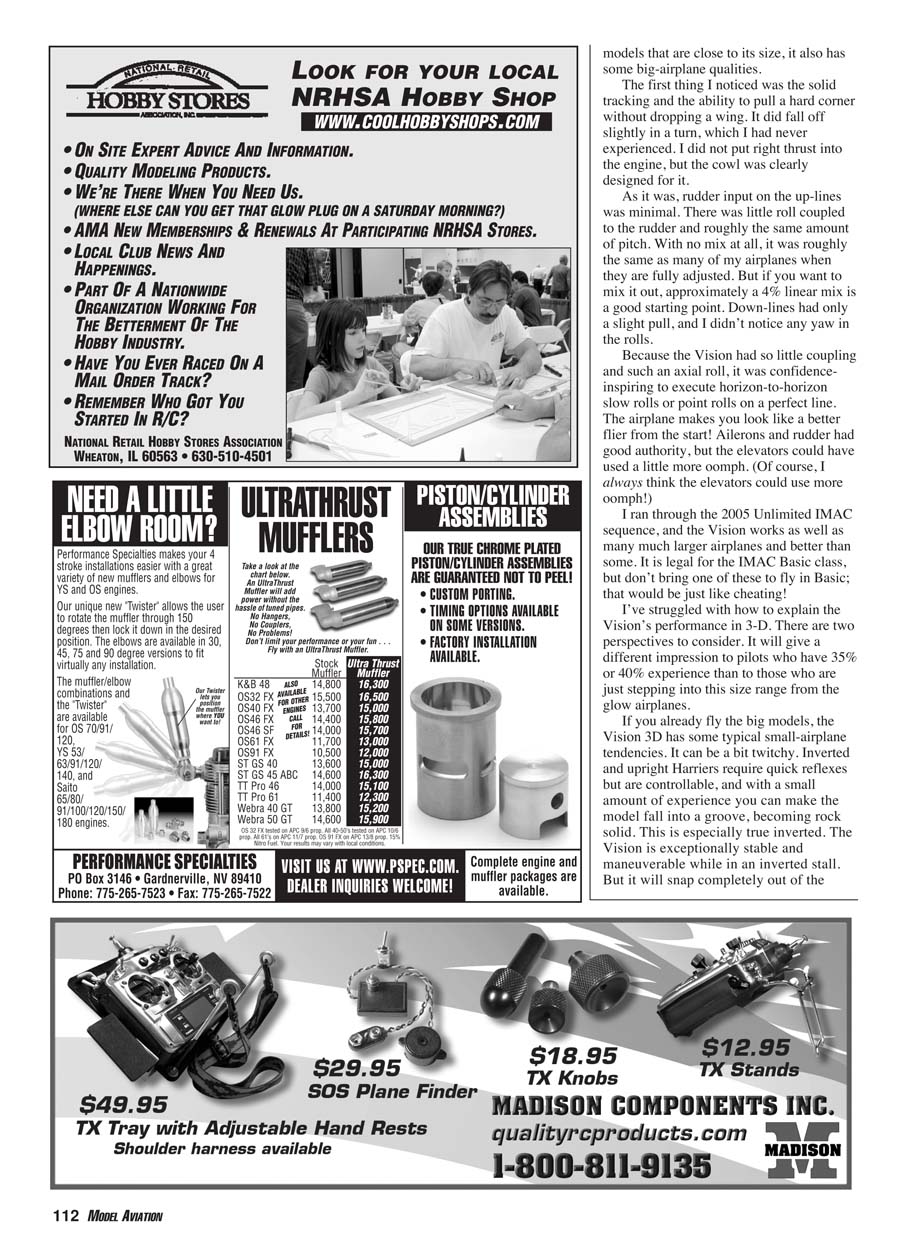
- Designed from the beginning to use a modern 50cc single-cylinder gasoline engine; allows use of a tuned pipe or canister with a built-in pipe tunnel and fiberglass undertray.
One disappointment is the extensive use of wood screws throughout the model. Some builders won’t mind, but I’d prefer more blind nuts or threaded inserts for added reliability and ease of maintenance. Overall, the design is state of the art and lacks nothing for modelers who stay on the cutting edge of techniques and equipment.
Kit, instructions, and recommended power
The kit didn’t come with printed instructions, so I downloaded them from the CHP website (www.chiphyde.com) and printed them. Web-based instructions are useful because the company can update them as needed; Chip has made a few updates since the Vision’s introduction based on customer feedback.
CHP recommends a Desert Aircraft (DA) 50cc gas engine, and that’s what I used. DA supplied the header and hardware for CHP’s quiet canister and a Mejzlik carbon-fiber spinner. When ordering a new engine, tell the DA staff your model so they can supply the correct header and proper-length engine mounts. I used CHP’s quiet pipe and a CHP 22 x 8 wood propeller.
Recommended electronics (my test setup):
- JR DS8611 digital servos on all control surfaces
- JR DS811 servo for throttle
- NEH531 standard servo for the choke
- JR XP9303 transmitter
- One receiver
- One 2700 mAh NiMH battery pack for the radio
- One 2100 mAh battery for the ignition
Assembly and fit
Assembly is straightforward for someone with previous modeling experience, but if you’re used to the wide-open spaces of a 40% Giant Scale, this is like building a ship in a bottle. I often considered cutting the forward hatch portion off to gain access to gear positions. It would have been more convenient if the hatch/canopy were built from the firewall aft. My wife Candie’s small hands and patience were indispensable.
A preinstalled servo-wire tube in the rear section would be a useful addition—getting back there to anchor servo wires is nearly impossible. General construction quality—parts fit, covering, and paint—is excellent. Wing tubes are snug but not too tight. Wings, stabilizers, and hatch mate perfectly to the fuselage, and the fiberglass parts and landing gear fit without a hitch.
I built the Vision largely according to the instructions and ended up with the center of gravity about 1/4 in behind the recommended point, which is fine for me. I estimate less than 30 hours of build time.
Ground handling and first flights
I headed to the field for the first flight with a new DA-50 that had not been bench-tested or broken in. Unlike a glow engine, there’s no need to run a gas engine rich during break-in or to run it on the bench before flying.
The engine fired easily but was a tad rich at first. After leaning it, I got instant throttle response and a perfect idle. The DA-50 was smooth, reliable, and powerful from the start. The CHP quiet pipe was easy on the ears, and the CHP propeller pulled hard. Even at our altitude this is a strong combination.
A few early issues:
- Tailwheel spring wire was a bit soft; I had to bend it back after every landing. I plan to replace it with piano wire.
- Tail gear is a bit short; with 50° of elevator throw, the stabilizer counterbalances are close to the ground while taxiing at full deflection.
- Chip told me he didn’t want customers worrying about incidence, so I didn’t check incidences before flight. If they’re off, it’s very little. It required some trim on the first flight, but no further corrections since then.
Flight characteristics and aerobatics
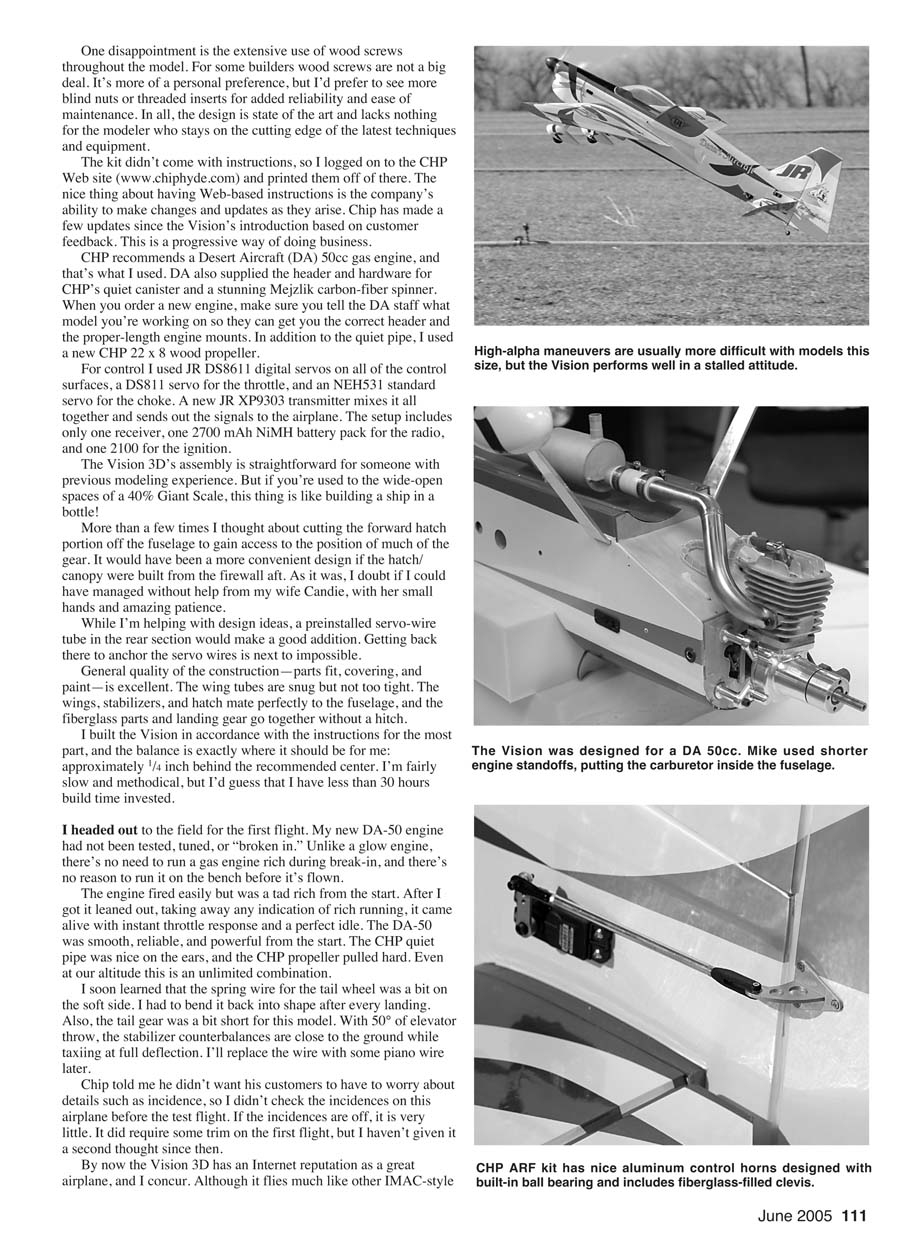
The Vision 3D has developed an Internet reputation as a great airplane, and I concur. Although it flies much like other IMAC-style models of similar size, it also has some large-airplane qualities.
The first thing I noticed was solid tracking and the ability to pull a hard corner without dropping a wing. It did fall off slightly in a turn—something I hadn’t experienced before. I did not add right thrust to the engine, but the cowl was clearly designed for it.
Rudder input on up-lines was minimal. There was little roll coupled to the rudder and roughly the same amount of pitch. With no mixing it behaved like many of my other airplanes when fully adjusted. If you want to add mix, a roughly 4% linear rudder-to-aileron mix is a good starting point. Down-lines had only a slight pull, and I didn’t notice any yaw in the rolls.
Because the Vision has little coupling and an axial roll, executing horizon-to-horizon slow rolls or point rolls on a perfect line is confidence-inspiring. The airplane makes you look like a better flier from the start. Ailerons and rudder have good authority, but the elevators could use a bit more power.
I ran the 2005 Unlimited IMAC sequence; the Vision performs as well as many much larger airplanes and better than some. It is legal for the IMAC Basic class, but it’s too capable for Basic—better used as a practice or intermediate competition platform.
3-D performance
Explaining the Vision’s 3-D performance requires two perspectives: pilots who already fly 35%–40% models and those stepping up into this size from glow airplanes.
- For experienced big-model pilots: the Vision exhibits some small-airplane tendencies and can be a bit twitchy. Inverted and upright Harriers require quick reflexes but are controllable. With a little experience you can make the model fall into a groove and become rock solid—especially inverted. The Vision is exceptionally stable and maneuverable while in an inverted stall and will not spin completely out of the stall. Be on the ball when flying Harriers.
- For pilots moving up to this category: the Vision will feel like 3-D nirvana. I’ve never flown anything in this size class that executes 3-D as well.
Because the elevators are small, the model needed a bit more power than I’m used to to settle into a stalled groove. Rolling Harriers are controllable, though the roll rate felt a bit faster than I expected. You may need a bit more rear weight to get Walls and Parachutes to fall past 45° with power off. With a lot of power (full power) the Vision can do Waterfalls in its own length.
The man behind the product
One of the best points about buying and building a Vision 3D, or any CHP item, is the founder, Chip Hyde. During my build I spoke with Chip directly, as many customers do. His knowledge, experience, and understanding of what pilots of all levels need in an aircraft of this type are unique in the industry. His personal involvement brings a value you can’t find anywhere else.
Chip is passionate about bringing the best-quality, best-flying products to the market and is open to feedback—he’s serious about evolving and improving his products. I’ve watched him stop and talk with fans and customers during practice and competitions when he could have been preoccupied. Because of Chip, I wouldn’t hesitate to buy any of his aircraft or products.
Conclusion
Aside from Chip personally, the Vision 3D stands on its own merits. It’s a little too good for competition in the Basic IMAC class, but it makes a perfect practice model when you want to hone Rolling Circles or practice double snaps on a 45° down-line.
For 3-D it will test your skill and, if you’re up to the challenge, will make you one heck of a 3-D master. It’s a perfect 3-D practice airplane and a Freestyle-sequence design tool. The Vision 3D went together quickly and straight, the quality is first-class, and if you’re in the market for a model in the 50cc class, you can’t go wrong with this one.
Transcribed from original scans by AI. Minor OCR errors may remain.

