
Mike’s impressions of a few popular SA models
Mike Hurley [[email protected]]
I'm not sure about the other special-interest columns in this magazine, but it might be helpful to some readers to remember that the information in the Scale Aerobatics (SA) column is my opinion based solely on my experiences. With that disclaimer —
I get many questions from readers and from pilots I meet while flying about what airplanes I like and which ones to avoid, so I thought I'd share some of those thoughts with you. I hope you'll understand that my thoughts and experiences may not be the same as yours. That's perfectly okay. Flight performance is a perception and perceptions differ. This overview is meant to give you a basic understanding of how each design varies and help you make a decision about your next airframe.
In the next two SA columns I'm going to highlight four types of airplanes, giving you my impressions of them and revealing a bit about how I like to set them up. With any given design there are basic similarities and vast differences in flight performance when comparing brands and sizes. A 25% CAP will have some of the same nuances of a different brand of 40% CAP, but the overall experience may be completely different.
So although I may like one brand or size of CAP, I may not recommend another. Just because brand "A" performs well (or poorly) does not mean all CAPs will.
For this exercise I will be discussing only models that have wingspans exceeding 80 inches. I don't have enough experience with the smaller models to make a judgment about their performance.
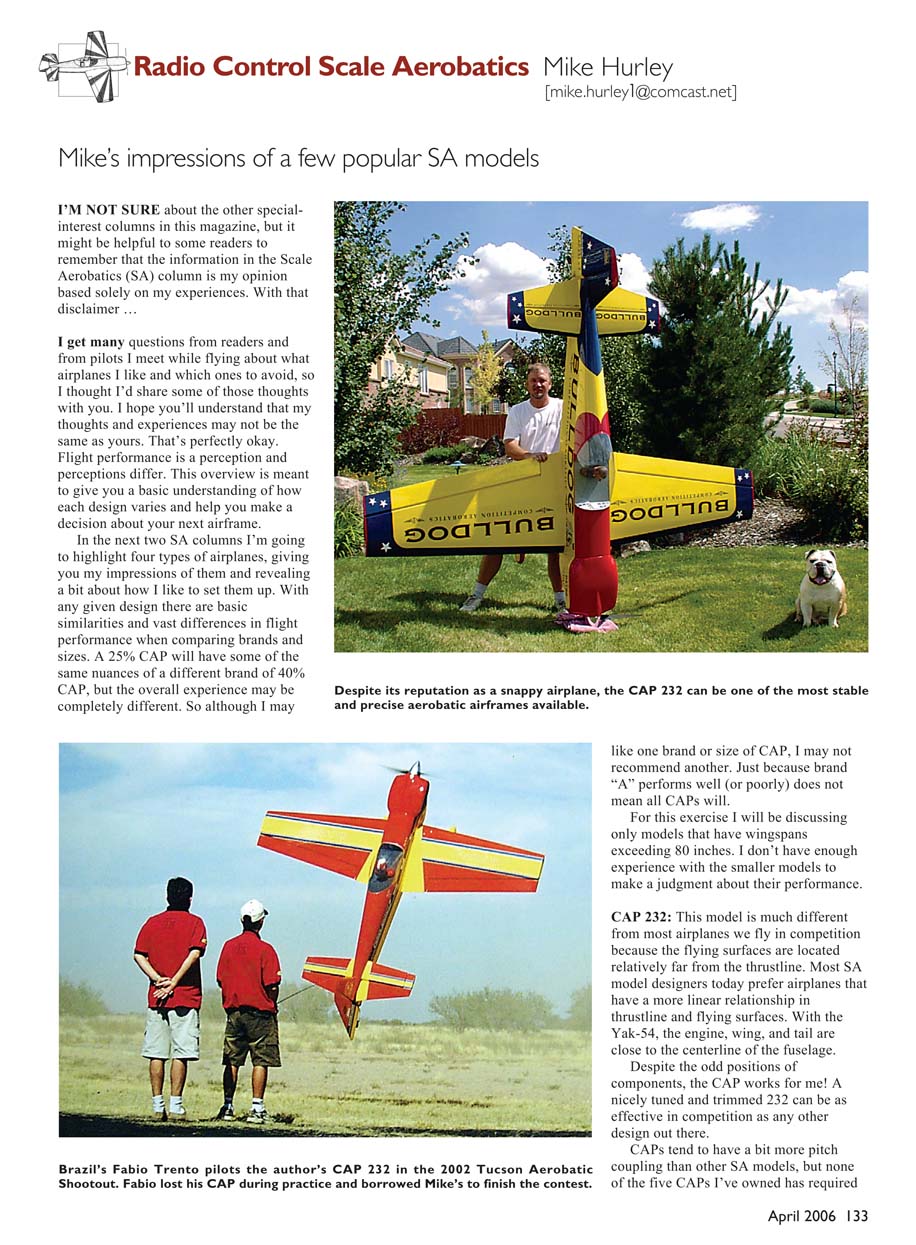
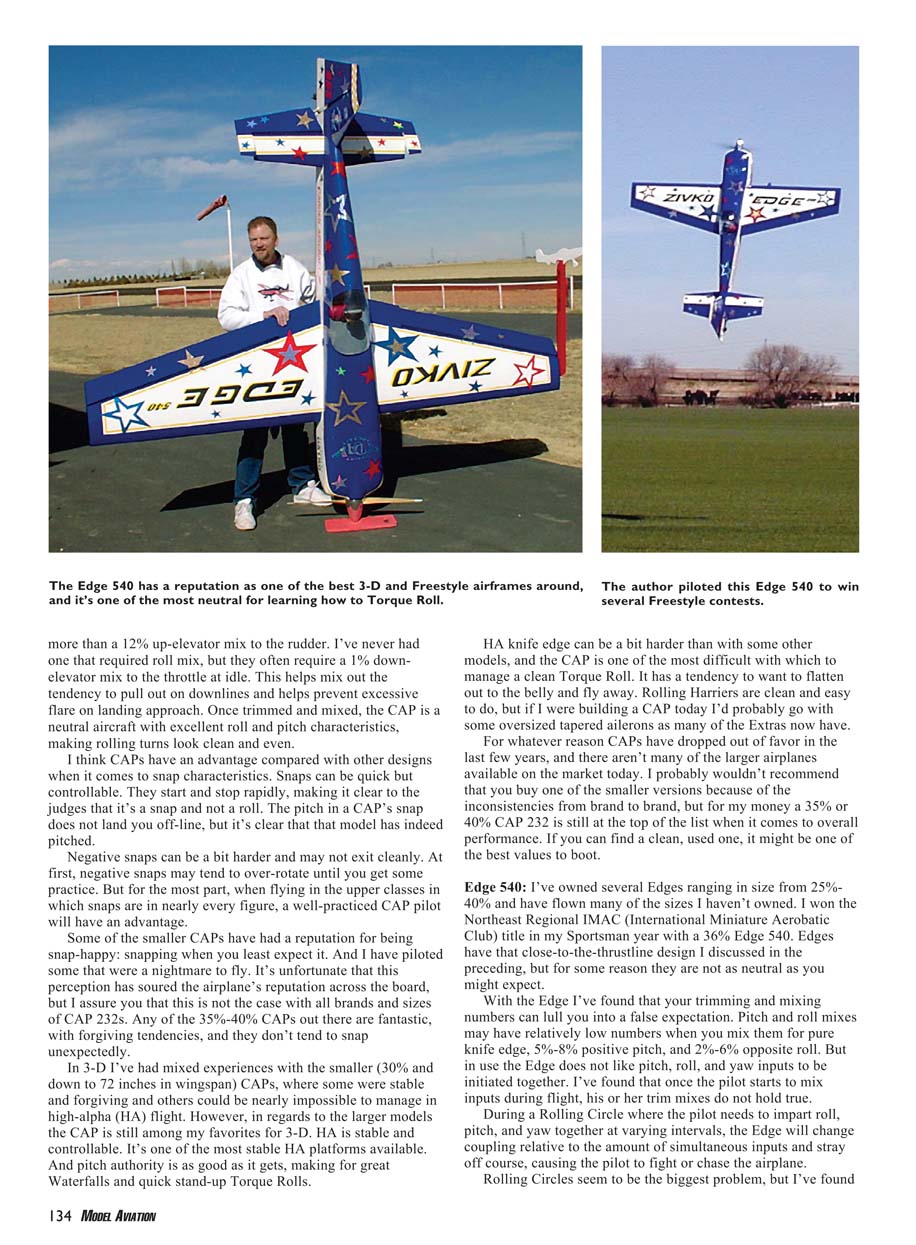
CAP 232
This model is much different from most airplanes we fly in competition because the flying surfaces are located relatively far from the thrustline. Most SA model designers today prefer airplanes that have a more linear relationship in thrustline and flying surfaces. With the Yak-54, the engine, wing, and tail are close to the centerline of the fuselage.
Despite the odd positions of components, the CAP works for me! A nicely tuned and trimmed 232 can be as effective in competition as any other design out there.
CAPs tend to have a bit more pitch coupling than other SA models, but none of the five CAPs I've owned has required more than a 12% up-elevator mix to the rudder. I've never had one that required roll mix, but they often require a 1% down-elevator mix to the throttle at idle. This helps mix out the tendency to pull out on downlines and helps prevent excessive flare on landing approach. Once trimmed and mixed, the CAP is a neutral aircraft with excellent roll and pitch characteristics, making rolling turns look clean and even.
I think CAPs have an advantage compared with other designs when it comes to snap characteristics. Snaps can be quick but controllable. They start and stop rapidly, making it clear to the judges that it's a snap and not a roll. The pitch in a CAP's snap does not land you off-line, but it's clear that that model has indeed pitched. Negative snaps can be a bit harder and may not exit cleanly. At first, negative snaps may tend to over-rotate until you get some practice. But for the most part, when flying in the upper classes in which snaps are in nearly every figure, a well-practiced CAP pilot will have an advantage.
Some of the smaller CAPs have had a reputation for being snap-happy: snapping when you least expect it. I have piloted some that were a nightmare to fly. It's unfortunate that this perception has soured the airplane's reputation across the board, but I assure you that this is not the case with all brands and sizes of CAP 232s. Any of the 35%–40% CAPs out there are fantastic, with forgiving tendencies, and they don't tend to snap unexpectedly.
In 3-D I've had mixed experiences with the smaller (30% and down to 72 inches in wingspan) CAPs, where some were stable and forgiving and others could be nearly impossible to manage in high-alpha (HA) flight. However, regarding the larger models the CAP is still among my favorites for 3-D. HA is stable and controllable. It's one of the most stable HA platforms available. And pitch authority is as good as it gets, making for great waterfalls and quick stand-up torque rolls.
HA knife-edge can be a bit harder than with some other models, and the CAP is one of the most difficult with which to manage a clean torque roll. It has a tendency to want to flatten out to the belly and fly away. Rolling harriers are clean and easy to do, but if I were building a CAP today I'd probably go with some oversized tapered ailerons as many of the Extras now have.
For whatever reason CAPs have dropped out of favor in the last few years, and there aren't many of the larger airplanes available on the market today. I probably wouldn't recommend that you buy one of the smaller versions because of the inconsistencies from brand to brand, but for my money a 35% or 40% CAP 232 is still at the top of the list when it comes to overall performance. If you can find a clean, used one, it might be one of the best values to boot.
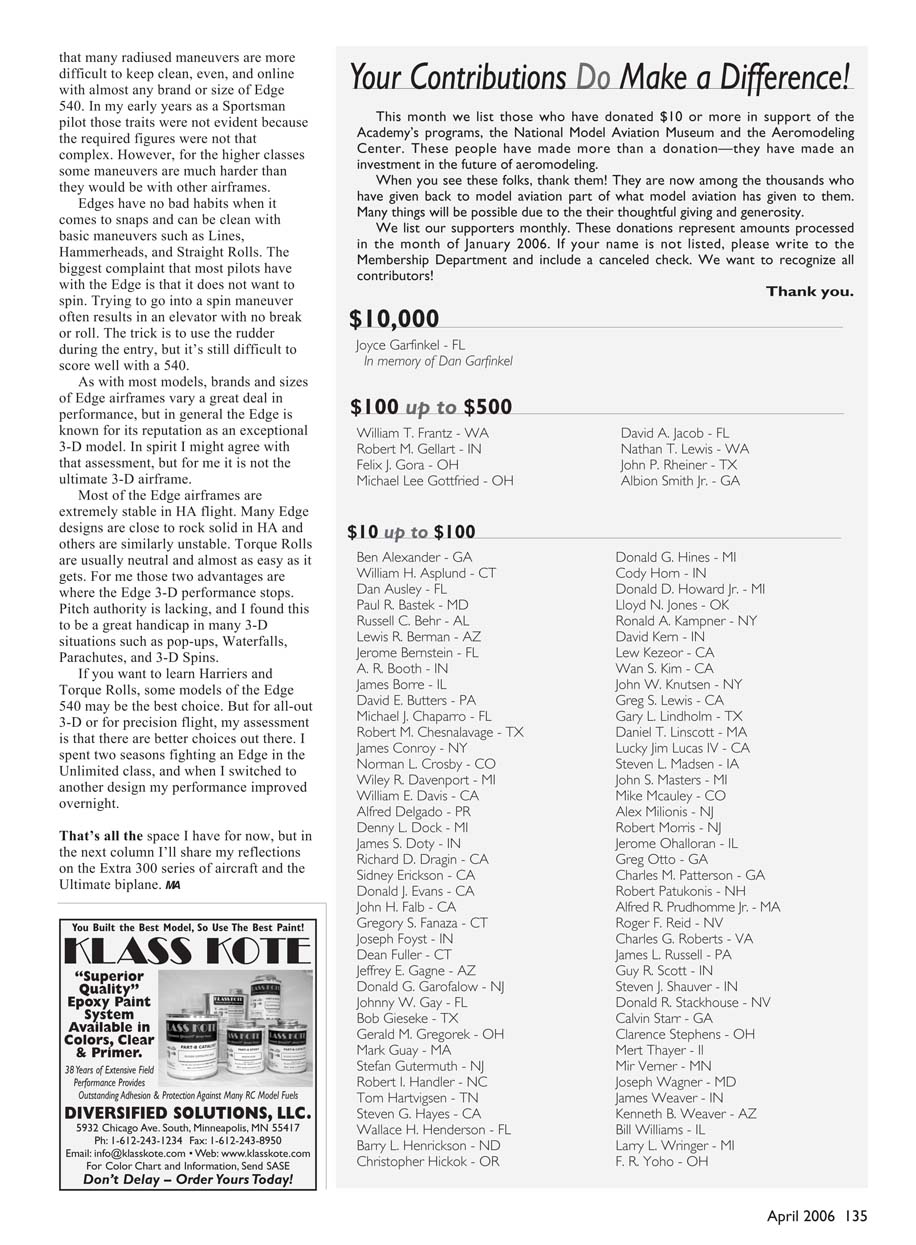
Edge 540
I've owned several Edges ranging in size from 25%–40% and have flown many of the sizes I haven't owned. I won the Northeast Regional IMAC (International Miniature Aerobatic Club) title in my Sportsman year with a 36% Edge 540. Edges have that close-to-the-thrustline design I discussed above, but for some reason they are not as neutral as you might expect.
With the Edge I've found that your trimming and mixing numbers can lull you into a false expectation. Pitch and roll mixes may have relatively low numbers when you mix them for pure knife edge, 5%–8% positive pitch, and 2%–6% opposite roll. But in use the Edge does not like pitch, roll, and yaw inputs to be initiated together. I've found that once the pilot starts to mix inputs during flight, his or her trim mixes do not hold true.
During a rolling circle where the pilot needs to impart roll, pitch, and yaw together at varying intervals, the Edge will change coupling relative to the amount of simultaneous inputs and stray off course, causing the pilot to fight or chase the airplane.
Rolling circles seem to be the biggest problem, but many radiused maneuvers are more difficult to keep clean, even, and online with almost any brand or size of Edge 540. In my early years as a Sportsman pilot those traits were not evident because the required figures were not that complex. However, for the higher classes some maneuvers are much harder than they would be with other airframes.
Edges have no bad habits when it comes to snaps and can be clean with basic maneuvers such as lines, hammerheads, and straight rolls. The biggest complaint that most pilots have with the Edge is that it does not want to spin. Trying to go into a spin maneuver often results in an elevator with no break or roll. The trick is to use the rudder during the entry, but it's still difficult to score well with a 540.
As with most models, brands and sizes of Edge airframes vary a great deal in performance, but in general the Edge is known for its reputation as an exceptional 3-D model. In spirit I might agree with that assessment, but for me it is not the ultimate 3-D airframe.
Most of the Edge airframes are extremely stable in HA flight. Many Edge designs are close to rock solid in HA and others are similarly unstable. Torque rolls are usually neutral and almost as easy as it gets. For me those two advantages are where the Edge 3-D performance stops. Pitch authority is lacking, and I found this to be a great handicap in many 3-D situations such as pop-ups, waterfalls, parachutes, and 3-D spins.
If you want to learn harriers and torque rolls, some models of the Edge 540 may be the best choice. But for all-out 3-D or for precision flight, my assessment is that there are better choices out there. I spent two seasons fighting an Edge in the Unlimited class, and when I switched to another design my performance improved overnight.
That's all the space I have for now, but in the next column I'll share my reflections on the Extra 300 series of aircraft and the Ultimate biplane.
Transcribed from original scans by AI. Minor OCR errors may remain.

