
Radio Control Aerobatics
Eric Henderson [[email protected]]
One club's winter-building-season Pattern project
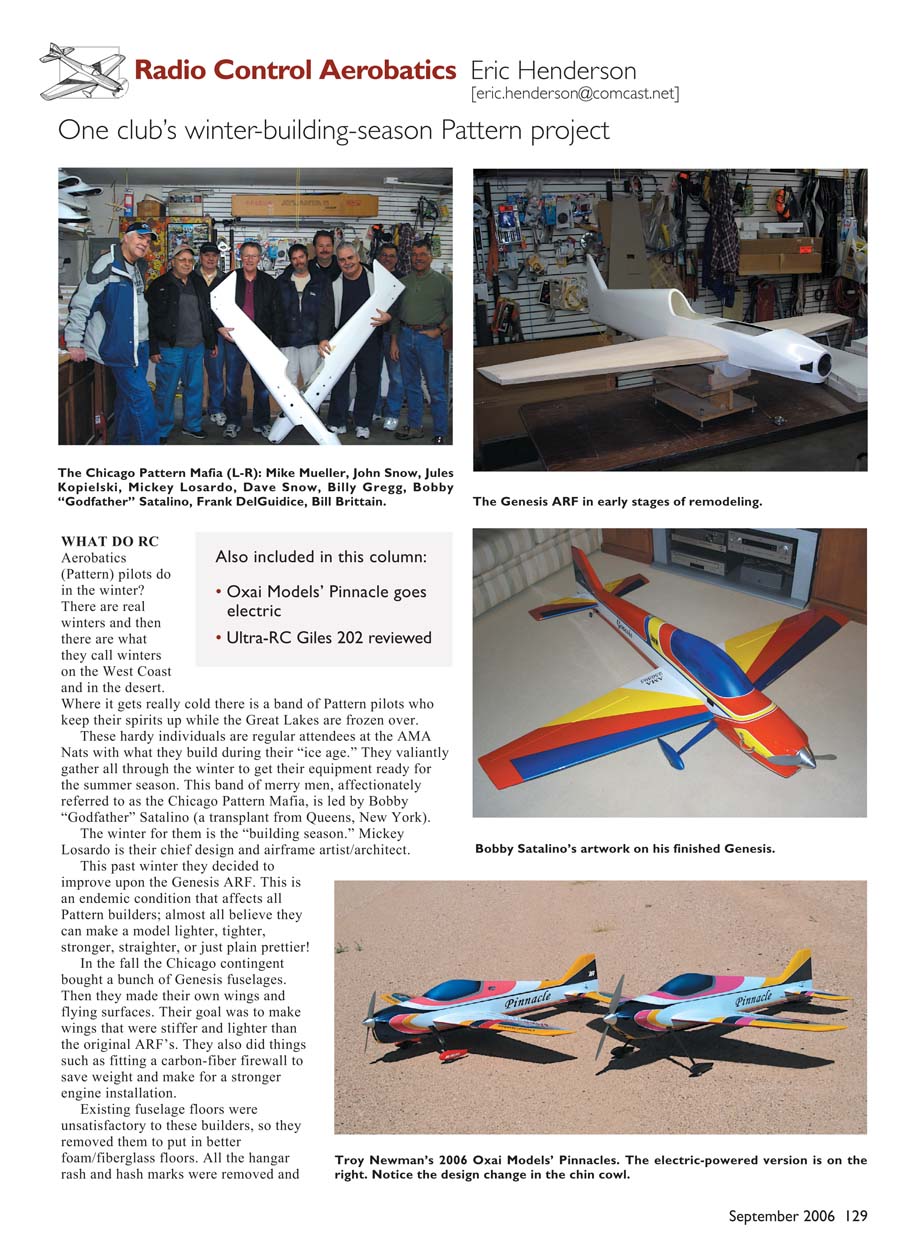
What do RC aerobatics (Pattern) pilots do in the winter? There are real winters and then there are what they call winters on the West Coast and in the desert. Where it gets really cold there is a band of Pattern pilots who keep their spirits up while the Great Lakes are frozen over.
These hardy individuals are regular attendees at the AMA Nats with what they build during their "ice age." They gather through the winter to get their equipment ready for the summer season. This band of merry men, affectionately referred to as the Chicago Pattern Mafia, is led by Bobby "Godfather" Satalino (a transplant from Queens, New York). The winter for them is the "building season." Mickey Losardo is their chief design and airframe artist/architect.
This past winter they decided to improve upon the Genesis ARF. This is an endemic condition that affects all Pattern builders; almost all believe they can make a model lighter, tighter, stronger, straighter, or just plain prettier!
In the fall the Chicago contingent bought a bunch of Genesis fuselages and then made their own wings and flying surfaces. Their goal was to make wings that were stiffer and lighter than the original ARF's. They also did things such as fitting a carbon-fiber firewall to save weight and provide a stronger engine installation.
Existing fuselage floors were unsatisfactory to these builders, so they removed them to put in better foam/fiberglass floors. All the hangar rash and hash marks were removed and filled with car-body paint filler. Canopy flanges were reinforced with carbon-fiber strips. The list of changes is long and extensive. A great deal of extra work was put in to get a Pattern airplane the way the group wanted it. Now they have only eight more to complete before the July 2006 Pattern Nats.
In another part of America—Phoenix, Arizona—Troy Newman and Oxai Models have been taking the Pinnacle design into the expanding world of electric power. Their idea of winter is much more like time to practice flying before the real flying season starts, which presents the problem of getting time to build. A Pinnacle ARF's completeness and finish help with that dilemma: a glow-powered Pinnacle takes about 20–25 hours of workshop time to outfit with the equipment of your choice. Enter the new Oxai electric-powered Pinnacle. It was purpose-built to be lighter specifically for electric motors and redesigned to take advantage of electric power while still using the proven Pinnacle framework. It is not a converted glow model.
Nearly all the usual hard work is done for you at the factory:
- Preinstalled baffles direct cooling and keep it out of the canopy area by diverting airflow out the bottom of the model.
- Servo mounting plates are preinstalled.
- Hard points for control horns are already built into the surfaces.
- Rudder-cable exits are accurately installed.
The elevator control system is a matter of preference; this model can accommodate many choices such as MK, dual servos, cables, etc. Troy used his favorite DEPS — a dual elevator pushrod system — from Central Hobbies.
The motor is an item of personal taste; Oxai doesn’t assume what you will hang on the front. Troy’s model used a 1/8" plywood ring mounted to the spinner ring to accommodate a Hacker C50 F3A motor, with a "false" firewall as a rear ring support. (For outrunner motors the rear support may be unnecessary.) This work probably takes the most time to complete, since there isn’t anything in the model to remove before doing it your way.
With different motors come slightly different cooling choices. Outrunners need different cooling up front than a Hacker C50. The cooling holes and options are left up to the pilot/assembly technician to decide what works best.
Once all the electronic gear and motor are in, the landing gear and tail wheel finish the assembly. The landing-gear plate and hard points are installed, and you can choose the gear you like best. Just program the radio and off you go to the field. All incidences are already set at the factory and have proven to be close right off the board. The new electric Pinnacle and all the pieces mentioned are available from Central Hobbies at www.centralhobbies.com.
One additional suggestion: use a separate battery for the radio system; do not use the motor battery to also power the radio. A 900 mAh receiver pack weighs only 1.3 ounces and will save your airplane in the event of a motor or motor-battery malfunction.
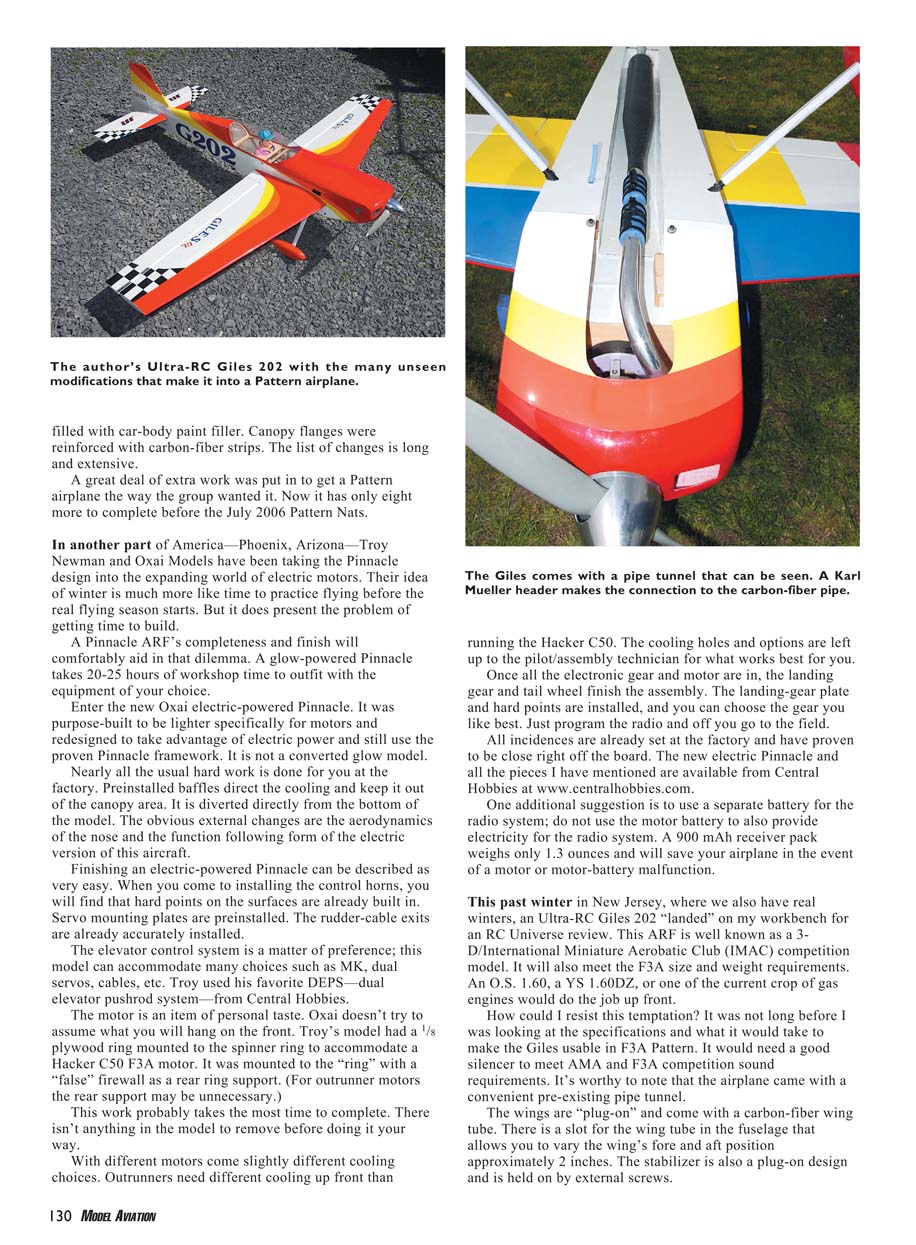
This past winter in New Jersey, where we also have real winters, an Ultra-RC Giles 202 “landed” on my workbench for an RC Universe review. This ARF is well known as a 3-D/IMAC competition model. It will also meet F3A size and weight requirements. An O.S. 1.60, a YS 1.60DZ, or one of the current crop of gas engines would do the job up front.
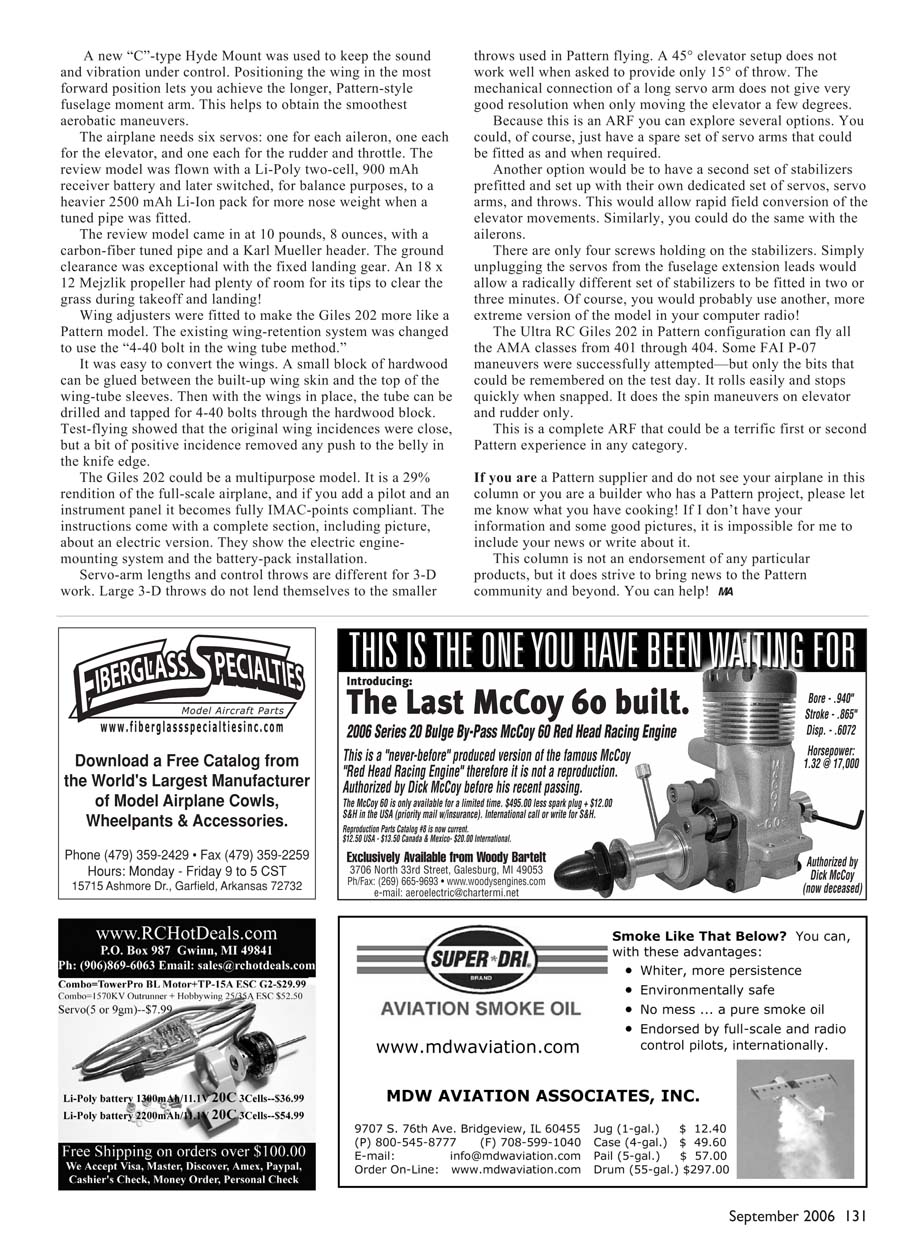
How could I resist this temptation? It was not long before I was looking at the specifications and what it would take to make the Giles usable in F3A Pattern. It would need a good silencer to meet AMA and F3A competition sound requirements. It’s worth noting that the airplane came with a convenient pre-existing pipe tunnel.
Key Giles 202 features and modifications:
- Wings are plug-on and come with a carbon-fiber wing tube. There is a slot for the wing tube in the fuselage that allows you to vary the wing’s fore-and-aft position by approximately 2 inches.
- The stabilizer is a plug-on design held on by external screws.
- A new "C"-type Hyde Mount was used to keep sound and vibration under control.
- Positioning the wing in the most forward position yields a longer Pattern-style fuselage moment arm, helping smooth aerobatic maneuvers.
- The airplane needs six servos: one for each aileron, one for each elevator half (or a single elevator servo depending on setup), one for the rudder, and one for throttle.
- The review model was flown with a 2S Li-Po, 900 mAh receiver battery and later switched, for balance purposes, to a heavier 2500 mAh Li-Ion pack when a tuned pipe was fitted.
- The review model weighed 10 lb 8 oz with a carbon-fiber tuned pipe and a Karl Mueller header. Ground clearance was exceptional with the fixed landing gear; an 18 x 12 Mejzlik propeller had plenty of tip clearance during takeoff and landing.
Wing adjusters were fitted to make the Giles 202 more like a Pattern model. The existing wing-retention system was changed to use the 4-40 bolt-in-the-wing-tube method. It was easy to convert the wings: a small block of hardwood can be glued between the built-up wing skin and the top of the wing-tube sleeves. Then, with the wings in place, the tube can be drilled and tapped for 4-40 bolts through the hardwood block. Test flying showed the original wing incidences were close, but a bit of positive incidence removed any tendency to push to the belly in knife-edge flight.
The Giles 202 could be a multipurpose model. It is a 29% rendition of the full-scale airplane, and if you add a pilot and an instrument panel it becomes fully IMAC-points compliant. The instructions include a complete section, with pictures, about an electric version showing engine-mounting and battery-pack installation.
Servo-arm lengths and control throws are different for 3-D work versus Pattern flying. Large 3-D throws do not lend themselves to the smaller throws used in Pattern. A 45° elevator setup does not work well when you want only about 15° of throw; a long servo arm can lack resolution when moving the elevator only a few degrees.
Because this is an ARF you can explore several options:
- Keep a spare set of servo arms that can be fitted as needed.
- Prefit a second set of stabilizers, each with their own servos and throws, to allow rapid field conversion of elevator movement.
- Do the same for the ailerons. There are only four screws holding on the stabilizers. Simply unplugging the servos from the fuselage extension leads would allow a radically different set of stabilizers to be fitted in two or three minutes. Of course, you would probably use a different radio setup in your computer radio for the alternate configuration.
The Ultra-RC Giles 202 in Pattern configuration can fly all the AMA classes from 401 through 404. Some FAI P-07 maneuvers were successfully attempted during testing. It rolls easily and stops quickly when snapped and performs spin maneuvers using elevator and rudder only.
This is a complete ARF that could be a terrific first or second Pattern experience in any category.
If you are a Pattern supplier and do not see your airplane in this column, or you are a builder who has a Pattern project, please let me know what you have cooking. If I don't have your information and some good pictures, it is impossible for me to include your news or write about it.
This column is not an endorsement of any particular products, but it does strive to bring news to the Pattern community and beyond. You can help! MA
Transcribed from original scans by AI. Minor OCR errors may remain.

