
Radio Control Scale Aerobatics
John Glezellis [[email protected]]
The new RC Scale Aerobatics columnist introduces himself
Also included in this column:
- Presenting your model in competition
- A flight-mix rundown
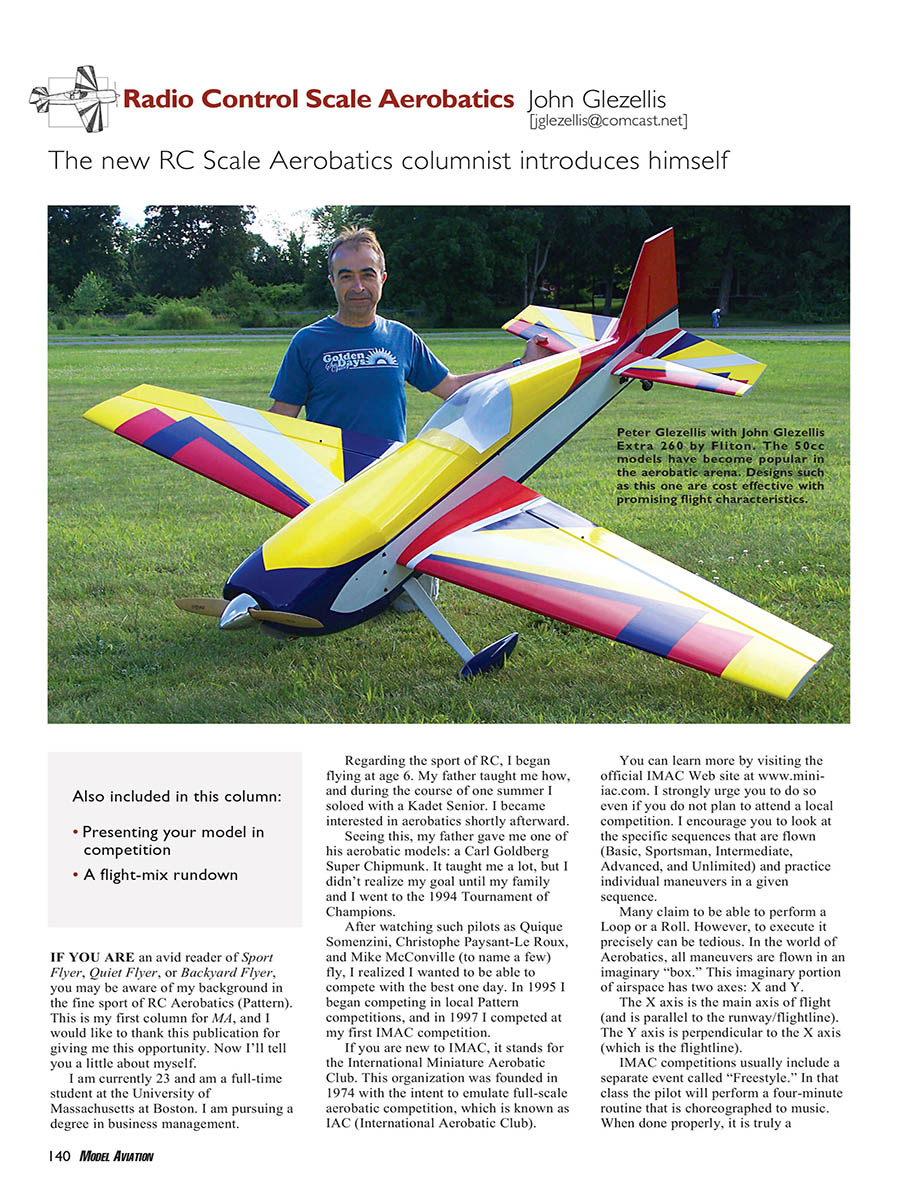
If you are an avid reader of Sport Flyer, Quiet Flyer, or Backyard Flyer, you may be aware of my background in the fine sport of RC Aerobatics (Pattern). This is my first column for MA, and I would like to thank this publication for giving me this opportunity. Now I'll tell you a little about myself.
I am 23 and a full-time student at the University of Massachusetts at Boston, pursuing a degree in business management.
I began flying at age six. My father taught me, and during the course of one summer I soloed in a Kadet Senior. I became interested in aerobatics shortly afterward. Seeing this, my father gave me one of his aerobatic models: a Carl Goldberg Super Chipmunk. It taught me a lot, but I didn't realize my goal until my family and I went to the 1994 Tournament of Champions.
After watching pilots such as Quique Somenzini, Christophe Paysant-Le Roux, and Mike McConville, I realized I wanted to be able to compete with the best one day. In 1995 I began competing in local Pattern competitions, and in 1997 I competed at my first IMAC competition.
If you are new to IMAC, it stands for the International Miniature Aerobatic Club. This organization was founded in 1974 with the intent to emulate full-scale aerobatic competition, which is governed by the IAC (International Aerobatic Club).
You can learn more by visiting the official IMAC website at www.mini-iac.com. I strongly urge you to do so even if you do not plan to attend a local competition. I encourage you to look at the specific sequences that are flown (Basic, Sportsman, Intermediate, Advanced, and Unlimited) and practice individual maneuvers in a given sequence.
Many claim to be able to perform a loop or a roll. However, executing these maneuvers precisely can be tedious. In the world of aerobatics, all maneuvers are flown in an imaginary "box." This imaginary portion of airspace has two axes: X and Y.
- The X axis is the main axis of flight and is parallel to the runway/flightline.
- The Y axis is perpendicular to the X axis.
IMAC competitions usually include a separate event called "Freestyle." In that class the pilot performs a four-minute routine choreographed to music. When done properly, it is truly a beautiful flight — similar to watching a perfectly choreographed ice-skating routine.
Flying Presentation
Flying too close or too far away can hurt your overall flight scores. When flying too close to yourself, the sequence appears "rushed" because the pilot will fly immediately from one maneuver into the next. However, flying too far away makes it difficult for the judges (and the pilot) to see the maneuver.
It is usually safe to fly at a distance of 170–200 meters from yourself, and slightly farther out depending on the size of the airframe. As Tournament of Champions Chief Judge Fred Johnson claims, the clearest presentation of the geometry of the maneuver is the primary criterion for the best score.
In addition, it is essential to master the throttle stick. I prefer flying in a manner called "constant speed." If I remember correctly, Hanno Prettner was one of the first pilots to utilize this technique, and it showed.
Flying in a "constant speed" manner is exactly what its name indicates: the model should fly at the same rate when tracking on vertical up-lines, down-lines, and in standard horizontal flight.
You may think you need to spend thousands of dollars on an airframe to be competitive. Larger models do tend to fly better, but it is even more important to set up your aircraft properly. As an aspiring competition pilot, you need to spend time preparing your model perfectly (mixes, dual rates, etc.).
Mixing
It is common for most airplanes to require different flight mixes to assist the pilot during flight. The most common are:
- Rudder-to-elevator: This mix is needed in knife-edge flight. To test for it, fly parallel to the runway at full throttle, then roll the airplane so the top of the airframe is visible. Apply enough rudder to maintain altitude and watch the model's tracking. If it pitches toward the undercarriage, you will need a mix that adds up-elevator when rudder is applied (rudder channel = master; elevator channel = slave). If the model pulls to the canopy, use a mix that adds down-elevator with rudder.
- Rudder-to-aileron: Also needed in knife-edge flight. Using the same test (parallel to the runway, full throttle, roll to knife edge), if the model rolls to the right when rudder is applied, you will need a mix that adds a touch of left aileron with that rudder input (and vice versa). Again, rudder is the master channel and aileron is the slave channel.
- Throttle-to-elevator: Although this mix may seem unconventional, it is commonly used. To test, climb to a high altitude and reduce throttle to idle. Push the model to a vertical down-line and watch its tracking. If the aircraft "pulls" to the canopy, use a throttle-to-elevator mix that adds down-elevator at idle. If the model pushes toward the undercarriage, add up-elevator at idle.
During the next few columns I plan to familiarize you with the Basic class. We will break down the 2007 Basic sequence maneuver by maneuver and describe each one in the language of aerobatics, Aresti.
In the meantime, review what I have written, then go out to the flying field and verify whether your airframe requires any of the aforementioned mixes. If it does, mix away!
Until next time, fly hard!
Sources
- International Miniature Aerobatic Club
Box 1010 King, NC 27021 www.mini-iac.com
- Fliton USA
4790 Irvine Blvd. Ste. 105-299 Irvine, CA 92620 www.fliton.com
Transcribed from original scans by AI. Minor OCR errors may remain.

