
Radio Control Scale Aerobatics
John Glezellis [[email protected]]
A discussion about spins
When I started working for MA, I wrote a column based on the International Miniature Aerobatic Club (IMAC) Basic sequence for that year and the various Aresti figures the program entailed. This month I will write about spins. We will look at the Aresti drawings for the spins in the 2009 Basic, Sportsman, Intermediate, Advanced, and Unlimited programs.
As a recap for those new to the aerobatic scene, Aresti is the language of aerobatics. Aresti diagrams are drawn figures of maneuvers; when pilots compete internationally they need a common system of communication, which is Aresti.
All spins start from level flight. In its most basic form, the pilot will enter the spin from upright, level flight at a fairly high altitude. Then he or she pulls the throttle back so the model slows and approaches a stall.
The pilot must feed up-elevator to maintain the same altitude. Once a wingtip drops, the pilot must spin the model simultaneously in the same direction as the wingtip that dropped.
To perform an upright spin, hold up-elevator and same-direction rudder and aileron. When performing an inverted (negative) spin, hold down-elevator and opposite-direction rudder and aileron.
While spinning, the model will descend quickly while rotating about an imaginary vertical axis. When the desired number of rotations has been completed, release the inputs and establish a vertical down-line. If needed, this down-line may be wind-corrected. If a roll is to be performed after the spin, a brief line segment must be shown between the spin rotation and the rolling segment. When the pilot is finished with the spin and after the vertical down-line is shown, he or she must either pull or push to exit upright or inverted. Again, this is the spin in its simplest form.
If you experience difficulty spinning your aircraft, look at the control-surface deflection on your spin rate. I use a flight condition that is the midposition on my JR 12X radio’s rudder switch. On this rate I have a higher amount of elevator, rudder, and aileron deflection compared to my low-rate condition.
Spinning inputs may differ from airplane to airplane. Some aircraft can spin only by using rudder and elevator. Other models spin better using rudder, elevator, and a touch of aileron input. Notice how your airplane wants to execute a spin before getting discouraged about being unable to perform the maneuver to the best of your ability.
Before I examine each spin that is covered in the various 2009 IMAC programs, I’ll describe the elements that a spin must contain. These include:
- A clean breaking stall in horizontal flight (either upright or inverted).
- A fully stalled autorotation (the aircraft should not “barrel roll” through a rotation; if it does, it is not in a stalled state).
- The model must be stopped in a prestated heading.
- The 90° down-line segment may be wind-corrected after the airplane stops on its heading.
Spins within the 2009 Basic routine
- Maneuver 10 of the 2009 Basic program is an upright two-turn spin. It starts from upright, level flight and exits to upright, level flight.
- To perform this maneuver, stall the airplane; one wingtip will drop. Spin in the direction of the break (the instant one wingtip drops). After two rotations are completed, the model must establish and show a vertical down-line segment.
- The pilot will slowly add power while pulling to an upright, level-flight exit with wings level. This maneuver begins and ends traveling in the same direction.
Spins within the 2009 Sportsman routine
- Maneuver 8 of the 2009 Sportsman Known program is a 1½-turn upright spin. It starts from upright, level flight and exits to upright, level flight.
- Once the model is stalled and a wingtip drops, execute a 1½-turn rotation. After this is completed, show a vertical down-line segment, then perform a one-quarter loop to an upright, level exit.
- This maneuver begins and exits traveling in opposite directions.
Spins within the 2009 Intermediate routine
- Maneuver 2 of the 2009 Intermediate Known program includes a spin with additional elements.
- Perform a 1½-turn upright spin followed by a half roll in the opposite direction. A brief line segment must exist between the spin rotation and the half roll.
- Upon establishing the down-line, pull to a 45° vertical up-line and perform two points of a four-point roll. Then push to a horizontal, upright exit.
- Note: Ensure the model stalls in the spin's entry; if it does not, you will receive a zero for the spin portion of the maneuver, which can zero the entire figure even if the rest was flown flawlessly.
Spins within the 2009 Advanced routine
- The first maneuver of the 2009 Advanced Known program is Figure 9, and it includes a 1½-turn negative (inverted) spin.
- This maneuver begins from inverted flight. After the aircraft stalls, perform 1½ turns of a negative spin followed by a half roll in the opposite direction. A brief line segment should exist between the spin rotation and the half roll.
- Then pull three-quarters of an inside loop to inverted, level flight. Once inverted level flight is established, perform an eight-point roll to exit inverted.
- This maneuver begins and exits while traveling in the same direction, and it must exit at a fairly high altitude to prepare for two additional maneuvers involving a half inside loop.
Spins within the 2009 Unlimited routine
- The fourth maneuver of the Unlimited Known program entails a spin. The pilot begins by performing 1¾ positive spins, followed by a half roll in the opposite direction.
- Then the pilot must pull to an upright cross-box exit. The direction of the spin rotation will determine whether the pilot exits the cross-box coming toward him or her or going away from him or her.
- At the end of the maneuver the pilot must perform a 90° pull to exit cross-box in upright level flight. (Had the exit line been dotted and red in the diagram, the pilot would have to perform a 90° push to an inverted horizontal cross-box exit.)
Figure notes (Aresti diagram descriptions)
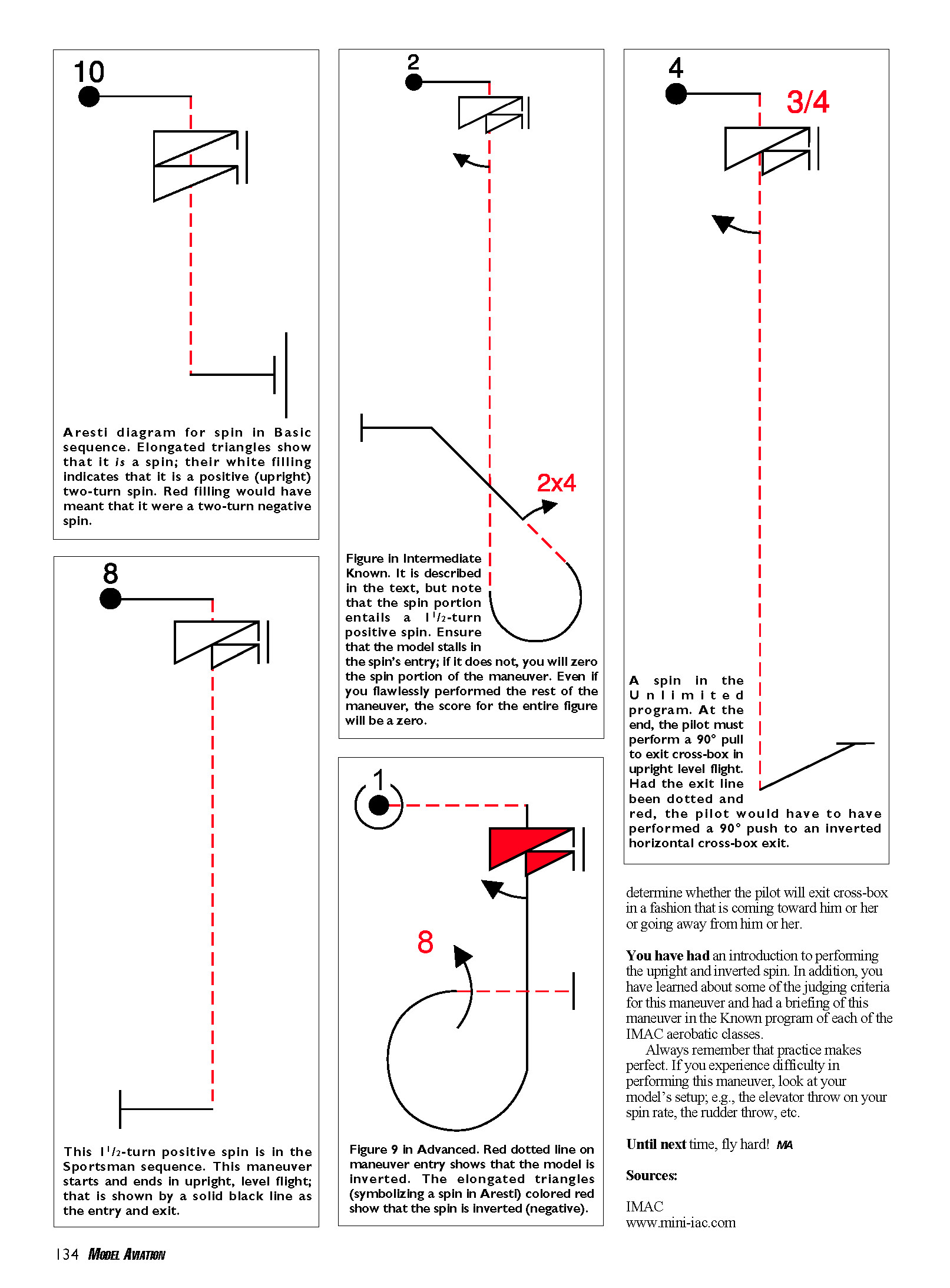
- Aresti diagram for the Basic sequence spin: elongated triangles show that it is a spin; their white filling indicates a positive (upright) two-turn spin. Red filling would indicate a two-turn negative spin.
- The 1½-turn positive spin in the Sportsman sequence starts and ends in upright, level flight; that is shown by a solid black line as the entry and exit.
- The Intermediate Known figure shows a 1½-turn positive spin. Ensure the model stalls in the spin's entry; otherwise the spin portion will score zero.
- Figure 9 in Advanced: a red dotted line on maneuver entry shows the model is inverted. The elongated triangles colored red indicate an inverted (negative) spin.
- The Unlimited spin figure: after the spin and half roll, the 90° pull to exit cross-box results in an upright level-flight exit. If the exit line were dotted and red, it would indicate a 90° push to an inverted horizontal cross-box exit.
You now have an introduction to performing upright and inverted spins, judging criteria for the maneuver, and a briefing of the spins in the Known program of each IMAC aerobatic class. Always remember that practice makes perfect. If you experience difficulty performing this maneuver, check your model's setup (for example, elevator throw on your spin rate, rudder throw, etc.).
Until next time, fly hard! MA
Sources
- IMAC — www.mini-iac.com
Transcribed from original scans by AI. Minor OCR errors may remain.

