
Success at the flying field
John Glezellis [[email protected]]
Although this column is intended for the Scale Aerobatics aficionado, this month's discussion is for all giant-scale pilots and builders alike. I will focus on batteries, regulators, receivers, and redundancy. When setting up your aircraft, pay particular attention to these key areas to ensure success at the flying field.
I use my 33% Hangar 9 Sukhoi, 35% Hangar 9 Extra 260, and 40% Thunder Tiger Extra 260 as examples, all running Li-Poly batteries. Below I explain why I set up each model the way I have.
Hangar 9 33% Sukhoi
Choosing the right battery system can be difficult for a 33%-scale model because you must balance redundancy and weight. While only one battery can be used in many 33% aircraft, using two batteries is best in case one pack fails. A 33% aircraft is not cheap to build, and I recommend two batteries whenever possible.
For my Sukhoi I used six JR DS8711HV servos so I could install two 7.4V Li-Poly batteries directly into the airplane without voltage regulators. I also used:
- Two 2000 mAh batteries for the Spektrum AR9100 PowerSafe receiver (ideal for high-current applications).
- One 2000 mAh battery with a regulator for the ignition.
Because I fly this Sukhoi for extreme flying and demonstrations, I wanted maximum voltage and speed from each servo. If you fly IMAC, however, regulate the voltage down to 5.9–6.0V so you experience consistent servo performance throughout the flight. As battery voltage decreases, servo speed and torque change. For example, a 7.4V Li-Poly reads about 8.4V fresh and might drop to 7.6V after several flights; that change can alter how the airplane responds. Regulating servos to 5.9V keeps the "feel" consistent from flight to flight.
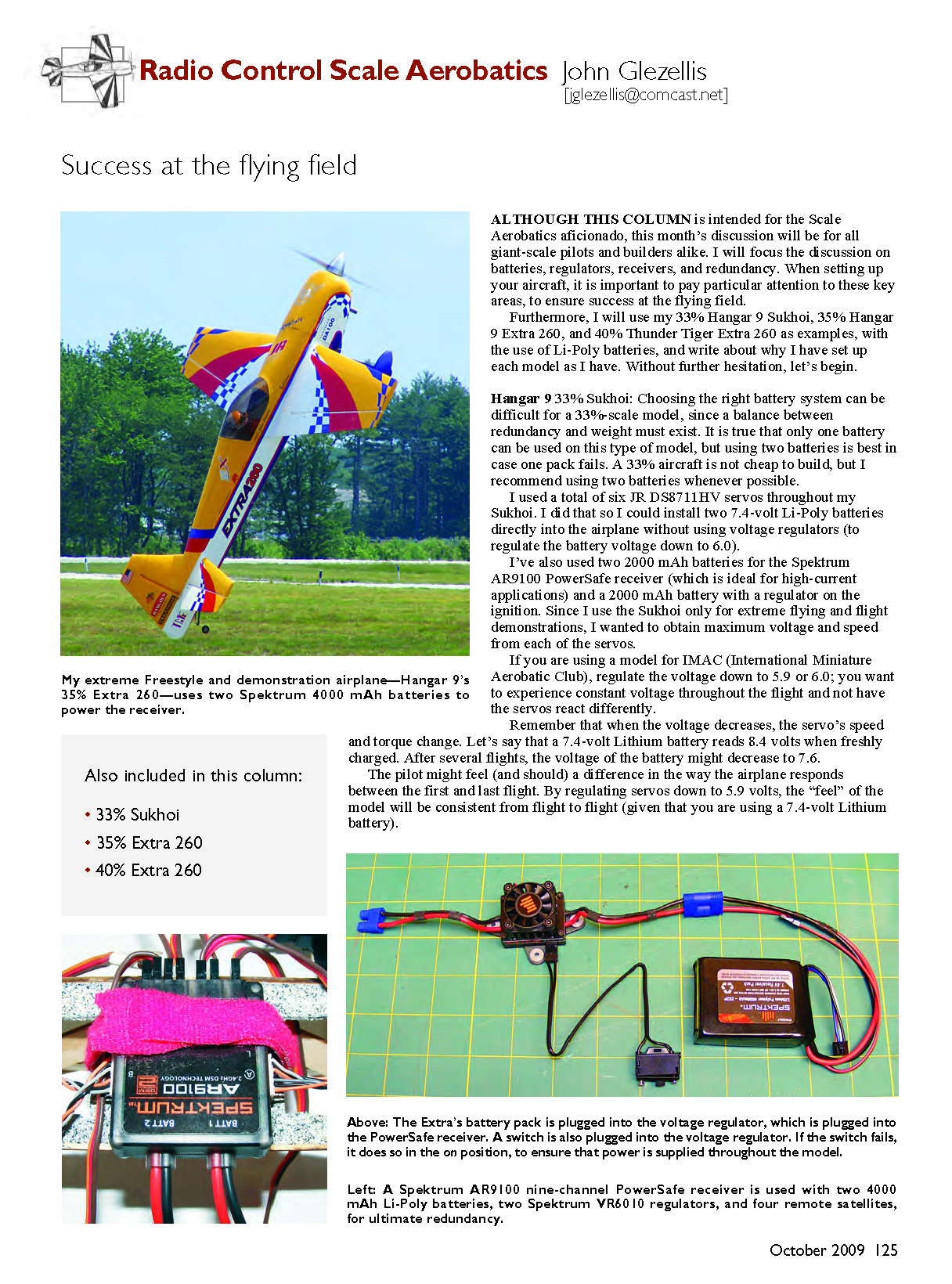
Hangar 9 35% Extra 260
On a typical 35% model that uses seven to nine high-voltage servos, one 4000 mAh receiver battery is usually safe. On my 35% Extra I use:
- Spektrum AR9100 PowerSafe receiver with two 4000 mAh batteries for the receiver and a 2000 mAh battery for the ignition.
- Eight JR DS8711 digital servos for the control surfaces and one JR DS8231 digital servo for the throttle.
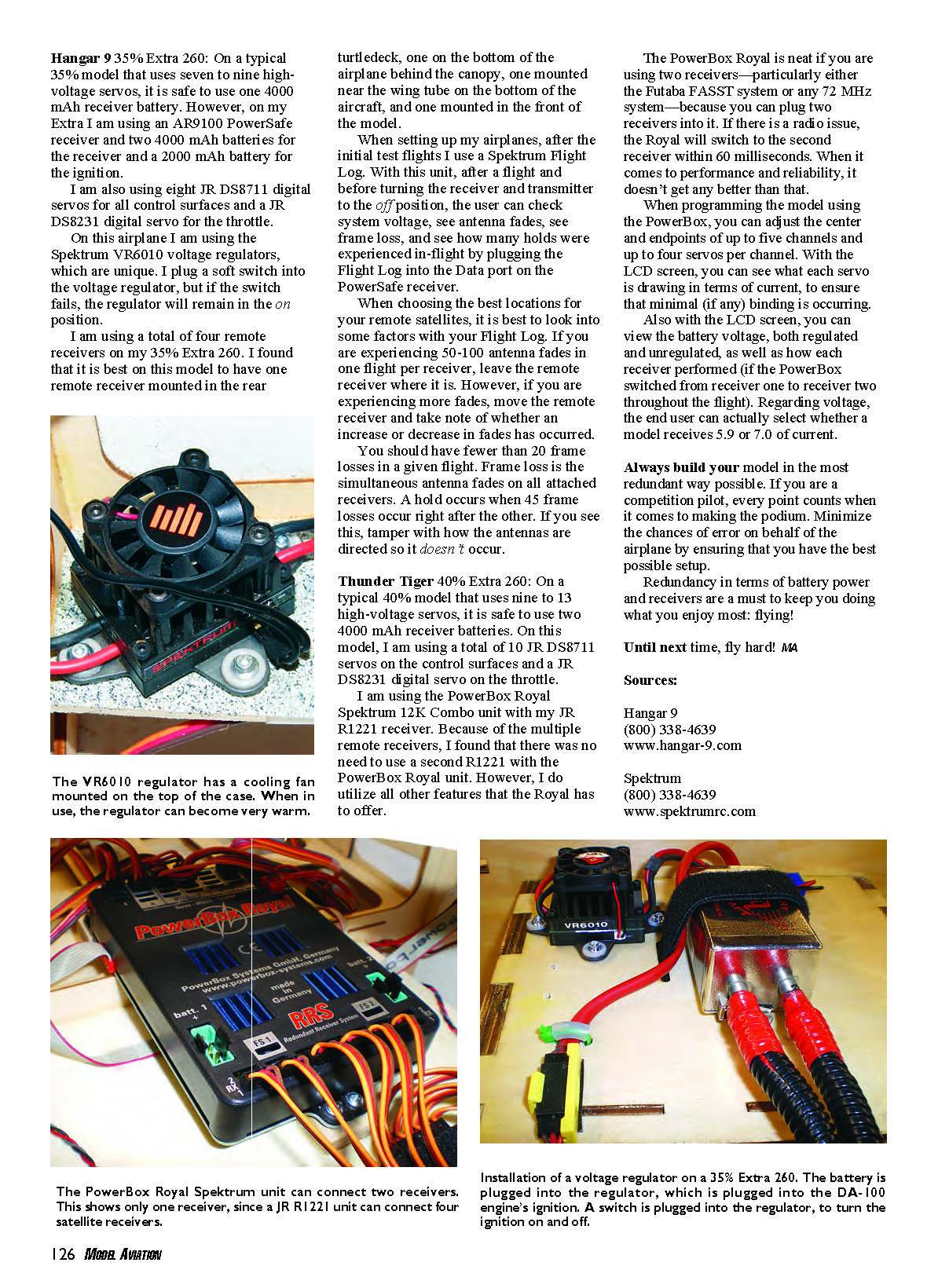
- Spektrum VR6010 voltage regulators. I plug a soft switch into the regulator; if the switch fails, the regulator remains on. The VR6010 has a cooling fan on top and can become warm in use.
I use four remote receivers on this model. The best locations I found are:
- Rear turtledeck
- Bottom of the airplane behind the canopy
- Near the wing tube on the bottom of the aircraft
- Front of the model
After initial test flights I use a Spektrum Flight Log. Before turning the receiver and transmitter off, plug the Flight Log into the Data port on the PowerSafe receiver to check system voltage, antenna fades, frame loss, and the number of holds experienced in-flight.
When choosing remote-satellite locations, use the Flight Log to evaluate performance:
- If you see 50–100 antenna fades in one flight per receiver, you can generally leave the receiver where it is.
- If you see more fades, move the remote receiver and note whether fades increase or decrease.
- Aim for fewer than 20 frame losses in a given flight. Frame loss means simultaneous antenna fades on all attached receivers.
- A hold occurs when 4–5 frame losses happen consecutively. If you see holds, adjust antenna orientation to prevent them.
The PowerBox Royal is an excellent option when using two receivers—especially with Futaba FASST or any 72 MHz system—because you can plug two receivers into it. If a radio issue occurs, the Royal will switch to the second receiver within about 60 milliseconds. When it comes to performance and reliability, that is hard to beat.
With the PowerBox you can:
- Adjust center and endpoints for up to five channels and up to four servos per channel.
- Use the LCD to see current draw per servo to ensure minimal binding.
- View regulated and unregulated battery voltage and see how each receiver performed (including whether the PowerBox switched receivers during the flight).
- Select whether the model receives 5.9V or 7.0V output.
Thunder Tiger 40% Extra 260
On a typical 40% model that uses nine to 13 high-voltage servos, it is safe to use two 4000 mAh receiver batteries. On my 40% Extra I use:
- Ten JR DS8711 servos on the control surfaces and a JR DS8231 digital servo on the throttle.
- PowerBox Royal Spektrum 12K Combo unit with my JR R1221 receiver.
Because I use multiple remote receivers, I found no need for a second R1221 when using the PowerBox Royal, but I do utilize the other features the Royal offers.
Always build your model with maximum redundancy. If you are a competition pilot, every point counts toward the podium. Minimize the chances of error by ensuring the best possible setup.
Redundancy in battery power and receivers is essential to keep you doing what you enjoy most: flying!
Until next time, fly hard! JG
Sources
- Hangar 9 — (800) 338-4639 — www.hangar-9.com
- Spektrum — (800) 338-4639 — www.spektrumrc.com
Transcribed from original scans by AI. Minor OCR errors may remain.

