
RADIO CONTROL SLOPE SOARING
Dave Garwood, 5 Birch Ln., Scotia NY 12302; E-mail: [email protected]
Landing in Hostile Territory
Have you been flying slope long enough to realize that there are more places to launch a slope sailplane than to land one? This is one of the imbalances in the universe, and one we can rebalance a little if we can learn to land in smaller spots—the landing areas surrounded by trees, cactus, rocks, water, fences, stone walls, and other elements that comprise hostile territory for sailplanes.
I mentioned flying buddy Terry Dwyer in the foamie-building-tips column. In addition to engineering useful modifications and improvements to slope sailplanes, Terry spends a prodigious amount of time and energy discovering new flying sites, and some that he's found are extreme. Traveling with Terry to one of his new flying sites calls to mind Dirty Harry Callahan's most important philosophy: "A man's got to know his limitations."
Terry is an upstate New York native who likes to spend his time in the Adirondack Mountains. One crisp fall day Joe Chovan and I met Terry at Whiteface Mountain—not at the actual site of the 1980 Winter Olympics, but a little farther north along the ridge where a scenic road climbs to the summit. Terry had arranged an 8 a.m. meeting with the park superintendent for us to demonstrate slope soaring and to have him assess whether we could be granted permission to fly in the park.
We drove up the mountain and parked along the side of the road at a spot facing the wind—a stunning vista overlooking lakes many hundreds of feet below. There was no question of whether or not we would have sufficient lift to fly, but the available areas for landing looked skimpy at best. No matter; we had EPP (expanded polypropylene) foam airplanes.
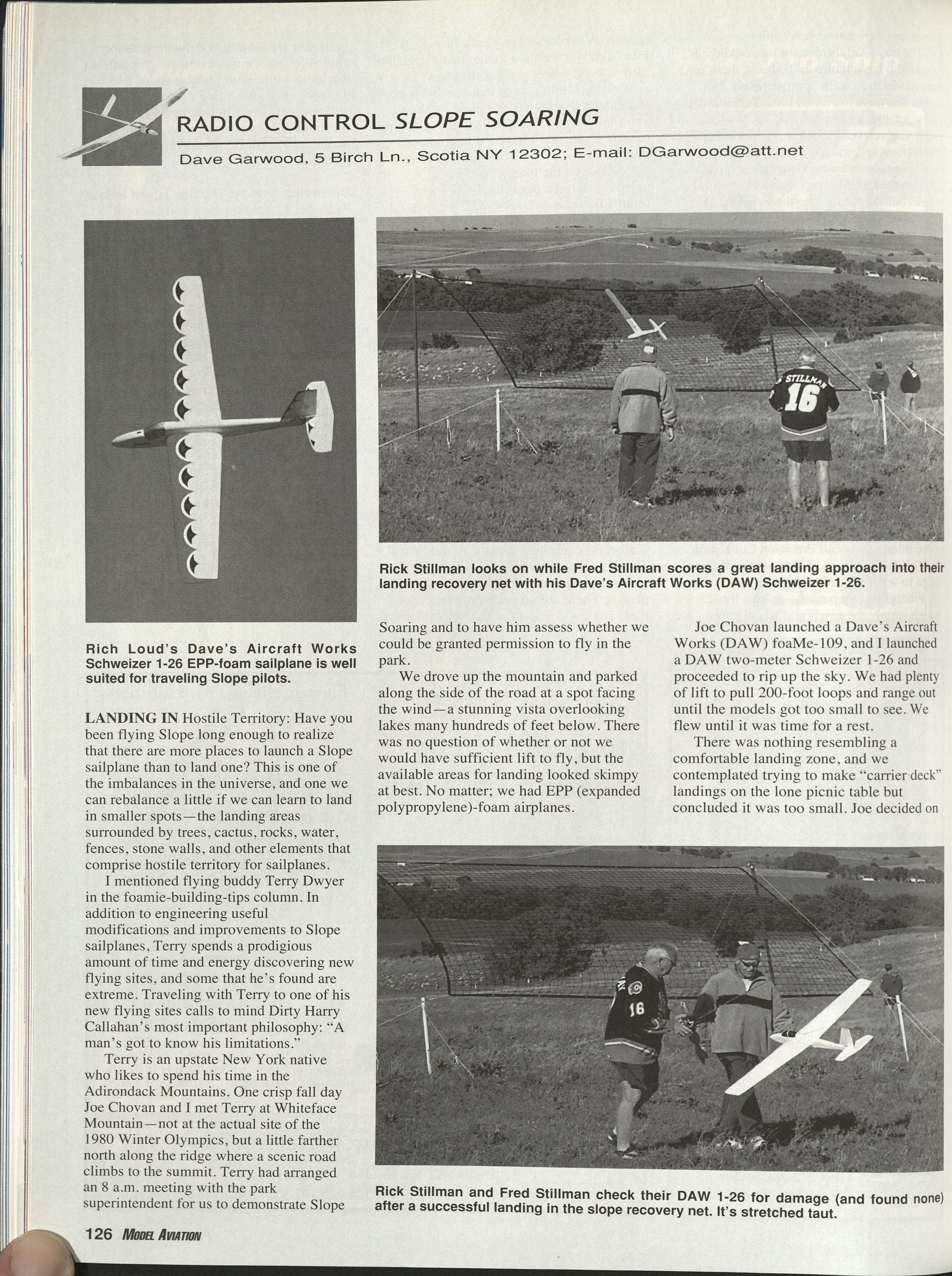
Joe Chovan launched a Dave's Aircraft Works (DAW) foamie Me-109, and I launched a DAW two-meter Schweizer 1-26 and proceeded to rip up the sky. We had plenty of lift to pull 200-foot loops and range out until the models got too small to see. We flew until it was time for a rest.
There was nothing resembling a comfortable landing zone, and we contemplated trying to make "carrier-deck" landings on the lone picnic table but concluded it was too small. Joe decided on the direct approach: he brought his foamie warbird across the road and into a rock cliff face. The sailplane fell into the ditch beside the road, and when he picked it up it looked not much worse for wear. It was a little crumpled in the nose area, maybe, but flyable. Gotta love that EPP wonder foam.
I decided that although Joe's method clearly worked, it was hard on the sailplane and I wanted to improve on its lack of elegance. Now that all eyes were on me, I called my landing approach. "I'll bring it in parallel to the ridge, between the closest treetops and the stone wall here in front of us, and just past the wall scrape off some speed on the gravel beside the road, and slide to a stop over there. If it comes in hotter than I expect, I'll dump it in the bushes beside the road." My approach pattern was acceptable, but as the model got in close, the first problem dawned on me: the Schweizer 1-26 was moving very fast—faster than I'd ever flown it on approach. The "big sky" lift conditions were so good that we'd been flying bigger, faster maneuvers than we were accustomed to on smaller hills. The second problem was that my aim was off. I'd managed to avoid hitting the trees or the rock wall, but the sailplane's nose slammed into my transmitter, sending the radio flying onto the gravel beside the road, with the 1-26 jerking to a stop at my feet. All present were silent. It seemed like 15 to 20 seconds before anyone spoke, then the ranger said, "That's the kind of thing I was concerned about."
In the end it turned out fine, thanks to Terry's ([email protected]) efforts and the understanding cooperation of the NYS Department of Parks and Recreation. We have permission to fly this site in the two-hour period before the road opens to visitors. Watch the weather forecast and call the park the day before to make arrangements for early admission. And bring bounceable sailplanes.
Landing in Small Landing Zones (LZs)
This story entered my mind when I received a question from a reader about landing in small landing zones (LZs). Jim Tolpin wrote:
"We have two slope sites, one for NW winds and the other for southerlies. Good high bluffs, nearly vertical, both face the ocean, empty beach below. Sounds great but one problem: the launch area is extremely narrow. I'm talking about 20 foot max between cliff edge and head-high bramble patch at one side and a road at the other. How do you slow the non-foamy airplanes down enough in this situation to survive?
"Currently, I just come in level to the landing area, upwind if there is an upwind direction, and just scrape to a stop. A non-foamy won't last long in this landing style I don't think. Landing into the bluff face isn't an option (too steep and difficult to retrieve). I've never used crow—does this really slow an airplane down noticeably? Are there other ways to bleed off speed before landing along the edge?
"Thanks, and keep up the great work in your new column in MA."
Jim, I've used the following methods to hit a small LZ at the top of the slope.
- As you mention, especially with a little crosswind, head into the wind and scrape the airplane along the ground. As you say, it works for foamies and other tough sailplanes.
- Fly a landing approach where you drop down below the bluff edge, then as you pop up to where you're standing, speed will bleed off (trading altitude for airspeed). Fly low over the LZ, turn back into the wind, pull up, and stall the model.
This takes practice, but you look like a pro when you can pull it off because you can land your sailplane nearly at your feet.
- With a heavy sailplane you can fly the downwind, crosswind, and upwind legs of your landing approach, and when the model is coming back into the wind, bring the nose up so it slows way down in ground speed, working all the time to avoid a stall, and let it "settle" down to the ground.
This requires concentration and coordination, but I've seen Brian Laird make 95% of his landing approaches that way in rough country. I can pull it off once in a while.
- You mention drag-producing and lift-spoiling devices on the sailplane. Yes, they work well. The smallest model you usually see with flaps and spoilers has a 2-meter span, but 2-meter and 3-meter airplanes fly fine on the slope.
- Flaps: A part of the wing trailing edge that goes down. They add lift and drag to slow the sailplane down and provide extra lift to allow it to fly slower than its normal stall speed.
- Spoilers: These generally pop up from a wing. They add drag, but no lift. Deploying spoilers increases the angle of glide-path descent, but it doesn't change the model's speed much.
- Spoilerons: Essentially ailerons rigged to go up on command. They add drag, but no lift. They work like spoilers, but are not quite as effective as separate spoilers. The use of them reduces available aileron throw.
- Crow: This setting has flaps down and ailerons up. It is a powerful way to slow a sailplane. This is generally set up with a computer transmitter and four servos in the wing.
- Speed brakes: These require a pivoting trailing-edge surface in the location of flaps. When deployed, part of the surface goes up and part goes down. These are cool and fairly effective on the last sailplane I had them on: the DynaFlite Freedom.
Any of these will help to hit a small landing spot with a crunchy sailplane, with crow being the most powerful.
Landing Recovery Net
Another approach to flying in spots where landing is tough is a landing recovery net. A "catch net" comes up in discussion and has probably entered the imagination of any slope pilot who has had to land in a tight area surrounded by obstructions.
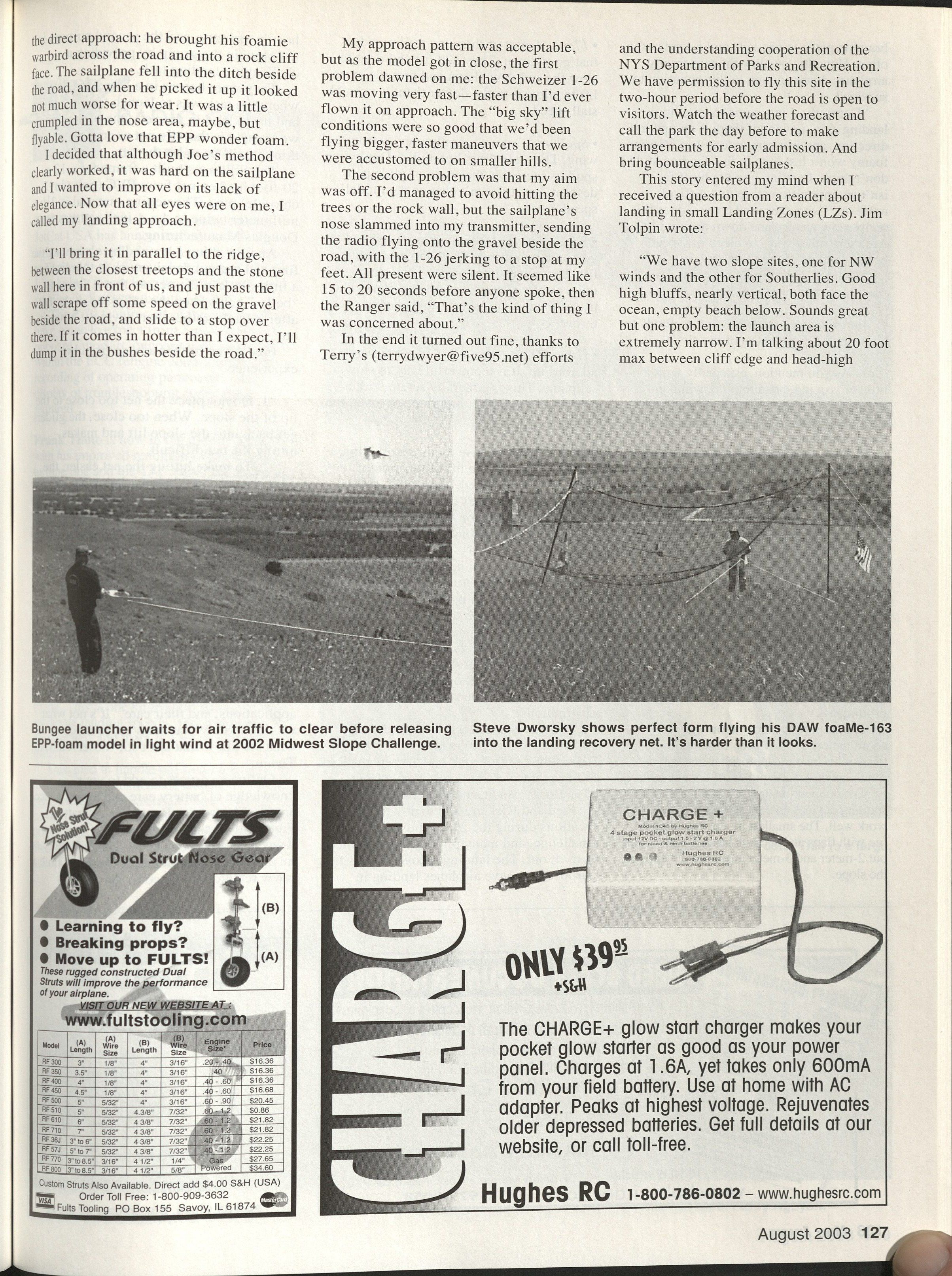
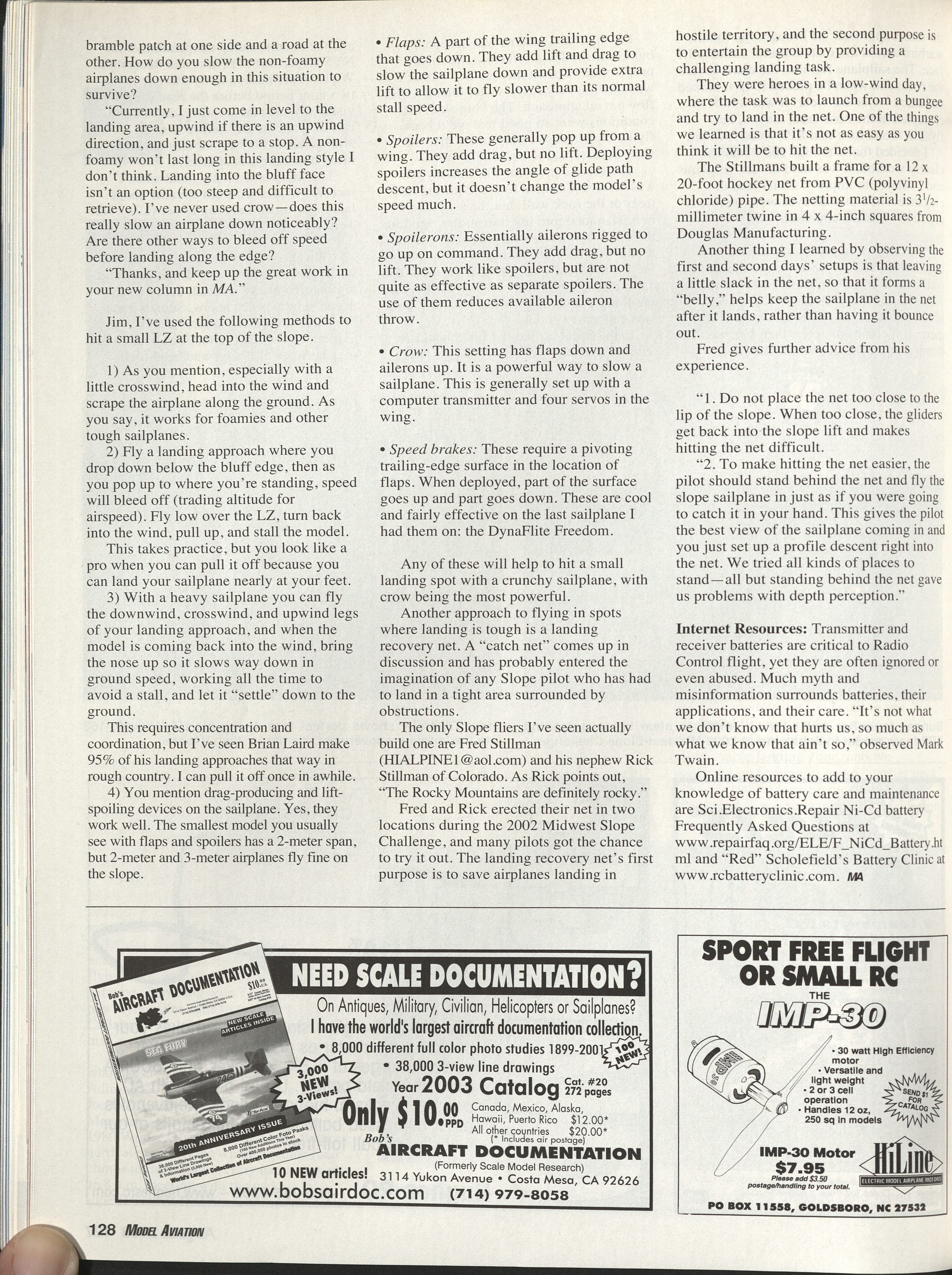
The only slope fliers I've seen actually build one are Fred Stillman ([email protected]) and his nephew Rick Stillman of Colorado. As Rick points out, "The Rocky Mountains are definitely rocky."
Fred and Rick erected their net in two locations during the 2002 Midwest Slope Challenge, and many pilots got the chance to try it out. The landing recovery net's first purpose is to save airplanes landing in hostile territory, and the second purpose is to entertain the group by providing a challenging landing task.
They were heroes on a low-wind day, where the task was to launch from a bungee and try to land in the net. One of the things we learned is that it's not as easy as you think it will be to hit the net.
The Stillmans built a frame for a 12 x 20-foot hockey net from PVC (polyvinyl chloride) pipe. The netting material is 3 1/2-millimeter twine in 4 x 4-inch squares from Douglas Manufacturing.
Another thing I learned by observing the first and second days' setups is that leaving a little slack in the net, so that it forms a "belly," helps keep the sailplane in the net after it lands, rather than having it bounce out.
Fred gives further advice from his experience:
- Do not place the net too close to the lip of the slope. When too close, the gliders get back into the slope lift and it makes hitting the net difficult.
- To make hitting the net easier, the pilot should stand behind the net and fly the slope sailplane in just as if you were going to catch it in your hand. This gives the pilot the best view of the sailplane coming in and you just set up a profile descent right into the net. We tried all kinds of places to stand—all but standing behind the net gave us problems with depth perception.
Internet Resources
Transmitter and receiver batteries are critical to radio control flight, yet they are often ignored or even abused. Much myth and misinformation surrounds batteries, their applications, and their care. "It's not what we don't know that hurts us, so much as what we know that ain't so," observed Mark Twain.
Online resources to add to your knowledge of battery care and maintenance are Sci.Electronics.Repair Ni-Cd battery Frequently Asked Questions at www.repairfaq.org/ELE/F_NiCd_Battery.html and "Red" Scholefield's Battery Clinic at www.rcbatteryclinic.com.
MA
Transcribed from original scans by AI. Minor OCR errors may remain.

