
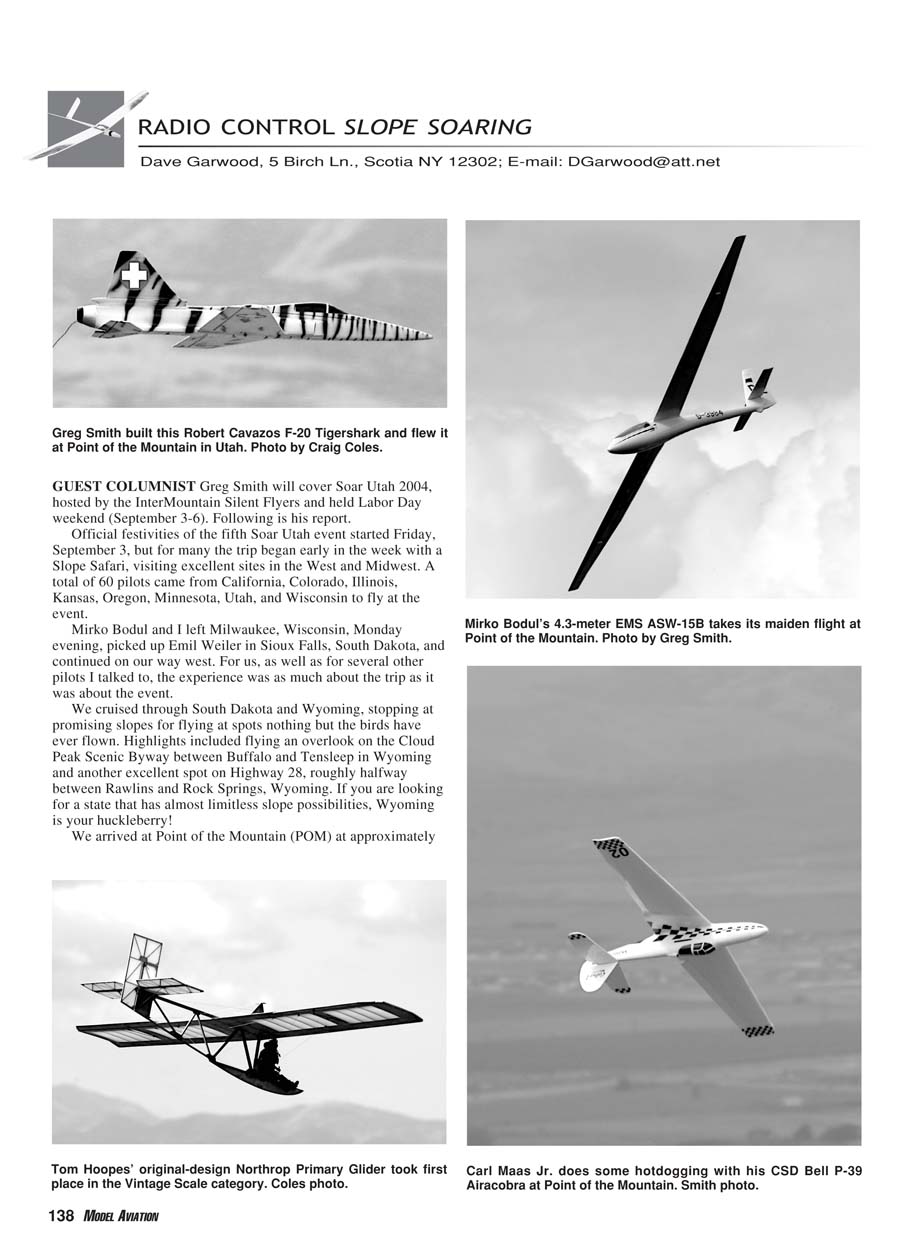
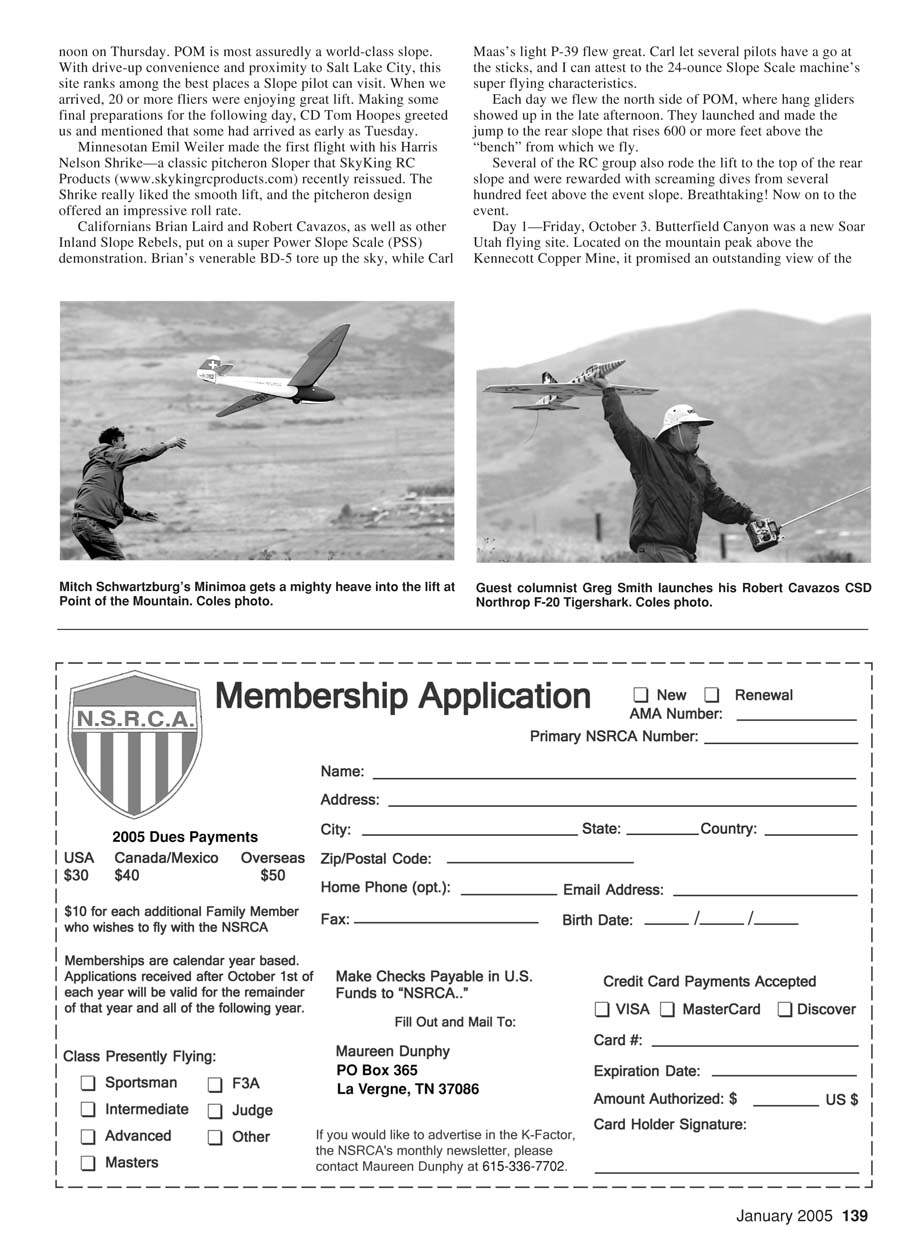
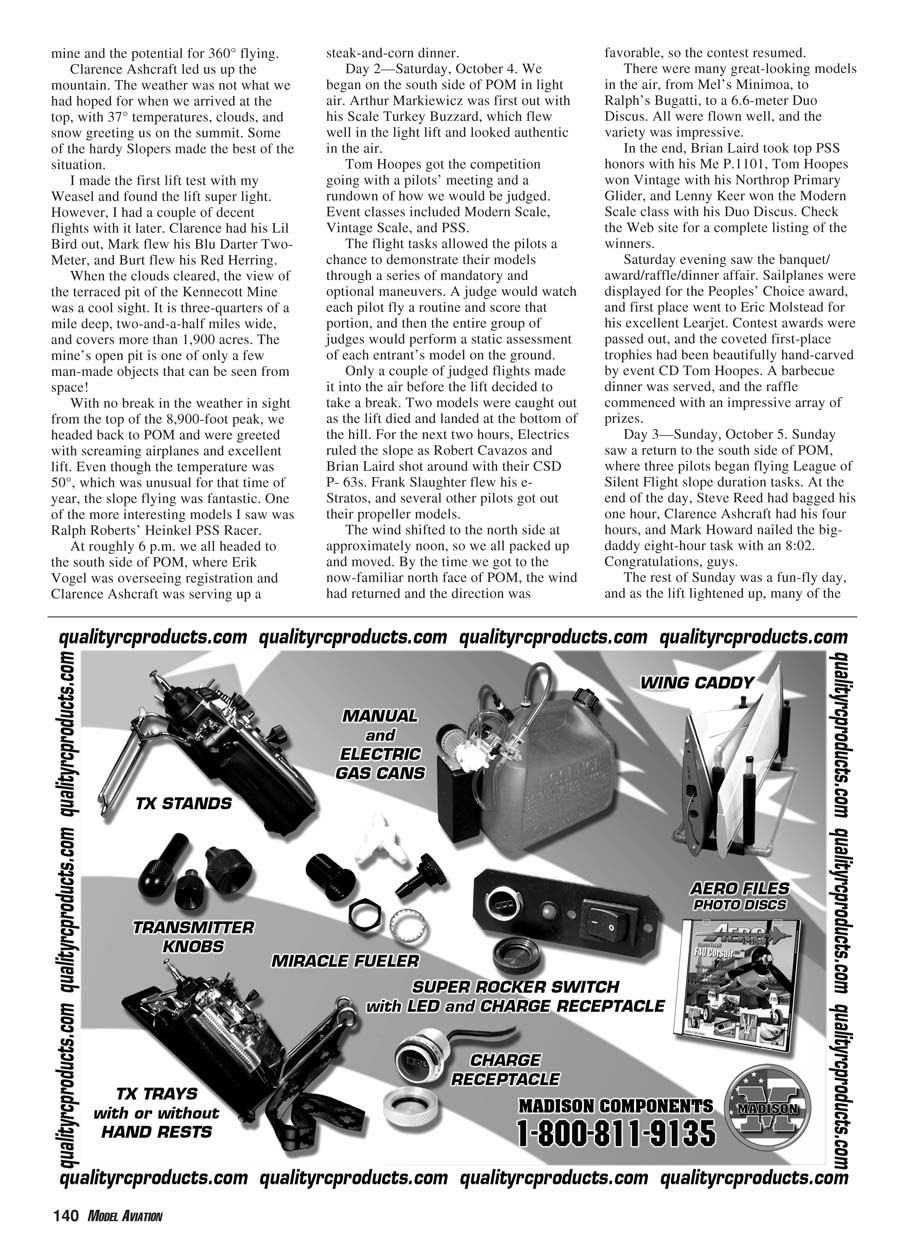
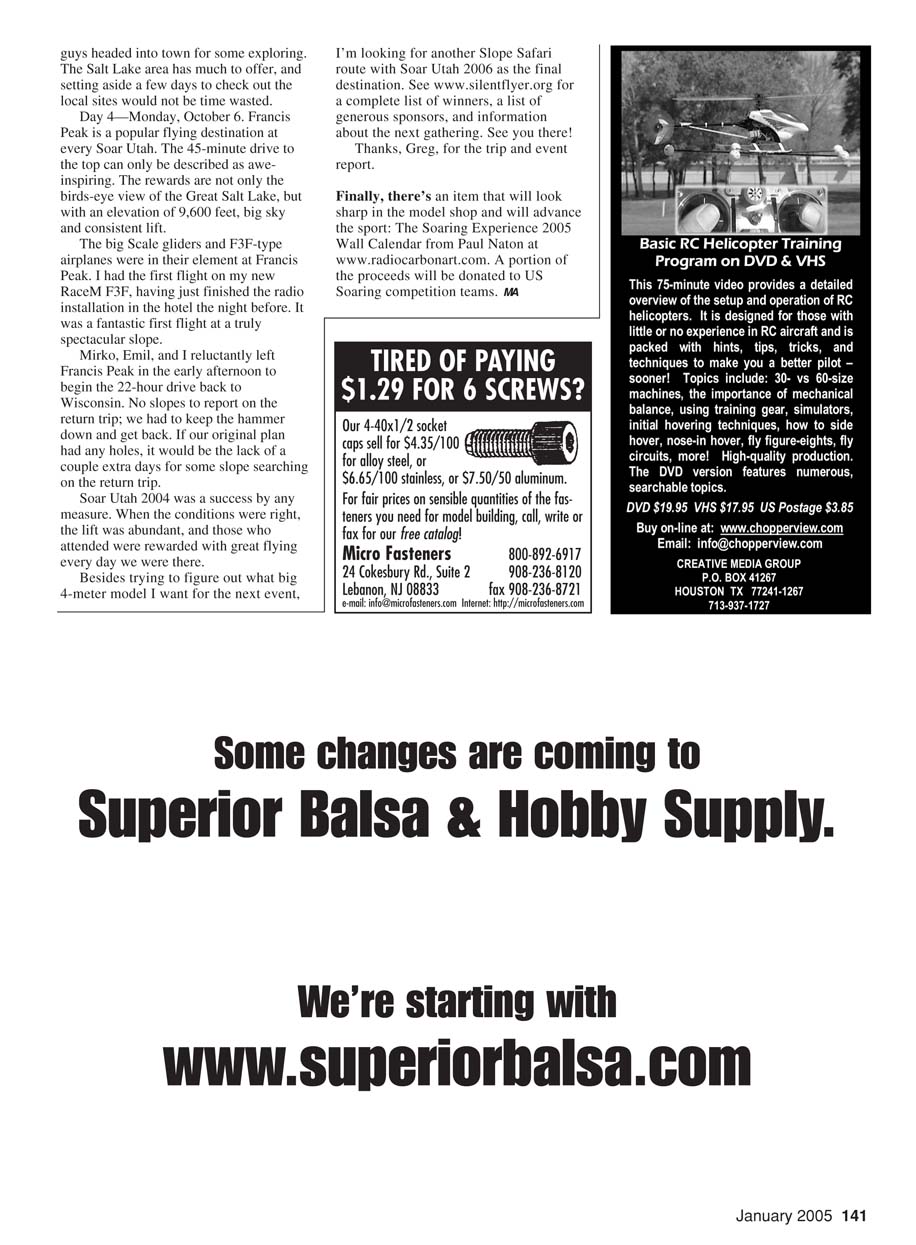
RADIO CONTROL SLOPE SOARING
Dave Garwood, 5 Birch Ln., Scotia NY 12302; E-mail: [email protected]
Soar Utah 2004 — Guest column by Greg Smith
GUEST COLUMNIST Greg Smith covers Soar Utah 2004, hosted by the InterMountain Silent Flyers and held Labor Day weekend (September 3–6, 2004). Official festivities of the fifth Soar Utah event started Friday, September 3, but for many the trip began earlier in the week with a Slope Safari, visiting excellent sites in the West and Midwest. A total of 60 pilots came from California, Colorado, Illinois, Kansas, Oregon, Minnesota, Utah, and Wisconsin to fly at the event.
Mirko Bodul and I left Milwaukee, Wisconsin, Monday evening, picked up Emil Weiler in Sioux Falls, South Dakota, and continued on our way west. For us, as well as for several other pilots I talked to, the experience was as much about the trip as it was about the event.
We cruised through South Dakota and Wyoming, stopping at promising slopes for flying at spots nothing but the birds have ever flown. Highlights included flying an overlook on the Cloud Peak Scenic Byway between Buffalo and Tensleep in Wyoming and another excellent spot on Highway 28, roughly halfway between Rawlins and Rock Springs, Wyoming. If you are looking for a state that has almost limitless slope possibilities, Wyoming is your huckleberry!
We arrived at Point of the Mountain (POM) at approximately noon on Thursday. POM is most assuredly a world-class slope. With drive-up convenience and proximity to Salt Lake City, this site ranks among the best places a slope pilot can visit. When we arrived, 20 or more fliers were enjoying great lift. Making some final preparations for the following day, CD Tom Hoopes greeted us and mentioned that some had arrived as early as Tuesday.
Minnesotan Emil Weiler made the first flight with his Harris Nelson Shrike—a classic pitcheron Sloper that SkyKing RC Products (www.skykingrcproducts.com) recently reissued. The Shrike really liked the smooth lift, and the pitcheron design offered an impressive roll rate.
Californians Brian Laird and Robert Cavazos, as well as other Inland Slope Rebels, put on a super Power Slope Scale (PSS) demonstration. Brian’s venerable BD-5 tore up the sky, while Carl Maas’s light P-39 flew great. Carl let several pilots have a go at the sticks, and I can attest to the 24-ounce Slope Scale machine’s superb flying characteristics.
Each day we flew the north side of POM, where hang gliders showed up in the late afternoon. They launched and made the jump to the rear slope that rises 600 or more feet above the “bench” from which we fly. Several of the RC group also rode the lift to the top of the rear slope and were rewarded with screaming dives from several hundred feet above the event slope. Breathtaking!
Event summary and daily highlights
- Day 1 — Friday, September 3
Butterfield Canyon was a new Soar Utah flying site. Located on the mountain peak above the Kennecott Copper Mine, it promised an outstanding view of the steak-and-corn dinner.
- Day 2 — Saturday, September 4
We began on the south side of POM in light air. Arthur Markiewicz was first out with his Scale Turkey Buzzard, which flew well in the light lift and looked authentic in the air. Tom Hoopes got the competition going with a pilots’ meeting and a rundown of how we would be judged. Event classes included Modern Scale, Vintage Scale, and PSS.
The flight tasks allowed the pilots a chance to demonstrate their models through a series of mandatory and optional maneuvers. A judge would watch each pilot fly a routine and score that portion, and then the entire group of judges would perform a static assessment of each entrant’s model on the ground.
Only a couple of judged flights made it into the air before the lift decided to take a break. Two models were caught out as the lift died and landed at the bottom of the hill. For the next two hours, electrics ruled the slope as Robert Cavazos and Brian Laird shot around with their CSD P-63s. Frank Slaughter flew his e-Stratos, and several other pilots got out their propeller models.
The wind shifted to the north side at approximately noon, so we all packed up and moved. By the time we got to the now-familiar north face of POM, the wind had returned and the direction was favorable, so the contest resumed.
There were many great-looking models in the air — from Mel’s Minimoa to Ralph’s Bugatti to a 6.6-meter Duo Discus. All were flown well, and the variety was impressive.
In the end, Brian Laird took top PSS honors with his Me P.1101, Tom Hoopes won Vintage with his Northrop Primary Glider, and Lenny Keer won the Modern Scale class with his Duo Discus. Check the Web site for a complete listing of the winners.
Saturday evening saw the banquet/award/raffle/dinner affair. Sailplanes were displayed for the People’s Choice award, and first place went to Eric Molstead for his excellent Learjet. Contest awards were passed out, and the coveted first-place trophies had been beautifully hand-carved by event CD Tom Hoopes. A barbecue dinner was served, and the raffle commenced with an impressive array of prizes.
- Day 3 — Sunday, September 5
Sunday saw a return to the south side of POM, where three pilots began flying League of Silent Flight slope duration tasks. At the end of the day, Steve Read had bagged his one-hour task, Clarence Ashcraft had his four-hour task, and Mark Howard nailed the big-daddy eight-hour task with an 8:02. Congratulations to the achievers.
The rest of Sunday was a fun-fly day, and as the lift lightened up, many of the guys headed into town for some exploring. The Salt Lake area has much to offer, and setting aside a few days to check out the local sites would not be time wasted.
- Day 4 — Monday, September 6
Francis Peak is a popular flying destination at every Soar Utah. The 45-minute drive to the top can only be described as awe-inspiring. The rewards are not only the bird's-eye view of the Great Salt Lake, but with an elevation of 9,600 feet, big sky and consistent lift.
The big-scale gliders and F3F-type airplanes were in their element at Francis Peak. I had the first flight on my new RaceM F3F, having just finished the radio installation in the hotel the night before. It was a fantastic first flight at a truly spectacular slope.
Mirko, Emil, and I reluctantly left Francis Peak in the early afternoon to begin the 22-hour drive back to Wisconsin. No slopes to report on the return trip; we had to keep the hammer down and get back. If our original plan had any holes, it would be the lack of a couple extra days for some slope searching on the return trip.
Soar Utah 2004 was a success by any measure. When the conditions were right, the lift was abundant, and those who attended were rewarded with great flying every day we were there.
Besides trying to figure out what big 4-meter model I want for the next event, I'm looking for another Slope Safari route with Soar Utah 2006 as the final destination. See www.silentflyer.org for a complete list of winners, a list of generous sponsors, and information about the next gathering. See you there!
Thanks, Greg, for the trip and event report.
Finally, there's an item that will look sharp in the model shop and will advance the sport: The Soaring Experience 2005 Wall Calendar from Paul Naton at www.radiocarbonart.com. A portion of the proceeds will be donated to U.S. Soaring competition teams.
MA
Transcribed from original scans by AI. Minor OCR errors may remain.

