
Radio Control Slope Soaring
Dave Garwood [[email protected]]
Greg Smith explains the fun of slope racing and how to get into it
Venerable slope flier, traveler, discoverer, and photographer Greg Smith ([email protected]) makes a guest appearance this month. Following is his overview of slope racing, including emerging classes.
Stick around in the slope-soaring end of our wonderful hobby for long, and you are bound to come upon slope racing in some form or another. Whether it's an organized event such as the Midwest Slope Challenge (MWSC), the International Slope Race, any number of California weekend contests, or impromptu horsing around at your local hill, slope racing can be one of the most fun endeavors going for the avid slope pilot.
With that premise in mind, the following is a primer on RC slope racing. On the organized end of the game there are several established racing formats and a couple newcomers that promise a load of fun in the future.
One Design Racing (ODR)
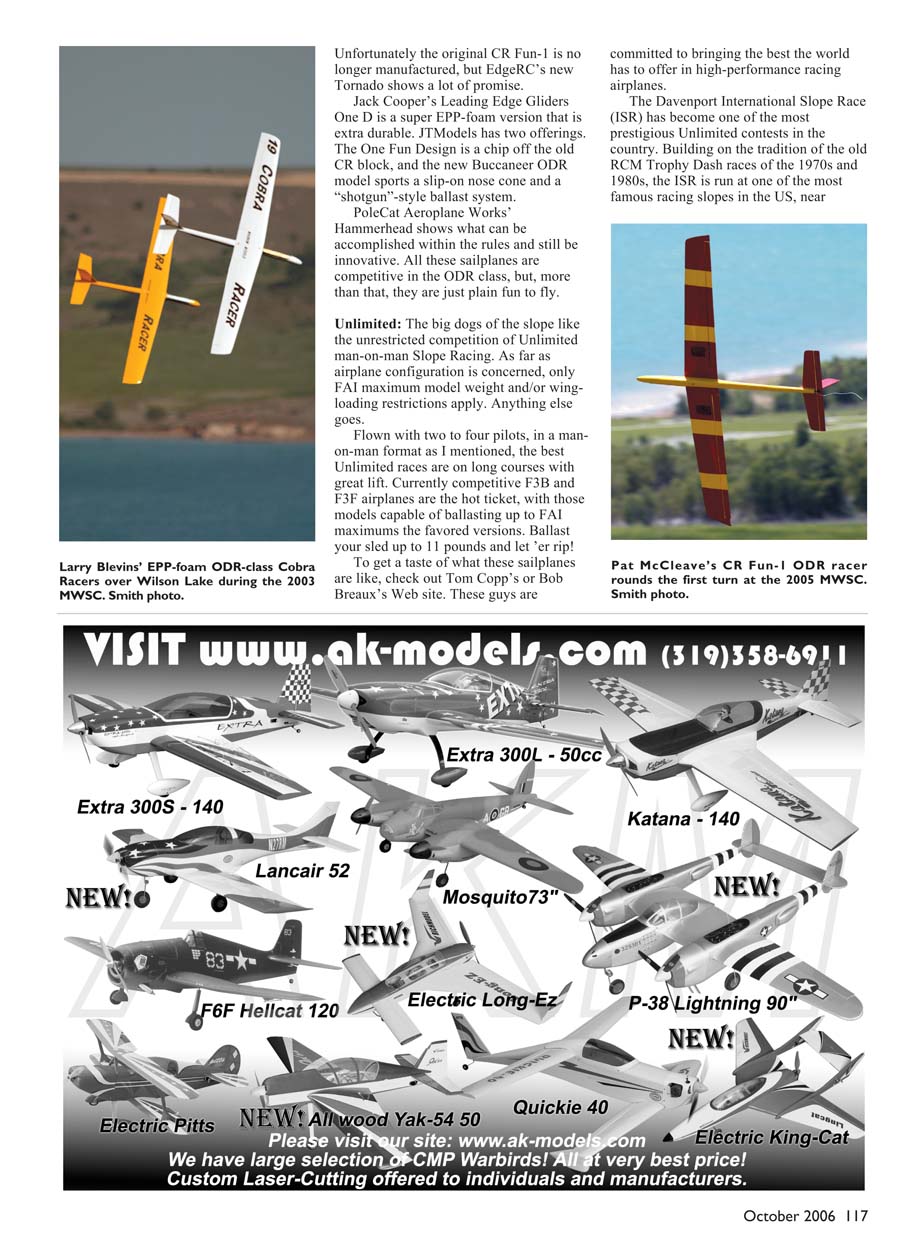
Originally developed by Paul Naton and Charlie Richardson of the Torrey Pines Gulls Soaring Club as an entry-level racing class with low-cost sailplanes built to a specific set of rules, ODR has taken hold at several spots across the U.S., including Kansas, Colorado, Arizona, and California where the concept was invented.
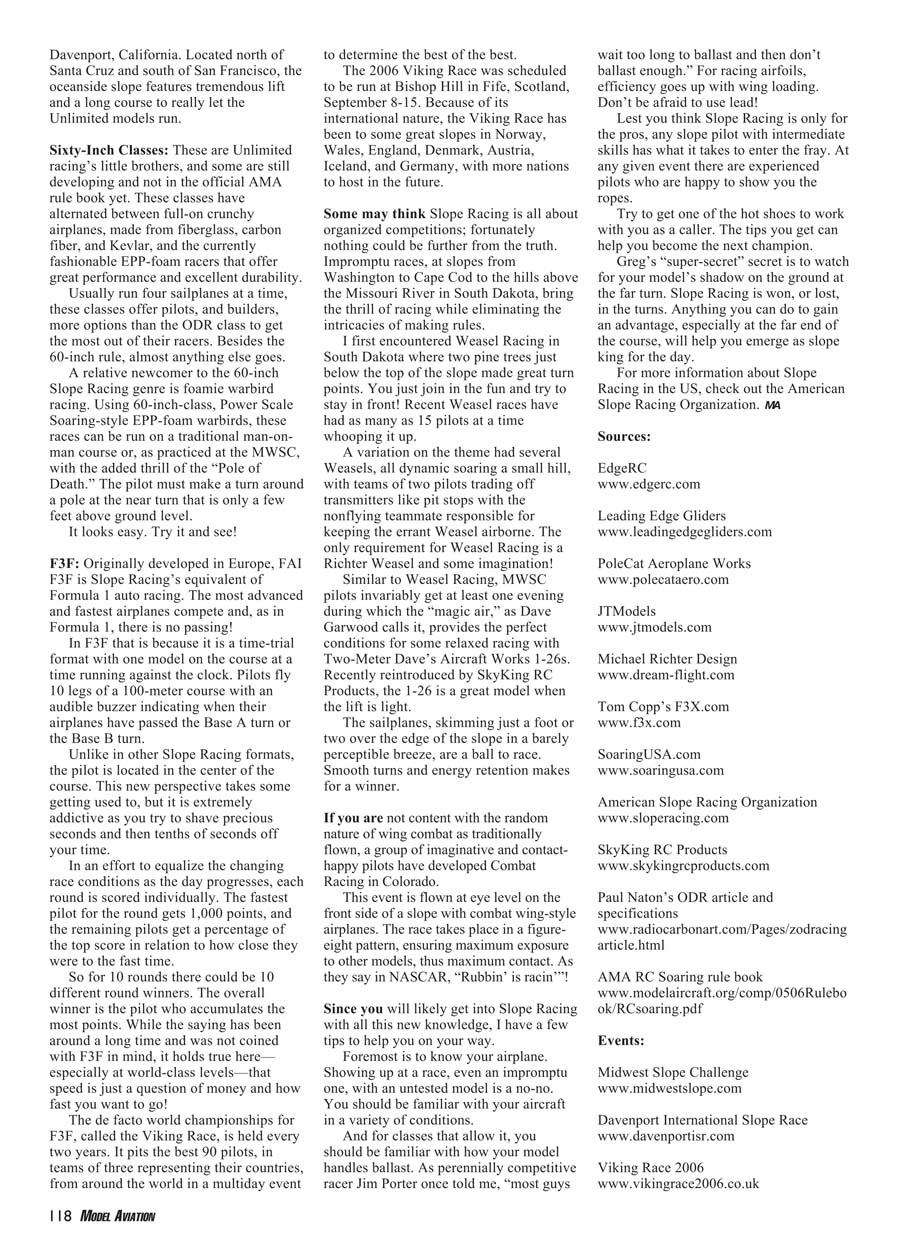
Usually flown four airplanes at a time, this man-on-man race class can be as exciting as anything out there. Pilots line up at the edge of the slope on one end of the racecourse to have a good view of the near turn while a helper, or caller, watches for a flagger on the far turn to signal when to turn. With similar models the racing can be very close.
The fact that ODR-class slope soarers make great all-around airplanes for intermediate, and even advanced, pilots has prompted several manufacturers to develop their own take on the original design. Unfortunately the original CR Fun-1 is no longer manufactured, but EdgeRC's new Tornado shows a lot of promise. Jack Cooper's Leading Edge Gliders One D is a super EPP-foam version that is extra durable. JTModels has two offerings: the One Fun Design is a chip off the old CR block, and the new Buccaneer ODR model sports a slip-on nose cone and a "shotgun"-style ballast system. PoleCat Aeroplane Works' Hammerhead shows what can be accomplished within the rules and still be innovative. All these sailplanes are competitive in the ODR class, but more than that, they are just plain fun to fly.
Unlimited
The big dogs of the slope like the unrestricted competition of Unlimited man-on-man slope racing. As far as airplane configuration is concerned, only FAI maximum model weight and/or wing-loading restrictions apply. Anything else goes. Flown with two to four pilots in a man-on-man format, the best Unlimited races are on long courses with great lift.
Currently competitive F3B and F3F airplanes are the hot ticket, with those models capable of ballasting up to FAI maximums being the favored versions. Ballast your sled up to 11 pounds and let 'er rip! To get a taste of what these sailplanes are like, check out Tom Copp's or Bob Breaux's websites. These guys are committed to bringing the best the world has to offer in high-performance racing airplanes.
The Davenport International Slope Race (ISR) has become one of the most prestigious Unlimited contests in the country. Building on the tradition of the old RCM Trophy Dash races of the 1970s and 1980s, the ISR is run at one of the most famous racing slopes in the U.S., near Davenport, California. Located north of Santa Cruz and south of San Francisco, the oceanside slope features tremendous lift and a long course to really let the Unlimited models run.
Sixty-Inch Classes
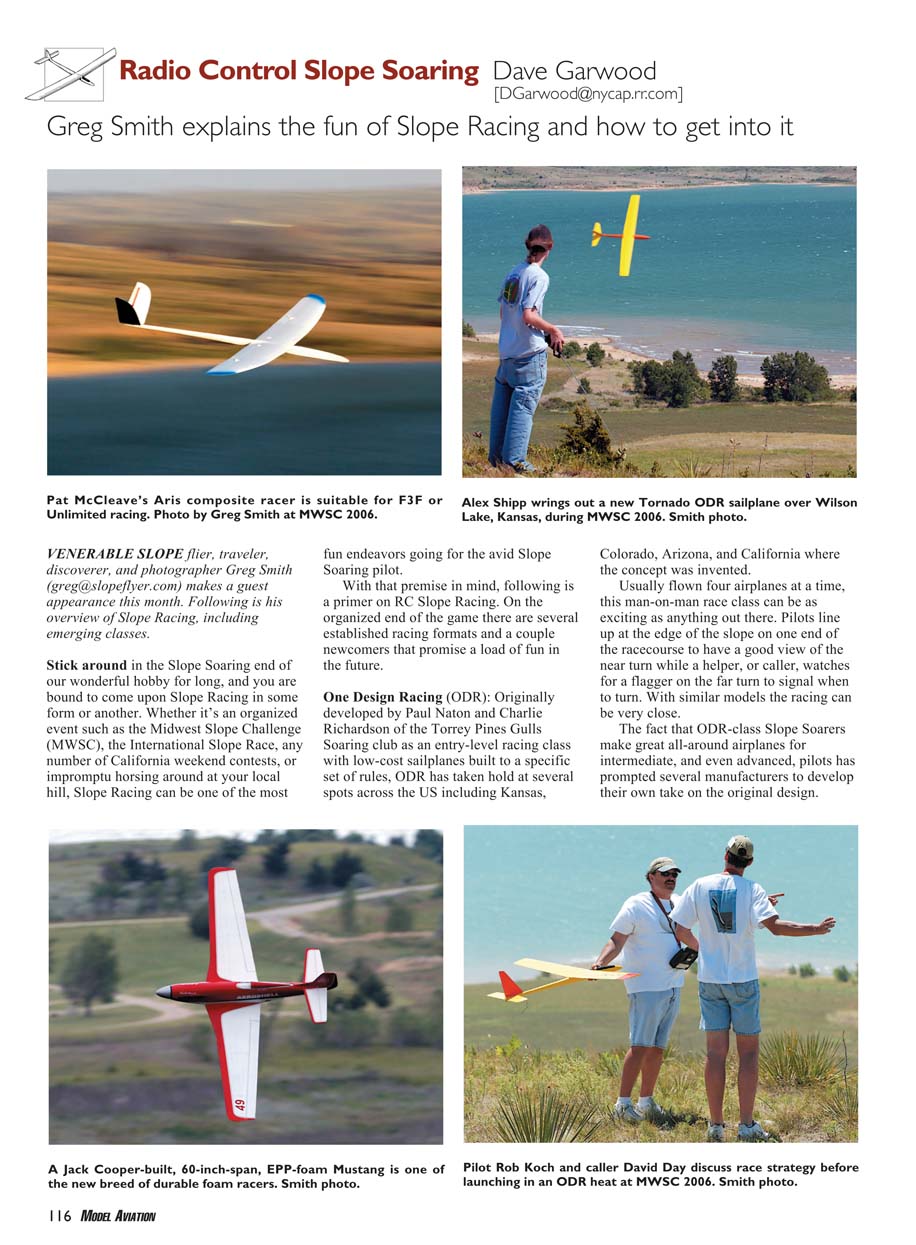
These are Unlimited racing's little brothers; some are still developing and not yet in the official AMA rule book. These classes have alternated between full-crunchy airplanes, made from fiberglass, carbon fiber, and Kevlar, and the currently fashionable EPP-foam racers that offer great performance and excellent durability.
Usually run four sailplanes at a time, these classes offer pilots and builders more options than the ODR class to get the most out of their racers. Besides the 60-inch rule, almost anything else goes.
A relative newcomer to the 60-inch slope-racing genre is foamie warbird racing. Using 60-inch-class, Power Scale Soaring-style EPP-foam warbirds, these races can be run on a traditional man-on-man course, or as practiced at the MWSC, with the added thrill of the "Pole of Death." The pilot must make a turn around a pole at the near turn that is only a few feet above ground level. It looks easy. Try it and see!
F3F
Originally developed in Europe, FAI F3F is slope racing's equivalent of Formula 1 auto racing. The most advanced and fastest airframes compete and, as in Formula 1, there is no passing!
In F3F that is because it is a time-trial format with one model on the course at a time running against the clock. Pilots fly 10 legs of a 100-meter course with an audible buzzer indicating when their airplanes have passed the Base A turn or the Base B turn.
Unlike in other slope-racing formats, the pilot is located in the center of the course. This new perspective takes some getting used to, but it is extremely addictive as you try to shave precious seconds and then tenths of seconds off your time.
In an effort to equalize the changing race conditions as the day progresses, each round is scored individually. The fastest pilot for the round gets 1,000 points, and the remaining pilots get a percentage of the top score in relation to how close they were to the fast time. So for 10 rounds there could be 10 different round winners. The overall winner is the pilot who accumulates the most points.
While the saying has been around a long time and was not coined with F3F in mind, it holds true here—especially at world-class levels—that speed is just a question of money and how fast you want to go!
The de facto world championships for F3F, called the Viking Race, are held every two years. It pits the best pilots, in teams representing their countries, from around the world in a multiday event to determine the best of the best. The 2006 Viking Race was scheduled to be run at Bishop Hill in Fife, Scotland, September 8–15. Because of its international nature, the Viking Race has visited some great slopes in Norway, Wales, England, Denmark, Austria, Iceland, and Germany, with more nations to host in the future.
Informal and Impromptu Racing
Some may think slope racing is all about organized competitions; fortunately nothing could be further from the truth. Impromptu races at slopes from Washington to Cape Cod to the hills above the Missouri River in South Dakota bring the thrill of racing while eliminating the intricacies of making rules.
I first encountered Weasel Racing in South Dakota where two pine trees just below the top of the slope made great turn points. You just join in the fun and try to stay in front! Recent Weasel races have had as many as 15 pilots at a time whooping it up.
A variation on the theme had several Weasels, all dynamic soaring a small hill, with teams of two pilots trading off transmitters like pit stops, with the nonflying teammate responsible for keeping the errant Weasel airborne. The only requirement for Weasel Racing is a Richter Weasel and some imagination!
Similar to Weasel Racing, MWSC pilots invariably get at least one evening during which the "magic air," as Dave Garwood calls it, provides the perfect conditions for some relaxed racing with Two-Meter Dave's Aircraft Works 1-26s. Recently reintroduced by SkyKing RC Products, the 1-26 is a great model when the lift is light. The sailplanes, skimming just a foot or two over the edge of the slope in a barely perceptible breeze, are a ball to race. Smooth turns and energy retention make for a winner.
If you are not content with the random nature of wing combat as traditionally flown, a group of imaginative and contact-happy pilots have developed Combat Racing in Colorado. This event is flown at eye level on the front side of a slope with combat wing-style airplanes. The race takes place in a figure-eight pattern, ensuring maximum exposure to other models and thus maximum contact. As they say in NASCAR, "Rubbin' is racin'!"
Tips for Getting Started
- Know your airplane. Showing up at a race, even an impromptu one, with an untested model is a no-no. You should be familiar with your aircraft in a variety of conditions.
- For classes that allow it, be familiar with how your model handles ballast. As perennially competitive racer Jim Porter once said, "Most guys wait too long to ballast and then don't ballast enough." For racing airfoils, efficiency goes up with wing loading. Don't be afraid to use lead.
- Seek help from experienced pilots. Any slope pilot with intermediate skills has what it takes to enter the fray. At events there are experienced pilots who are happy to show you the ropes.
- Get a caller. Try to get one of the hot shoes to work with you as a caller. The tips you get can help you become the next champion.
- Watch the shadow. Greg's "super-secret" tip is to watch for your model's shadow on the ground at the far turn. Slope racing is won, or lost, in the turns. Anything you can do to gain an advantage, especially at the far end of the course, will help you emerge as slope king for the day.
For more information about slope racing in the U.S., check out the American Slope Racing Organization.
Sources
- EdgeRC www.edgerc.com
- Leading Edge Gliders www.leadingedgegliders.com
- PoleCat Aeroplane Works www.polecataero.com
- JTModels www.jtmodels.com
- Michael Richter Design www.dream-flight.com
- Tom Copp's F3X.com www.f3x.com
- SoaringUSA.com www.soaringusa.com
- American Slope Racing Organization www.sloperacing.com
- SkyKing RC Products www.skykingrcproducts.com
- Paul Naton's ODR article and specifications www.radiocarbonart.com/Pages/odrracingarticle.html
- AMA RC Soaring rule book www.modelaircraft.org/comp/0506Rulebook/RCsoaring.pdf
Events
- Midwest Slope Challenge www.midwestslope.com
- Davenport International Slope Race www.davenportisr.com
- Viking Race 2006 www.vikingrace2006.co.uk
Transcribed from original scans by AI. Minor OCR errors may remain.

