
Radio Control Slope Soaring
Dave Garwood [[email protected]]
Guest coverage of the Soar Utah 2006 event
Guest report by Greg Smith
Dave Kramer and I traveled on a 10-day trip from Milwaukee, Wisconsin, to Salt Lake City, Utah, to attend Soar Utah 2006 held over the Labor Day weekend, September 1–4, 2006.
True to Slopin' Safari form, we meandered along on the way and checked slopes in South Dakota, Wyoming, and Montana. The most fruitful state for finding new flying areas was Wyoming, where we spent a couple of days just wandering around. The main nemesis to a great bunch of flying on this part of the trip was a lack of wind, not a lack of spectacular terrain!
We did have some good flights at several great slopes, but overall the wind that normally thrashes Wyoming was nowhere to be found. Undaunted, we continued west to the Beehive State, Utah, and the several sloping venues in and around Salt Lake City.
Point of the Mountain (POM)
While the actual Soar Utah event does not start until Friday, many pilots gather in the afternoon on Thursday to catch the afternoon winds on the north side of the Point of the Mountain (POM). When we arrived there was a light breeze blowing from the northeast. The lift was light, but Weasels and hand-launch sailplanes were able to fly, so Dave and I got a couple of sailplanes ready to go.
There were already a couple of guys at the slope, including Thomas and Sam from Vancouver Island, who were flying fast electrics. Sam's Trinity had a 33-volt Li-Poly pack with something like 18 Li-Poly cells! Whoa — does that thing move! The Trinity is a 3-plus-meter F3F-style sailplane that has an electric fuselage option and makes a great model for those days when the lift is light.
I flew my Airtech Pixel, McLean Extreme, and Richter Design Weasel. I had a blast Weaseling around with Carl Maas, Dave, and Fred Sanford. The Weasel Pro is still one of my favorite airplanes, especially when the lift is light as it was on this day.
Dave and I also flew the heck out of our Weasels during the Slopin' Safari portion of the trip. It is an excellent test sailplane for new slopes and can be used to work small areas as well as spotty lift.
Conditions were favorable for dynamic soaring (DS) later in the afternoon on Thursday, so several of us piled into Marty Hill's truck for a trip most of the way up the mountain behind the normal flying spot at POM North. Another 100 feet or so of vertical on foot and we were 1,000-plus feet above the valley floor and on a saddleback that is good for dynamic soaring.
I got to fly Marty's JW DS and turned some laps. Brian Courtice, from Hawaii, had a blast learning something about the DS groove. Marty gave Brian the sticks to the JW and talked him through flying the groove that was working best. I think Brian will be looking around Hawaii for suitable DS slopes!
A welcome development at POM, both North and South, is that the area was designated a Utah State Park, dedicated July 14, 2006. The new park is called Flight Park State Recreation Area.
Utah State Parks and Recreation and the Utah Hang Gliding and Paragliding Association (UHGPGA) partnered to save the land from being lost to encroaching development. In addition, there is local RC club representation through the InterMountain Silent Flyers (IMSF), who are looking after the RC slope-soaring pilots' interests in future site plans. The IMSF is also the host club for Soar Utah.
POM has been a launching site for RC sailplanes, hang gliders, and paragliders for several decades and is often mentioned as one of the premier slope-flying areas in the world. Utah State Parks will maintain ownership of the property while management of the park will be left to the association.
One of the goals for the IMSF in working with Utah State Parks and the UHGPGA will be to help establish a set of guidelines for the continued coexistence of RC airplanes and the human pilots of hang gliders and paragliders at POM. For many years there has been an unofficial separation between the two groups at the south flying site, mostly due to the suitability of the slope for each type of flying.
At the north site there has been a more casual atmosphere with respect to the cohabitation of RC pilots and our flying human friends, which can create hazardous situations. The most likely solution will involve utilizing separate launch areas on the north side similar to the situation on the south site.
Of course, the goal is to allow all enthusiasts of flight — whether they are RC pilots, hang glider pilots, or paraglider pilots — to enjoy the great conditions at POM while maintaining the safest conditions for all involved.
Butterfield Canyon
Soar Utah 2006 opened on Friday with a trip to Butterfield Canyon. The flying site is located on the mountain peak above the Kennecott Copper Mine. The elevation of the peak is about 8,900 feet and makes this a fantastic flying spot that provides a great view of the mine — one of the largest open pits in the world.
A contingent of the IMSF club hauled trailers up the 13-mile twisty access road to the top and had breakfast on the peak ready. Very cool!
While Butterfield Canyon is a 360° flying site for both slope and thermal flying, this day was primarily thermal lift. Hand launches as well as larger TD (Thermal Duration)-type sailplanes were doing fine. Clarence Ashcraft had a huge Bubble Dancer with extended tips like a super-huge hand launch!
Flying over the terraced pit of the copper mine is a unique experience. The sheer scale of the pit is amazing. Just goes to show what happens when you dig a hole continuously for over 100 years!
I flew my Erwin and the Frankenplane DLG (Discus Launch Glider). Both flew well, but apparently the DLG had a bad battery pack. Fortunately, the airplane had a wish to come home since it made the turn to final and the approach all without my help and plunked down fine. By the way, a "Frankenplane" is a combination of the parts of two or more damaged airplanes made into a flyable third.
The main bummer at the Butterfield location is that the Kennecott mine is going to be expanding, so it looks like this is the last Soar Utah for which we will be able to utilize this spot.
Aerotow on the Salt Flats
Next we headed over to the aerotow held on a salt flat near Grantsville, Utah, about 40 miles west of Salt Lake City. This was the first time an aerotow was a part of the Soar Utah weekend.
There could not have been a better day for it. The temperature was in the high 80s, the wind was light, and the thermals were plentiful.
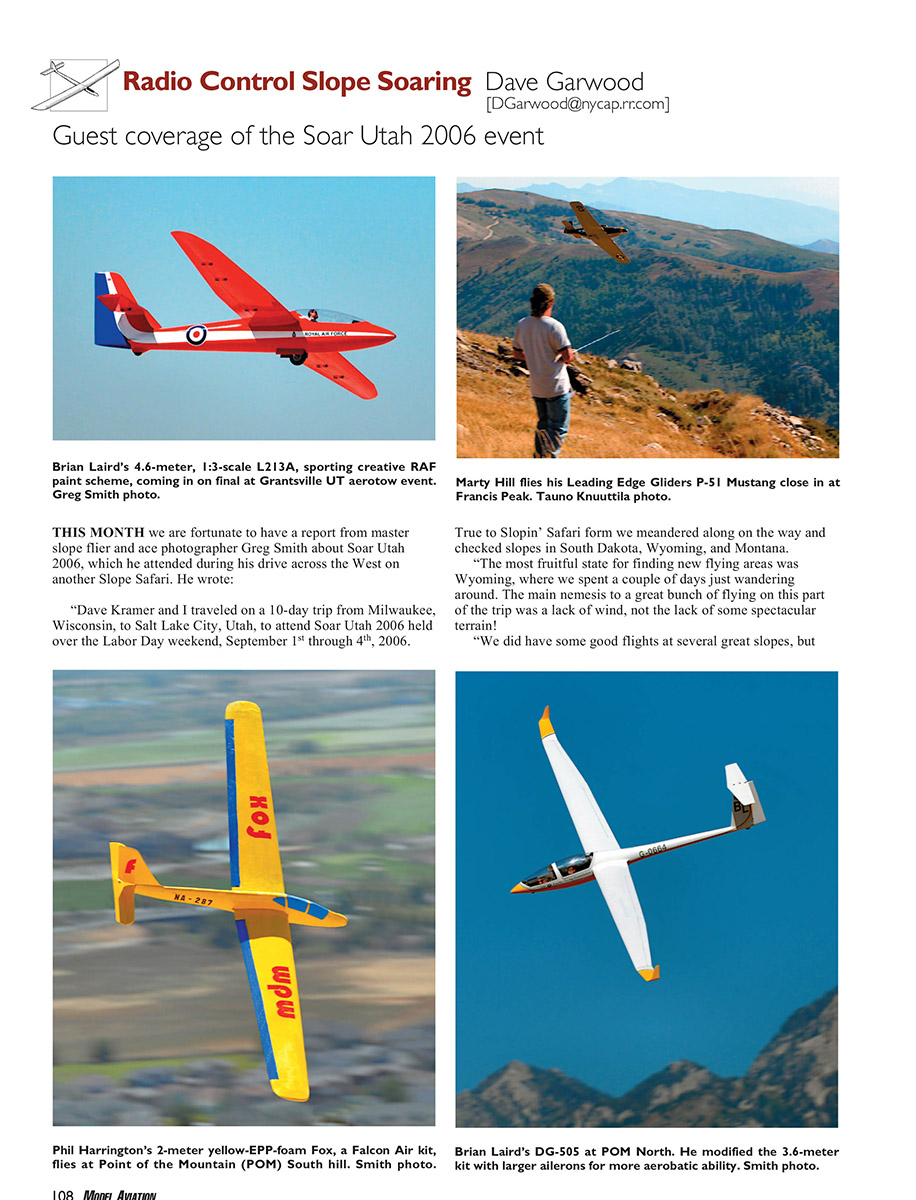
Aerotowing involves using a powered tug to tow up large sailplanes. Most of the sailplanes are large-scale models 3 meters and up. Brian Laird's big, red L-213 stood out and it looked great going up, up until it was a couple thousand feet above the desert floor. Brian had a good flight, and when he brought the L-213 in it looked almost like my new Slope Scale P-63, which flew great right out of my hand.
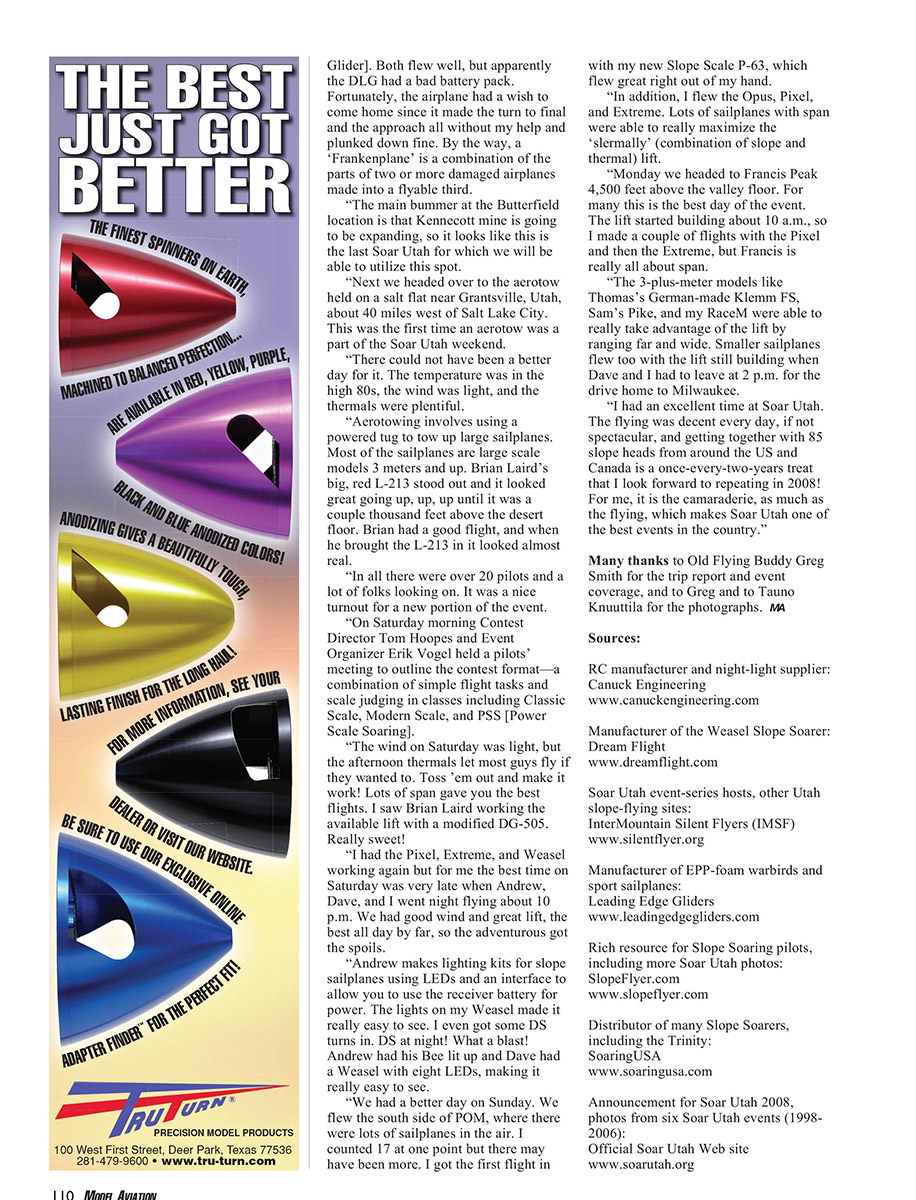
In addition, I flew the Opus, Pixel, and Extreme. Lots of sailplanes with span were able to really maximize the "s-thermal" (combination of slope and thermal) lift.
Francis Peak
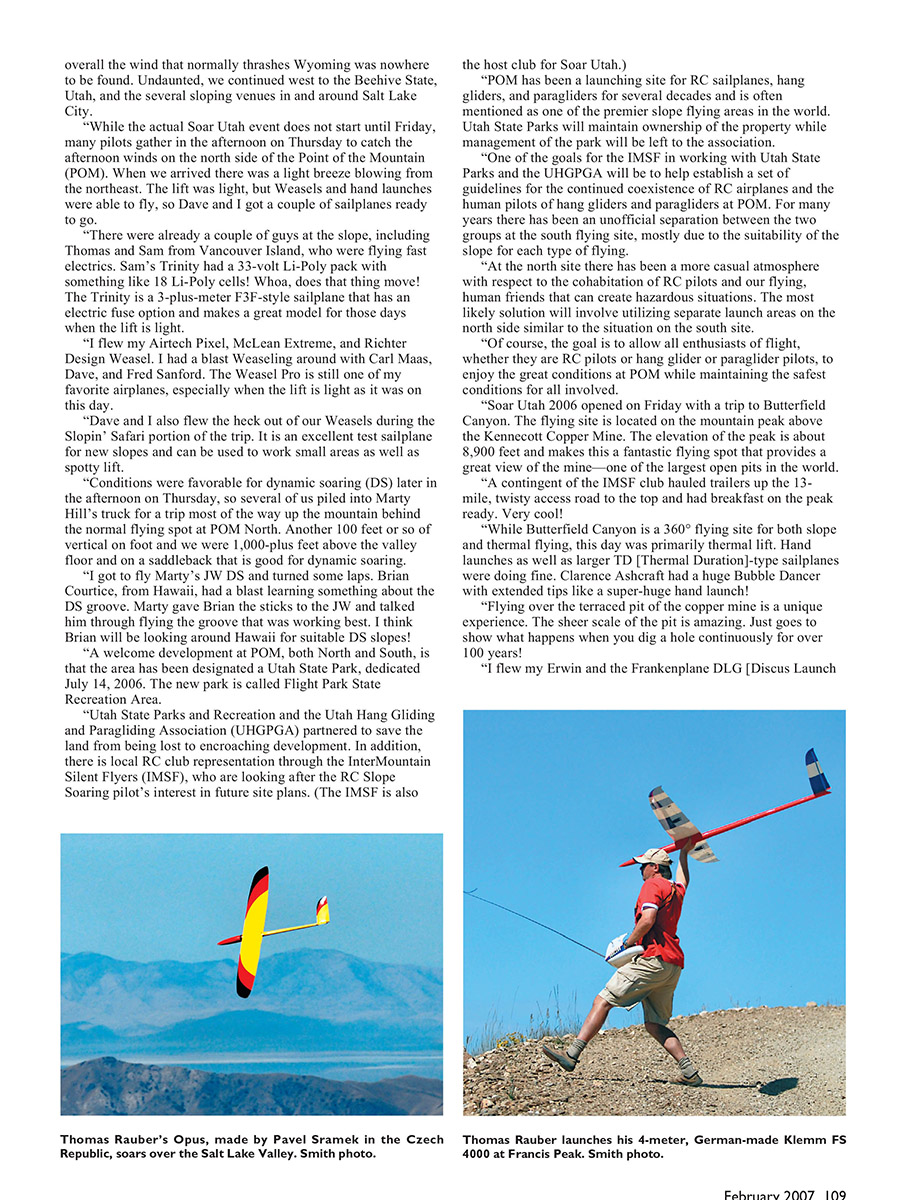
Monday we headed to Francis Peak, 4,500 feet above the valley floor. For many this is the best day of the event. The lift started building about 10 a.m., so I made a couple of flights with the Pixel and then the Extreme, but Francis is really all about span.
The 3-plus-meter models like Thomas's German-made Klemm FS, Sam's Pike, and my Racer were able to really take advantage of the lift by ranging far and wide. Smaller sailplanes flew too, with the lift still building when Dave and I had to leave at 2 p.m. for the drive home to Milwaukee.
I had an excellent time at Soar Utah. The flying was decent every day, if not spectacular, and getting together with 85 slope heads from around the U.S. and Canada is a once-every-two-years treat that I look forward to repeating in 2008! For me, it is the camaraderie as much as the flying that makes Soar Utah one of the best events in the country.
Many thanks to old flying buddy Greg Smith for the trip report and event coverage, and to Greg and Tauno Knuuttila for the photographs.
Sources
- Canuck Engineering — RC manufacturer and night-light supplier
- Dream Flight — Manufacturer of the Weasel slope soarer
- InterMountain Silent Flyers (IMSF) — Soar Utah event-series hosts, other Utah slope-flying sites
- Leading Edge Gliders — Manufacturer of EPP-foam warbirds and sport sailplanes
- SlopeFlyer.com — Rich resource for slope-soaring pilots, including more Soar Utah photos
- SoaringUSA — Distributor of many slope soarers, including the Trinity
- Official Soar Utah Web site — Announcement for Soar Utah 2008, photos from six Soar Utah events (1998–2006)
Transcribed from original scans by AI. Minor OCR errors may remain.

