
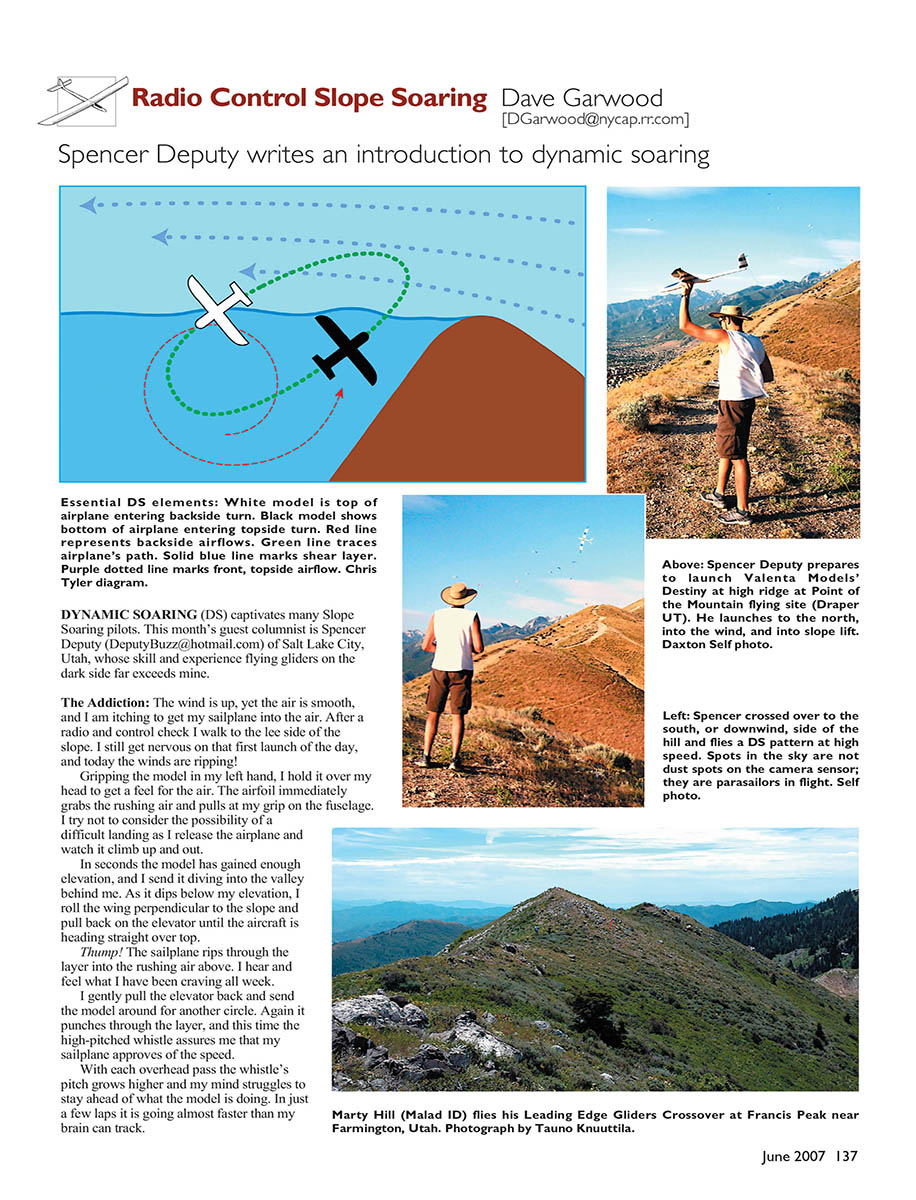

Radio Control Slope Soaring
Dave Garwood [[email protected]]
Spencer Deputy writes an introduction to dynamic soaring
DYNAMIC SOARING (DS) captivates many slope soaring pilots. This month's guest columnist is Spencer Deputy ([email protected]) of Salt Lake City, Utah, whose skill and experience flying gliders on the dark side far exceeds mine.
The Addiction
The wind is up, yet the air is smooth, and I am itching to get my sailplane into the air. After a radio and control check I walk to the lee side of the slope. I still get nervous on that first launch of the day, and today the winds are ripping!
Gripping the model in my left hand, I hold it over my head to get a feel for the air. The airfoil immediately grabs the rushing air and pulls at my grip on the fuselage. I try not to consider the possibility of a difficult landing as I release the airplane and watch it climb up and out.
In seconds the model has gained enough elevation, and I send it diving into the valley behind me. As it dips below my elevation, I roll the wing perpendicular to the slope and pull back on the elevator until the aircraft is heading straight over top. Thump! The sailplane rips through the layer into the rushing air above. I hear and feel what I have been craving all week.
I gently pull the elevator back and send the model around for another circle. Again it punches through the layer, and this time the high-pitched whistle assures me that my sailplane approves of the speed. With each overhead pass the whistle's pitch grows higher and my mind struggles to stay ahead of what the model is doing. In just a few laps it is going almost faster than my brain can track.
What Is DS?
It's a technique of flying in which your sailplane repeatedly crosses a horizontal shear layer between two air masses. The top air mass will have a high velocity while the lower mass will be fairly calm. The goal in DS is to gather speed in high-velocity air and then retain that speed by diving through the shear layer into the calmer air below. While your model is in the calm air below, turn around for another push from the high-velocity air above. When conditions are right the sailplane will also gather energy in the backside turn. With 15 mph winds, a good airplane and pilot can easily exceed 100 mph. Winds exceeding 25 mph can provide model speeds in excess of 150 mph. In optimal conditions, many sailplanes and pilots have exceeded 200 mph, with the current world record at 301 mph.
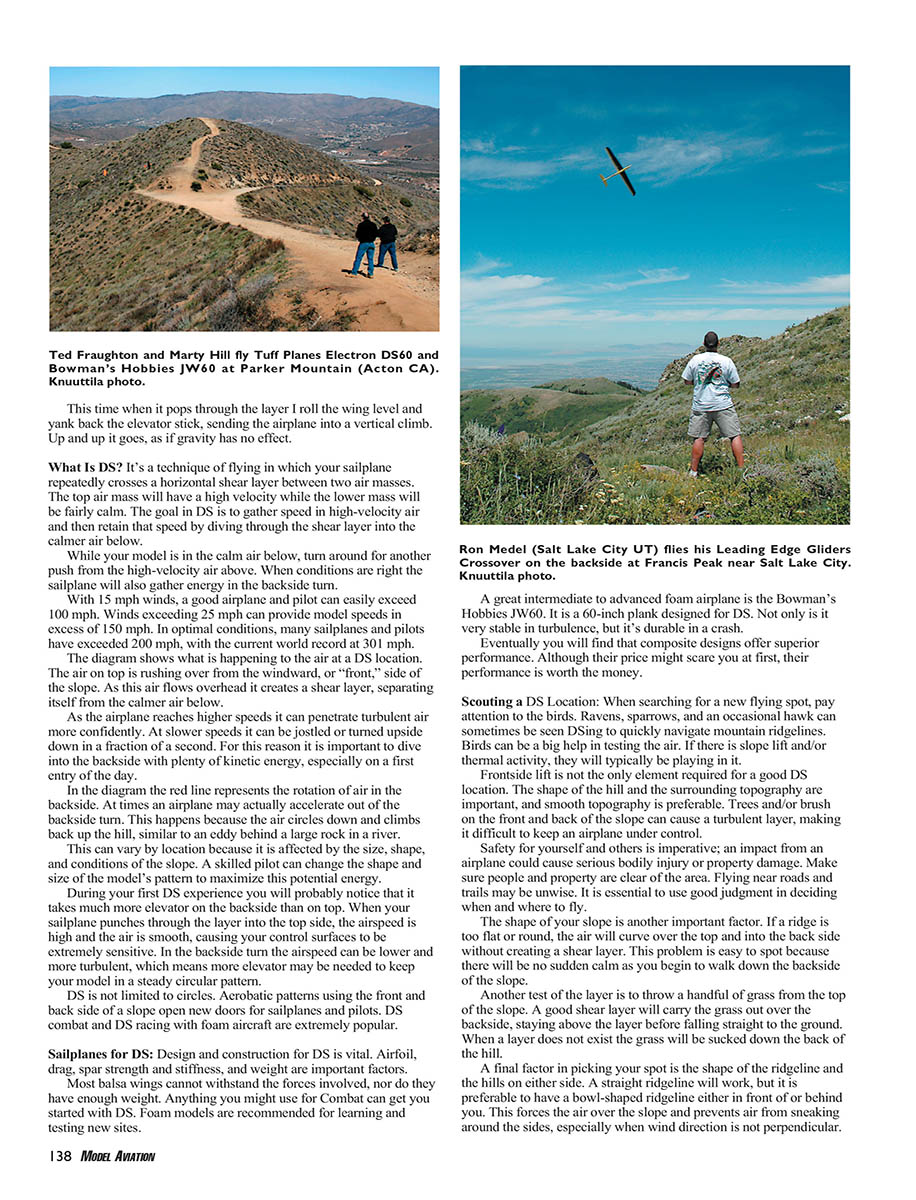
The diagram shows what is happening to the air at a DS location. The air on top is rushing over from the windward, or "front," side of the slope. As this air flows overhead it creates a shear layer, separating itself from the calmer air below.
As the airplane reaches higher speeds it can penetrate turbulent air more confidently. At slower speeds it can be jostled or turned upside down in a fraction of a second. For this reason it is important to dive into the backside with plenty of kinetic energy, especially on a first entry of the day.
In the diagram the red line represents the rotation of air in the backside. At times an airplane may actually accelerate out of the backside turn. This happens because the air circles down and climbs back up the hill, similar to an eddy behind a large rock in a river.
This can vary by location because it is affected by the size, shape, and conditions of the slope. A skilled pilot can change the shape and size of the model's pattern to maximize this potential energy.
During your first DS experience you will probably notice that it takes much more elevator on the backside than on the topside. When your sailplane punches through the layer into the topside, the airspeed is high and the air is smooth, causing your control surfaces to be extremely sensitive. In the backside turn the airspeed can be lower and more turbulent, which means more elevator may be needed to keep your model in a steady circular pattern.
DS is not limited to circles. Aerobatic patterns using the front and back side of a slope open new doors for sailplanes and pilots. DS combat and DS racing with foam aircraft are extremely popular.
Sailplanes for DS
Design and construction for DS is vital. Airfoil, drag, spar strength and stiffness, and weight are important factors. Most balsa wings cannot withstand the forces involved, nor do they have enough weight. Anything you might use for combat can get you started with DS. Foam models are recommended for learning and testing new sites.
A great intermediate to advanced foam airplane is the Bowman's Hobbies JW60. It is a 60-inch plank designed for DS. Not only is it very stable in turbulence, but it's durable in a crash.
Eventually you will find that composite designs offer superior performance. Although their price might scare you at first, their performance is worth the money.
Scouting a DS Location
When searching for a new flying spot, pay attention to the birds. Ravens, sparrows, and an occasional hawk can sometimes be seen DSing to quickly navigate mountain ridgelines. Birds can be a big help in testing the air. If there is slope lift and/or thermal activity, they will typically be playing in it.
Frontside lift is not the only element required for a good DS location. The shape of the hill and the surrounding topography are important, and smooth topography is preferable. Trees and/or brush on the front and back of the slope can cause a turbulent layer, making it difficult to keep an airplane under control.
Safety for yourself and others is imperative; an impact from an airplane could cause serious bodily injury or property damage. Make sure people and property are clear of the area. Flying near roads and trails may be unwise. It is essential to use good judgment in deciding when and where to fly.
The shape of your slope is another important factor. If a ridge is too flat or round, the air will curve over the top and into the back side without creating a shear layer. This problem is easy to spot because there will be no sudden calm as you begin to walk down the backside of the slope.
Another test of the layer is to throw a handful of grass from the top of the slope. A good shear layer will carry the grass out over the backside, staying above the layer before falling straight to the ground. When a layer does not exist the grass will be sucked down the back of the hill.
A final factor in picking your spot is the shape of the ridgeline and the hills on either side. A straight ridgeline will work, but it is preferable to have a bowl-shaped ridgeline either in front of or behind you. This forces the air over the slope and prevents air from sneaking around the sides, especially when wind direction is not perpendicular.
Some locations may have wind curving around a low point on the ridgeline. That causes undesirable backside airflows, which increase turbulence and shrink the areas of smooth air in your playground.
The Landing
One problem may be finding a suitable landing zone. Some locations offer only small and rocky landing areas.
Depending on obstacles, you may choose a front- or backside landing. Opinions differ on which is easier, but I prefer landing on the front side. A backside landing requires that you maneuver the model under the layer and use circles, flaps, or spoilers to decrease its speed. At the right moment the airplane must be brought around, pointed at the right position, and set down.
This landing requires commitment because once the model has slowed, there is no inertia to carry it around to try again. I am less fond of backside landings because of the sporadic turbulence, which can be even more violent for a sailplane at lower speeds.
In a frontside landing, start with the model low on the slope and then climb at an angle against the hill toward your position. Speed is bled off by climbing the slope and further controlled with flaps or spoilers. The goal is to stall the model into the chosen landing zone when ground speed nears zero.
Spoilerons (upward-deployed ailerons) work great for frontside landings. There is no need to force these landings because the airplane can go around as many times as needed.
Talk the Talk
- Dark Side: Also referring to the downwind side of the slope, this term refers more to the high-speed, unpredictable element, which can cause adrenaline addiction and spectacular crashes.
- Groove or Grooving: The pattern with the most energy. It also refers to a state of mind.
- Lift: Area on the slope’s front side, offering rising air for your model.
- Flutter: Rapid oscillation of a wing or control surface. The fluttering component forms a resonant vibration, which can amplify across a surface and can strip servos or shatter wings, ailerons, and elevator. Minimizing the chance of flutter is an important consideration in designing a DS sailplane.
DS is a unique sport, and those who commit to the relationship seem to fall hopelessly in love. It takes a pilot who is not only skilled enough to perform the demanding flying, but is also able to access suitable locations, which may require hiking. DS requires patience and weather-watching skills, and the great DS days require that you be at Mother Nature’s beck and call.
When all elements fall together, there is nothing more exhilarating than a big day with a fast sailplane. But don’t take my word for it; find your local site and see for yourself what all the excitement is about. MA
Sources
- DS article
www.geocities.com/soaringbythebay/dsoar.htm
- Tuff Planes DS article
www.tuffplanes.com/Flying/Flying_Technics/Dynamic_Soaring.html
- General article about DS
www.en.wikipedia.org/wiki/Dynamic_soaring (Lookup term: dynamic soaring)
- Bill Patterson art, DS videos
www.billpattersonart.com/dszone.swf
- Crossover (aka Jackhammer) kit:
Leading Edge Gliders www.leadingedgegliders.com
- JW60 kit:
Bowman's Hobbies www.bowmanshobbies.com
- Valenta Models Destiny:
Soaring USA www.soaringusa.com
- Lift Ticket video with DS speed-record footage:
Reese Productions www.reeseproductions.com
- RC GROUPS—online discussion and message base
Transcribed from original scans by AI. Minor OCR errors may remain.

