
RADIO CONTROL SOARING
Mike Garton, 2733 NE 95th Ave., Ankeny IA 50021; E-mail: [email protected]
The theme this month is thermaling. I'll give you a bunch of tips on how to find and ride these finicky columns of rising air. This month's instructions and methods add to the information from the January 2004 column about the "Condensation Analogy." As usual, I'll start with basics and build to more advanced ideas.
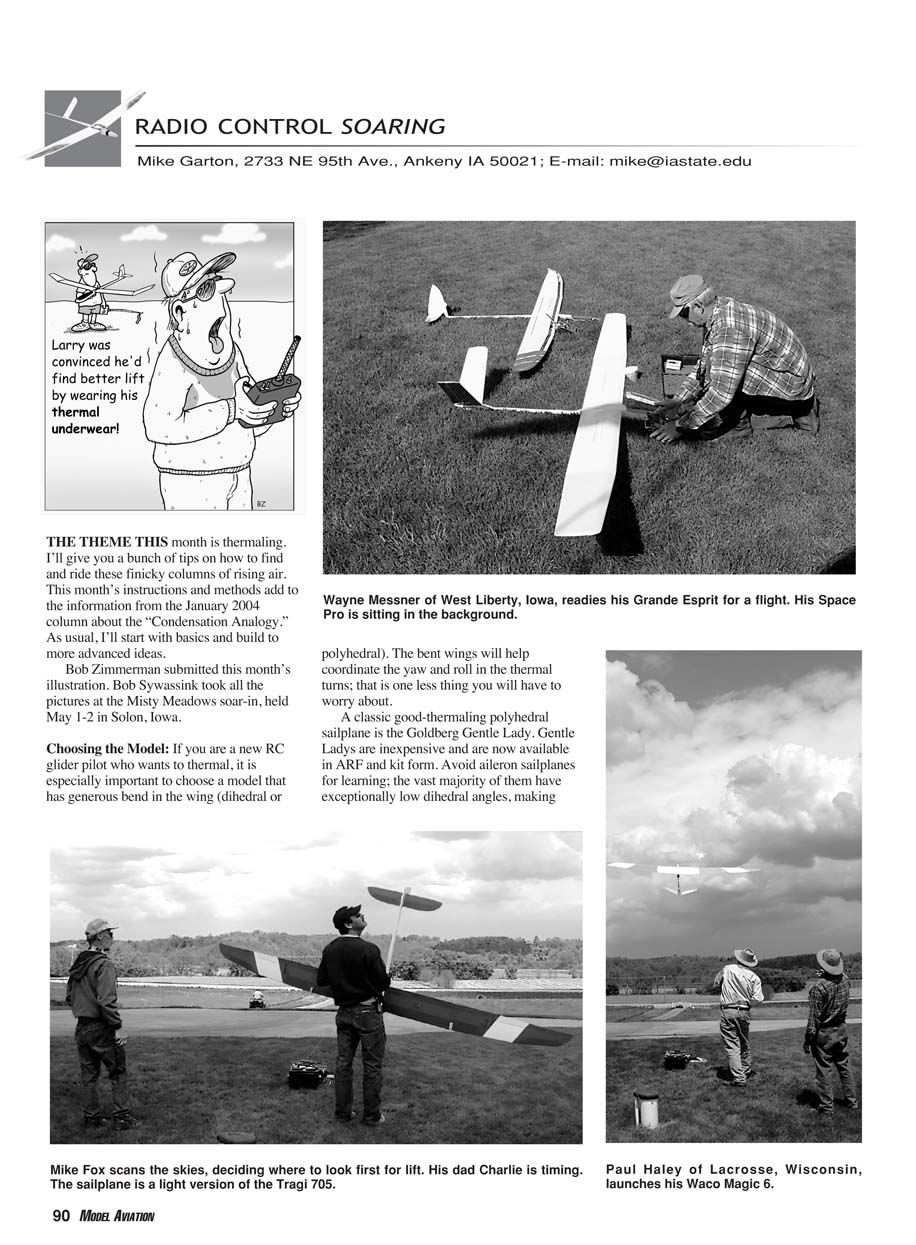
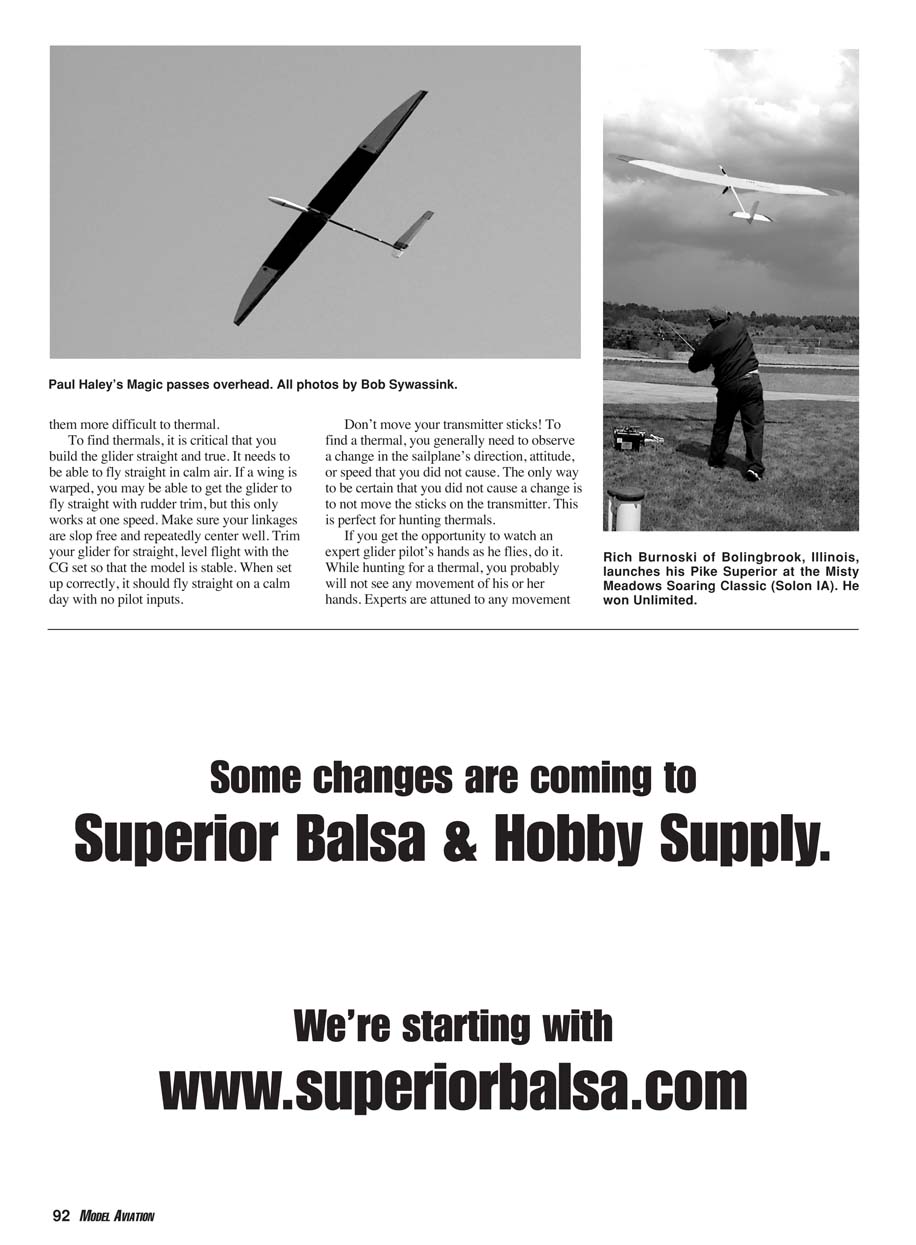
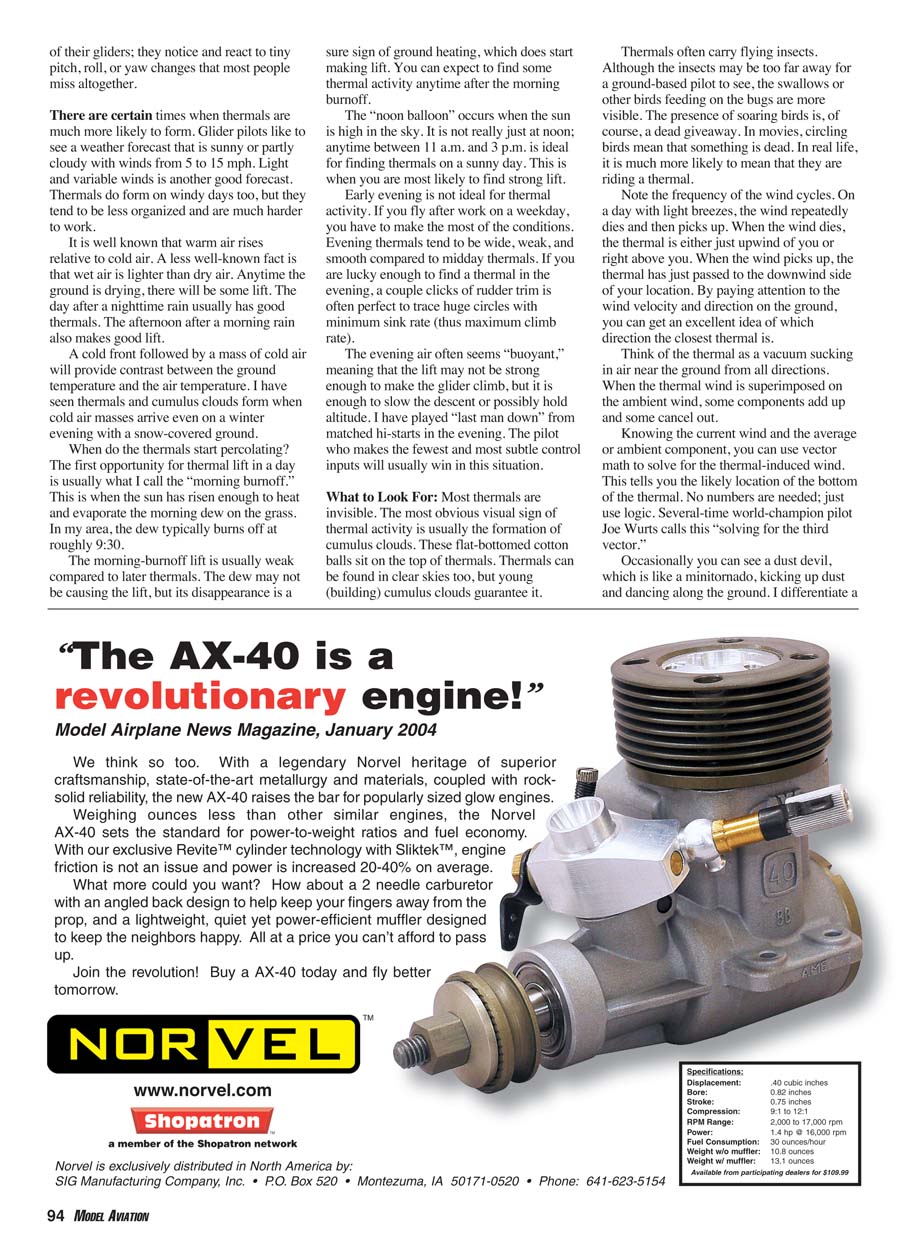
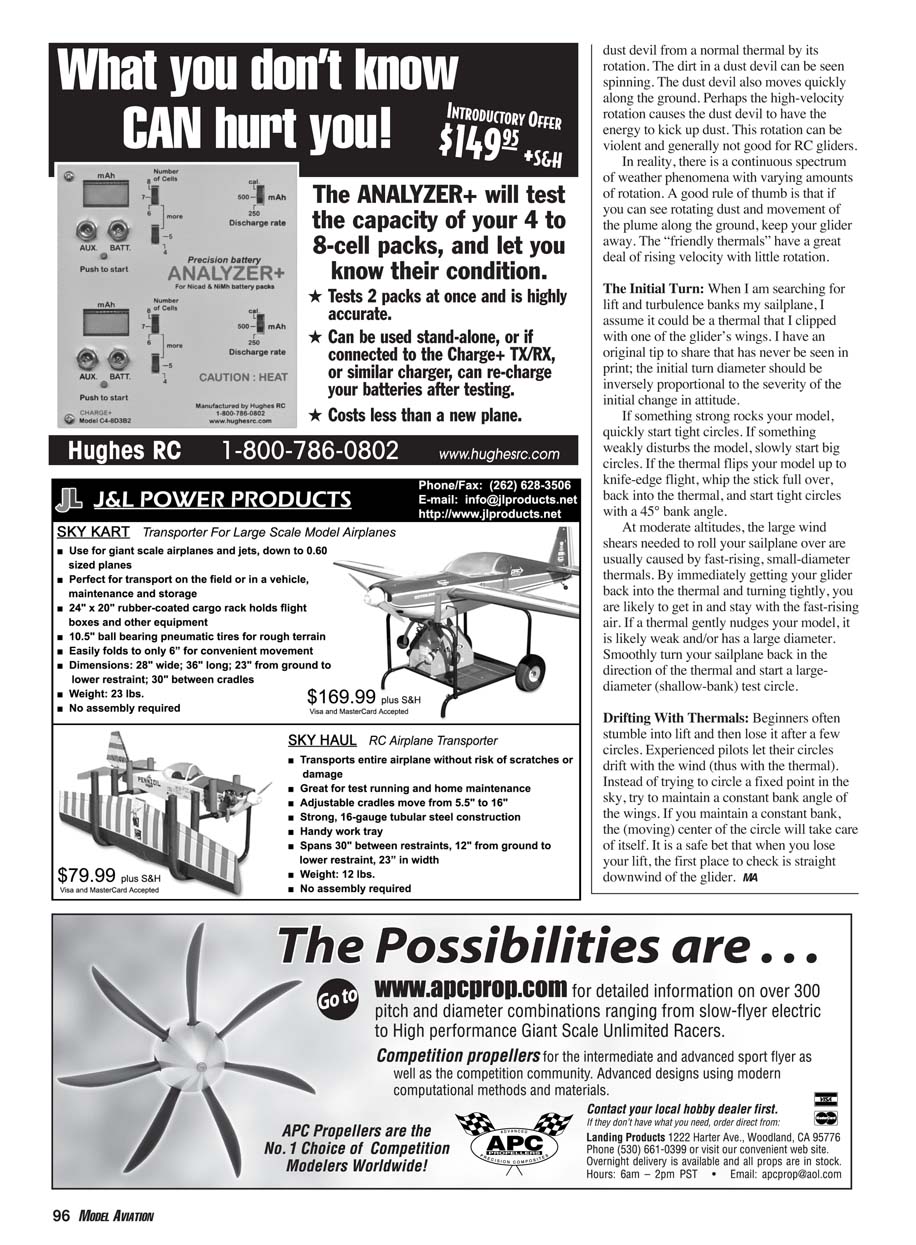
Bob Zimmerman submitted this month's illustration. Bob Sywassink took all the pictures at the Misty Meadows soar-in, held May 1–2 in Solon, Iowa.
Choosing the Model:
If you are a new RC glider pilot who wants to thermal, it is especially important to choose a model that has generous bend in the wing (dihedral or polyhedral). The bent wings will help coordinate yaw and roll in thermal turns; that is one less thing you will have to worry about.
A classic good-thermaling polyhedral sailplane is the Goldberg Gentle Lady. Gentle Ladies are inexpensive and are now available in ARF and kit form. Avoid aileron sailplanes for learning; the vast majority of them have exceptionally low dihedral angles, making them more difficult to thermal.
To find thermals, it is critical that you build the glider straight and true. It needs to be able to fly straight in calm air. If a wing is warped, you may be able to get the glider to fly straight with rudder trim, but this only works at one speed. Make sure your linkages are slop-free and repeatedly center well. Trim your glider for straight, level flight with the CG set so that the model is stable. When set up correctly, it should fly straight on a calm day with no pilot inputs.
Don't move your transmitter sticks! To find a thermal, you generally need to observe a change in the sailplane's direction, attitude, or speed that you did not cause. The only way to be certain that you did not cause a change is to not move the sticks on the transmitter. This is perfect for hunting thermals. If you get the opportunity to watch an expert glider pilot's hands as he flies, do it. While hunting for a thermal, you probably will not see any movement of his or her hands. Experts are attuned to any movement of their gliders; they notice and react to tiny pitch, roll, or yaw changes that most people miss altogether.
Where and When Thermals Form:
There are certain times and conditions when thermals are much more likely to form. Glider pilots like to see a weather forecast that is sunny or partly cloudy with winds from 5 to 15 mph. Light and variable winds is another good forecast. Thermals do form on windy days too, but they tend to be less organized and are much harder to work.
- Anytime the ground is drying, there will be some lift. The day after a nighttime rain usually has good thermals. The afternoon after a morning rain also makes good lift.
- A cold front followed by a mass of cold air will provide contrast between the ground temperature and the air temperature. I have seen thermals and cumulus clouds form when cold air masses arrive even on a winter evening with a snow-covered ground.
- The first opportunity for thermal lift in a day is usually what I call the "morning bump."
Remember that warm air rises relative to cold air. A less well-known fact is that wet air is lighter than dry air.
Recognizing Thermals:
Thermals often carry flying insects. Although the insects may be too far away for a ground-based pilot to see, the swallows or other birds feeding on the bugs are more visible. The presence of soaring birds is, of course, a dead giveaway.
Note the frequency of the wind cycles. On a day with light breezes, the wind repeatedly dies and then picks up. When the wind dies, the thermal is either just upwind of you or right above you. When the wind picks up, the thermal has just passed to the downwind side of your location. By paying attention to the wind velocity and direction on the ground, you can get an excellent idea of which direction the closest thermal is.
Think of the thermal as a vacuum sucking in air near the ground from all directions. When the thermal wind is superimposed on the ambient wind, some components add up and some cancel out. Knowing the current wind and the average or ambient component, you can use vector logic to solve for the thermal-induced wind. This tells you the likely location of the bottom of the thermal. No numbers are needed; just use logic. Several-time world-champion pilot Joe Wurts calls this "solving for the third vector."
Occasionally you can see a dust devil, which is like a mini-tornado, kicking up dust and dancing along the ground. I differentiate a dust devil from a normal thermal by its rotation. The dirt in a dust devil can be seen spinning. The dust devil also moves quickly along the ground. Perhaps the high-velocity rotation causes the dust devil to have the energy to kick up dust. This rotation can be violent and generally not good for RC gliders.
In reality, there is a continuous spectrum of weather phenomena with varying amounts of rotation. A good rule of thumb is that if you can see rotating dust and movement of the plume along the ground, keep your glider away. The "friendly thermals" have a great deal of rising velocity with little rotation.
The Initial Turn:
When I am searching for lift and turbulence I bank my sailplane; I assume it could be a thermal that I clipped with one of the glider's wings. I have an original tip to share that has never been seen in print: the initial turn diameter should be inversely proportional to the severity of the initial change in attitude.
- If something strong rocks your model, quickly start tight circles.
- If something weakly disturbs the model, slowly start big circles.
- If the thermal flips your model up to knife-edge flight, whip the stick full over, back into the thermal, and start tight circles with about a 45° bank angle.
At moderate altitudes, the large wind shears needed to roll your sailplane over are usually caused by fast-rising, small-diameter thermals. By immediately getting your glider back into the thermal and turning tightly, you are likely to get in and stay with the fast-rising air. If a thermal gently nudges your model, it is likely weak and/or has a large diameter. Smoothly turn your sailplane back in the direction of the thermal and start a large-diameter (shallow-bank) test circle.
Drifting With Thermals:
Beginners often stumble into lift and then lose it after a few circles. Experienced pilots let their circles drift with the wind (thus with the thermal). Instead of trying to circle a fixed point in the sky, try to maintain a constant bank angle of the wings. If you maintain a constant bank, the (moving) center of the circle will take care of itself. It is a safe bet that when you lose your lift, the first place to check is straight downwind of the glider.
Transcribed from original scans by AI. Minor OCR errors may remain.

