



RADIO CONTROL SOARING
Mike Garton 2733 NE 95th Ave., Ankeny IA 50021 E-mail: [email protected]
This month's theme
This month's theme is electronic components for large gliders. I'll compare several high-end transmitters, including the new Multiplex Royal Evo 12-channel synthesized transmitter, the Profi 4000, and the Airtronics Stylus. I also provide information about the Multiplex 12-channel IPD receiver and the ElectroDynamics amplified optoisolator (Pow'R Bus Pro) for long servo leads.
Requirements
Unlimited-class gliders typically use "full-house" controls: six servos controlling rudder, elevator, two ailerons, and two flaps. Using a computer radio makes it possible to create complex control mixes such as:
- Camber (all four wing servos change neutral position together)
- Crow (flaps down and ailerons up for landing; also called butterfly)
- Snap-flap (moderate up-elevator produces small down-camber)
- Aileron-to-rudder coupling
- Inboard flaperons (flaps deflect as additional ailerons)
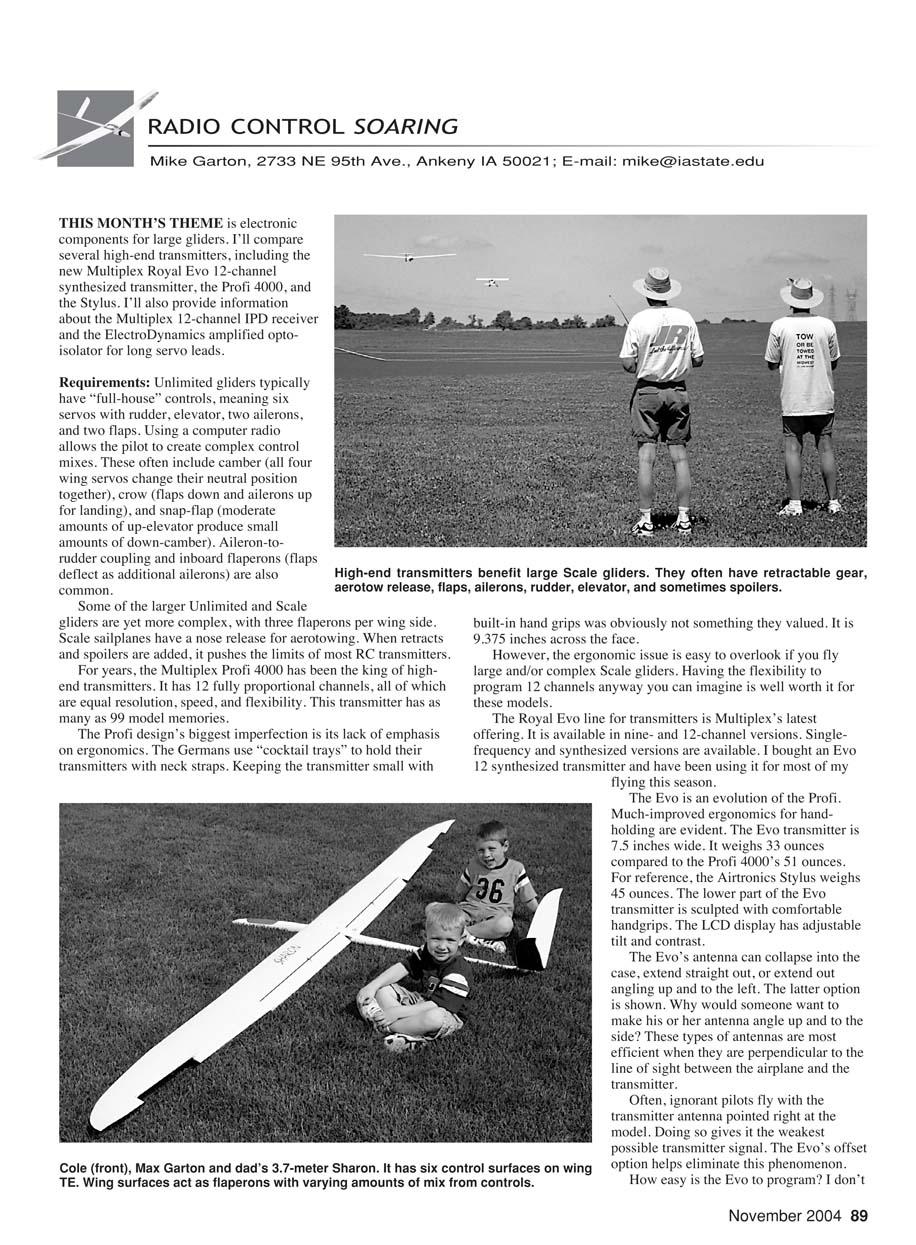
Some larger Unlimited and Scale gliders are even more complex, with three flaperons per wing side, nose releases for aerotow, retracts, and spoilers. These features push the limits of most RC transmitters.
Transmitters
Multiplex Profi 4000
For years the Multiplex Profi 4000 has been the king of high-end transmitters. It offers 12 fully proportional channels, all with equal resolution, speed, and flexibility, and up to 99 model memories. Its software and hardware offer ultimate flexibility: the Profi provides 13-point curves and very expandable switches and levers.
The Profi's biggest shortcoming is ergonomics. The transmitter is large (about 9.375 inches across the face) and heavy (about 51 ounces). Multiplex's traditional approach favors a compact box used with a neck strap or "cocktail tray" rather than a hand-held form factor with sculpted grips.
Pilots who need the ultimate in hardware and software flexibility for very complex models should still consider the Profi.
Multiplex Royal Evo (12-channel synthesized)
The Royal Evo is Multiplex's latest line. It comes in nine- and 12-channel versions and in single-frequency or synthesized variants. I flew the Evo 12 synthesized most of this season and found it an excellent evolution of the Profi.
Key points:
- Much-improved ergonomics: the Evo is 7.5 inches wide and weighs about 33 ounces (compared to the Profi's 51 ounces and the Stylus's 45 ounces). The lower case is sculpted with comfortable handgrips.
- Tilt-adjustable, contrast-adjustable LCD display.
- Antenna can collapse into the case, extend straight out, or extend out angled up and to the left. The angled option helps keep the antenna perpendicular to the line of sight to the airplane, which improves signal strength compared to pointing the antenna directly at the model.
- Templates for common models are already in memory. The menu layout and consistency make navigation easier than many other high-end radios.
- The Evo uses five-point curves (versus the Profi's 13-point curves) and its hardware is less expandable. So while it handles most glider requirements, the Profi still has the edge for absolute flexibility.
Programming and learning curve:
- I wouldn't call the Evo "easy" out of the box, but it is more user-friendly than the Profi 4000 and the Stylus. The software's consistency and logical layout help once you learn the basic system.
- Joedy Drulia's excellent Evo tutorial (available free online in PDF via a link from the Multiplex website) was invaluable. The tutorial includes flowcharts, detailed illustrations, and glider-specific programming examples (full-house sailplanes, electric RES sailplanes, selectable crow/brake, discus-launch presets, etc.). With the tutorial, the Evo's learning curve is significantly reduced.
Trims and feedback:
- I really like the digital trims and their graphical display on the LCD. Trims are stored per model memory, so you don't need to fuss with mechanical trim positions when switching models.
- An audible-feedback option beeps with each trim click and uses a different tone when crossing center, allowing centering trims by feel while flying.
The Evo's case opens easily without tools (two spring-loaded buttons) like the Profi. Overall, I think the Evo 12 is the best high-end radio currently available for gliders: it handles thermal-duration models and complex scale sailplanes with ease.
Airtronics Stylus
The Airtronics Stylus, especially with the glider card, seems tailored for American thermal-duration flying. It is an 8-channel transmitter whose most complex templates are geared toward models with four wing servos. Although you can use Y-harnesses to combine servos (for example, to make inboard flaps operate together), the Stylus does not easily support fully independent control of two tail servos plus six wing servos.
The Stylus is great for gliders with up to six total control surfaces (four wing servos) plus a couple of binary functions, but it is limiting for larger, more complex sailplanes.
Power isolation and receivers
ElectroDynamics Pow'R Bus Pro (amplified optoisolator)
Large sailplanes usually mount servos as close to control surfaces as possible to minimize linkage weight and slop. Aileron leads can be very long (approaching half the wingspan), which creates two problems:
- Voltage drop along the long lead
- The long wires acting as antennas that feed unwanted radio noise back into the receiver
The Pow'R Bus Pro from ElectroDynamics addresses both issues by using separate power busses to isolate servo noise and loads from the receiver. The receiver can use its own battery while the servos use a separate, higher-voltage battery. Servo signals are converted to optical signals, transferred across the isolated boundary, converted back to electronic signals, and amplified before being sent to the servos.
- The box can isolate up to six channels (choose the ones with the longest leads).
- A socket is provided for expansion if more channels need isolation.
- Retail price is roughly $80, making it a relatively inexpensive solution to voltage-drop and noise problems.
Multiplex 12-channel IPD receiver
A 12-channel transmitter requires a 12-channel receiver to be fully utilized. The Multiplex 12-channel IPD receiver includes built-in support for redundant batteries. You can power it with one 4- to 6-cell pack or two 5-cell packs for redundancy — a sensible precaution on large-scale gliders with high replacement costs. A jumper (the single-wire loop connector) selects the battery configuration.
The IPD ("Intelligent Processing Device") circuitry filters out unwanted signals and helps assure crystal-clear, glitch-free reception. In plain terms, the receiver ignores interference unless it closely resembles a valid signal. This approach has proven effective at reducing glitches.
The receiver also features a fail-safe mode: if it hasn't received a valid signal for 0.5 seconds, you can program it to lower flaps and turn gently (or take other predefined safe actions).
Sources
- Multiplex (distributed exclusively in North America by Hitec RCD)
- Airtronics
- ElectroDynamics
Transcribed from original scans by AI. Minor OCR errors may remain.

