
RADIO CONTROL SOARING
Darwin Barrie
4316 W. Rickenbacker Way, Chandler AZ 85226 E-mail: [email protected]
I'll open my first column with a sincere thanks to Mike Garton for the past few years of service to Model Aviation and the soaring community. The job of a monthly or bimonthly columnist requires commitment and dedication that steals time away from other aspects of life. Thanks, Mike. I hope I can keep the bar as high as you have.
By way of introduction, I am 49 years old and recently retired after serving 30 years in law enforcement. A public-safety career provides many exciting opportunities as well as numerous frustrating and troubling memories. I've had the opportunity to do everything from investigate homicides to fly helicopters.
As I was promoted up the ranks, I performed many interesting functions. My last assignment was as commander of a large jail with an average daily intake of 330 new prisoners. I'm glad I'm out and look forward to enjoying retirement.
Early modeling and the Lil' T
My modeling days started as most do, I would guess: through my dad. Although he did not actively fly models, he loved building them. My first project with him was at age five. I acquired my first radio-controlled airplane when I was eight — an AristoCat with an Orbit analog radio, which I still have. Man, have we come a long way.
My second model and first sailplane was a Midwest Lil' T. This was not purely a sailplane since it had a Cox .049 engine on the nose to get it aloft. The Lil' T set the tone for my longtime passion for soaring.
A park close to my house provided a walking-distance flying field. I would fly almost every day after school. After wearing out a couple of .049s, I bolted on an O.S. .10 with a 1-ounce tank. I had no throttle control, so a rich setting was maintained. Then it happened.
Following my usual routine, I came home from school, grabbed the model, and headed for the park. I checked the radio, fired up the .10, and gave it a toss. Seconds later I realized I had no control. The sailplane was perfectly trimmed and was climbing rapidly in a slight left turn. With a three-minute burn and no control, it was out of sight in no time. I was only ten years old and devastated.
The Lil' T flew east over Indian-reservation land, where farm fields stretched for miles. I knew that finding the model would be tough. I thought my parents would be upset with me, but they were very understanding.
My dad remembered a friend who flew small private aircraft and called him to see if he could fly us over the area. That Saturday we flew over in a Cessna 172 but were unsuccessful in locating the sailplane. I didn't find the model to fly, but I had been introduced to general aviation aircraft.
In the next few years I owned a variety of airplanes, mostly powered, and flew whenever possible. I enjoyed the hobby with my dad as he taught me the craftsmanship skills that I carry with me today. These skills are not only beneficial in modeling but in everyday life and, as you will see later, in full-scale aviation as well.
Soaring, competition, and giant-scale aerobatics
The soaring passion has been with me since those early days, but the soaring-competition bug hit me in the early 1990s. My first contest model was a Larry Jolly Model Products Pantera, which was quite competitive at the time. I was reasonably competitive in the Central Arizona Soaring League (CASL) club events. Full-function models were just starting to show on the scene and were soon required even to have a chance. That Pantera still flies today, in the hands of its third or fourth owner.
Today I have several Open-class and Two-Meter sailplanes. I love competition, but the camaraderie of soaring is truly what it is all about. Anyone who has attended the Visalia Fall Soaring Festival probably understands what I mean. I'm sure there are many other events where the social aspect is equal to the competition, but the Visalia event is the king daddy of them all.
My other modeling passion is giant-scale aerobatics. I fly in several competitions each year, in which specific aerobatic figures are flown in sequence and judged. My current model is an Aeroworks 33% Edge 540T with a Desert Aircraft 100 for power. The engine puts out roughly 10 horsepower and can hover at half throttle.
I am building a Columbo Anderson 40% Extra 330 for next season, and it will be powered by a Desert Aircraft 150. The Extra spans 122 inches and will weigh approximately 38 pounds. Although these airplanes are big, they fly much like a basic trainer. Landing does require power management and active rudder control.
Full-scale RV-7 project and how modeling skills carried over
As if that weren’t enough, my current project is a Van’s Aircraft RV-7. This full-scale airplane is a two-place, side-by-side seating, 200-mph machine. Built from a kit, it is the most popular homebuilt aircraft in the world. There are nearly 4,000 Van’s Aircraft airplanes flying worldwide.
The RV-7 will feature a full IFR (instrument flight rules) all-electric panel with EFIS (electronic flight information system) moving-map GPS, and a two-axis autopilot. The autopilot is tied to the GPS to provide course management. Adding to the cool factor is a carbon-fiber panel. See, the modeling skills do carry over to full scale.
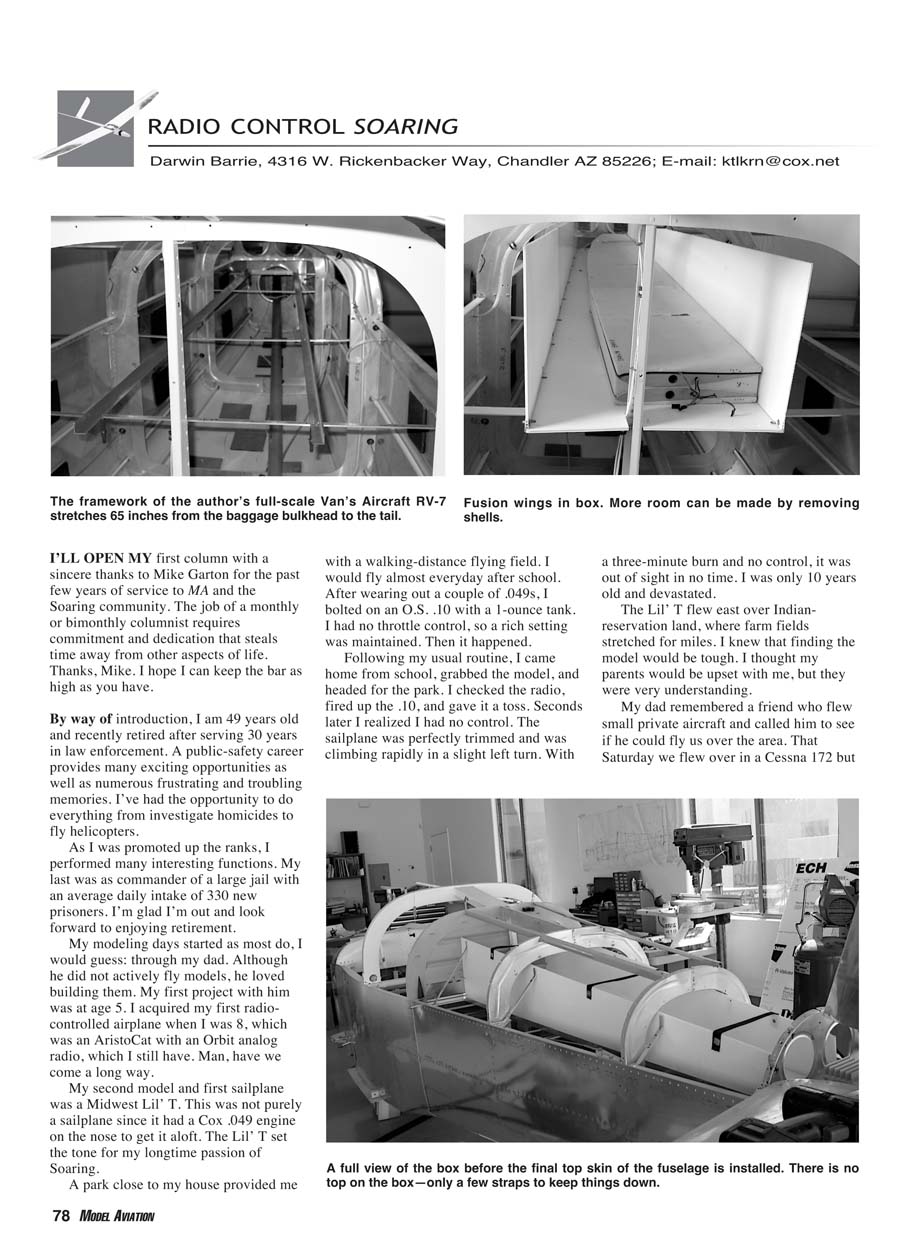
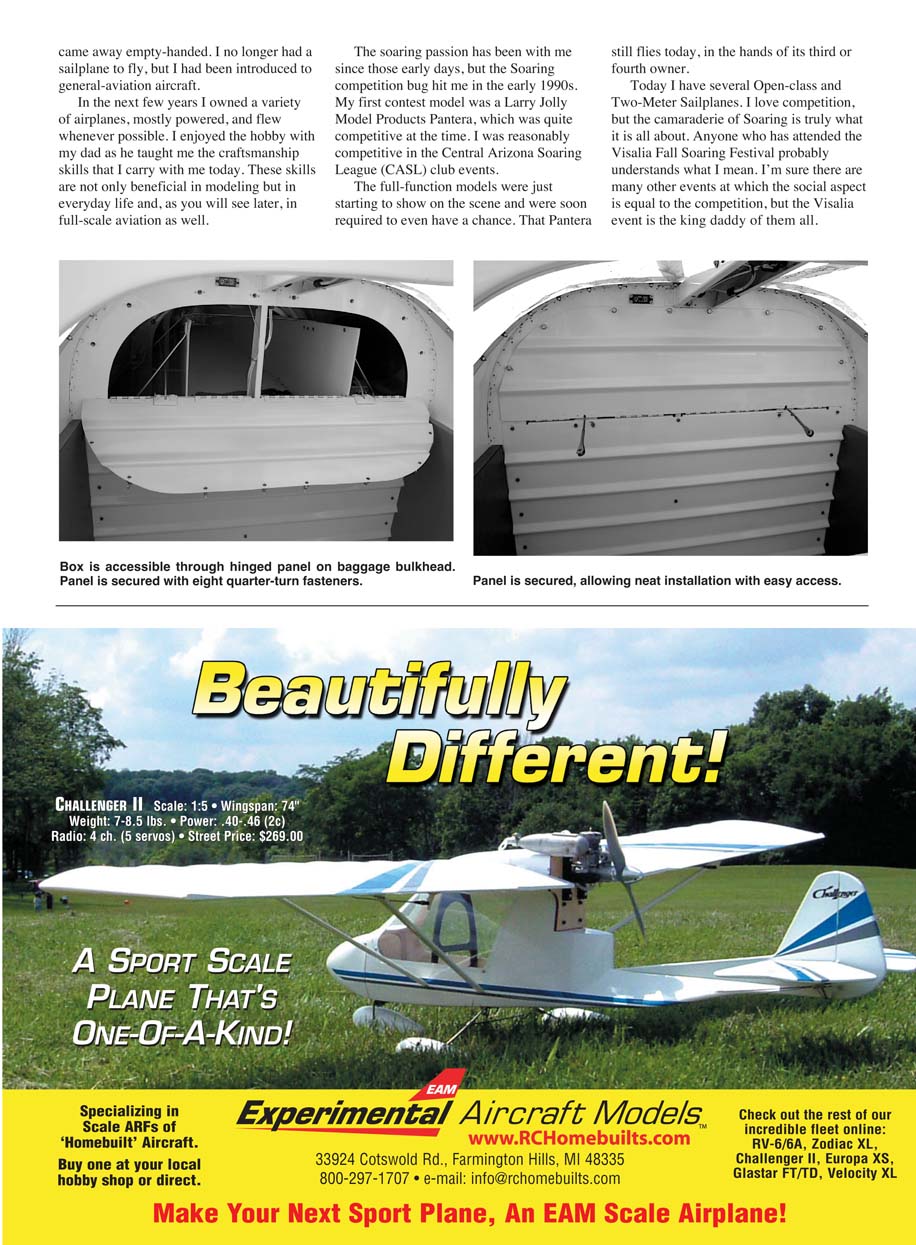
Yes, this is related to soaring. During construction I sought information from other RV builders who had built storage areas behind the baggage compartment under the turtledeck. I found a few who had, but all looked too heavy and incapable of what I had in mind. My goal was to carry a couple of Open-class sailplanes and/or golf clubs.
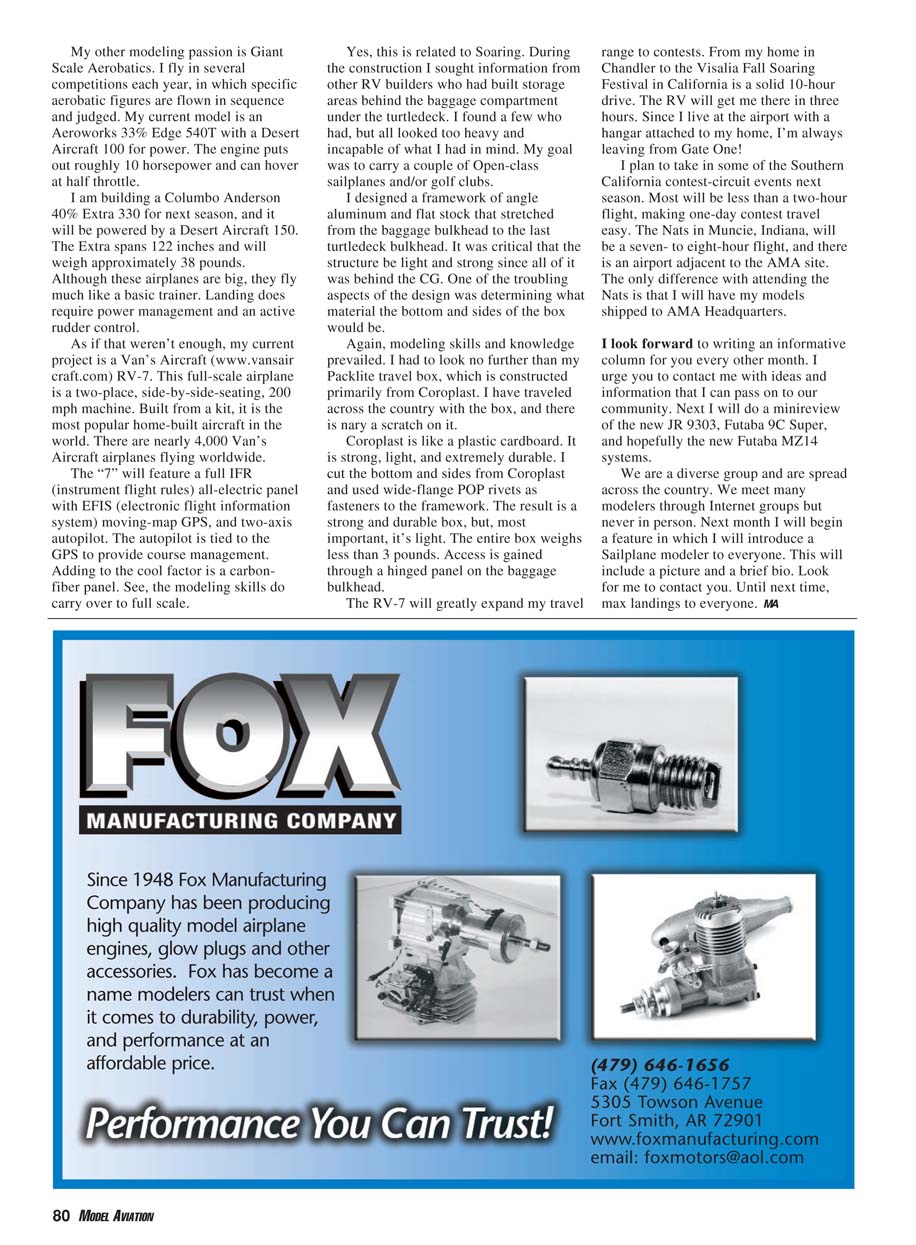
I designed a framework of angle aluminum and flat stock that stretched from the baggage bulkhead to the last turtledeck bulkhead. It was critical that the structure be light and strong since all of it was behind the CG. One of the troubling aspects of the design was determining what material the bottom and sides of the box would be.
Again, modeling skills and knowledge prevailed. I had to look no further than my Packlite travel box, which is constructed primarily from Coroplast. I have traveled across the country with the box, and there is nary a scratch on it.
Coroplast is like a plastic cardboard. It is strong, light, and extremely durable. I cut the bottom and sides from Coroplast and used wide-flange POP rivets as fasteners to the framework. The result is a strong and durable box, but most important, it’s light. The entire box weighs less than three pounds. Access is gained through a hinged panel on the baggage bulkhead.
Travel and contest plans
The RV-7 will greatly expand my travel range to contests. From my home in Chandler to the Visalia Fall Soaring Festival in California is a solid 10-hour drive. The RV will get me there in three hours. Since I live at the airport with a hangar attached to my home, I’m always leaving from Gate One!
I plan to take in some of the Southern California contest-circuit events next season. Most will be less than a two-hour flight, making one-day contests travel easy. The Nats in Muncie, Indiana, will be a seven- to eight-hour flight, and there is an airport adjacent to the AMA site. The only difference with attending the Nats is that I will have my models shipped to AMA Headquarters.
Upcoming columns and contact
I look forward to writing an informative column for you every other month. I urge you to contact me with ideas and information that I can pass on to our community. Next I will do a mini-review of the new JR 9303, Futaba 9C Super, and hopefully the new Futaba MZ-14 systems.
- JR 9303
- Futaba 9C Super
- Futaba MZ-14 (anticipated)
We are a diverse group and are spread across the country. We meet many modelers through Internet groups but never in person. Next month I will begin a feature in which I will introduce a sailplane modeler to everyone. This will include a picture and a brief bio. Look for me to contact you.
Until next time — max landings to everyone.
Transcribed from original scans by AI. Minor OCR errors may remain.

