
Notes from the 32nd Annual CVRC Fall Soaring Festival
Darwin Barrie [[email protected]]
Overview
The 32nd annual Central Valley Radio Control (CVRC) Fall Soaring Festival in Visalia, California, is in the books. As happened in 2004, Daryl Perkins won in a down-to-the-wire finish. The 2005 edition of this premier U.S. soaring event, held October 1–2, featured 171 pilots in Open, 19 in Two Meter, 68 in Rudder‑Elevator‑Spoiler (RES), and 10 in Youth.
The CVRC staff does a great job running this event despite being a small club. Getting nearly 300 people through seven rounds of flying is difficult. Saturday featured four rounds with a completion time of roughly 3:30—plenty of time to get in the fun stuff.
Vendors and new gear
Many vendors were in attendance, showing the latest and greatest. A full list is available on the CVRC website: www.cvrcsoaring.com. Here are some highlights:
- Airtronics was represented by Bobby Tom and others. The company's new 94761 digital servo is ideal for sailplane use; I'll have more details later.
- Gordy Stahl manned the Volz servo booth and showed the all‑digital line for Michael Volz.
- Alberto of Hobby Club had several new airplanes on exhibit, including the Azure that Mike Lee flew. It’s a great-looking model that flies extremely well.
- Barry Kennedy displayed the new Supra, an Open-class F3J thermal-duration model that drew much interest. It features a multidimensional airfoil, exceptional fit and finish, and orders from top pilots including members of the U.S. and Canadian F3J teams. Price: about $1,200.
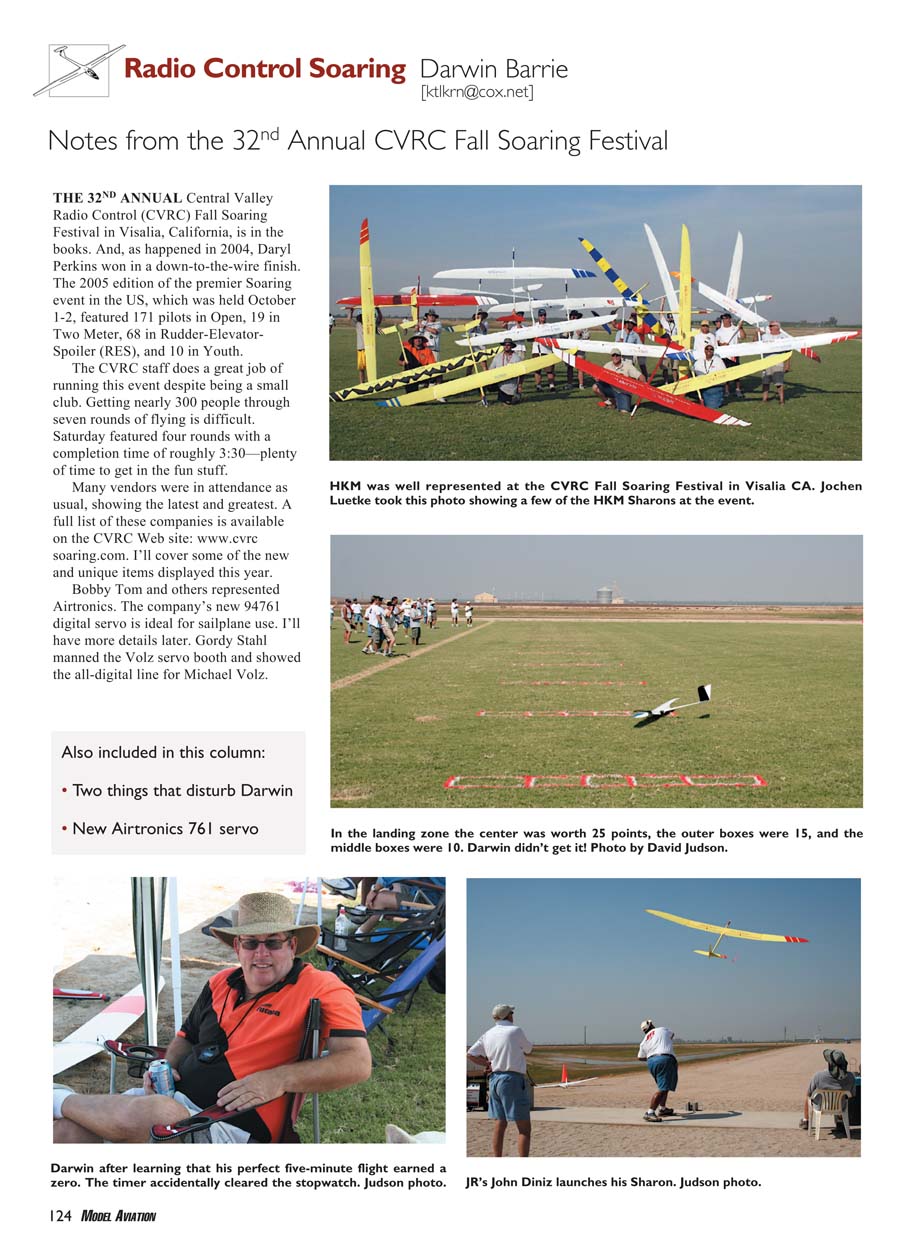
- The Sharon 3.7 from HKM had the largest turnout. Jochen Luetke promoted it; many owners were present and I have one on order.
Also included in this column:
- Two things that disturb Darwin
- New Airtronics 761 servo
Contest summary
The contest began with the usual downwind launches and landings. Winds were relatively light on Saturday, though several tip‑overs occurred on landings. The rest of the day was largely uneventful, with times fairly easy to get.
Sunday was another story: brisk winds that rotated during the day and considerably cooler temperatures. Launches were into quartering winds all day, which made landing tough.
The first flight of Sunday was a three‑minute round. The next round was eight minutes—fairly early in the day, with cooler temperatures and wind. My flight group was selected to be first on Sunday. At the beginning of the eight‑minute round, several of us stepped up to the winches. I wasn’t feeling great, but I had a plan. I was third to launch and we all went straight out and right. We spotted a bird high and circling; I went for it and got hooked up for approximately three minutes before it died out.
My model was extremely high, and I thought I could coast out the last five minutes. I went back upwind and began S‑turning; the airplane kept climbing and I finally relaxed. I figured that if we got the eight minutes this early in the round, everyone would. Wrong.
During the flight we realized all the winches were down and we were the only three in the air. Things turned ugly for many in this round. It seems as if there is always some awful air for a period of time.
Top fliers in Open were close in points; it became apparent it would come down to seconds on the clock and landing points. Daryl Perkins was in the lead, but there would be a tie if Joe Wurts got a dead‑on four‑minute flight and a 25‑point max landing. With 39 minutes of flying and a max of 175 landing points, how could a tie occur?
For Joe Wurts, four minutes is not a big deal, but the crosswind landing and an exact time is tough for anyone. As Joe clicked off the final 10 seconds, we knew it would be close. Touchdown and slide into the 25‑point box—Joe’s wife Jan was timing and looked up to announce “4:01”! Daryl had won by one second.
One of the great things to see is the up‑and‑coming Juniors. They posted some great scores that were right there with the top competitors. Cody Remington posted a score of 2,399 that would have put him in fifth place overall. We can only hope these Juniors discover girls before too long.
Soapbox
Two things have always disturbed me, and many others, about this event:
- The need for some sort of "gotcha" landing (explained below).
- Off‑field landings still get you flight points.
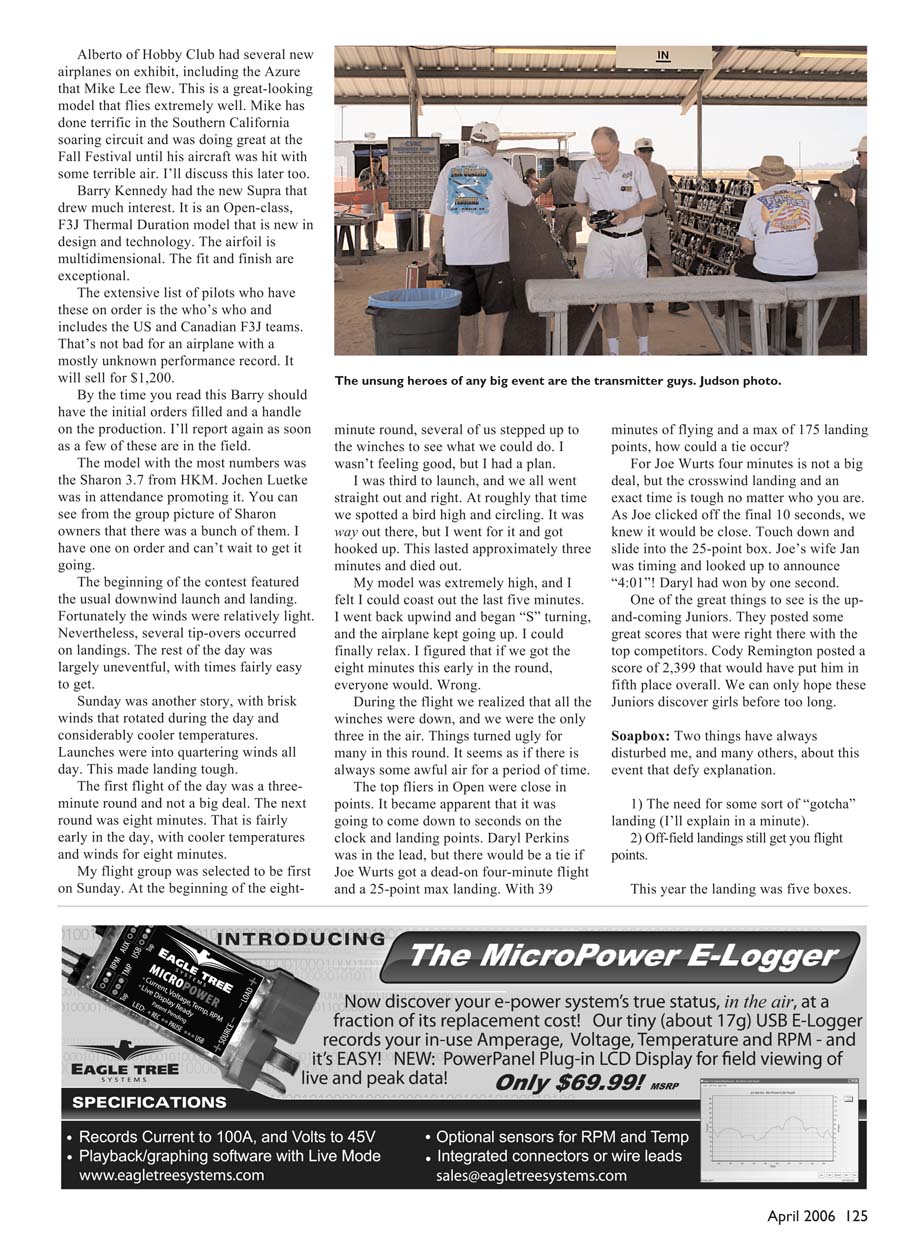
This year the landing was five boxes. The center box was awarded 25 points, the boxes on each side of the center netted 10 points, and the outermost boxes were worth 15 points. I don't understand why the scoring didn't follow a logical sequence of 25, 15, 10, and 10.
Pilots are essentially penalized for going for the center and missing by inches, while someone who undershoots or overshoots the center and lands in an end box is rewarded with 15 points. For an otherwise great landing zone, the luck factor comes into play—and it shouldn't.
The second factor is the off‑field landing. This is the only contest I know of in which you can be a mile away and still get your flight points. If you can get eight minutes but can’t get back, you still get your flight score. You should land within defined field boundaries to get your flight time. This is part of the flight technique: find thermals, exit if necessary, and find new ones so you can get back to the field. If you're not good enough to get back, you should earn a zero. This reminds me of my favorite bumper sticker: “Stupid should hurt.”
My round and timing mishap
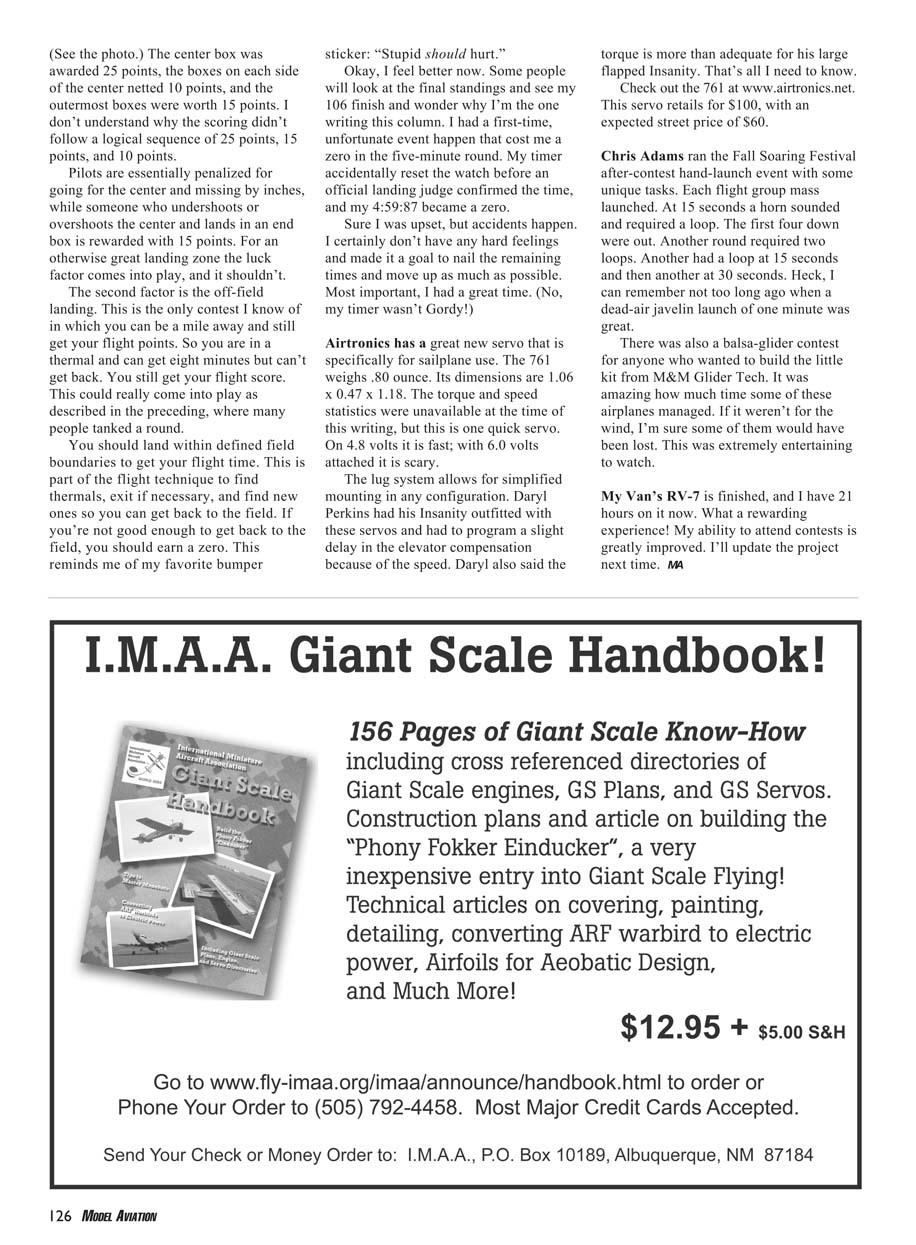
Some people will look at the final standings and see my 106th place and wonder why I'm the one writing this column. I had a first‑time, unfortunate event that cost me a zero in the five‑minute round. My timer accidentally reset the watch before an official landing judge confirmed the time, and my 4:59.87 became a zero.
Sure I was upset, but accidents happen. I don't have hard feelings and made it a goal to nail the remaining times and move up as much as possible. Most important, I had a great time. (No, my timer wasn't Gordy!)
Airtronics 761 servo
Airtronics has a great new servo specifically for sailplane use: the 761. Specs:
- Weight: 0.80 ounces
- Dimensions: 1.06 × 0.47 × 1.18 inches
Torque and speed statistics were unavailable at the time of writing, but this is a very quick servo. On 4.8 volts it is fast; with 6.0 volts attached it is scary. The lug system allows for simplified mounting in any configuration. Daryl Perkins had his Insanity outfitted with these servos and had to program a slight delay in the elevator compensation because of the speed. Daryl also said the torque is more than adequate for his large flapped Insanity. That's all I need to know. Check out the 761 at www.airtronics.net. This servo retails for $100, with an expected street price of $60.
After‑contest events
Chris Adams ran the Fall Soaring Festival after‑contest hand‑launch event with some unique tasks. Each flight group mass‑launched. At 15 seconds a horn sounded and required a loop; the first four down were out. Another round required two loops. Another had a loop at 15 seconds and then another at 30 seconds. Heck, I can remember not too long ago when a dead‑air javelin launch of one minute was great.
There was also a balsa‑glider contest for anyone who wanted to build the little kit from M&M Glider Tech. It was amazing how much time some of these airplanes managed. If it weren't for the wind, I'm sure some of them would have been lost. This was extremely entertaining to watch.
Personal note
My Van's RV‑7 is finished, and I have 21 hours on it now. What a rewarding experience! My ability to attend contests is greatly improved. I'll update the project next time.
—MA
Transcribed from original scans by AI. Minor OCR errors may remain.

