
Radio Control Soaring - 2008/05
Darwin Barrie [[email protected]]
The 2007 International Hand Launch Glider Festival
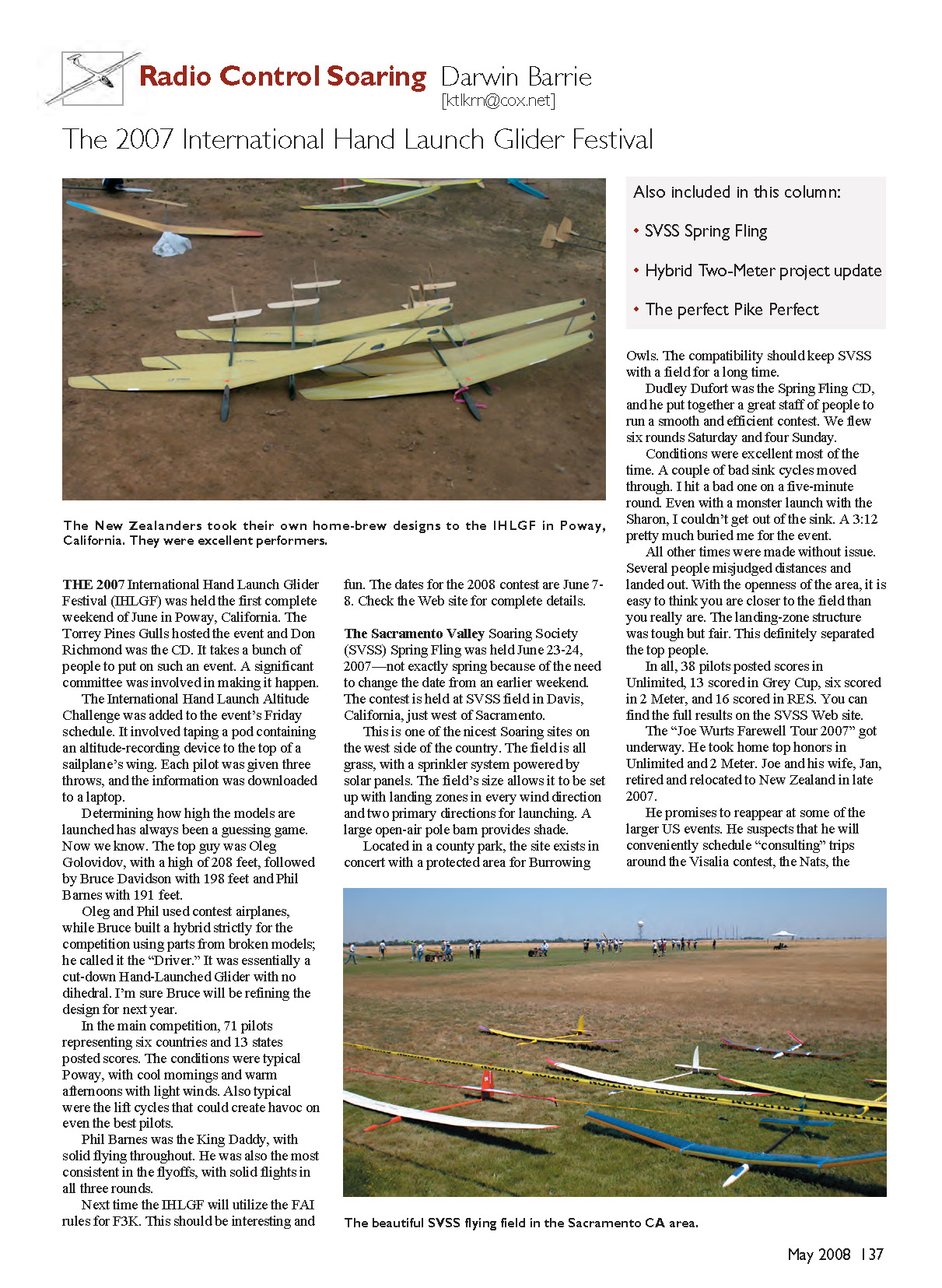
THE 2007 International Hand Launch Glider Festival (IHLGF) was held the first complete weekend of June in Poway, California. The Torrey Pines Gulls hosted the event and Don Richmond was the CD. It takes a bunch of people to put on such an event. A significant committee was involved in making it happen.
The International Hand Launch Altitude Challenge was added to the event’s Friday schedule. It involved taping a pod containing an altitude-recording device to the top of a sailplane’s wing. Each pilot was given three throws, and the information was downloaded to a laptop.
Determining how high the models are launched has always been a guessing game. Now we know. The top guy was Oleg Golovidov, with a high of 208 feet, followed by Bruce Davidson with 198 feet and Phil Barnes with 191 feet.
Oleg and Phil used contest airplanes, while Bruce built a hybrid strictly for the competition using parts from broken models; he called it the “Driver.” It was essentially a cut-down hand-launched glider with no dihedral. I’m sure Bruce will be refining the design for next year.
In the main competition, 71 pilots representing six countries and 13 states posted scores. The conditions were typical Poway, with cool mornings and warm afternoons and light winds. Also typical were lift cycles that could create havoc for even the best pilots.
Phil Barnes was the King Daddy, with solid flying throughout. He was also the most consistent in the flyoffs, with solid flights in all three rounds.
Next time the IHLGF will utilize the FAI rules for F3K. This should be interesting and fun. The dates for the 2008 contest are June 7–8. Check the web site for complete details.
Sacramento Valley Soaring Society (SVSS) Spring Fling
The Sacramento Valley Soaring Society (SVSS) Spring Fling was held June 23–24, 2007—not exactly spring because the date was changed from an earlier weekend. The contest is held at the SVSS field in Davis, California, just west of Sacramento.
This is one of the nicest soaring sites on the west side of the country. The field is all grass, with a sprinkler system powered by solar panels. The field’s size allows it to be set up with landing zones in every wind direction and two primary directions for launching. A large open-air pole barn provides shade.
Located in a county park, the site exists in concert with a protected area for Burrowing Owls. The compatibility should keep SVSS with a field for a long time.
Dudley Dufort was the Spring Fling CD, and he put together a great staff of people to run a smooth and efficient contest. We flew six rounds Saturday and four Sunday.
Conditions were excellent most of the time. A couple of bad sink cycles moved through. I hit a bad one on a five-minute round. Even with a monster launch with the Sharon, I couldn’t get out of the sink. A 3:12 pretty much buried me for the event.
All other times were made without issue. Several people misjudged distances and landed out. With the openness of the area, it is easy to think you are closer to the field than you really are. The landing-zone structure was tough but fair. This definitely separated the top people.
In all, 38 pilots posted scores in Unlimited, 13 scored in Grey Cup, six scored in Two-Meter, and 16 scored in RES. You can find the full results on the SVSS web site.
Joe Wurts Farewell Tour 2007
The “Joe Wurts Farewell Tour 2007” got underway. He took home top honors in Unlimited and Two-Meter. Joe and his wife, Jan, retired and relocated to New Zealand in late 2007.
He promises to reappear at some of the larger U.S. events. He suspects that he will conveniently schedule “consulting” trips around the Visalia contest, the Nats, the May IHLGF, and possibly a couple others.
I had a great time at this event. SVSS's hospitality is great. The lodging is close by and was extremely nice for a Motel 6.
I was able to attend by flying my RV-7 into nearby Davis University airport. What would be a minimum 12- to 14-hour drive was only a three-hour, 45-minute flight from Chandler, Arizona.
Hybrid Two-Meter (personal notes)
The hybrid Two-Meter has dozens of flights on it now. The final all-up weight is 32 ounces. I could not be happier with the way the model is flying. Launches are smooth and predictable. The tow hook location has been optimized, and launches are higher than I was expecting.
I first thought the sailplane would have to be launched as if I were flying a more fragile type of model. Now I am doing aggressive launches, much like with an Open-class glider.
Flying characteristics are interesting. The hybrid is solid, with handling characteristics of an Open-class sailplane yet with the thermal read of a hand-launched glider. I have the CG set up so that inverted flight requires only roughly 1/8 inch of down-stick movement. This seems ideal for the model.
Another positive aspect I didn't expect is the hybrid's ability to range out. I have worked it out very far and have still had no trouble getting back. Penetration is much better than expected. With a little reflex programmed in, this sailplane really scoots.
I've flown this model in a variety of wind conditions, with excellent results. By the time this is in print, I will have built two pockets in the fuselage for ballast for those extreme conditions.
As I mentioned, the thermal read is excellent. This glider handles weak, low thermals with ease. As I obtained more time with the model, I became comfortable flying "hand-launch" altitude thermals. I have the rudder/aileron mix as ideal as possible. The hybrid locks into turns while thermaling better than any other Two-Meter I've had. Once coerced, little control is needed to stay there.
I set up a preset for camber but found that it isn't necessary. I'll be experimenting with this as I get more time on the airplane.
I'm using a six-point curve for flap/elevator compensation on a Futaba 14MZ transmitter. The flaps are extraordinarily effective. It took some work, but I got the compensation so that full travel of the flap stick only slows the model, with virtually no attitude change.
I also programmed reverse differential into the ailerons. The result is a solid-landing sailplane with excellent glide path and speed control and no yawing tendencies.
I have two skegs on the glider: one on the nose and one behind the tow hook. I'd normally use only a nose skeg, but the rear skeg keeps the lightweight tail, subfin, and rudder off the ground.
Spot landings have been easy. I've tried landing in crosswinds only a few times. Even with the winglets, the glide path is solid. I'll be working on this as well. I'll relate more as I get more time and experience with the hybrid.
Pike Perfect
Another new model I've been flying is the Pike Perfect. This is the best Unlimited model I've ever flown. It was well worth the year wait. I understand that Samba has added molds to increase production to meet the demand.
I set up the glider to the exact recommendations on the F3J site. At a local club contest I decided to maiden the model before the contest. I didn't do hand tosses or anything; I put the Perfect on the winch and launched.
The first launch was excellent, with only a little up needed. I flew it for 10 minutes and found everything to be nearly perfect. I tested the elevator/flap compensation and found it to be nearly dead on. It was so close that I felt confident flying it in the contest.
I managed two 50-point landings (the highest possible) and a 40. On the fourth landing the model clipped a small desert bush with a wingtip and landed approximately 5 feet short. All times were made, and I managed a win.
The Pike Perfect is available through Skip Miller Models or SoaringUSA.
Sources:
- IHLGF: www.torreypinesgulls.org/IHLGF.htm
- Skip Miller Models (720) 231-4400: www.skipmillermodels.com
- SoaringUSA (626) 967-6660: www.soaringusa.com
- SVSS: www.svss.org
Transcribed from original scans by AI. Minor OCR errors may remain.

