
It's in the way that you use it
Lee Estingoy
Remember that cool new model you had to have? It was the expensive one, with the hot new airfoil and the extra span. Remember how you felt when you first flew it and learned that you could land better or perhaps see its reaction to the thermals more readily than with your tired, old sailplane?
I'll go out on a limb and suggest that maybe those better landings and easier thermals were largely owed to your being a better pilot. That time you spent with the previous sailplane made you a better pilot, and it showed when you flew the hot new sailplane.
Don't get me wrong; I love the excitement of getting a new model. There's the anguish of seeing the brown truck trundle past your house without stopping. Then there's the thrill of the doorbell ring and the anxious moments opening the box to see if the new baby has any—I mean any—dings.
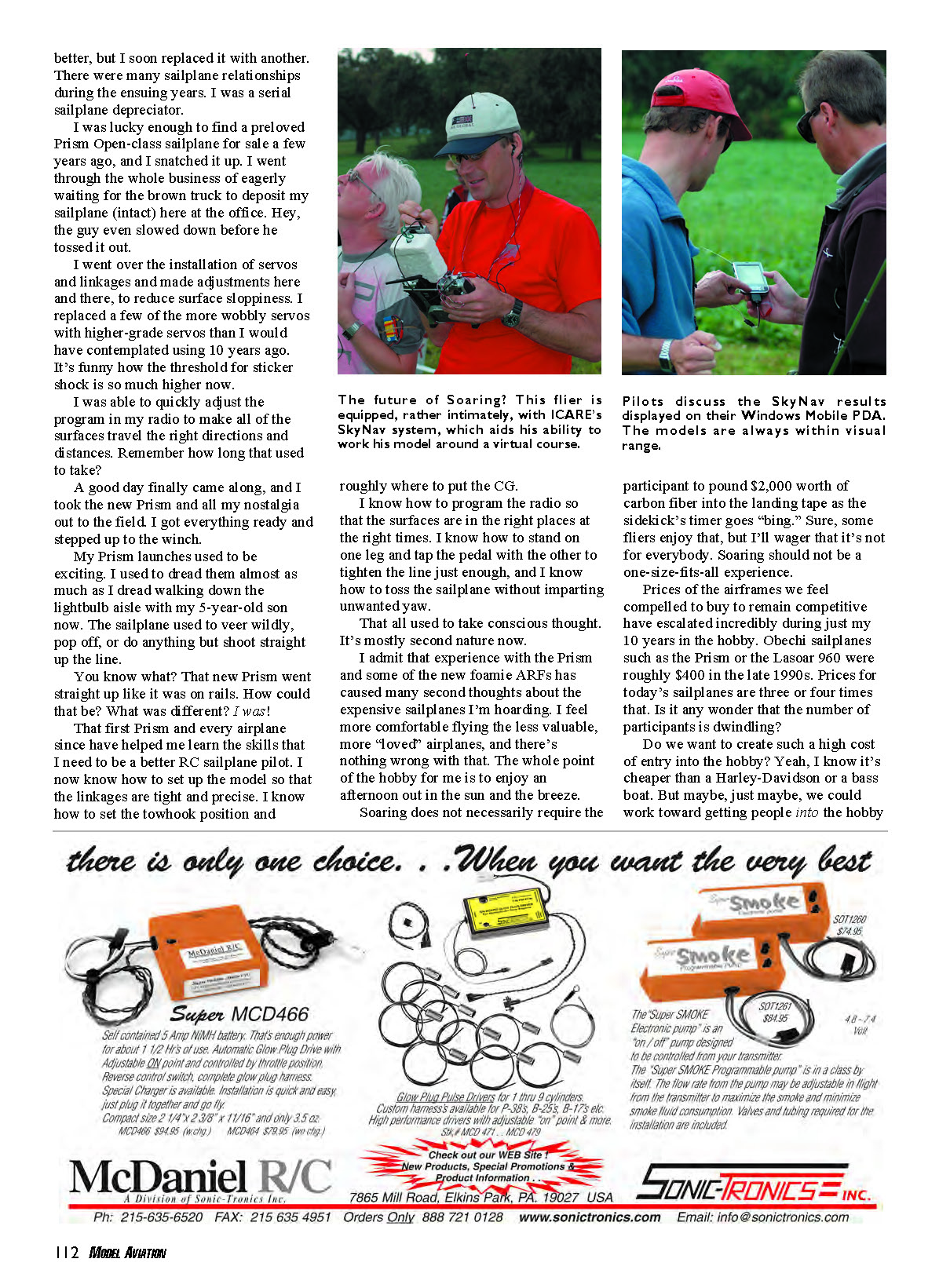
There has been an incredible improvement in the airframers' art in the past 10 years. My first full-house sailplane was a Prism by Ron Vann. It was a good machine back in 1995. It had beautiful Obechi-skinned 7037 wings and was just pretty. It was a much better airplane than I was a pilot in 1998.
I remember quickly outgrowing the Prism and moving on to something more expensive. Sure, that new sailplane flew better, but I soon replaced it with another. There were many sailplane relationships during the ensuing years. I was a serial sailplane depreciator.
I was lucky enough to find a preloved Prism Open-class sailplane for sale a few years ago, and I snatched it up. I went through the whole business of eagerly waiting for the brown truck to deposit my sailplane (intact) here at the office. Hey, the guy even slowed down before he tossed it out.
I went over the installation of servos and linkages and made adjustments here and there to reduce surface sloppiness. I replaced a few of the more wobbly servos with higher-grade servos than I would have contemplated using 10 years ago. It's funny how the threshold for sticker shock is so much higher now.
I was able to quickly adjust the program in my radio to make all of the surfaces travel the right directions and distances. Remember how long that used to take?
A good day finally came along, and I took the new Prism and all my nostalgia out to the field. I got everything ready and stepped up to the winch.
My Prism launches used to be exciting. I used to dread them almost as much as I dread walking down the lightbulb aisle with my 5-year-old son now. The sailplane used to veer wildly, pop off, or do anything but shoot straight up the line.
You know what? That new Prism went straight up like it was on rails. How could that be? What was different? I was!
That first Prism and every airplane since have helped me learn the skills that I need to be a better RC sailplane pilot. I now know how to set up the model so that the linkages are tight and precise. I know how to set the towhook position and roughly where to put the CG.
I know how to program the radio so that the surfaces are in the right places at the right times. I know how to stand on one leg and tap the pedal with the other to tighten the line just enough, and I know how to toss the sailplane without imparting unwanted yaw.
That all used to take conscious thought. It's mostly second nature now.
I admit that experience with the Prism and some of the new foamie ARFs has caused many second thoughts about the expensive sailplanes I'm hoarding. I feel more comfortable flying the less valuable, more "loved" airplanes, and there's nothing wrong with that. The whole point of the hobby for me is to enjoy an afternoon out in the sun and the breeze.
Soaring does not necessarily require the participant to pound $2,000 worth of carbon fiber into the landing tape as the sidekick's timer goes "bing." Sure, some fliers enjoy that, but I'll wager that it's not for everybody. Soaring should not be a one-size-fits-all experience.
Prices of the airframes we feel compelled to buy to remain competitive have escalated incredibly during just my 10 years in the hobby. Obechi sailplanes such as the Prism or the Lasaar 960 were roughly $400 in the late 1990s. Prices for today's sailplanes are three or four times that. Is it any wonder that the number of participants is dwindling?
Do we want to create such a high cost of entry into the hobby? Yeah, I know it's cheaper than a Harley-Davidson or a bass boat. But maybe, just maybe, we could work toward getting people into the hobby before we expect them to spend the family's vacation budget on a model.
Those who are bitten by the soaring bug will ultimately find their place in the hobby, but that should be a journey they make by their own choice—not a prerequisite for showing up at the field on Day One.
WRAM Show 2009
I saw a new gadget that looked like fun at the WRAM Show in White Plains, New York. Etienne Dorig of ICARE Sailplanes and Electrics is importing a GPS telemetry transmitter/receiver system called "SkyNavigator."
This unit allows the soaring pilot to enter waypoints in a handheld Windows Mobile personal digital assistant (PDA) and then watch as the model's route is mapped by the computer as the sailplane travels around the course. The idea is to set up three virtual waypoints that are as much as 1,650 feet away from the pilot and then fly the course with the sailplane.
The computer tracks the laps and ensures that the virtual pylons aren't cut. There's a time window, and participants race to fly as many laps as possible in that period. This is an approximation of one of the events in full-scale soaring.
I wish I hadn't just made such an impassioned case for cutting costs; this baby retails for $859 and that does not include the PDA.
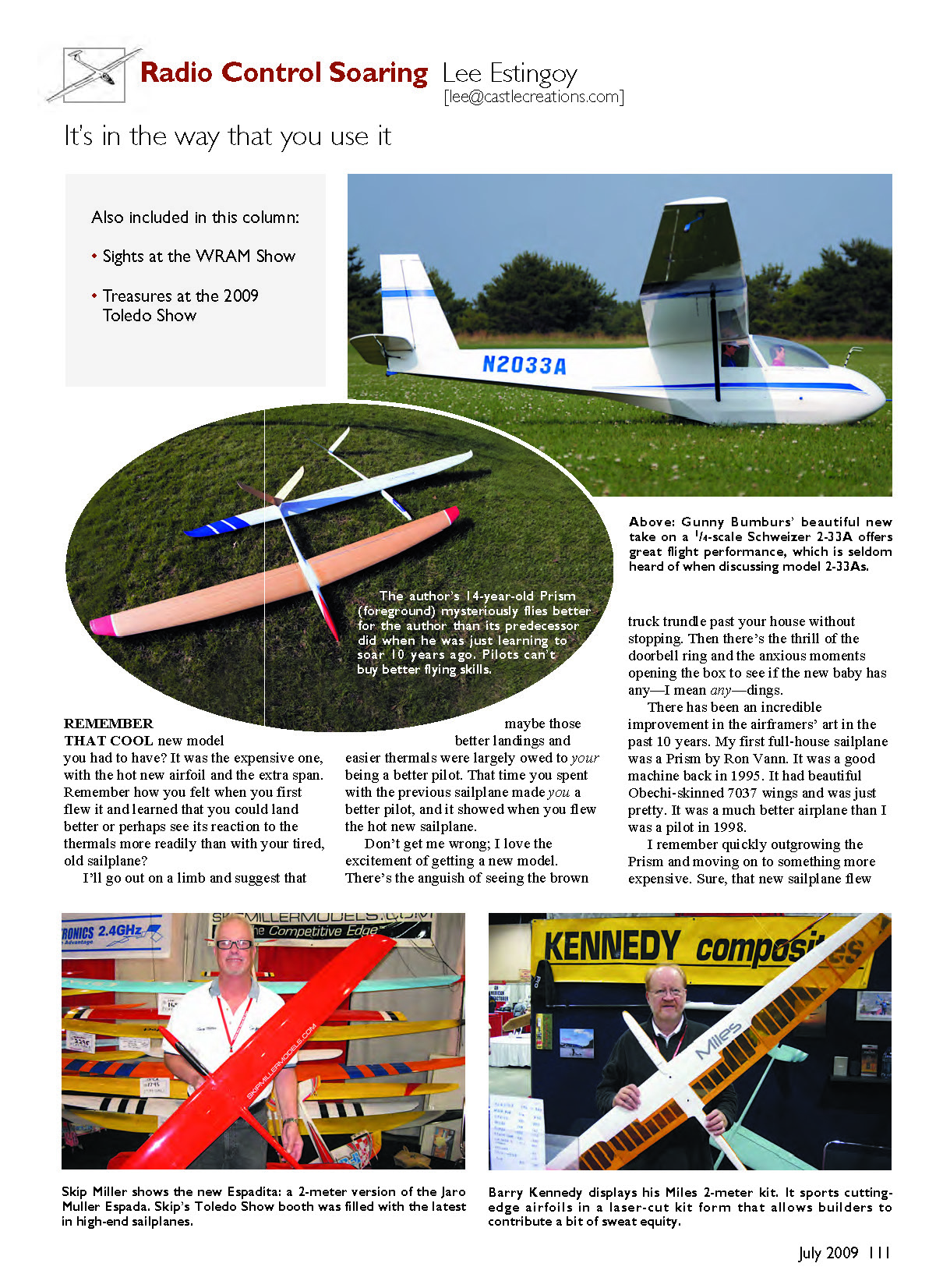
Another slick item I saw at the WRAM Show was Aviation Concepts' Gunny Bumburs' stunning short kit of the Schweizer 2-33A. This is a top-notch product.
Gunny is a skilled craftsman, and he has made a kit that builds to a great-size model for aerotow. It spans 153 inches, is 78.5 inches in length, and weighs 12 pounds all-up. It's large enough to fly impressively, yet it's still small enough to live with.
Gunny used the evergreen 7037 airfoil, which should have an enjoyable speed envelope that will allow the pilot to do much more than hover the Schweizer over the release point. If you have questions or want additional information, e-mail Gunny.
Toledo Show 2009
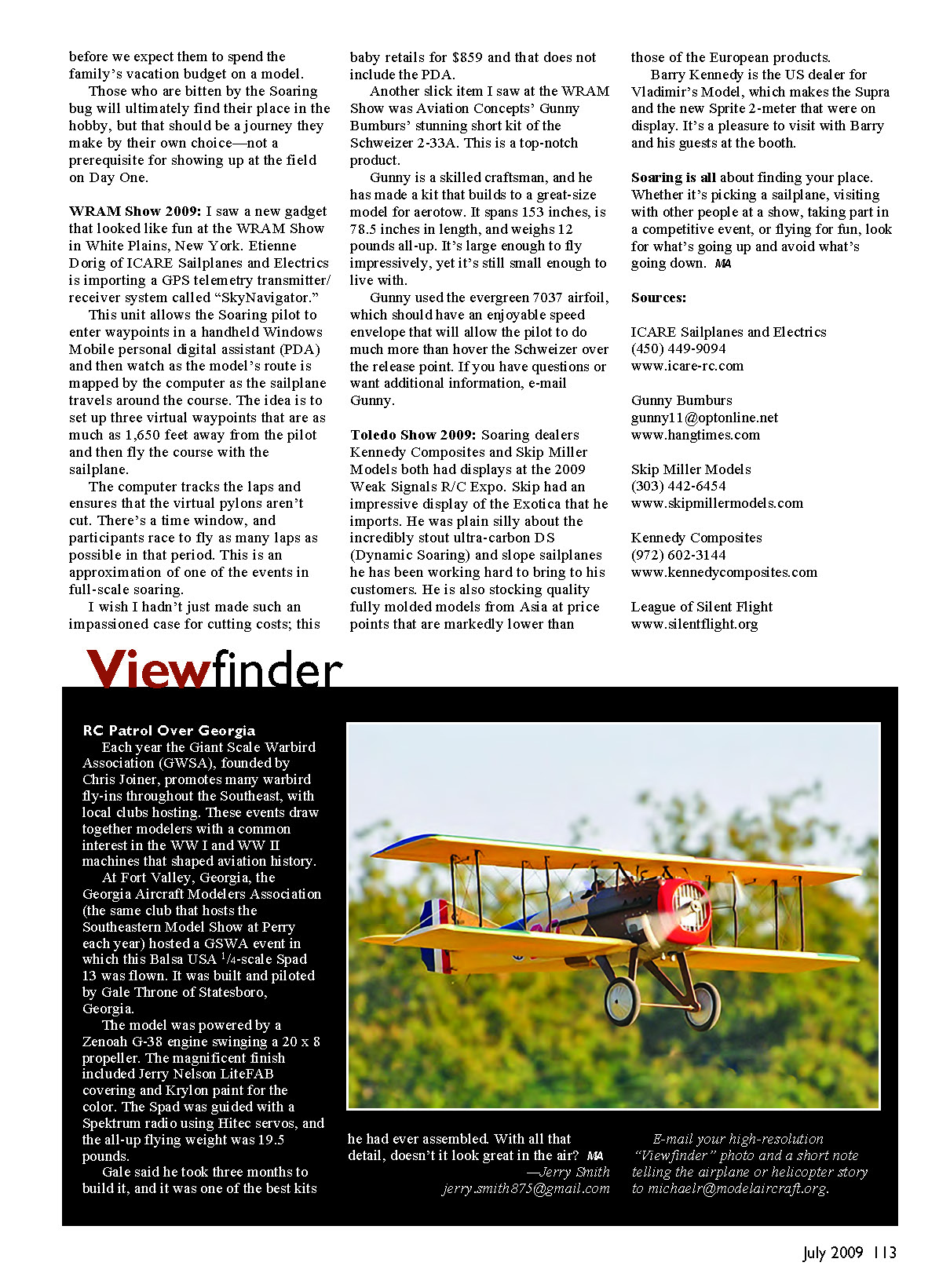
Soaring dealers Kennedy Composites and Skip Miller Models both had displays at the 2009 Weak Signals R/C Expo. Skip had an impressive display of the Exotica that he imports. He was plain silly about the incredibly stout ultra-carbon DS (Dynamic Soaring) and slope sailplanes he has been working hard to bring to his customers. He is also stocking quality fully molded models from Asia at price points that are markedly lower than those of the European products.
Barry Kennedy is the U.S. dealer for Vladimir's Model, which makes the Supra and the new Sprite 2-meter that were on display. It's a pleasure to visit with Barry and his guests at the booth.
Soaring is all about finding your place. Whether it's picking a sailplane, visiting with other people at a show, taking part in a competitive event, or flying for fun, look for what's going up and avoid what's going down.
Sources
- ICARE Sailplanes and Electrics
(450) 449-9094 www.icare-rc.com
- Gunny Bumburs
[email protected] www.hangtimes.com
- Skip Miller Models
(303) 442-6454 www.skipmillermodels.com
- Kennedy Composites
(972) 602-3144 www.kennedycomposites.com
- League of Silent Flight
Transcribed from original scans by AI. Minor OCR errors may remain.

