
Radio Control Soaring
Lee Estingoy <[email protected]>
The Soaring Wonders of Don Peters
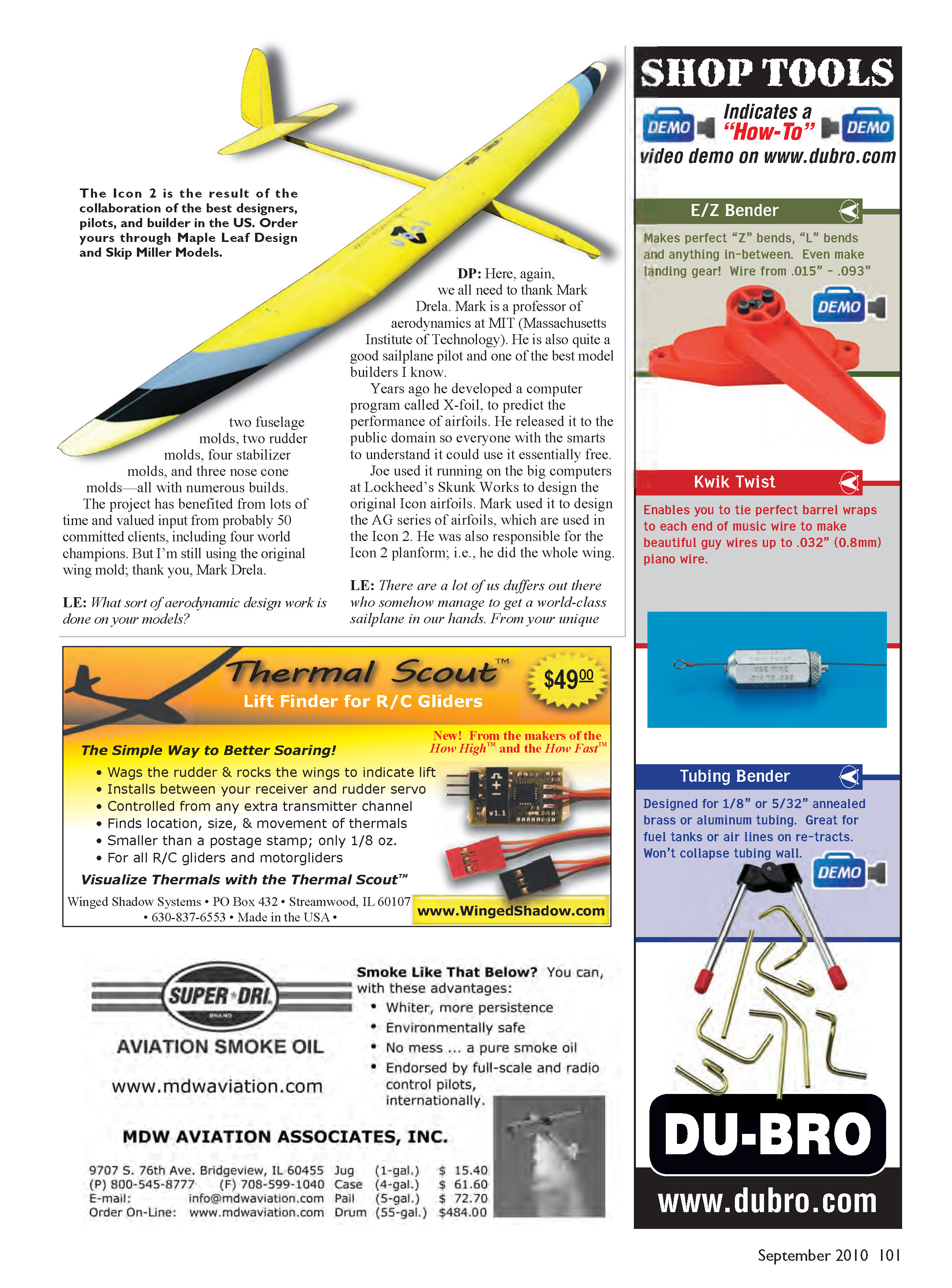
Hi, group! My name is Lee and I'm a soaring addict. Today we have a special treat: master airframer Don Peters, the man behind Maple Leaf Design, has been kind enough to share some of his thoughts and experiences with us.
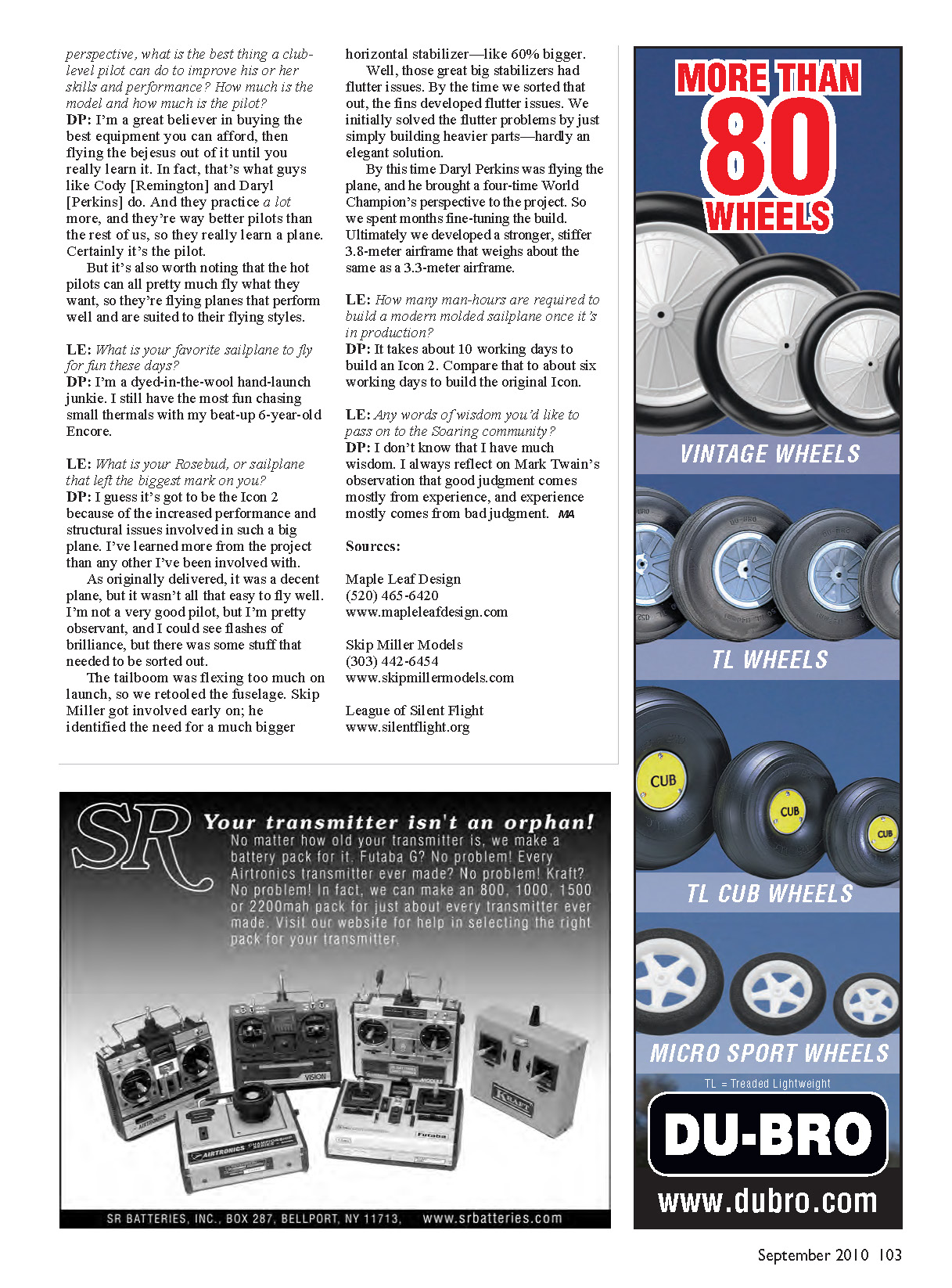
Don's models, most notably the Icon, have led the trend toward larger competition gliders. His latest design, the Icon 2, represents the best in U.S. model sailplane design and building artistry.
LE: How long have you been making models commercially? Is this your day job? DP: I built my first commercial sailplane about 15 years ago. After about two years I had a significant backorder—enough to quit my real job and build airplanes full-time.
LE: How have the building processes changed since then? Has it been hard to adapt? DP: In those early days, vacuum-bagged wings were cutting edge. The technology was pretty simple, and the designs adapted well. You needed some light E-glass, a tiny 1/6-horsepower vacuum pump, and some 14-mil Mylar, and you were a state-of-the-art builder.
I began building hollow molded wings for the 2-meter Image after doing about 50 of them with bagged wings.
I remember being really surprised that molded wings are actually heavier than bagged wings. Molded wings weren't that hard to adapt to, but they do require a lot more tooling and equipment. And, while you can take molds from hand-built masters, it makes a lot more sense to use computer-controlled machines.
LE: I would imagine that new-sailplane development is evolutionary, but the Icon and Icon 2 seem to be dramatically different from the models that the European manufacturers make. Are your models designed to play the same game? Why the differences? DP: The original Icon was certainly bigger than the Euro sailplanes at the time. In those days—about 12 years ago—it was thought that larger airplanes wouldn't launch. The Icon was designed by Joe Wurtz, who was convinced that that was nonsense, and he was right. The Icon 2 follows that trend, again mostly at the suggestion of the designer, Mark Drela.
Bigger sailplanes have a number of inherent advantages: they are more efficient—they have less drag, they cover more ground, and they're easier to see. They launch just as well, although they are harder on towlines, and they can land just as well.
LE: How do you go about prototyping a sailplane? Don't molded models require a substantial investment in plugs and molds? How can you make changes to the design? DP: I remember asking Joe Wurtz if he thought it made sense to test the Icon design by building a six- or eight-panel bagged wing. He replied that the increased drag losses built into such a prototype would negate its testing value. And the model market is way too small to do the kind of initial research and development that companies like Boeing or Lockheed could afford.
So, as a model builder, you have to take several significant up-front risks. The tooling is so expensive and my company is so small that I have to commit to the best design thinking I can find and then work with it to get the desired result.
We were unbelievably lucky with the Icon. It probably could have benefited from a larger horizontal stabilizer, but nobody felt strongly enough to actually do anything about it.
The Icon 2 has been a very different experience. While the wing was just about perfect—we haven't made any changes to it—the fuselage and empennage have required quite a bit of development work to get it to the level required for international competition.
This is expensive because the engineering is almost totally iterative—you develop the idea, then you build the necessary tooling, then you test the plane with the new part. From that you learn what you should have done, then you start the process again. You often destroy some part or all of a plane in each iteration, then throw away the new tooling too, just to add insult to injury.
The Icon 2 has required two years and two fuselage molds, two rudder molds, four stabilizer molds, and three nose cone molds—all with numerous builds. The project has benefited from lots of time and valued input from probably 50 committed clients, including four world champions. But I'm still using the original wing mold; thank you, Mark Drela.
LE: What sort of aerodynamic design work is done on your models? DP: Here, again, we all need to thank Mark Drela. Mark is a professor of aerodynamics at MIT (Massachusetts Institute of Technology). He is also quite a good sailplane pilot and one of the best model builders I know.
Years ago he developed a computer program called XFOIL to predict the performance of airfoils. He released it to the public domain so everyone with the smarts to understand it could use it essentially free.
Joe used it running on the big computers at Lockheed’s Skunk Works to design the original Icon airfoils. Mark used it to design the AG series of airfoils, which are used in the Icon 2. He was also responsible for the Icon 2 planform; i.e., he did the whole wing.
LE: There are a lot of us duffers out there who somehow manage to get a world-class sailplane in our hands. From your unique perspective, what is the best thing a club-level pilot can do to improve his or her skills and performance? How much is the model and how much is the pilot? DP: I'm a great believer in buying the best equipment you can afford, then flying the bejesus out of it until you really learn it. In fact, that's what guys like Cody Remington and Daryl Perkins do. And they practice a lot more, and they're way better pilots than the rest of us, so they really learn a plane. Certainly it's the pilot.
But it's also worth noting that the hot pilots can all pretty much fly what they want, so they're flying planes that perform well and are suited to their flying styles.
LE: What is your favorite sailplane to fly for fun these days? DP: I'm a dyed-in-the-wool hand-launch junkie. I still have the most fun chasing small thermals with my beat-up 6-year-old Encore.
LE: What is your Rosebud, or sailplane that left the biggest mark on you? DP: I guess it's got to be the Icon 2 because of the increased performance and structural issues involved in such a big plane. I've learned more from the project than any other I've been involved with.
As originally delivered, it was a decent plane, but it wasn't all that easy to fly well. I'm not a very good pilot, but I'm pretty observant, and I could see flashes of brilliance, but there was some stuff that needed to be sorted out.
The tailboom was flexing too much on launch, so we retooled the fuselage. Skip Miller got involved early on; he identified the need for a much bigger horizontal stabilizer—like 60% bigger.
Well, those great big stabilizers had flutter issues. By the time we sorted that out, the fins developed flutter issues. We initially solved the flutter problems by just simply building heavier parts—hardly an elegant solution.
By this time Daryl Perkins was flying the plane, and he brought a four-time World Champion's perspective to the project. So we spent months fine-tuning the build. Ultimately we developed a stronger, stiffer 3.8-meter airframe that weighs about the same as a 3.3-meter airframe.
LE: How many man-hours are required to build a modern molded sailplane once it's in production? DP: It takes about 10 working days to build an Icon 2. Compare that to about six working days to build the original Icon.
LE: Any words of wisdom you'd like to pass on to the soaring community? DP: I don't know that I have much wisdom. I always reflect on Mark Twain's observation that good judgment comes mostly from experience, and experience mostly comes from bad judgment.
Sources
- Maple Leaf Design
(520) 465-6420 www.mapleleafdesign.com
- Skip Miller Models
(303) 442-6454 www.skipmillermodels.com
- League of Silent Flight
Transcribed from original scans by AI. Minor OCR errors may remain.

