

Radio Eyes
Rick Allison
YEARS AGO, I had a pin on my "flying hat" that I picked up at a street-fair craft booth. It was a pair of aviator wings, with a human eye superimposed on a hand for a center emblem—the essence of Radio Control (RC) flight.
Many of us who fly RC models have heard the spectator question: "How far away can you fly them?"
We all give roughly the same answer, "Farther away than you can see them," and some of us have even had that unfortunate experience!
When it comes to RC model flying, vision is the indispensable cornerstone of a demanding hand/eye coordination sport—perhaps the ultimate in hand/eye sports.
The gold standard for the toughest hand/eye feat in sports has long been hitting a major-league fastball, but years ago a major-league hitting coach (who was also an RC pilot) told me he thought precision RC flying was much harder!
It must depend on what you're good at. I'd rather fly RC aerobatics by candlelight in a January blizzard than watch a 98 mph Randy Johnson heater whistle under my chin on a bright, sunny July afternoon.
On the other hand, nobody is writing me checks with long strings of zeros on them for flying model airplanes, so strictly from a career standpoint, maybe I opted to put my hand/eye skills to the wrong use.
Hands—the important other half of the hand/eye squad—are usually easy-care items. Glue removal, a little soap and water, lotion, and an occasional manicure (use nail clippers; spinning propellers are difficult to handle for fine work) are all most paws need to stay in tune.
Taking care of your eyes is a little more difficult and expensive.
Vision and Anatomy
Each human eye is a single-lens, camera-type unit. Humans are issued two of them in the color of their chromosomes' choice at birth.
This bicameral arrangement provides depth perception, which is vital when it comes to flying RC model aircraft—it is the major tool we use to judge distance and locate the model in three-dimensional space.
An anatomy review is worthwhile.
The optic nerve connects the eye to the vision center of the brain's cerebral cortex. Visible light is focused on the receptor cells (rods and cones) of the retina by the cornea and the lens, and this stimulus creates visual images that are shipped to the brain, where all the data-sorting and processing is done. "Seeing" is the result of all this.
However, this stripped-down version isn't the whole story. We don't yet understand completely how visual images are processed, compiled to indicate motion, stored, and acted upon by the brain.
There is evidence that at least some image processing takes place in the eye before the information is ever sent to the brain—particularly contrast and contour enhancement. Some information is emphasized, and some is discarded or toned down. Still more processing happens along the optic nerve, and things are finished off in the cerebral cortex.
The result, the theory goes, is a far-sharper image in the brain than the original picture focused on the retinal wall. This is your brain's version of computerized photo enhancement.
Rods and Cones
The receptor cells of the retina come in two types: rods, which are light-sensitive units, and cones, which give us color vision.
- Rods are very sensitive and efficient in low light, peripheral, and night vision, and are concentrated toward the periphery of the retina.
- Cones need more light to operate efficiently and are concentrated near the center of the retina.
There is one type of rod cell, but at least three types of cone cells—blue-absorbing, green-absorbing, and red-absorbing. Each type of cone cell is sensitive to a broad band of the visible spectrum, with a peak sensitivity in a different portion of that spectrum. When light from an object hits the retina, the stimulation of various cones in combination produces the sensation of color—additive color mixing.
As each human is genetically unique, each pair of eyes is unique. Individuals see different colors in varying levels of intensity. This depends on the numbers and types of cone receptors in their eyes.
Color, Contrast, and RC Flying
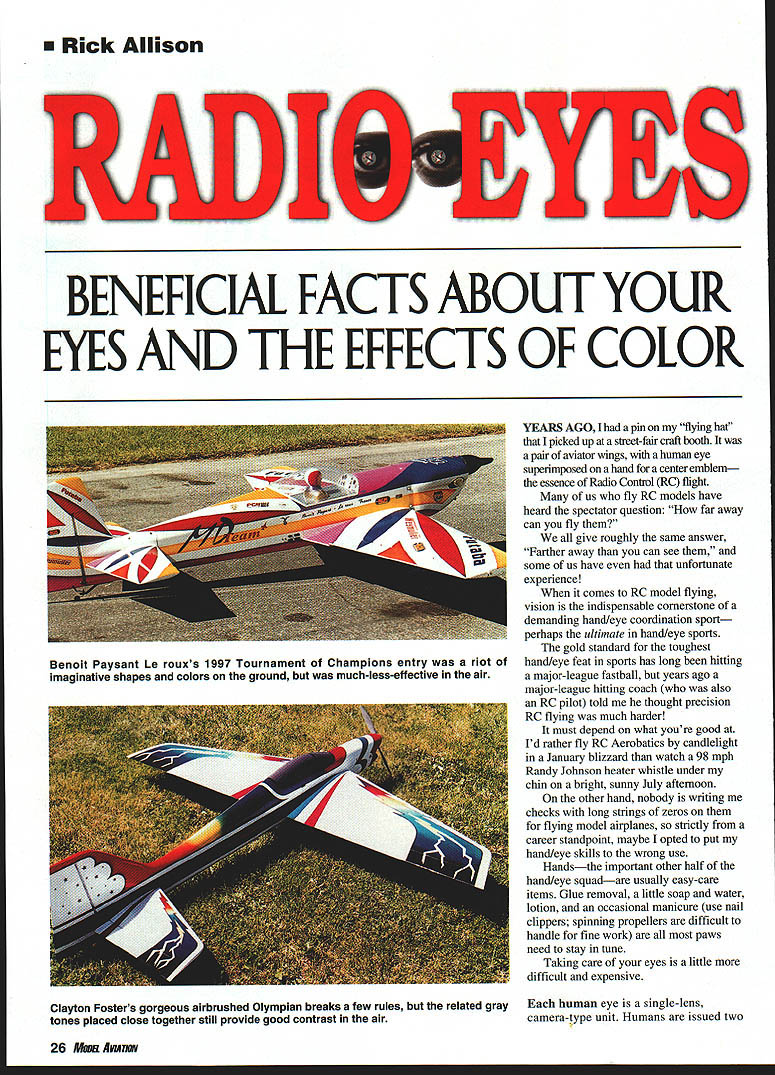
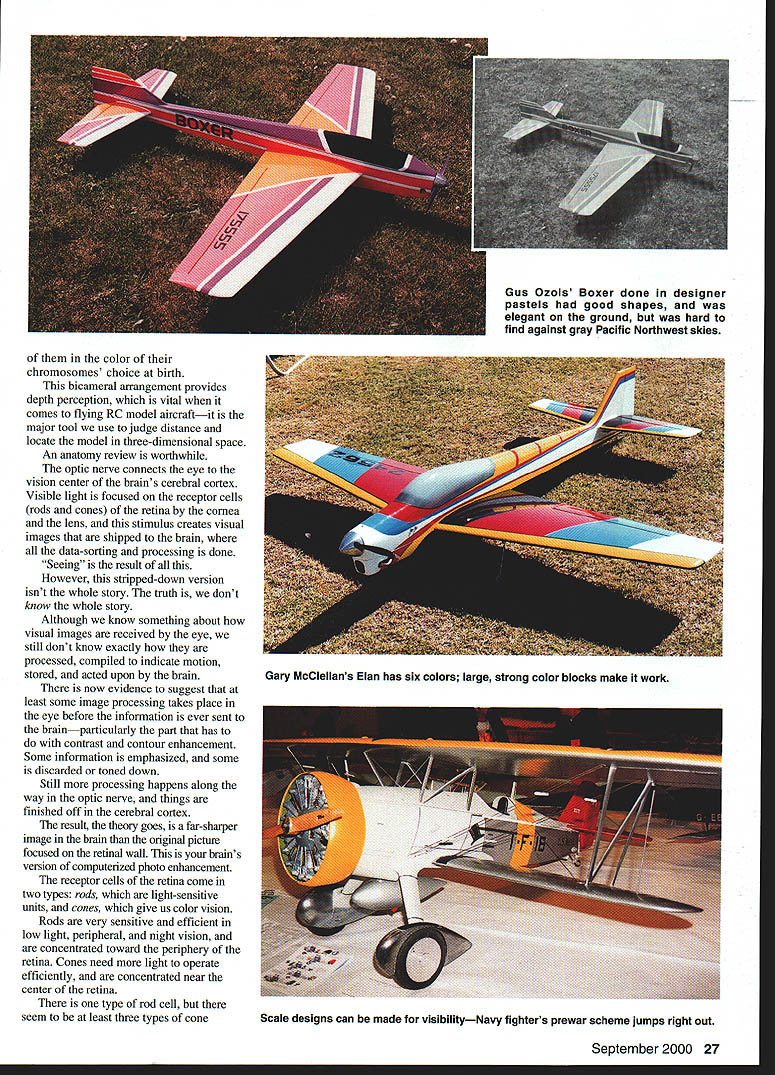
Color vision is important to RC flying because color helps identify shape and orientation and provides depth cues. Saturation and brightness affect visibility; strongly saturated colors stand out against many backgrounds, while pastel colors may wash out against bright sky.
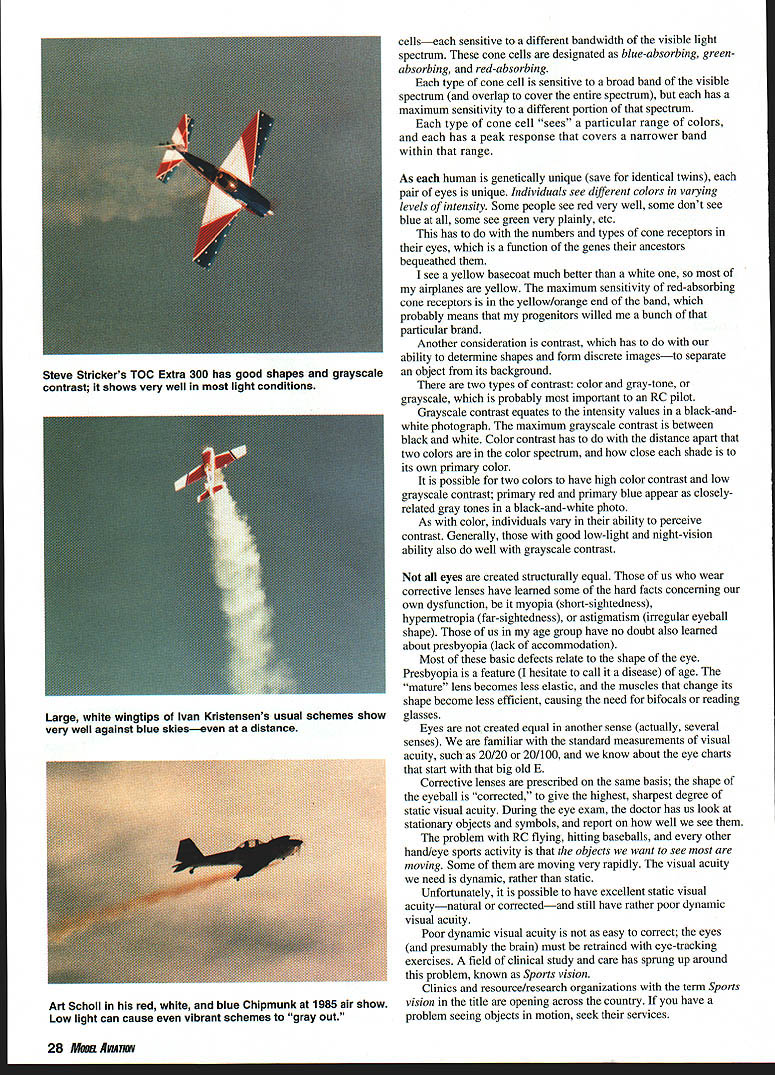
Contrast with the background is often more important than color alone. A color that contrasts strongly with the sky or ground will be easier to pick up at distance. Patterns and color blocks also help; large, strong color blocks give clear orientation cues.
Brightness and the position of the sun relative to the model and the observer are additional factors. Glare and specular reflections can hide detail; glossy finishes are more likely to cause glare than flat finishes.
Eye health and proper corrective lenses matter. Don't fly if your vision is inadequate for safe control. Regular eye exams and appropriate sunglasses for bright conditions will improve safety and enjoyment.
Grayscale vs. Color Contrast
Contrast can be divided into two types:
- Color contrast: distance apart that two colors are in the color spectrum, and how close each shade is to its primary color.
- Grayscale contrast: intensity values as in a black-and-white photograph. Maximum grayscale contrast is between black and white.
It is possible for two colors to have high color contrast and low grayscale contrast; for example, primary red and primary blue may appear as closely related gray tones in black-and-white. Grayscale contrast is probably most important to an RC pilot, because the ability to detect and perceive color diminishes rapidly as distance increases or available light decreases, while strong gray-tone differences persist.
Visual Defects and Dynamic Acuity
Not all eyes are created structurally equal. Common dysfunctions include myopia (near-sightedness), hypermetropia (far-sightedness), astigmatism (irregular eyeball shape), and presbyopia (age-related loss of accommodation).
Visual acuity measurements like 20/20 or 20/100 are taken with stationary objects. The problem with RC flying and other hand/eye sports is that the objects we want to see most are moving. Dynamic visual acuity—the ability to see moving objects—is crucial.
- It is possible to have excellent static visual acuity and still have poor dynamic visual acuity.
- Poor dynamic visual acuity is not as easy to correct; retraining with eye-tracking exercises may be needed. A field of clinical study—Sports Vision—focuses on this problem. If you have difficulty seeing objects in motion, seek their services.
Applying Vision Knowledge to Model Color and Trim
Applying this information to piloting RC models requires some reasonable assumptions:
- The better you can see the model at any distance, the better you can control its flight.
- Since all persons vary in ability to perceive color, motion, and contrast, how we choose aircraft color and trim drastically affects RC command and control abilities.
Aircraft color and trim schemes can be divided into two types: those designed to aid visual identification of aircraft or attitude, and those designed to impress onlookers or satisfy the owner's esthetic sense. Good schemes for identification follow a few simple rules:
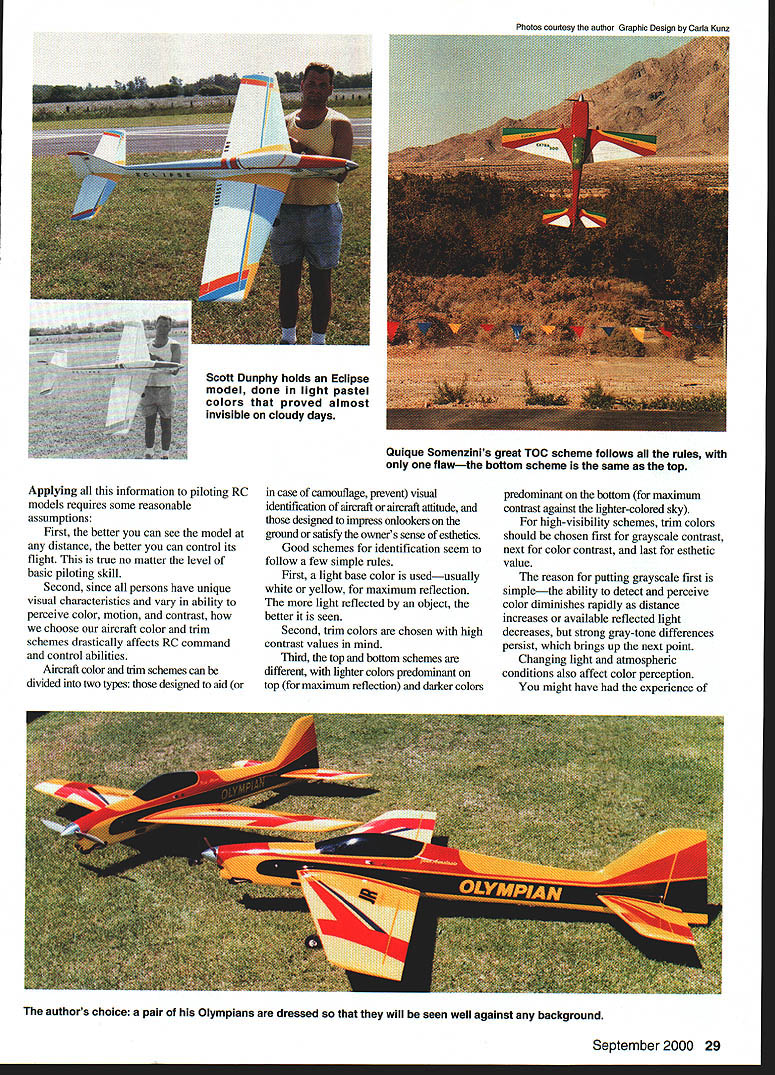
- Use a light base color—usually white or yellow—for maximum reflection.
- Choose trim colors with high contrast values in mind.
- Make top and bottom schemes different: lighter colors on top (for reflection) and darker colors on the bottom (for contrast with the sky).
- For high visibility, choose trim colors first for grayscale contrast, next for color contrast, and last for esthetic value.
Changing light and atmospheric conditions affect color perception. A model brilliant in bright sun may appear washed out in haze. For control-oriented schemes, emphasize strong light-dark contrasts and simple patterns that show attitude at a glance (top/bottom, left/right, nose/tail). Stripes and large blocks of color work well; small intricate artwork does not.
Other useful techniques:
- Stripe control surfaces leading edge to trailing edge to enhance motion visibility.
- Add accent lines along wing tips and tail tips.
- Avoid choosing similar colors for upper and lower surfaces or for adjacent control surfaces.
- Consider the background where you fly most often—sky, trees, water—and choose contrasting colors accordingly.
If unsure whether a scheme will show up well, take a black-and-white photo or run a color print through a black-and-white copier to check the gray tones. It’s not perfect, but gives a reasonable approximation before you commit to paint or covering.
Distance, Shape, and Visibility
Even in clear, bright conditions, colors on average-size models start to "gray out" at about 160–175 meters. This is coincidentally the same distance RC Pattern rules stipulate as a maximum line-of-flight distance from the judges. Poorly chosen schemes can become nearly invisible at around 150 meters under low-light conditions.
RC pilots often fly at distances of 500–600 meters at the farthest point in the flight path. At such distances, colors alone are of limited help; shape and bold, large-grayscale contrasts matter most. Fine details, narrow stripes, sunbursts, or many closely spaced shades become an amorphous mass in the air.
Color scheme dos and don'ts:
- Do use bold lines and large, strong shapes your eye can resolve at a distance.
- Do keep the number of main colors to three or four; extra colors should be narrow accent stripes.
- Do make top and bottom different and place dark colors near outlines.
- Do divide or border strong dark colors with light colors for better contrast.
- Don't rely on small intricate artwork or metallics placed near outline borders.
- Don't use pastel shades when bright contrast is needed.
Consider the typical sky where you fly. If the sky is usually bright blue, white basecoat or white wingtips show up well. If the sky is often milky or overcast, white near model outlines may not be the best choice.
Eye Health, Sunglasses, and Corrective Lenses
Visual health is essential to RC flying enjoyment and safety.
- Have regular eye exams. If possible, have your eyes examined by an ophthalmologist at least once every few years to assess overall eye health; optometrists are excellent for prescribing corrective lenses.
- Protect your eyes from ultraviolet (UV) light—UV exposure can contribute to cataracts and macular degeneration.
- Sunglasses are mandatory for RC pilots. Good sunglasses should filter 99–100% of UV-A and UV-B light.
- Wraparound sunglasses that block UV and fit close to the face are best because they also reduce scattered light.
- Polarized lenses reduce glare from ground and water and can improve contrast, but can interfere with some LCD displays or change instrument appearance.
- Avoid very dark lenses that reduce visible light but do not block UV; they cause pupils to open wider and can let in more harmful UV if the lenses lack proper UV protection.
- Read labels, get guarantees, or deal with a reliable optician. Price is not always a reliable indicator of protection, but often correlates with scratch resistance, optical purity, and frame durability.
If you need corrective lenses:
- Tell your prescribing professional that you will be looking at high-speed objects far off in the distance and at high angles.
- Consider having a separate pair of single-vision glasses made just for flying if you normally wear bifocals.
- Even advanced "lineless" bifocals have a more restricted field of view than single-vision glasses; using the wrong lens can cause neck strain and headaches.
Other eye-care tips:
- Keep your eyes well hydrated. Dry eyes are more common with age and can lead to intermittent blurring. Use artificial tears, humidify your environment, and avoid direct wind into the eyes.
- Be aware that many common medications can affect vision, contrast sensitivity, and night vision. If you notice unexplained changes, get an eye exam and review medications with your physician.
- Eyes are strongly affected by lack of sleep, alcohol, and drugs. When tired, they lose accommodation and depth perception; vision is the sense most affected by exhaustion. Get plenty of sleep before flying.
Putting It All Together
Choosing the right model finish, color, pattern, and maintaining good visual health will make your plane easier to see, fly, and enjoy, and will reduce the chance of losing orientation or losing the model altogether.
Remember: prioritize visibility and contrast over pure esthetics when safety and precise flight control depend on visual perception.
Rick Allison 26405 S.E. 160th St. Issaquah WA 98027
Transcribed from original scans by AI. Minor OCR errors may remain.

